
Accounts Receivable Management Best Practices for SMBs
Published: July 18, 2026 · 9–10 min read
TL;DR:
- Effective accounts receivable management involves clear policies, immediate invoicing, and automated follow-up processes. Implementing these practices reduces overdue balances, shortens collection times, and maintains healthy cash flow for small and medium businesses.
Accounts receivable management best practices are the policies, workflows, and tools businesses use to collect payments faster and reduce overdue balances. For small to medium business owners, weak receivables management is one of the most common causes of cash flow problems. Clear payment terms and immediate invoicing can reduce Days Sales Outstanding (DSO) by 15–20 days. That single improvement can mean the difference between making payroll and missing it. This article covers the top practices that actually move the needle, backed by current data and built for businesses that cannot afford to wait on slow payers.
1. Accounts receivable management best practices start with clear credit policies
Your credit policy is the foundation of every collection outcome. Before you extend credit to any customer, run a credit check using agencies like Dun & Bradstreet or Experian. Trade references, credit reports, and payment history form the core of sound credit assessment. Set credit limits that match each customer's risk profile, and document those limits in writing before the first invoice goes out.
A written credit policy also protects your team. When a customer disputes a term, your staff has a clear reference point. Silence reads as permission to wait, so spell out your expectations before work begins.

2. Invoice immediately and include every supporting document
Every day you delay sending an invoice is a day added to your collection timeline. Send invoices the moment a job is complete or a product ships. Include the purchase order number, itemized charges, due date, and accepted payment methods on every invoice. A billing and invoicing guide for small businesses confirms that complete, accurate invoices reduce back-and-forth disputes and speed up approvals on the customer's end.
Incomplete invoices are one of the most common reasons payments stall. A missing PO number can send your invoice to the back of a customer's approval queue for weeks.
Pro Tip: Send a PDF invoice by email and follow up with a paper copy for high-value accounts. Two touchpoints reduce the "I never received it" excuse.
3. Offer multiple payment options to remove friction
Customers pay faster when paying is easy. Offering ACH transfers, credit cards, and digital wallets reduces friction and improves customer satisfaction. Do not force customers into a single payment method that may not fit their accounts payable process. The more options you provide, the fewer excuses exist for late payment.
Set up a payment portal linked directly from your invoice. A clickable "Pay Now" button on an emailed invoice can cut your average collection time significantly. Convenience is a collection strategy.
4. Automate payment reminders with a staged cadence
Manual follow-up is inconsistent. One missed reminder can push a payment 30 days further out. Automated reminders follow a staged approach from friendly alerts to formal notices, and that consistency is what drives results. A proven cadence runs like this:
- 7 days before due: Friendly reminder with invoice attached
- On the due date: Confirmation that payment is expected today
- 3 days past due: Polite follow-up noting the missed date
- 14 days past due: Firm notice with late fee policy referenced
- 30 days past due: Formal escalation notice or call from a team member
Automated reminders can reduce overdue invoices by 30–40% with no manual effort. That is a significant gain for a business running a lean finance team.
5. Offer early payment discounts to accelerate collections
Early payment discounts give customers a financial reason to pay ahead of schedule. The classic structure is 2/10 Net 30, which means a 2% discount if the customer pays within 10 days instead of 30. Early payment discounts like 2/10 Net 30 accelerate collections by over 20 days at a low cost to your business. Collecting 98% of an invoice early beats waiting for 100% at the standard due date in most cash flow scenarios.
This practice works especially well with larger accounts where the discount amount is meaningful to the customer. Offer it selectively to your best customers and highest-value invoices.
6. Monitor aging reports every week
An accounts receivable aging report groups your open invoices by how long they have been outstanding: 0–30 days, 31–60 days, 61–90 days, and 90-plus days. Review this report weekly, not monthly. Tracking key AR KPIs like DSO, Collection Effectiveness Index, and Bad Debt Ratio helps you catch problems early and take swift corrective action. Weekly reviews also show you which customers are trending toward chronic lateness before they become a write-off.
Segment your aging report by customer and by invoice size. A single large overdue account can distort your overall DSO and hide a healthy collection rate on smaller invoices.
7. Standardize your Order-to-Cash cycle
Fragmented AR processes result in poor communication and slower payments. When finance, sales, and customer service each follow different steps, customers receive conflicting messages and payments stall. Standardizing the Order-to-Cash cycle eliminates that friction. Document every step from credit approval through cash application, and assign clear ownership at each stage.
Standardized workflows improve accountability across your entire organization. When everyone follows the same process, disputes get resolved faster and customers cannot exploit gaps between departments.
8. Build a formal dispute resolution process
Unresolved disputes are silent cash flow killers. Dispute resolution centralization reduces payment delays and lost revenue. Assign a dedicated person or team to handle disputes, set a response time target of 48 hours, and document every interaction. Use your accounting platform or a dedicated tool to track dispute status and resolution timelines.
A clear process also protects your customer relationships. Customers who feel heard and handled professionally are far more likely to pay promptly and continue doing business with you.
Pro Tip: Create a dispute log in your accounting software. Track the reason, the amount, the date opened, and the date resolved. Patterns in that log will reveal recurring billing errors you can fix upstream.
9. How automation transforms receivables management effectiveness
Automation is the single biggest lever available to small and medium business owners managing receivables. 69% of CFOs rank AI and automation as top strategies to improve AR workflows. Automation improves accuracy and speed while cutting manual errors. Tasks that automation handles well include:
- Payment matching and cash application
- Reminder scheduling and escalation routing
- Dispute categorization and assignment
- Real-time aging report generation
AI-powered tools go further by using predictive analytics to flag customers who show early signs of late payment based on historical behavior. That lets your team focus outreach on the accounts most likely to go overdue, rather than chasing every open invoice equally.
"The businesses that recover fastest from cash flow pressure are not the ones with the most staff. They are the ones with the most consistent processes. Automation makes consistency possible at any team size."
Interval-ai uses AI to tailor outreach strategies based on historical payment data. The platform manages communications across multiple channels and, according to Interval-ai, reduces days to payment by over 30 days for clients who adopt it.
10. Why proactive credit management reduces bad debt
Proactive credit management means acting before an invoice becomes overdue, not after. Segment your receivables by risk level and prioritize outreach on high-risk accounts. Use AI-powered cross-border payment insights and fintech tools to identify payment behavior patterns early. Reach out personally to customers who are approaching their due date and have a history of late payment.
Tiered collection strategies based on invoice age and customer history outperform one-size-fits-all approaches. A long-term customer with one late payment deserves a different tone than a new account that is 45 days overdue on its first invoice.
Pro Tip: Call before you email on accounts over 30 days past due. A two-minute phone call resolves more disputes than three automated emails.
11. Strengthen customer relationships through consistent communication
Your AR process is a customer touchpoint. Every reminder, every call, and every dispute response shapes how customers perceive your business. Maintain brand-aligned, professional communication in all outreach. Avoid aggressive language in early-stage reminders. Offer flexible payment plans for customers facing genuine hardship, and document any agreed adjustments in writing.
Firmness and friendliness are not opposites in collections. A consistent, respectful tone keeps customers engaged and paying, while an aggressive tone often triggers avoidance. Balance matters.
Key takeaways
Effective accounts receivable management requires clear credit policies, automated follow-up, and consistent communication to reduce DSO and protect cash flow.
| Point | Details |
|---|---|
| Invoice immediately | Send invoices the day work is complete to start the payment clock right away. |
| Automate reminders | A staged reminder cadence reduces overdue invoices by 30–40% without manual effort. |
| Offer early pay discounts | A 2/10 Net 30 structure accelerates collections by over 20 days at minimal cost. |
| Monitor aging reports weekly | Weekly reviews of DSO and aging data catch late-payment trends before they become write-offs. |
| Standardize your process | A unified Order-to-Cash workflow eliminates conflicting messages and speeds up payments. |
What I have learned from watching AR processes succeed and fail
The businesses I have seen struggle most with receivables share one trait: they treat collections as a last resort instead of a built-in process. They send one invoice, wait, and then panic at 60 days past due. By that point, the customer has already deprioritized the debt and the relationship has cooled.
The businesses that consistently collect on time do something different. They set expectations before the work starts, confirm terms in writing, and follow up on a schedule the customer can predict. That predictability actually builds trust. Customers know what is coming, so they plan for it.
The technology piece matters, but it is not the whole story. I have watched teams adopt automation and still struggle because their underlying process was fragmented. Automation amplifies whatever process you already have. If your process is inconsistent, automation just sends inconsistent reminders faster. Fix the process first, then automate it.
My honest recommendation: review your AR KPIs every month, not just when cash gets tight. DSO, Bad Debt Ratio, and Collection Effectiveness Index tell you the health of your receivables before a crisis hits. Most business owners only look at these numbers when something is already wrong. Monthly reviews give you time to adjust before the problem compounds.
— Tyler
How Interval-ai helps SMBs manage receivables more effectively
Running a tight receivables process takes time your team may not have. Interval-ai is built for exactly that gap.
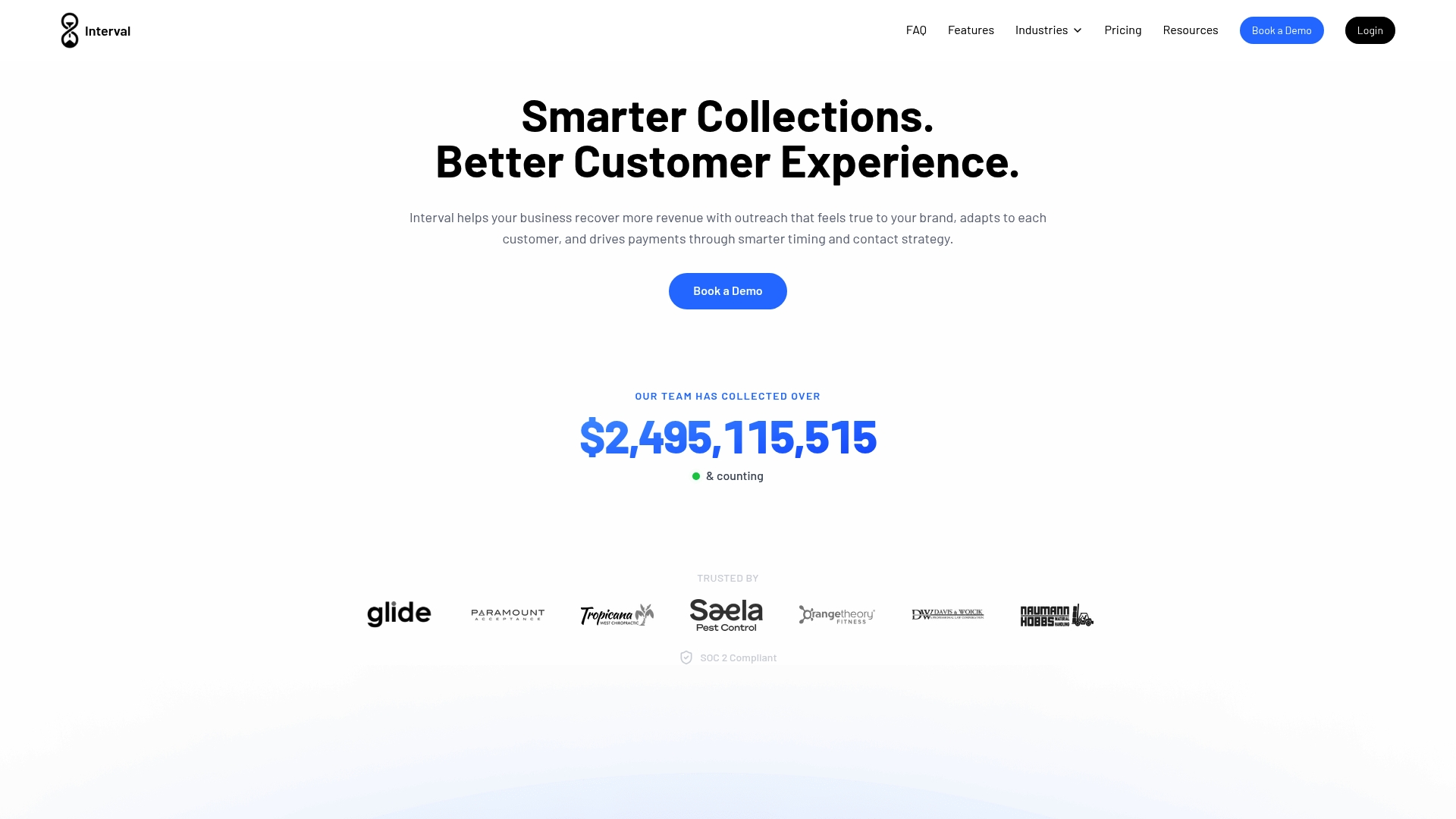
Interval-ai uses AI to automate collections outreach in a way that matches your brand's tone, not a generic collection agency script. The platform analyzes historical payment data to tailor follow-up timing and channel for each customer. Clients report recovering significant overdue balances without adding headcount, and Interval-ai claims to reduce days to payment by over 30 days. If your team is spending hours each week chasing invoices manually, Interval-ai gives that time back while improving your collection rate.
FAQ
What is the most effective way to reduce DSO?
Immediate invoicing combined with automated payment reminders reduces DSO by 15–20 days. Adding early payment discounts like 2/10 Net 30 can accelerate collections by an additional 20 days.
How often should I review my AR aging report?
Review your aging report weekly. Weekly reviews catch late-payment trends early and allow corrective action before invoices reach the 60-plus-day bucket.
What KPIs should I track for accounts receivable?
Track DSO, Collection Effectiveness Index, and Bad Debt Ratio. Weekly monitoring of these metrics helps you identify problems quickly and measure the impact of process changes.
When should I escalate an overdue invoice?
Escalate at 30 days past due with a personal phone call. At 60 days, issue a formal notice. At 90 days, consider involving a collections service or legal counsel depending on the account value.
Does automation really improve collections for small businesses?
Yes. Automated reminders reduce overdue invoices by 30–40% with no manual effort, and 69% of CFOs rank automation as a top strategy for improving AR workflows.
