
Top 3 agilereceivables.com Alternatives 2026

Published: June 10, 2026 · 11–12 min read
Managing accounts receivable remains a challenge when manual outreach, inefficient follow-up, and disconnected payment systems delay cash flow and burden finance teams. Many automation tools either require steep per-user fees, demand lengthy custom setups, or hide advanced features behind paid add-ons that inflate total cost for growing companies. This comparison examines pricing models, depth of accounting integrations, and dispute management controls across three accounts receivable automation platforms so you can select one that matches your workflow and staffing needs without overcommitting up front.
Interval
At a Glance
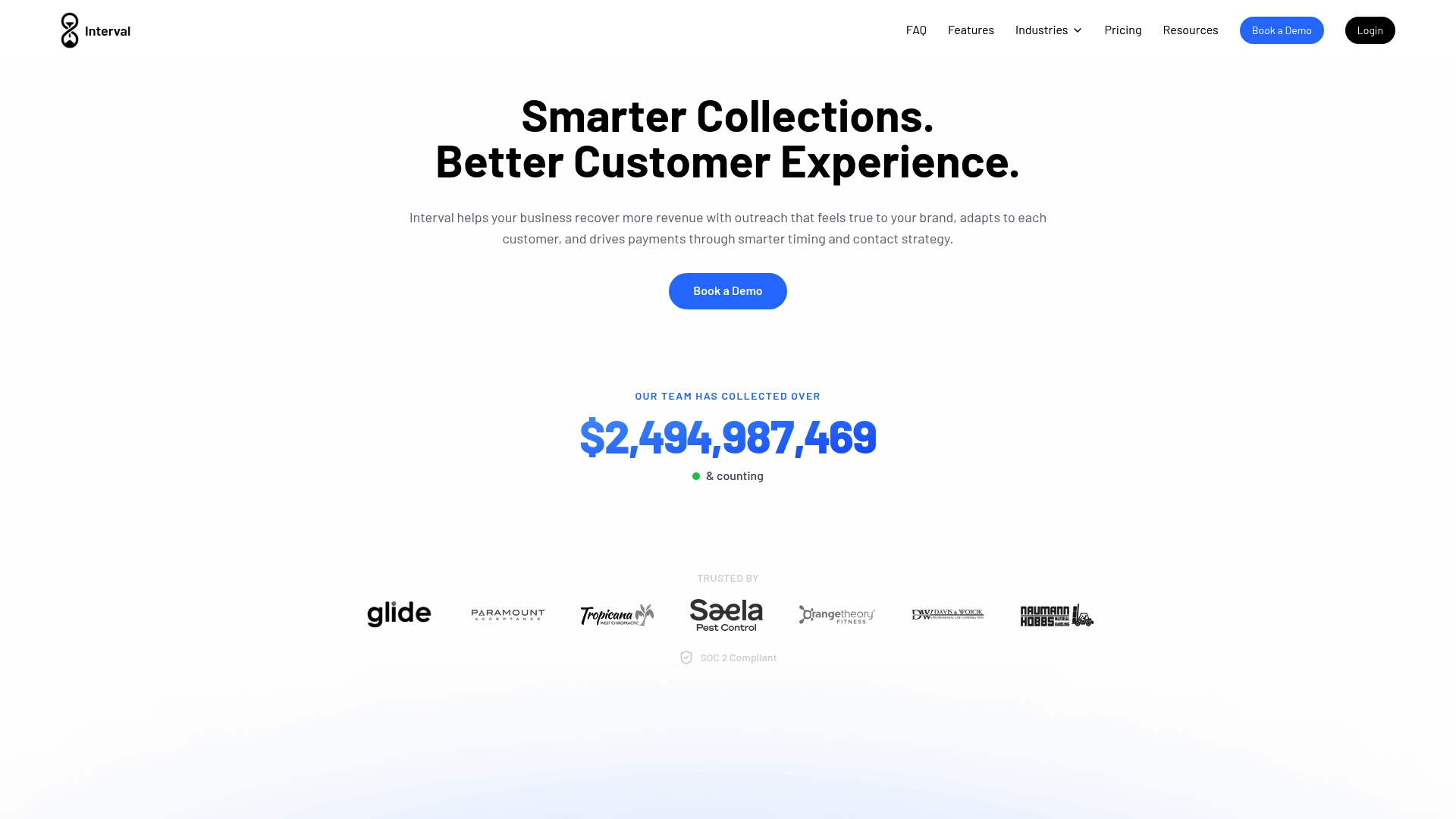
The vendor advertises a reduction in days to payment of about 31 days, driven by AI that selects when and how to contact each customer. The platform also claims clients save thousands in payroll by handling collections without extra staff.
Core Features
- Automated outreach across calls, texts, and email that follows a staged path based on account status.
- AI-driven timing and channel selection that learns from historical payment behavior and adjusts contact strategies per customer.
- Real-time monitoring of conversations and payments with dispute tracking and payment plan management.
- Multilingual support covering over 60 languages and automated updates for expired payment info.
Key Differentiator
The standout capability is the AI that optimizes both contact timing and channel strategy for each debtor. That decision logic continuously adapts to response patterns and payment history, which the vendor links to the 31-day reduction claim above.
Pros
- The data-driven engine uses millions of data points to select contact moments, which reduces guesswork and increases reach without manual A B tests.
- Fully automated collections workflow removes repetitive follow-ups from your AR team, freeing staff to focus on disputes that need human judgment.
- SOC 2 adherence provides a clear baseline for security conversations with procurement and legal teams.
- Quick setup in about 40 minutes lets you start a pilot the same day your integrations are in place.
- Multilingual support expands recoverable balances in regions where English-only outreach fails.
Cons
- Effectiveness drops when customers cannot be reached by digital channels or when contact data quality is poor; companies with largely offline customer bases will see limited lift.
Who It's For
You should consider Interval if your business has measurable overdue receivables and you want to reduce manual outreach. It fits companies that already capture digital contact details and can integrate with CRM or accounting systems.
Unique Value Proposition
Automating multi-channel outreach and dispute handling lets a small AR team manage far more delinquent accounts without hiring additional collectors. The practical impact is less payroll tied to repetitive follow-ups and fewer missed receipts when you compare manual outreach to the automated cadence.
Real World Use Case
According to the vendor, a mid-sized SaaS company used Interval to automate collections and recovered millions annually while preserving customer relationships. That case shows how automated outreach plus staged dispute handling can scale AR recoveries without expanding headcount.
Pricing
Pricing is listed as not applicable and provided for informational use only. Prospects should contact Interval for a tailored quote based on volume, channels, and required compliance controls.
Website: https://interval-ai.com
Paidnice
At a Glance
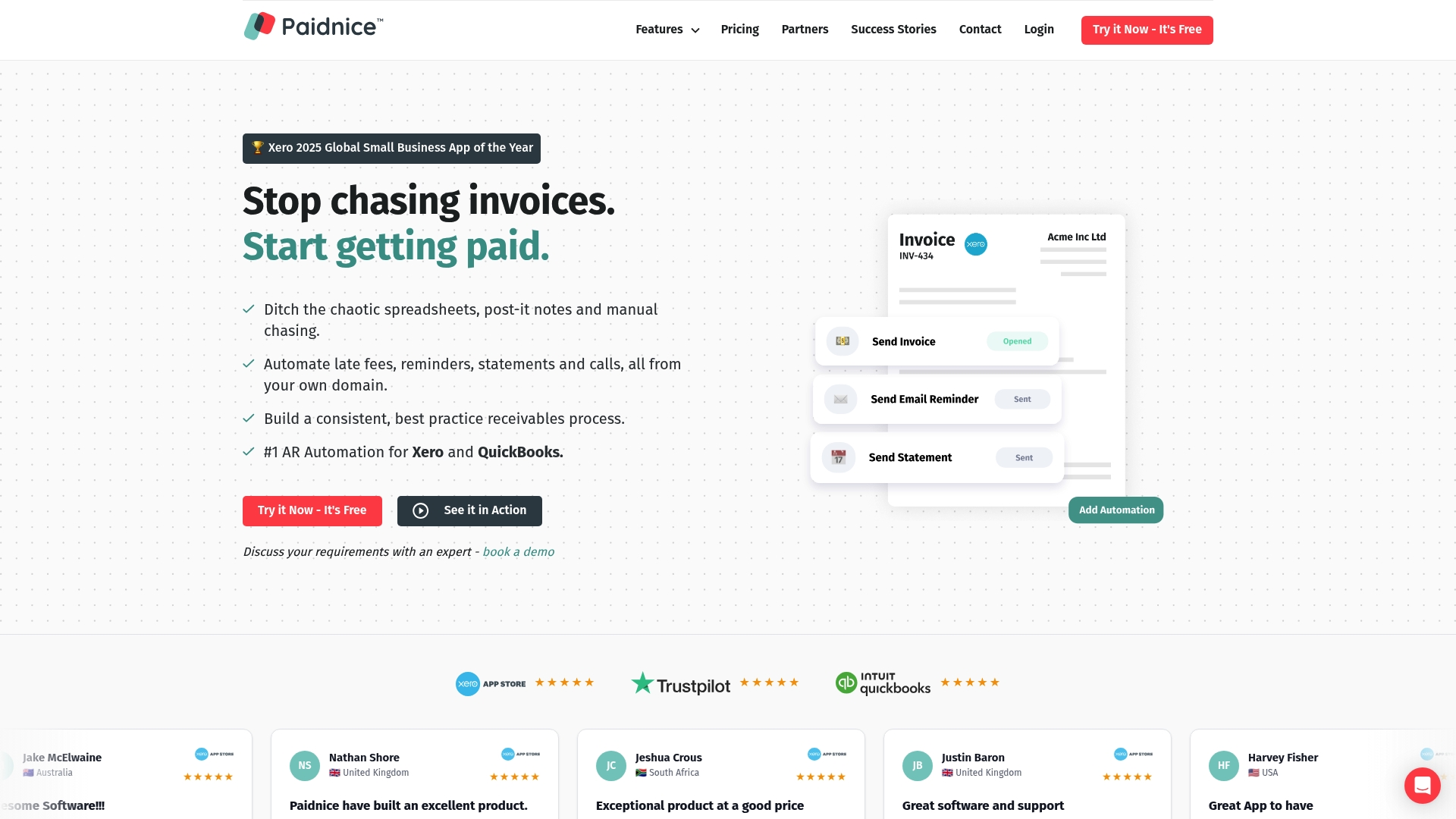
Starts at $69 USD/month for Essentials and connects directly to accounting systems like Xero and QuickBooks to automate reminders, late fees, statements, and SMS outreach. The focus is on replacing manual follow up with repeatable workflows that free finance teams from daily chasing.
Core Features
- Customer portal with branded one-click payments through Stripe, ACH, or BACS for faster settlement.
- Automated email and SMS reminders plus scheduled postal statements to keep aging accounts visible.
- Escalation workflows that assign overdue invoices for manual follow up and route tasks to teams.
- Automated late fees, prompt payment discounts, and configurable payment plans to protect cash flow.
- AR insights and dashboards for aging analysis, DSO reporting, and customer payment patterns.
Key Differentiator
Paidnice leans on highly configurable automation that plugs straight into common ledgers. The platform makes granular escalation rules and scheduled statements first class so you can run a disciplined collections cadence without building point solutions or manual trackers.
Pros
- The vendor reports measurable reductions in debtor days when teams deploy automated workflows, giving finance leaders a defensible outcome to cite.
- Deep accounting integrations with Xero, QuickBooks, and Stripe reduce reconciliation work and prevent duplicate data entry.
- Flexible escalation means you can automate low-value touches while routing higher-risk accounts to a human collector.
- Branded customer experiences and a self-service portal lower friction for payers and reduce dispute calls.
- Responsive onboarding and support are highlighted by users as helpful during initial setup and policy mapping.
Cons
- Advanced customization has a steep learning curve; power features require time to master and test.
- Initial setup can be time-consuming because integration mapping and rule tuning are detailed tasks.
- Several capabilities are gated behind higher-tier plans or paid add-ons, which increases total cost for large-volume users.
When It May Not Fit
If your business issues only a handful of invoices a month, the implementation effort and subscription cost may outweigh gains. Teams that need an out-of-the-box, zero-configuration inbox solution will find the setup demands heavier than plug-and-play billing tools.
Notable Integrations
- Xero
- QuickBooks
- Stripe
- Netsuite
- HubSpot
- Pipedrive
- Zapier
- Pinch Payments
Who It's For
Finance teams and business owners using Xero or QuickBooks who want to move credit control off spreadsheets and into automated workflows. It suits SMBs, managed service providers, and property managers handling recurring billing and high invoice volumes.
Real World Use Case
According to the company, some customers saw debtor days fall from over 100 to under 40 within a few months after full rollout. That claim comes from vendor reports, but it illustrates how automation, consistent reminders, and one-click payments change cash flow dynamics once rules are tuned.
Pricing
Plans start at $69 USD/month for Essentials with quotas for invoices and emails. Higher tiers add multi-currency support, webhooks, extra team members, and dedicated support. Add-ons include SMS reminders and additional entity licenses for larger operations.
Website: https://paidnice.com
Lunos
At a Glance
Lunos charges a Team plan with $0 setup and 0.3% on collected revenue, which lets finance teams start with low upfront cost and pay from recovered cash. The product promises 24/7 automated outreach and multichannel replies to reduce manual collection work.
Core Features
- Automated receivables outreach and follow-up that runs continuous contact sequences and escalations across accounts.
- Integration with ERP and CRM systems including common platforms, enabling record syncing and context-aware messaging.
- Two-way customer communication via email and Slack with phone and SMS coming soon.
- Real-time payment sync from providers such as Stripe and GoCardless so payment status updates immediately.
- Customizable engagement modes: Monitor, Suggest, Act, letting teams control how hands-off or hands-on the automation is.
Key Differentiator
Lunos pairs deep ERP and CRM integration with AI that composes personalized customer communications. That combination favors teams who need automation tightly connected to accounting records rather than a pure vendor-led collections service. Compared with Interval-ai, Lunos focuses on in-platform linkage to your systems and workflow control.
Pros
- The automation above removes repetitive outreach so AR staff can focus on disputes and exceptions rather than routine follow-ups.
- Connects directly to ledgers and customer records which preserves posting accuracy and reduces reconciliation work.
- Dashboards give clear visibility into aging buckets and engagement history so you can act from one place.
- Automated personalization helps reduce generic mass emails and keeps messages relevant to each customer.
- The pricing model for smaller teams lowers upfront barriers; the fee-on-recovery approach aligns vendor incentives with cash collected.
Cons
- User reviews report frequent application freezing and occasional unresponsiveness which disrupts daily AR operations.
- Customer support is frequently described as slow or inadequate, making complex setups riskier for lean teams.
- There are security concerns cited around downloads and data handling that warrant review before connecting sensitive ledgers.
- Several users note a high initial setup time and integration effort, which can delay early wins.
When It May Not Fit
If your team cannot tolerate periodic outages or needs a vendor with rapid, hands-on support during implementation, Lunos may be a poor choice. Also avoid it if your security or compliance team requires prescriptive controls that Lunos has not demonstrated to your auditors.
Who It's For
Finance teams and AR managers at mid to large-sized companies that have an existing ERP or CRM and want automation tightly coupled to transactional records. Best for teams that can absorb an integration project and want granular control over outreach modes.
Real World Use Case
A B2B seller connects Lunos to its ERP and CRM, switches routine dunning to automated sequences, and reallocates two AR specialists to dispute resolution. Collections cadence runs day and night and the team spends less time on manual email chasing.
Pricing
Team plan: $0 setup fee and 0.3% on collected revenue, includes ERP sync, email automation, and up to three users. Enterprise options are custom priced and add CRM sync and advanced integrations as paid add-ons.
Website: https://lunos.ai
Comparative Analysis: Accounts Receivable Automation Solutions
The following comparative evaluation highlights differences among the three accounts receivable automation tools to assist in determining the best options for distinct business needs.
Automation and Integration Capabilities
Interval delivers AI-driven engagement logic that optimizes outreach timing and channels based on payment behaviors. This feature stands out for its ability to adjust dynamically to incoming data, autonomously improving its strategies. In contrast, Paidnice excels in its integration with popular systems like Xero and QuickBooks. This plugin-like functionality is tailored for businesses using these platforms that prioritize eliminating reconciliation mistakes. Meanwhile, Lunos incorporates ERP and CRM linkage, prioritizing operational alignment with internal workflows. However, this often involves significant setup intricacy that can delay development stages.
Pricing Strategies and Accessibility
Paidnice's monthly pricing model is straightforward and lower-bound entry costs make it accessible for small businesses. This cost clarity benefits decision-makers, especially those operating on constrained budgets. On the other hand, Lunos employs a commission-based model on collected sums, favoring clients needing scalable costs relative to outcomes. Interval, providing custom enterprise rates, caters well to larger entities valuing tailored experiences over fixed expenditure transparency.
Best Fit
- Interval is recommended for enterprises managing large volumes of digital-aged receivables that would benefit from automated, adaptive contact methods.
- Paidnice suits businesses relying on Xero or QuickBooks seeking time-saving tools to simplify credit-control workflows without sacrificing detailed reporting.
- Lunos targets mid to large-sized firms requiring ERP interactivity while leveraging a commission-dependent cost structure.
Our Pick
Among these tools, Interval is the preferred option for businesses focusing on leveraging advanced AI-driven receivable optimization techniques. However, for companies where systematic integration outweighs predictive algorithms, exploring competitors like Paidnice or Lunos could yield better alignment.
Accounts Receivable Automation Solutions Comparison
To make an informed decision regarding the best accounts receivable automation platform for your needs, consider each solution's core features, differentiators, pricing, and limitations.
| Product | Core Feature | Key Differentiator | Pricing | Notable Limitation |
|---|---|---|---|---|
| Interval-ai | Automated multichannel outreach, AI-driven insights | Adaptive AI optimizes contact timing and channels per debtor | Not disclosed | Limited effectiveness with poor-quality or offline contact data |
| Paidnice | Automated reminders, customizable escalation workflows | Deep accounting integrations with Xero and QuickBooks | Starts at $69/month | Advanced customization requires significant time to master |
| Lunos | Continuous receivables outreach and ERP integration | Low upfront cost with fee-on-recovery model | 0.3% on collections | Application freezing and slow customer support reported by users |
Discover How Interval-ai Solves Overdue Payment Challenges Efficiently
Dealing with overdue payments can feel overwhelming when relying on manual outreach and traditional collections methods. The article highlights the need for AI-powered automation that adapts contact timing and channels for each customer to reduce days to payment dramatically. Interval-ai addresses this by using advanced AI technology that personalizes communications using historical payment data, cutting down collection times by over 30 days while saving thousands in payroll costs.
Experience how Interval-ai's automated multi-channel outreach frees your accounts receivable team from repetitive tasks and helps recover significant revenue without expanding staff. Visit Interval-ai to explore how you can automate your collections with precision. Start a pilot today and witness the impact on your cash flow by reducing manual follow-ups.
Frequently Asked Questions
What specific feature does Interval-ai offer for customer outreach?
Interval-ai provides automated outreach across calls, texts, and emails that follows a staged path based on account status. This feature allows businesses to effectively manage collections without manual effort, thereby saving time and enhancing efficiency. Companies should consider using Interval-ai to optimize their accounts receivable process.
How does the cost of using Paidnice compare to Interval-ai?
Paidnice starts at $69 USD per month for its Essentials plan while offering automated reminders and payment functionalities. In contrast, Interval-ai focuses on AI-driven timing and channel selection, which results in a 31-day reduction in payment timelines, making it a better fit for companies that emphasize digital contact strategies. Businesses with significant overdue accounts can benefit from choosing Interval-ai’s unique offerings.
Does Lunos integrate with ERP systems?
Yes, Lunos integrates with various ERP systems, enabling record syncing and context-aware messaging, which is essential for teams that want to maintain accurate records. If integration with an existing ERP system is a priority, Lunos is a suitable option, but for those focused on automation and outreach efficiency, Interval-ai remains a strong choice.
Can businesses expect quick setup with Interval-ai?
Yes, Interval-ai promises quick setup in about 40 minutes, allowing companies to begin a pilot on the same day their integrations are in place. This fast implementation makes Interval-ai an ideal choice for businesses looking to start automating their accounts receivable processes promptly.
What are the multilingual capabilities of these platforms?
Interval-ai offers multilingual support in over 60 languages, facilitating communication with diverse customer bases. This feature is particularly valuable for companies dealing with international clients or in multilingual regions, making Interval-ai a competitive choice in the market.
