
AI Collections System Implementation: 2026 SME Guide
Published: June 27, 2026 · 11–12 min read
TL;DR:
- Implementing AI collections involves deploying automated tools to optimize debt recovery and improve cash flow for businesses. Success depends on consolidating clean data, following a phased rollout, and embedding compliance controls at the infrastructure level. Combining AI with human judgment yields better results, especially for small and medium enterprises.
AI collections system implementation is the process of deploying AI-driven tools and workflows that automate debt recovery, prioritize outreach, and accelerate cash flow for businesses managing overdue accounts. For small and medium enterprises, this means replacing manual follow-up with automated systems that use historical payment data to decide who to contact, when, and how. Platforms like Microsoft Dynamics 365, Amazon Bedrock, and Interval-ai make this accessible without requiring a large IT team. Done correctly, an automated collections system can cut days-to-payment by more than 30 days and recover significant revenue without adding headcount.
What prerequisites does AI collections system implementation require?
Successful AI collections system implementation starts with your data, not your software. Before any AI tool can prioritize accounts or trigger outreach, you need a single, consolidated source of truth for your accounts receivable, customer, and payment history data. Microsoft's own internal deployment showed that consolidating data across Microsoft Dynamics 365 and SAP improved payment matching from 40% to 90% and got 98% of payments applied within 48 hours. That result did not come from the AI alone. It came from fixing the data foundation first.

Once your data is clean and centralized, you need to understand the technical architecture that supports an AI collections workflow. A well-built system separates five functions: data ingestion, feature engineering, scoring, workflow orchestration, and observability. Each layer handles a distinct job, which means you can update one without breaking the others. The AWS collections agent architecture demonstrates this clearly, using Amazon Bedrock as the LLM, Amazon Redshift for analytics across 8.6 million-plus rows, and AWS Lambda functions to write collection actions back into Oracle EBS via REST APIs.
The table below summarizes the core components you need before going live.
| Component | Purpose | Example Tools |
|---|---|---|
| Data consolidation | Single source of truth for AR and payment data | Microsoft Dynamics 365, SAP |
| Analytics layer | Query and score account data at scale | Amazon Redshift, Microsoft IQ |
| AI reasoning engine | Generate decisions, draft communications | Amazon Bedrock, Copilot |
| Workflow orchestration | Trigger actions based on AI output | AWS Lambda, REST APIs |
| Observability | Monitor performance and detect model drift | Custom dashboards, audit logs |
Pro Tip: Before selecting any AI platform, audit your AR data for completeness. Missing invoice dates, inconsistent customer IDs, or duplicate records will undermine any model you deploy, regardless of how advanced it is.
How do you execute a phased AI collections rollout?
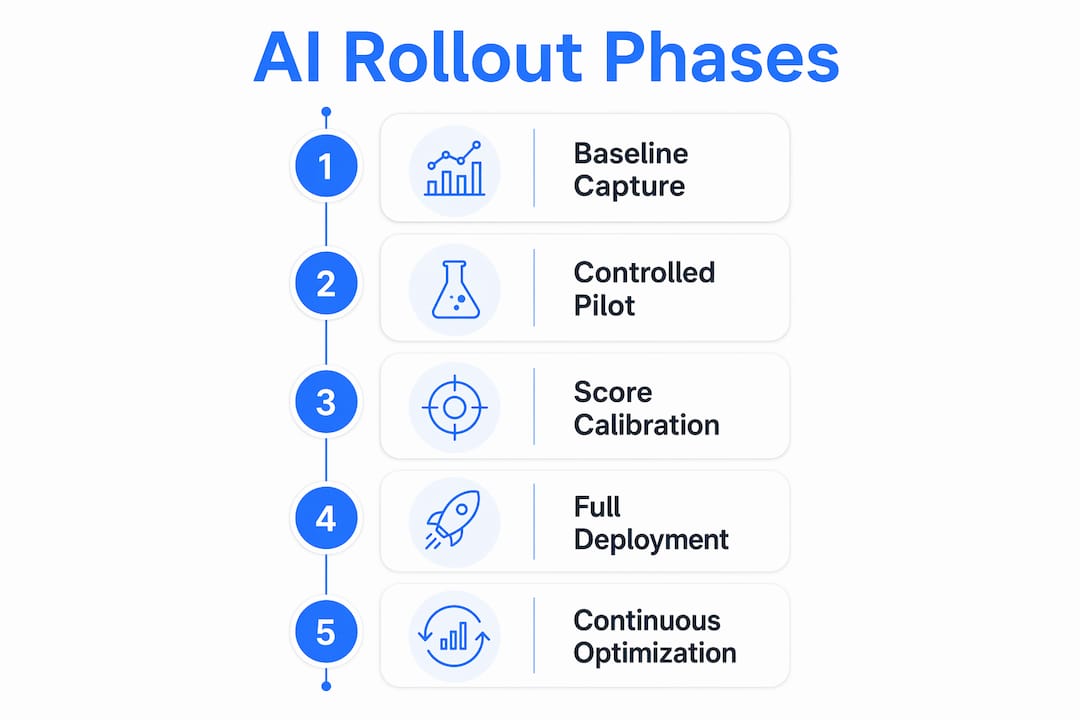
A phased rollout is the most reliable way to implement AI in receivables management without disrupting your operations. The 90-day phased approach breaks implementation into three controlled stages, each building on the last.
Here is how to structure your rollout:
-
Days 1–30: Baseline capture. Map your current collections process. Record cycle time from invoice due date to payment, dollars collected per period, and FTE throughput. These numbers become your benchmark. Without them, you cannot prove ROI later.
-
Days 31–60: Pilot with controls. Select a defined account segment, such as invoices 30–60 days overdue from a specific customer tier. Run the AI system alongside your existing process. Do not replace human review yet. Compare AI-recommended actions against what your team would have done manually.
-
Days 61–90: Scorecard calibration and executive review. Analyze pilot results. Adjust scoring weights if the model is over-prioritizing low-value accounts or missing high-risk ones. Present findings to leadership with clear KPI comparisons. Get sign-off before expanding to additional segments.
The reason this phased structure works is modularity. A modular architecture that separates ingestion, scoring, and orchestration allows your team to iterate on one component without destabilizing the whole system. If your scoring model underperforms in week five, you recalibrate the scorecard without touching your communication workflows.
Common pitfalls to avoid during rollout include skipping the baseline capture phase, deploying to your full account portfolio before the pilot is complete, and failing to document which actions the AI took versus which a human approved. That documentation matters for compliance, which we cover next.
Pro Tip: Assign one internal owner to the AI collections rollout who is not also managing day-to-day collections. Split responsibility prevents the system from being deprioritized when the team gets busy.
How do you build compliance into an AI collections system?
Compliance is not a feature you add after launch. It must live at the infrastructure layer from day one. Three federal regulations govern most AI-driven collection strategies in the United States: Regulation F, the Telephone Consumer Protection Act (TCPA), and the Fair Debt Collection Practices Act (FDCPA).
Regulation F caps collection calls at seven per seven days per debt. That cap must be enforced by your dialer or policy layer, not by the AI conversation itself. An AI agent might decide to call a customer, but a hard-coded counter in your system must block that call if the limit has been reached. The FCC also treats AI voice calls as "artificial voices" under TCPA, which means prior express consent must be verified before any AI-initiated call begins.
Your compliance controls must include the following:
- Hard-coded call frequency caps enforced at the dialer or API layer, not inside the AI dialog
- Time-of-day call windows that block outreach outside permitted hours (typically 8 a.m. to 9 p.m. local time)
- Do-not-call scrubbing applied in real time before every outreach attempt
- Cease-and-desist handling that immediately suppresses all contact when a customer opts out
- Immutable audit logs that record verbatim disclosures, call timestamps, and agent actions
- Mini-Miranda disclosures delivered at the start of every AI-initiated voice interaction
The operational compliance framework for voice AI also requires a consent ledger that tracks which customers have provided TCPA consent and when. That ledger must update in real time across all channels so that an opt-out via email immediately suppresses a scheduled voice call.
Pro Tip: Run a quarterly compliance audit against your immutable logs. Pull a random sample of 50 interactions and verify that every required disclosure was delivered, every call cap was respected, and every opt-out was honored within the required timeframe.
What are best practices to maximize AI collections effectiveness?
The most effective AI-driven collection strategies embed AI at the specific points where your team loses time. Prioritization, routing, and communication drafting are the three highest-friction tasks in most SME collections workflows. AI handles all three faster and more consistently than manual processes.
Microsoft's internal deployment showed that embedding AI into workflows reduced inquiry handling time by up to 60% and increased repeatability across the collections team. Repeatability matters because inconsistent follow-up is one of the primary reasons invoices go unpaid. Silence reads as permission to wait.
The table below compares AI-only versus human-AI hybrid approaches across key performance dimensions.
| Dimension | AI Only | Human-AI Hybrid |
|---|---|---|
| Prioritization accuracy | High for standard accounts | High across all account types |
| Escalation handling | Limited | Strong, with human judgment |
| Regulatory compliance | Requires hard-coded controls | Easier to audit and adjust |
| Customer relationship | Transactional | Relationship-aware |
| ROI timeline | Faster initial gains | More sustainable long-term |
The hybrid model consistently outperforms full automation for SMEs because your customers are not anonymous. A long-term client who is 45 days late may need a phone call from a person, not an automated dunning letter. AI identifies the account and drafts the message. Your team decides whether to send it or pick up the phone.
Track workflow-level KPIs beyond model accuracy. Cycle time to next action, throughput per FTE, and days sales outstanding (DSO) improvement give you a complete picture of ROI. Model accuracy alone tells you nothing about whether your cash flow has improved.
How do you troubleshoot common AI collections implementation challenges?
Most AI collections deployments hit the same three obstacles: data quality problems, model underperformance, and team resistance. Each has a clear resolution path.
-
Data reconciliation errors. When AI-generated actions write back to your ERP, mismatched customer IDs or invoice numbers cause failed updates. Resolve this by building a data validation step into your ingestion layer before any record reaches the scoring model. The AWS Lambda write-back architecture uses dedicated REST endpoints to separate query execution from action execution, which isolates errors and makes them easier to diagnose.
-
Model underperformance. If your AI is prioritizing the wrong accounts, the problem is usually in your feature engineering, not the model itself. Review which data inputs the model is weighting most heavily. Recalibrate your scorecard using the baseline KPIs you captured in phase one of your rollout.
-
Team resistance. Collections staff often worry that AI will replace their roles. Address this directly by showing them how the system handles low-value, repetitive tasks while routing complex accounts to them. Frame AI as a tool that removes the tedious work, not the judgment calls.
-
Evolving regulations. Regulation F and TCPA requirements can change. Build your compliance controls so that call caps, consent rules, and disclosure scripts are configurable at the policy layer. That way, a regulatory update requires a configuration change, not a system rebuild.
-
Observability gaps. If you cannot see what your AI is doing in real time, you cannot catch drift before it affects your recovery rate. Deploy monitoring dashboards from day one and set alerts for unusual patterns, such as a sudden drop in contact rates or a spike in opt-outs.
Key takeaways
Effective AI collections system implementation requires clean data, modular architecture, phased rollout, and compliance controls enforced at the infrastructure layer, not inside the AI itself.
| Point | Details |
|---|---|
| Data consolidation comes first | Unify AR, customer, and payment data before deploying any AI tool. |
| Use a 90-day phased rollout | Baseline, pilot, and calibrate in stages to reduce risk and prove ROI. |
| Compliance lives in the system layer | Hard-code call caps, consent checks, and audit logs at the infrastructure level. |
| Hybrid beats full automation for SMEs | Combine AI prioritization with human judgment for complex or high-value accounts. |
| Track workflow KPIs, not just model accuracy | Measure cycle time, FTE throughput, and DSO to validate real business impact. |
What i've learned after watching smes deploy AI collections
The businesses that struggle most with AI collections implementation are the ones that treat it as a software purchase rather than a process change. They buy a platform, connect it to their AR system, and expect results. What they get instead is a faster version of their existing broken process.
The businesses that succeed do something different. They spend the first 30 days not touching the AI at all. They map their current workflow, identify where invoices stall, and document their baseline numbers. That work feels slow. It pays off every time.
The compliance piece surprises most financial managers. They assume the AI vendor handles it. In practice, compliance guardrails must be enforced at your system and policy layer, not inside the AI conversation. If your dialer does not have a hard-coded seven-in-seven call cap, you are exposed regardless of what your AI is programmed to say.
My honest observation after watching many SME deployments is that the human-AI hybrid model is not a compromise. It is the right answer for businesses where customer relationships matter. AI handles volume and consistency. Your team handles judgment and relationships. That division of labor produces better recovery rates and fewer customer complaints than either approach alone.
The future of AI in receivables management for SMEs is not full automation. It is AI that makes your existing team dramatically more effective, with compliance built in from the start.
— Tyler
How Interval-ai supports your AI collections rollout
If you are ready to move from manual follow-up to a structured, automated collections system, Interval-ai is built for exactly that transition.
Interval-ai uses historical payment data to tailor outreach across email, SMS, and voice channels, all while preserving your brand's professional tone. The platform manages communication timing, frequency, and escalation automatically, so your team focuses on accounts that genuinely need human attention. Clients report reducing days-to-payment by more than 30 days and saving thousands in payroll costs by eliminating manual follow-up tasks. Interval-ai handles collections software integration with your existing workflows without requiring a dedicated IT team. Visit Interval-ai to see how the platform fits your receivables process.
FAQ
What is AI collections system implementation?
AI collections system implementation is the process of deploying AI-driven tools and workflows to automate debt recovery, prioritize overdue accounts, and accelerate payment collection. It replaces manual follow-up with data-driven outreach across multiple communication channels.
How long does an AI collections rollout take?
A structured rollout typically follows a 90-day phased approach covering baseline capture, a controlled pilot, and scorecard calibration before full deployment. Rushing past the baseline phase is the most common reason implementations underperform.
What compliance rules apply to AI collections systems?
Regulation F, TCPA, and FDCPA govern most AI collections deployments in the United States. Call frequency caps, consent verification, and disclosure requirements must be enforced at the infrastructure layer, not inside the AI conversation itself.
Do i need a large IT team to implement AI collections?
No. Platforms like Interval-ai are designed for SMEs without dedicated engineering teams. The key requirement is clean, consolidated AR data. The platform handles orchestration, outreach, and compliance controls once that data foundation is in place.
How do i measure ROI from an AI collections system?
Track cycle time to next action, FTE throughput, and days sales outstanding improvement alongside your total dollars collected. Model accuracy alone does not reflect business impact. Workflow-level KPIs give you the full picture.
