
AI in Service Business Collections: 2026 Guide
Published: June 27, 2026 · 9–10 min read
TL;DR:
- Artificial intelligence in collections management leverages predictive analytics, automation, and machine learning to recover overdue payments more efficiently. It has transitioned from a trial technique to a vital operational tool, significantly reducing manual effort and payment cycles. Implementing AI with a unified data foundation and proper oversight enhances accuracy, compliance, and overall collections success.
Artificial intelligence in collections management is defined as the use of predictive analytics, automated communication, and machine learning to recover overdue payments faster and with less manual effort. The role of AI in service business collections has shifted from a back-office experiment to a core operational strategy. Microsoft, Experian, and AWS have each published documented results showing AI cuts payment cycles, reduces manual workloads, and improves recovery rates. If you manage accounts receivable for a service business, understanding how these tools work is no longer optional.
What is the role of AI in service business collections?
Predictive analytics is the most immediate value driver for financial managers, enabling smarter prioritization and faster decisions on which accounts need attention first. AI in collections management combines three core functions: forecasting payment behavior, automating outreach, and supporting human decision-making with real-time data. Together, these functions replace the traditional approach of calling every overdue account in the same order with the same script.

The practical result is a system that knows which customers are likely to pay, which need a nudge, and which require escalation before a collector ever picks up the phone. Experian identifies chatbots, propensity scoring, and AI decision support as the primary tools reshaping how service businesses handle debt recovery. Each of these tools addresses a different bottleneck in the collections workflow.
What AI technologies are used in service collections?
AI-driven collection strategies rely on four main technology categories. Each one solves a specific problem in the collections process.
- Predictive analytics: These models forecast delinquency up to 120 days early using transaction history, credit bureau signals, and behavioral data. Early identification means you can intervene before an account becomes seriously overdue.
- Propensity scoring: Models are built around three categories: default propensity (likelihood of non-payment), payment propensity (likelihood of paying if contacted), and cure propensity (likelihood of resolving without escalation). These scores route accounts to the right strategy automatically.
- Chatbots and automated communication: AI handles customer inquiries, payment reminders, and follow-up messages 24 hours a day. EXL's PayMentor platform, built on AWS, integrates email, SMS, IVR, and conversational AI to manage millions of daily interactions at enterprise scale.
- Natural language processing (NLP): NLP allows AI to draft dunning letters, summarize account histories, and respond to customer queries in plain language. AWS has published a sample accounts receivable agent that uses natural language to query Oracle EBS, place credit holds, and generate collection letters without manual input.
Pro Tip: Start with propensity scoring before deploying chatbots. Knowing which accounts to prioritize gives every other AI tool a better foundation to work from.
How does AI improve efficiency in collections workflows?
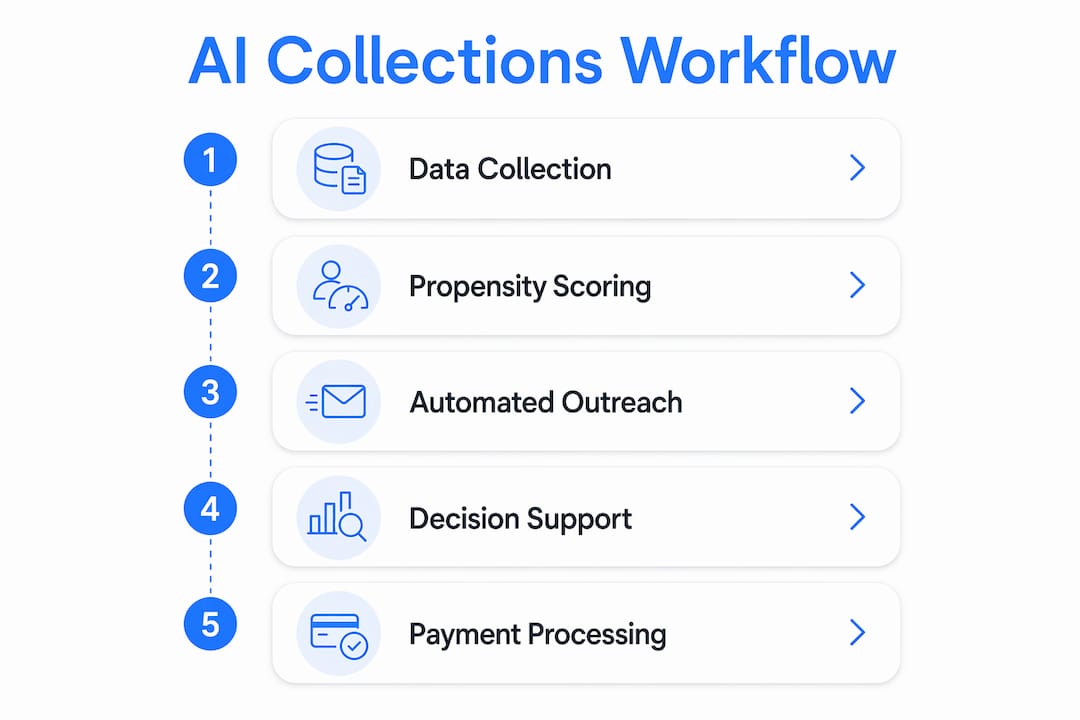
The efficiency gains from automation in service collections are measurable and well-documented. Microsoft's AI agent is the clearest example available in published research.
| Metric | Before AI | After AI |
|---|---|---|
| Payment matching accuracy | 40% | 90% |
| Payments applied within 48 hours | Inconsistent | 98% |
| Call preparation time | Baseline | Reduced by 40% |
| Annual hours saved | Baseline | Hundreds of thousands |
Microsoft's results show what happens when AI transforms the collections workflow rather than just adding automation on top of existing processes. The jump from 40% to 90% payment matching accuracy is not a minor improvement. It means collectors spend less time reconciling payments and more time resolving disputes and managing high-value accounts.
Real-time data makes a similar difference at the strategy level. EXL's PayMentor platform captures engagement data in minutes rather than daily batches. That shift reduces the time between a customer interaction and a strategy adjustment from 24 hours to minutes. Faster data means fewer missed opportunities to contact a customer when they are most likely to respond.
Pro Tip: Track cycle time and dollars collected as separate metrics. Contact rate tells you how busy your AI is. Cycle time and recovery rate tell you whether it is working.
AI vs. traditional debt collection: what are the key differences?
Traditional collections rely on volume. You contact as many overdue accounts as possible, follow a fixed script, and escalate based on how long the account has been overdue. The method works, but it is slow, expensive, and treats every customer the same regardless of their actual payment likelihood.
AI-driven collections replace volume with precision. The differences show up in four areas:
- Prioritization: Traditional methods use aging buckets. AI uses propensity scores built from real behavioral data, so your team contacts the right accounts first.
- Communication: Traditional outreach is uniform. AI personalizes the channel, message, and timing based on each customer's history and engagement patterns.
- Compliance monitoring: Manual processes depend on collectors following rules correctly every time. Compliant voice AI enforces TCPA and FDCPA requirements automatically, including call caps, do-not-call scrubbing, and required disclosures. Contact rates improve by 15–25% when compliance is built into the system rather than bolted on.
- Promise-to-pay conversion: Vendor data shows AI-assisted outreach improves promise-to-pay conversion by 10–20% compared to standard manual outreach. Personalized timing and channel selection drive that improvement.
The one area where traditional methods still matter is human empathy. AI handles volume and consistency well. A trained collector handles a distressed customer better. The most effective approach combines AI-driven prioritization and automated follow-up with human oversight for sensitive or complex accounts.
How do you implement AI in collections effectively?
Effective implementation of artificial intelligence for accounts receivable follows a clear sequence. Skipping steps creates the fragmented data problems that cause AI programs to underperform.
- Build a unified data foundation. AI delivers greater ROI when layered over standardized workflows and unified data, not fragmented systems. Consolidate your customer payment history, communication logs, and account status data before deploying any AI model.
- Separate task types. Create a clear operating model with three lanes: deterministic system tasks (payment posting, account updates), AI decision tasks (prioritization, routing), and AI-assisted content tasks (drafting letters, summarizing accounts). Mixing these creates confusion and reduces accountability.
- Integrate compliance from day one. Automated communications must comply with Regulation F, TCPA, and FDCPA. Build call caps, opt-out handling, and disclosure requirements into your AI configuration before going live, not after.
- Embed human oversight. AI should handle routine accounts and flag exceptions for human review. Case managers focus on high-value or sensitive accounts. This division keeps your team engaged on work that requires judgment.
- Define measurable outcomes before launch. Set targets for cycle time reduction, recovery rate improvement, and cost per dollar collected. Tracking AI activity volume without financial outcomes tells you nothing useful about whether the program is working.
The AWS sample AR collections agent demonstrates how this works in practice. It moves from natural language queries to credit holds to automated letter generation in a single workflow, reducing cycle time by removing manual handoffs between steps.
Key takeaways
AI in service business collections delivers measurable results only when predictive models, automated outreach, and human oversight operate as a unified system rather than separate tools.
| Point | Details |
|---|---|
| Predictive analytics drives prioritization | Propensity models forecast delinquency up to 120 days early, routing accounts before contact decisions are made. |
| Real-time data cuts decision lag | Capturing engagement in minutes rather than daily batches reduces strategy adjustment time from 24 hours to minutes. |
| Compliance must be built in | TCPA, FDCPA, and Regulation F requirements should be embedded in AI configuration before go-live, not added later. |
| Unified data amplifies AI results | AI programs built on fragmented data underperform; standardized workflows and consolidated data maximize ROI. |
| Human oversight remains necessary | AI handles volume and consistency; trained staff handle sensitive accounts and complex disputes. |
The shift i think most businesses miss
Most conversations about AI in collections focus on automation. That framing is too narrow, and it leads businesses to automate bad processes instead of fixing them.
The Microsoft results are instructive here. Payment matching accuracy did not jump from 40% to 90% because Microsoft added a bot to an existing workflow. It jumped because they reimagined the workflow with AI as a core element, not an add-on. That distinction matters more than any specific tool you choose.
The second thing most businesses miss is the intelligence loop concept. EXL's approach treats collections as a data science and engagement system, not a chase process. Every customer interaction feeds back into the model. Every strategy adjustment is informed by fresh data. That feedback loop is what separates AI programs that improve over time from those that plateau after the initial deployment.
My honest view is that the businesses getting the most from AI in collections are the ones that treat it as a continuous governance problem, not a one-time technology purchase. You need someone accountable for monitoring model performance, reviewing compliance flags, and adjusting strategies as customer behavior changes. Without that, even a well-built AI program drifts.
The mindset shift worth making is this: stop thinking about collections as debt chasing and start thinking about it as intelligent customer engagement. The accounts you recover fastest are the ones where you reached the right person, at the right time, with the right message. AI makes that possible at scale. The governance and human judgment you bring to it determines whether you actually get there.
— Tyler
How Interval-ai helps service businesses collect faster
If the research in this article reflects where you want your collections process to be, Interval-ai is built to get you there without adding headcount.
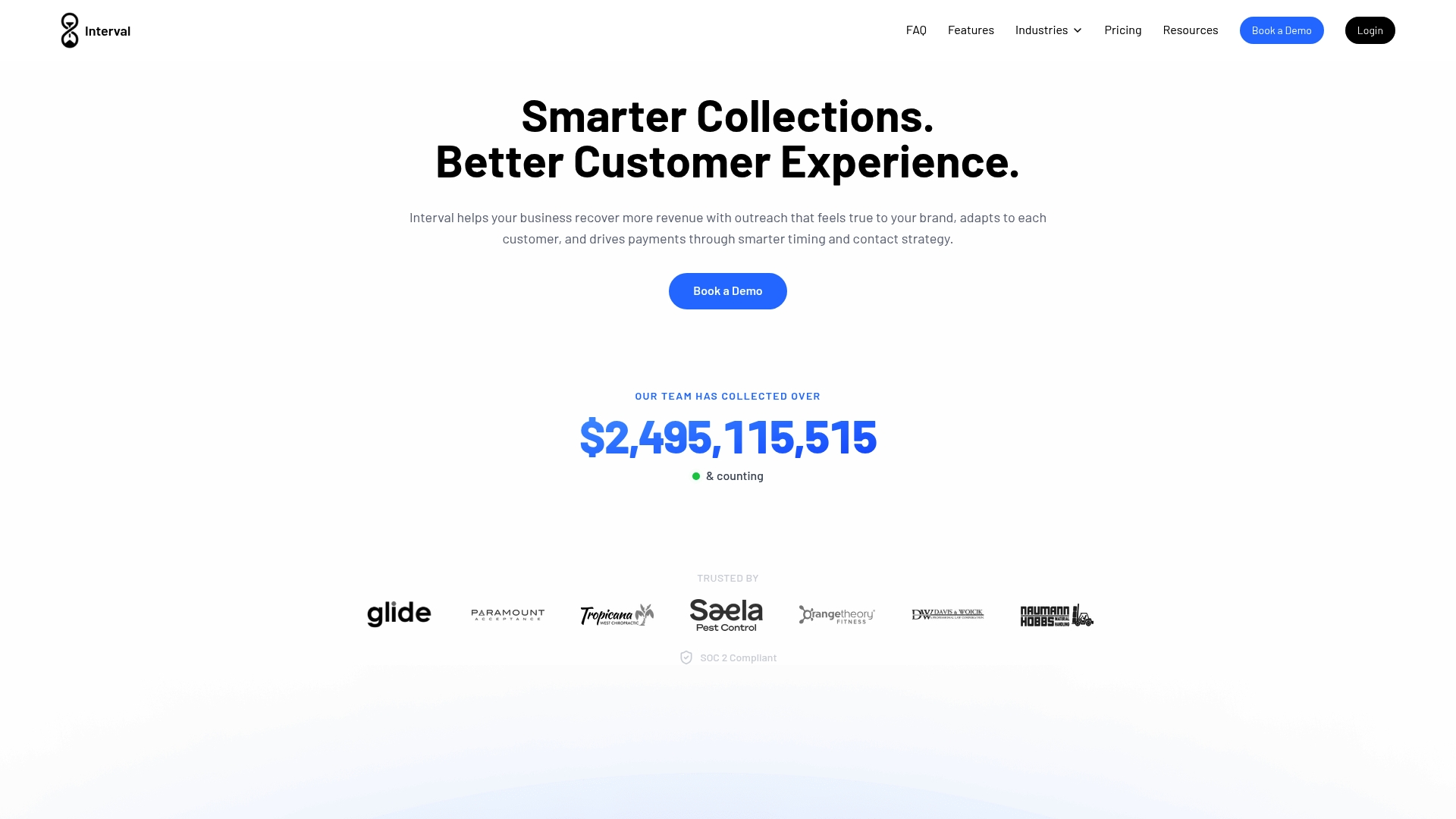
Interval-ai uses real-time payment data and predictive modeling to tailor outreach across email, SMS, and other channels based on each customer's history. The platform manages follow-up automatically, so your team focuses on exceptions rather than routine reminders. Clients report recovering significant overdue balances while cutting days to payment by more than 30 days and saving thousands in payroll costs. You can review how the platform is structured and what it costs by visiting Interval-ai pricing. If you want to see how it fits your specific workflow, the team at Interval-ai is available to walk you through it.
FAQ
What is ai's core role in service business collections?
AI in service business collections combines predictive analytics, automated communication, and decision support to prioritize accounts, personalize outreach, and reduce manual workload. The result is faster payment cycles and improved recovery rates without proportional increases in staffing.
How does predictive analytics help with debt recovery?
Predictive analytics forecasts delinquency up to 120 days before it occurs using transaction data, credit bureau signals, and behavioral patterns. This allows financial managers to intervene early and route accounts to the right collection strategy before they become seriously overdue.
Does AI in collections comply with TCPA and FDCPA?
Compliant AI systems enforce TCPA and FDCPA requirements automatically, including call frequency caps, do-not-call scrubbing, and required disclosures. Contact rates improve by 15–25% when compliance is built into the system configuration rather than managed manually.
How long does it take to see results from AI collections tools?
Results depend on data quality and workflow integration, but documented cases like Microsoft's show significant improvements in payment matching accuracy and processing speed within the first deployment cycle. Businesses with unified data foundations and standardized workflows see faster and larger gains.
Can small service businesses use AI for collections?
AI-driven collection strategies are available at multiple price points and do not require enterprise infrastructure to deploy. Platforms like Interval-ai are designed specifically for small and mid-sized service businesses, managing outreach automatically without requiring additional staff or technical teams.
