
Automated Follow-Up Alternatives for Pest Control Owners
Published: August 8, 2026 · 10–11 min read
TL;DR:
- Automated collections software offers pest-control owners a fast, data-driven way to recover overdue payments more efficiently. It integrates seamlessly with QuickBooks, uses multi-channel outreach, and enables measurable DSO improvements within weeks. Implementing AI-driven automation reduces manual effort, increases recovery rates, and maintains customer relationships.
The best alternative to manual invoice follow-ups for pest-control owners is automated, rules-based collections software with AI-driven personalization. Stop chasing payments one by one. Instead, run a short pilot using a QuickBooks-integrated sequence that sends three automated touches (one pre-due, two post-due) and measure your days-to-payment (DSO) before and after.

Pest-control firms sending a moderate number of invoices per month with moderately high days sales outstanding (DSO) see the fastest payback from AR automation. The setup takes as little as 30–60 minutes to connect your data, and a 30–90 day pilot is enough to see measurable cash recovered. Interval-ai is the recommended vendor to evaluate first; it integrates with QuickBooks, automates multi-channel outreach, and claims to reduce days-to-payment substantially without adding staff.
Key starting points:
- Connect your accounting system (QuickBooks or Stripe) before anything else
- Configure a 3-touch sequence: pre-due reminder, 7-day post-due, 14-day post-due
- Set a real-time stop condition so paid customers never receive a follow-up
- Measure DSO and recovery rate from day one of the pilot
Why does automation beat manual follow-ups for pest-control SMBs?
Automation wins because it applies consistent, rules-based outreach at scale and reads live payment status before every send. Manual follow-ups depend on someone remembering to check an aging report, drafting an email, and hoping the timing is right. Silence reads as permission to wait.
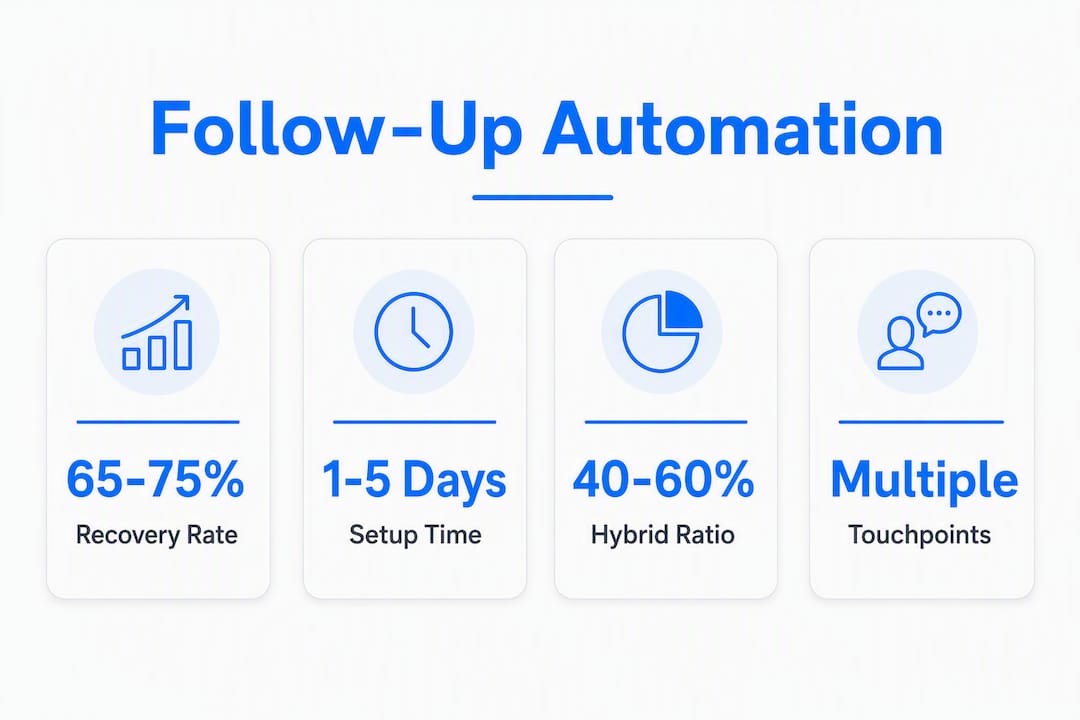
O2C automation shifts collections from reactive to proactive by prioritizing accounts based on payment risk and customer behavior rather than a static aging report. That means your highest-risk invoices get attention first, automatically. Automated 3-touch reminder sequences can recover 65–75% of overdue balances in SMB pilots without manual calls, while saving owners several hundred dollars per month per 50 outstanding invoices at a typical opportunity cost.
Practitioners also report that consistent, rules-based outreach often feels more professional to customers than infrequent, frustrated manual calls. A well-timed, branded email at day 7 post-due lands better than a phone call from a stressed bookkeeper at day 45.
Escalation sequences with increasing directness (friendly pre-due, direct post-due, personal-sender escalation) can reduce write-offs by an estimated 20–30% where consistently applied.
Pro Tip: Benchmark data recommends a balanced split of automated to manual outreach for best results. Use automation for routine reminders and reserve human outreach for high-value accounts, disputes, and escalations.
What features should you require before signing with any vendor?
Require live accounting integration, multi-touch automated sequences, embedded payment links, and dispute routing before you book a single demo. Without those four, you are buying a more expensive version of what you already do manually.
Highest-priority feature checklist:
- Real-time invoice status read and stop condition (paid = no message sent)
- Native accounting integrations: QuickBooks, Stripe
- Multi-channel outreach: email and SMS
- Branded messaging and tone controls per sequence stage
- AI-driven segmentation and personalization based on payment history
- Embedded pay links and flexible payment options
- Partial-payment handling with automatic balance follow-up
- Dispute case routing that pauses automated sequences
- Audit trail and compliance flags (PCI, SOC2 where applicable)
- Reporting dashboards showing DSO, recovery rate, and cost per recovered dollar
AR automation features that yield the largest efficiency gains include automated reminders, digital invoicing, flexible payment options, self-service portals, and automated cash application. If a vendor is missing more than two of those, keep looking.
Technical integration checklist:
- Confirm native QuickBooks connector or open API
- Verify data mapping covers invoice ID, customer contact, due date, and balance
- Test auto cash-application and reconciliation before go-live
- Review data security controls and request SOC2 attestation documentation
Questions to ask vendors:
- How does your stop condition work when a customer pays mid-sequence?
- What is your pricing model: flat subscription or percentage of recovered AR?
- What is the average setup time for a business our size?
- What support SLA do you offer during the pilot?
Red flags: no real-time stop condition, no native accounting integration, percentage-of-recovery pricing with no cap, and vague answers about data security.
What ROI and timeline should you realistically expect?
Typical SMB pilots show measurable cash recovered within several weeks to a few months and meaningful DSO reductions, depending on your baseline process. The faster your current DSO, the smaller the absolute gain; the more manual and inconsistent your current process, the larger the improvement.
| Timeline Stage | Duration | Key Milestone |
|---|---|---|
| Data connection | under a few hours | QuickBooks/Stripe synced, invoices visible |
| Workflow build | 1–5 days | Sequences configured, stop conditions live |
| Pilot run | about one to three months | DSO and recovery rate measured |
| Scale rollout | a few months | Full AR volume automated, staff retrained |
A conservative ROI model: with a typical volume of overdue invoices and manual follow-up time spent by staff, the opportunity cost can be several hundred dollars per month. A substantially higher recovery rate on overdue balances than typical manual rates — typically 65–75% recovered with multi-touch automation — translates directly to recovered revenue that most pest-control firms never see.
Variance drivers include dispute complexity, the mix of residential versus commercial accounts, and whether customers have stored payment methods on file.
How do you move from manual to automated collections?
Run a short pilot on a representative customer segment while keeping human oversight for exceptions. You do not need to automate everything on day one.
- Inventory your systems. Identify all invoice sources and confirm contact data completeness.
- Clean and segment accounts. Separate low-balance, predictable accounts from high-dollar or dispute-prone ones.
- Configure stop conditions and sequences. Build a few-touch sequence with tone templates matched to each stage (friendly pre-due, direct post-due, escalation).
- Connect payments. Embed pay links in every outreach message so customers can pay in one click.
- Run a pilot lasting several weeks to a few months. Measure DSO, recovery rate, and cost per recovered dollar against your pre-automation baseline.
- Define escalation rules. Set clear criteria for when a case moves to manual handling (dispute filed, balance over a set threshold, repeated missed touches).
- Roll out and train staff. Shift AR team time from sending reminders to managing exceptions and disputes.
| Pilot Checkpoint | Timing | What to Measure |
|---|---|---|
| Initial sync check | Day 1–2 | Data accuracy, stop condition firing correctly |
| First-touch response | Day 7 | Open rate, payment rate on pre-due reminder |
| Mid-pilot review | Day 30–45 | DSO trend, recovery %, escalation volume |
| Final pilot readout | Day 60–90 | Full KPI comparison vs. baseline |
Pro Tip: Start your pilot with accounts under $500 and customers with a consistent service history. Reserve full manual handling for accounts over $2,000 or any account with an open dispute.
What U.S. compliance rules apply to automated collections outreach?
Automation must respect U.S. rules on communications and debt collection. Design your sequences to avoid TCPA and FDCPA exposure, and confirm payment security (PCI) and data protection before go-live.
- FDCPA: Applies primarily to third-party collectors. If you are collecting your own receivables, FDCPA does not govern you directly, but vendor contract language may create indirect exposure. Review any vendor agreement for indemnification clauses.
- TCPA: Governs autodialed calls and SMS. Obtain written consent before sending automated texts, and build opt-out handling into every SMS sequence.
- PCI compliance: Any vendor processing or storing payment card data must be PCI-DSS compliant. Request documentation.
- SOC2 attestation: Confirms the vendor's data security controls meet a recognized standard. Ask for the report, not just a checkbox.
Operational safeguards to require: consent capture at the point of service, do-not-contact flags synced in real time, stop conditions that halt sequences immediately on payment, and templated escalation language reviewed by your attorney.
Which KPIs should you track after going live?
Track DSO, recovery rate, days-to-payment, cost per recovered dollar, and the percentage of accounts escalated to manual review. Those five metrics tell you whether the automation is working or needs adjustment.
| KPI | Calculation | Starter Benchmark |
|---|---|---|
| DSO | (AR balance ÷ revenue) × days in period | Aim for 10–35% reduction vs. baseline |
| Recovery rate | Overdue recovered ÷ total overdue | 65–75% with multi-touch sequences |
| Days-to-payment | Average days from invoice date to payment | Target: reduce by 30 days |
| Cost per recovered dollar | AR staff cost ÷ dollars recovered | Decrease month-over-month |
| Escalation rate | Accounts moved to manual ÷ total accounts | Below 20% signals healthy automation |
Run a daily sync for exceptions, weekly pilot check-ins for the first 90 days, and monthly executive reporting with trend lines. Always show absolute recovered dollars alongside percentage improvements. A 20% DSO reduction sounds abstract; "$14,000 recovered in 60 days" gets leadership's attention.
What results do Interval-ai clients actually see?
Interval-ai clients report meaningful reductions in days-to-payment and recovered revenue without adding headcount. Interval claims to reduce days-to-payment by over 30 days, with clients reporting thousands of dollars saved in payroll costs by eliminating manual AR work.
| Stage | Duration | Milestone |
|---|---|---|
| Discovery and data connection | 30–60 minutes | QuickBooks synced, sequences configured |
| Pilot run | 30–90 days | Recovery rate and DSO improvement measured |
| Scale rollout | 1–3 months | Full AR volume live, reporting active |
What is the verdict for pest-control SMBs?
Automation is the right move. Run a QuickBooks-integrated pilot with Interval-ai as your first evaluation. The evidence is consistent: measurable DSO recovery, lower payroll hours on AR, and controlled escalation for exceptions.
Vendor-selection checklist before you commit:
- Native QuickBooks integration confirmed
- Real-time stop condition verified in a live demo
- Pricing model is flat subscription, not percentage-of-recovery
- SOC2 or PCI documentation provided on request
- Onboarding support included for the pilot period
Evaluate Interval-ai via a demo or pilot before your next billing cycle.
Key Takeaways
Automated collections software is the most direct, measurable alternative to manual follow-ups for pest-control owners — pilot it fast, measure DSO and recovered dollars, and keep humans for exceptions only.
| Point | Details |
|---|---|
| Automation beats manual follow-ups | Multi-touch sequences recover 65–75% of overdue balances vs. lower manual rates. |
| QuickBooks integration is non-negotiable | Native sync eliminates reconciliation friction and speeds time-to-value. |
| Stop conditions protect relationships | Real-time payment status checks prevent messages to customers who already paid. |
| Pilot in 30–90 days | Data connection takes 30–60 minutes; measurable results appear within one pilot cycle. |
| Interval-ai is the recommended starting point | Interval-ai integrates with QuickBooks, automates multi-channel outreach, and claims 30+ day DSO reduction without extra staff. |
Why most pest-control owners underestimate this shift
Most owners assume the risk of automation is damaging customer relationships. The real risk is the opposite: inconsistent, delayed manual follow-ups signal disorganization, and customers learn they can pay late without consequence.
The data supports a hybrid approach, not full automation. A 40–60% automated-to-manual split outperforms both extremes. Automation handles the routine cadence; humans handle the relationship-sensitive moments. That balance is where most SMBs find the biggest improvement in both recovery rates and customer retention.
The pest-control industry runs on recurring service relationships. A well-configured automated sequence, with the right tone and a clear opt-out, reinforces professionalism rather than undermining it. The firms that resist automation longest tend to have the highest write-off rates and the most stressed bookkeepers.
Interval-ai recovers what manual follow-ups leave behind
Chasing overdue invoices manually costs pest-control owners real money in staff time and missed recoveries. Interval-ai replaces that process with AI-driven, multi-channel outreach that reads your QuickBooks data in real time, stops automatically when a customer pays, and escalates disputes to your team without dropping the ball on routine accounts.
Onboarding is straightforward: a discovery call to map your AR workflow, data connection in 30–60 minutes, sequence templates configured within 1–5 days, and a 30–90 day pilot to prove the numbers. Clients report recovering substantial overdue balances and saving thousands in payroll costs, all without hiring additional AR staff.
Start your pilot with Interval-ai and see your DSO improvement within the first billing cycle.
FAQ
What is the best alternative to manual follow-ups for pest-control owners?
Automated, rules-based collections software with QuickBooks integration is the most effective alternative. Tools like Interval-ai automate multi-touch outreach, stop on payment, and recover overdue balances without manual effort.
How quickly can you set up automated AR collections?
Data connection typically takes 30–60 minutes, and workflow sequences can be configured within 1–5 days, with measurable pilot results in 30–90 days.
Does automated collections outreach comply with U.S. law?
Yes, when configured correctly. Obtain written consent before SMS outreach (TCPA), build opt-out handling into every sequence, and confirm your vendor holds PCI-DSS compliance and SOC2 attestation.
What recovery rate should you expect from automated follow-ups?
Automated 3-touch reminder sequences recover 65–75% of overdue balances in SMB pilots, compared to lower rates typical of inconsistent manual processes.
How do you avoid damaging customer relationships with automation?
Use branded, professional tone templates, set real-time stop conditions so paid customers never receive a message, and reserve human outreach for high-value or dispute-prone accounts.
