
Automate Customer Communication Sequences for Cash Flow
Published: June 11, 2026 · 10–11 min read
TL;DR:
- Automated customer communication sequences send personalized messages at set intervals to improve collections efficiency and cash flow.
- Using platforms with AI personalization, multi-channel support, and CRM integration maximizes engagement and response rates.
Automated customer communication sequences are pre-built messaging workflows that send personalized outreach to customers at timed intervals without manual effort. For small and medium business owners, this is the most direct way to improve collections efficiency and protect cash flow. The average business takes 47 hours to respond to a new lead or payment inquiry, while automation delivers the first message within seconds. That speed gap is the difference between a customer who pays promptly and one who drifts into a 60-day overdue balance. Tools like FlowBots.ai, Blooio, OpenText CCM, and Interval-ai make it possible to automate customer communication sequences without adding headcount.
What tools are essential to automate customer communication sequences?
Choosing the right platform determines whether your automated messaging sequences actually move money or just generate noise. The core capabilities you need are AI-driven personalization, multi-channel delivery, two-way conversation support, and integration with your CRM or payment system. Without those four features working together, you end up with a broadcast tool rather than a true customer interaction workflow.

Here is how the leading platforms compare:
| Platform | Best For | Key Feature | Channel |
|---|---|---|---|
| FlowBots.ai | SMB follow-up sequences | Speed-to-lead automation | SMS |
| Blooio | Apple device-heavy audiences | iMessage automation | iMessage |
| OpenText CCM | Enterprise omnichannel | Hyper-personalized journeys | Email, SMS, print, web |
| Interval-ai | Collections and overdue payments | Payment-data-driven outreach | Multi-channel |
FlowBots.ai focuses on SMS follow-up sequences and handles unlimited concurrent conversations around the clock without staff involvement. Blooio specializes in iMessage automation, which is particularly effective for audiences on Apple devices. OpenText CCM targets larger operations that need omnichannel personalization across email, SMS, print, and web simultaneously. Interval-ai is purpose-built for collections, using historical payment data to tailor outreach timing and tone to each customer's behavior.
When evaluating any platform, prioritize these capabilities:
- Two-way messaging: The system must pause the automated sequence the moment a customer replies and enter live conversation mode.
- CRM and payment integration: Triggers should fire based on invoice status, payment date, or account balance, not just a calendar schedule.
- Compliance controls: TCPA and CAN-SPAM compliance features are non-negotiable for any business sending automated messages in the United States.
- AI reply drafting: Look for a draft-then-approve model rather than fully autonomous AI responses.
Pro Tip: Start with one channel, typically SMS, before expanding to multi-channel sequences. SMS messages open at a 98% rate within 3 minutes, compared to 20% for email. Proving the model on one channel first reduces setup complexity and gives you clean data to optimize against.
How to design effective automated messaging sequences for collections
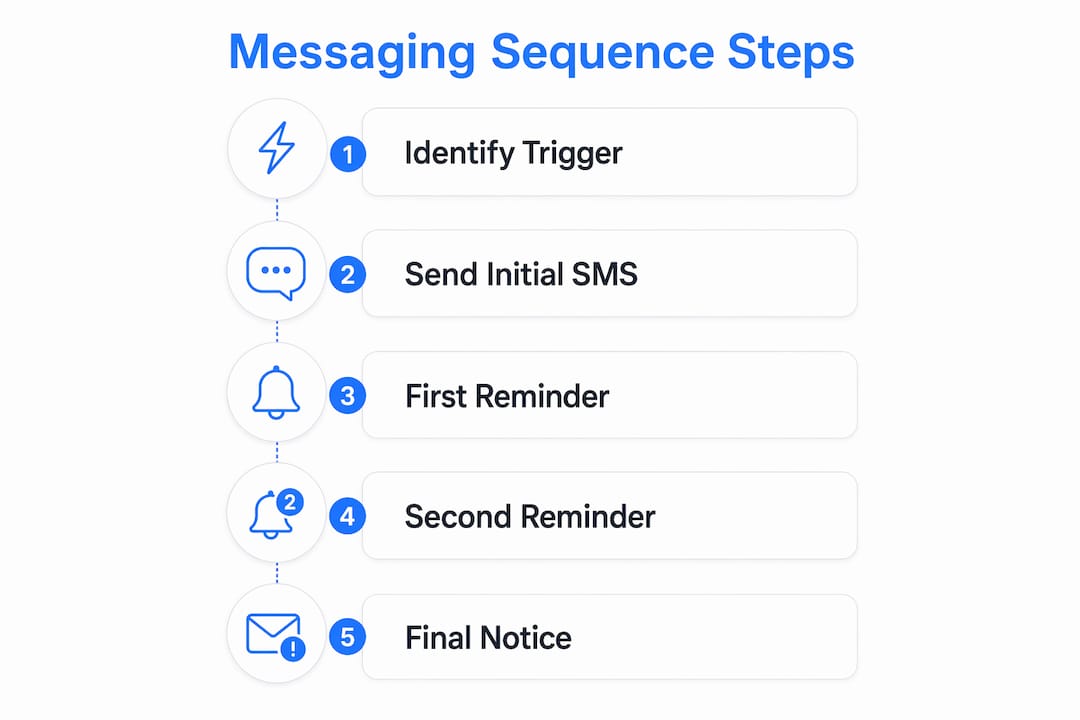
The structure of your sequence matters as much as the message content. A well-designed customer interaction workflow follows a clear cadence, adjusts tone based on customer response, and stops automatically when the customer engages.
Follow these steps to build a sequence that supports collections without damaging customer relationships:
-
Define your trigger. Set the sequence to fire based on a specific event: invoice sent, payment due date passed, or payment 7 days overdue. Behavior-based triggers outperform calendar-based ones because they reflect the customer's actual status.
-
Map your touchpoints. Optimal follow-up intervals are immediate (within minutes of the trigger), 1 hour, 4 hours, 24 hours, 3 days, and 7 days. You do not need all six for every sequence. A standard collections sequence works well with four to five messages.
-
Write conversational copy. Avoid formal demand language in early messages. A message like "Hi [Name], just a quick note that your invoice #1042 is ready for payment. Reply here if you have any questions." outperforms a stiff reminder every time. Silence reads as permission to wait, so keep the tone friendly and the ask clear.
-
Set auto-cancel rules. Sequences auto-cancel upon customer reply to prevent robotic follow-ups after a customer has already responded. This is a standard feature in FlowBots.ai and Blooio, and you should confirm it exists before committing to any platform.
-
Build in AI reply drafting. When a customer responds with a question or dispute, the system should draft a reply for a human agent to review and approve before sending. This draft-then-approve loop protects your brand voice while keeping response times fast.
-
Connect to your payment system. The sequence should close automatically when a payment is recorded. An open sequence running against a paid invoice is one of the fastest ways to frustrate a customer who just settled their balance.
Pro Tip: Cap your collections sequence at four to five messages total. Research confirms that sequences limited to 4-5 messages with tone adjustment after the first reply produce better outcomes than longer, more aggressive cadences. More messages past that threshold increase opt-outs without meaningfully improving payment rates.
What are common mistakes when automating communication sequences?
Most automation failures come from setup decisions made in the first week. The problems are predictable, and knowing them in advance saves you from rebuilding your sequences after they have already damaged customer relationships.
-
Over-messaging without a reply check. Sending five messages in two days to a customer who responded on day one is a trust-destroying error. Every platform you use must have automatic sequence cancellation on reply. If it does not, do not use it for collections.
-
Ignoring response data. If your response rate drops below 10% on a particular message in the sequence, that message is the problem. Most business owners let underperforming sequences run for months without reviewing the data. Check response rates weekly during the first 30 days.
-
Generic messaging that sounds robotic. Personalized customer messaging means more than inserting a first name. Reference the specific invoice number, the amount due, and the due date in every message. Customers are far more likely to respond to a message that reflects their actual account status.
-
Missing CRM integration. Without a live connection to your CRM or accounting software, your sequences cannot know when a payment has been made. This creates the scenario where a paid customer receives a collections message, which is both embarrassing and a compliance risk.
-
Fully autonomous AI responses. AI should act as a multiplier for human agents, handling routine queries and escalating complex issues with full conversation context. Letting AI respond autonomously to anything beyond simple FAQs or opt-out requests introduces brand voice and accuracy risks that are difficult to recover from.
"Automation enhances human agent productivity but should not fully replace human interaction. AI handles routine queries and escalates complex conversations with context intact."
The fix for most of these problems is a weekly review of your sequence analytics during the first month. After that, monthly reviews are sufficient unless you see a sudden drop in payment or response rates.
How do you measure success and optimize your sequences over time?
Measurement is what separates a set-it-and-forget-it automation from a system that actively improves your cash flow. The metrics that matter most for collections-focused sequences are response rate, payment conversion rate, days-to-payment, and opt-out rate.
| Metric | What It Measures | Target Benchmark |
|---|---|---|
| Response rate | Customer engagement per message | Above 15% for SMS |
| Payment conversion rate | Sequences that result in payment | Varies by industry |
| Days-to-payment | Speed of collections cycle | Reduction of 30+ days |
| Opt-out rate | Sequence fatigue or tone mismatch | Below 2% |
Connected omnichannel CCM solutions provide dashboards that surface these metrics in real time, which makes it practical to run A/B tests on message content and timing without manual tracking. Test one variable at a time: message copy in week one, send time in week two, sequence length in week three. Stacking multiple changes at once makes it impossible to know what drove the result.
Interval-ai clients report reducing days to payment by over 30 days after implementing automated collections sequences. That kind of result does not happen from a single well-written message. It comes from iterative improvement across timing, tone, and channel selection over several months.
Pro Tip: Use SMS for initial outreach and payment reminders, then shift to email for documentation-heavy communications like invoice copies or payment plans. SMS follow-up outperforms email response rates by 8 to 10 times, but email provides a paper trail that customers and accountants prefer for formal records.
Key takeaways
Automated customer communication sequences reduce days-to-payment, improve response rates, and protect cash flow when built with the right tools, timing, and human oversight.
| Point | Details |
|---|---|
| Speed is the primary advantage | Automation sends the first message within seconds, versus the 47-hour average manual response time. |
| Cap sequences at 4-5 messages | Longer sequences increase opt-outs without improving payment rates. |
| Auto-cancel on reply is non-negotiable | Every platform must pause the sequence the moment a customer responds. |
| Connect to your payment system | Sequences must close automatically when payment is recorded to avoid post-payment follow-ups. |
| Measure weekly for the first month | Response rate, payment conversion, and opt-out rate reveal problems before they compound. |
Why automation without oversight is a risk worth taking seriously
I have worked with enough small business owners to know that the appeal of "set it and forget it" is real. When you are managing a team, chasing invoices, and running operations simultaneously, the idea of a system that handles follow-ups while you sleep is genuinely attractive. And it works. The data on SMS open rates and no-show reduction from automated reminders is not marginal. SMS reminders reduce no-shows by 35 to 60%, and that translates directly to revenue recovered.
But the businesses I have seen get the most out of communication automation are not the ones who turned everything over to the system. They are the ones who kept a human in the loop for anything beyond a simple reminder. The draft-then-approve model is not a workaround for weak AI. It is the correct architecture for protecting your brand voice in a channel where customers expect to be talking to a person.
The other thing I would push back on is the instinct to automate everything at once. Start with your overdue payment sequence. Get the timing right, measure the response rate, and adjust the copy based on what you learn. Once that sequence is producing consistent results, expand to pre-due-date reminders, then onboarding, then re-engagement. Trying to build five sequences simultaneously means none of them get the attention they need to perform well.
The businesses that see the biggest cash flow improvements from communication automation are the ones that treat it as an ongoing practice, not a one-time setup. That mindset is the real differentiator.
— Tyler
See how Interval-ai handles this for you
If building and managing these sequences sounds like more work than you have bandwidth for right now, that is exactly the problem Interval-ai was designed to solve.
Interval-ai uses historical payment data to build outreach sequences that match each customer's behavior, not a generic template. The platform manages multi-channel communications, pauses sequences on reply, and closes them automatically when payment is recorded. Clients report recovering substantial overdue balances without adding staff, and reducing days-to-payment by more than 30 days. If you want to see how the system would work for your specific collections situation, schedule a demo at Interval-ai and walk through a live setup with the team.
FAQ
What is an automated customer communication sequence?
An automated customer communication sequence is a pre-built series of messages sent to customers at timed intervals based on specific triggers, such as an invoice due date or payment status. The sequence pauses automatically when the customer responds and resumes or closes based on the outcome.
How many messages should a collections sequence include?
Research confirms that 4 to 5 messages is the optimal range for a collections sequence. Sequences longer than five messages increase opt-out rates without meaningfully improving payment conversion.
Is SMS or email better for payment reminders?
SMS is the stronger channel for initial reminders because messages open at a 98% rate within 3 minutes, compared to 20% for email. Email works better for formal documentation like invoice copies or payment plan agreements.
Can AI handle customer replies automatically?
AI handles routine replies such as FAQs and opt-out requests well, but complex disputes or payment negotiations require human review. The draft-then-approve model is the recommended approach for protecting brand voice and accuracy.
How do I know if my sequences are working?
Track response rate, payment conversion rate, days-to-payment, and opt-out rate weekly for the first 30 days. A response rate above 15% on SMS and an opt-out rate below 2% indicate a healthy sequence.
