
Automate Recurring Service Billing in Pest Control
Published: August 13, 2026 · 11–12 min read
Deploy an AI-powered collections flow starting with Interval-ai, and you can recover most overdue recurring-service payments without adding any staff. The immediate next step: run a 30-day pilot on your oldest unpaid recurring accounts and activate payment-link outreach first. Here is the short verdict your finance lead can forward to operations today:
- Recommended tool: Interval-ai for automated past-due outreach, payment-method refresh, and dispute triage
- First action: Segment accounts 30+ days overdue, enable autopay prompts and SMS payment links
- Benchmark to expect: Purpose-built AR platforms report a ~23% reduction in DSO and ~25% reduction in days to pay
- Pilot window: 30 days on your most overdue recurring accounts before scaling
Key Takeaways
AI-powered collections automation cuts days-to-payment by more than half for recurring pest-control accounts while freeing staff from manual follow-up.
| Point | Details |
|---|---|
| DSO reduction is measurable | Purpose-built AR platforms report a ~23% DSO reduction and ~25% fewer days to pay. |
| Involuntary churn is recoverable | Card-update automation targets the 10–20% of customer losses caused by failed payments. |
| Start with low-risk buckets | Automate 7–21 day overdue accounts first; validate for one billing cycle before expanding. |
| Track the right KPIs | Monitor DSO, aging percentages, and staff hours saved weekly during your 30-day pilot. |
| Interval-ai is the recommended deployment | Interval-ai automates outreach, payment-method refresh, and dispute triage for recurring pest-control accounts. |
This article is general information, not a substitute for advice from a qualified financial advisor. Consult a qualified financial professional about your own circumstances before acting on anything here.
Why overdue recurring payments quietly drain pest-control businesses
Recurring pest-control accounts feel stable until payments stop. A missed monthly charge on a quarterly termite plan does not look urgent on day one, but silence reads as permission to wait. By day 30, that account is funding your chemical orders with money you do not have.
Stat to know: PYMNTS Intelligence reports that AR platforms combining invoicing, payments, and collections see a 23% reduction in DSO and a 25% reduction in days to pay. When all three functions operate together, that DSO reduction reaches 34%.
Recurring service billing behaves differently from a one-off invoice. Customers on monthly or quarterly plans often let a failed charge sit because they assume you will sort it out. Meanwhile, involuntary churn from expired or reissued cards accounts for roughly 10–20% of customer losses in subscription-style field-service businesses. At route scale, that compounds fast.
The practical impacts on your business:
- Payroll risk: You are paying technicians to service accounts that have not paid last month's invoice
- Buying power: Delayed cash slows chemical and fuel purchasing, forcing you to carry higher credit balances
- Staff time: Office staff chasing payments manually cannot focus on scheduling, upsells, or customer service
Which collection tasks AI-powered systems automate for recurring pest-control accounts
AI can automate the routine 60–70% of collection work, freeing your team to handle disputes and sensitive long-term accounts. For recurring pest-control billing, that automation covers:
- Predictive late-pay scoring: AI flags accounts likely to miss payment before the due date, using payment history and service frequency
- Automatic payment-link sending: Customers receive a direct link to pay or update their card the moment an invoice ages past a threshold you set
- SMS and email sequences: Timed, brand-consistent messages go out at 3, 7, and 14 days without anyone touching a keyboard
- Autopay reconciliation: Failed autopay attempts trigger an immediate retry sequence and a card-update prompt
- Dispute detection and triage: Unstructured signals like email sentiment and dispute frequency help the system predict payment behavior and route complex cases to a human reviewer
Pro Tip: Start by automating your 7–21 day overdue bucket only. Validate message quality and payment response rates for one full billing cycle before expanding to 30+ day accounts.
A 7-step rollout checklist for pest-control firms
Integrated workflows that send invoices at job completion and trigger reminders improve on-time payment rates for recurring services. A phased rollout protects relationships while you validate results.
| Step | Action | Responsible | Required Data | Pilot Milestone |
|---|---|---|---|---|
| 1 | Clean customer records | Office admin | Verified contacts, payment tokens | Complete before launch |
| 2 | Connect billing/CRM/accounting | IT or ops lead | Service ID, invoice amount, job date | Integration live by Day 5 |
| 3 | Configure aging buckets and rules | Finance manager | Aging thresholds, escalation triggers | Rules active by Day 7 |
| 4 | Build message templates | Office manager | Brand tone guide, service history | Templates approved by Day 10 |
| 5 | Run parallel pilot (one billing cycle) | Finance manager | Live AR data alongside manual process | Pilot active Days 10–30 |
| — | Validate results and refine | Finance manager | Response rates, DSO change, disputes | Review at Day 30 |
| 7 | Scale and add language variants | IT or ops lead | Multilingual contact segments | Full rollout by Day 60 |
Good field-service scheduling discipline matters here too. Technicians capturing accurate contact details, signatures, and job-completion photos at the point of service means your invoices go out faster and with fewer disputes to slow collections down.

How to handle overdue accounts professionally and when to escalate
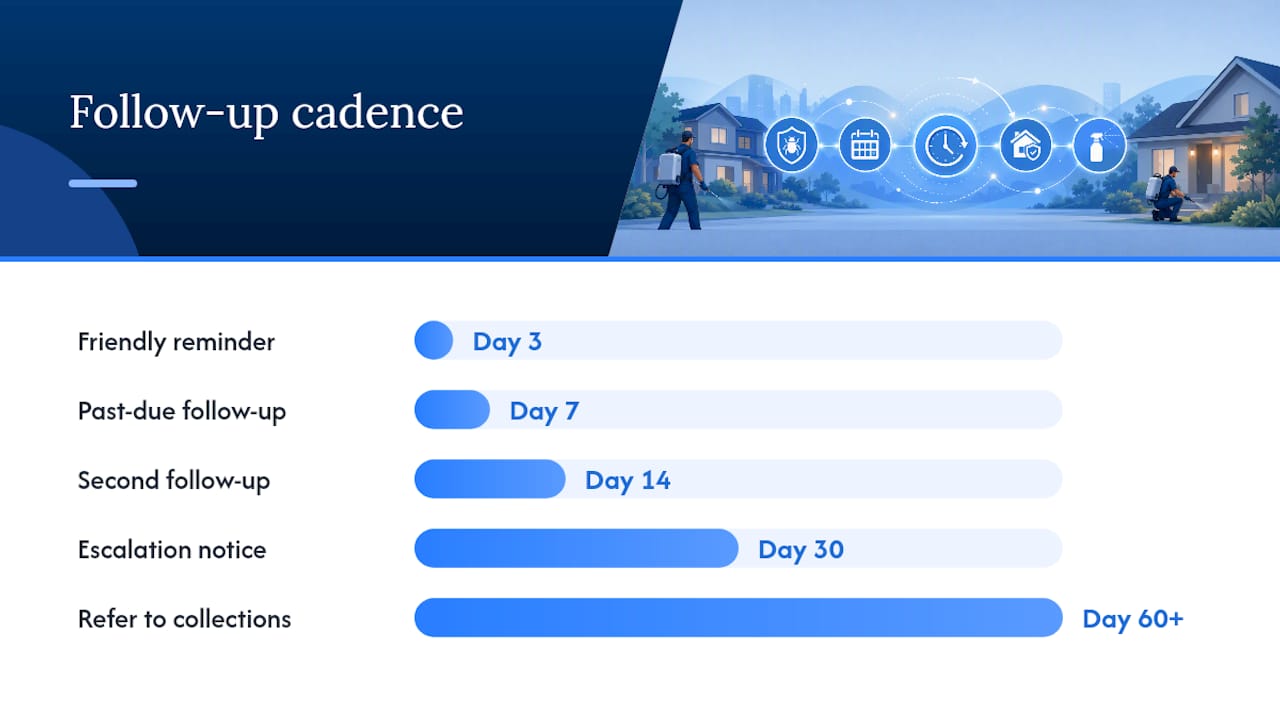
A consistent outreach cadence protects the customer relationship while keeping pressure on the account. Here is a practical schedule for recurring pest-control billing:
- Invoice day: Automated invoice with payment link delivered immediately at job completion
- Day 3: Friendly reminder via SMS or email ("We noticed your payment hasn't processed yet")
- Due date: Confirmation message with a one-click payment link
- Day 7: Follow-up noting the account is past due; offer autopay enrollment
- Day 14: Second follow-up with a payment plan option for larger balances
- Day 30: Escalation notice; offer a formal payment plan or flag for human review
- Day 60+: Refer to a collections agency or consider small claims (limits vary by jurisdiction)
Documentation to keep for every escalated account: signed service agreements, all automated message logs, job-completion photos, and any written dispute correspondence.
Pro Tip: Keep every automated message logged with a timestamp. If an account disputes a charge later, that audit trail is your first line of defense.
Consult qualified legal counsel for jurisdiction-specific collection rules before sending escalation notices or pursuing small claims. This article is general guidance, not legal advice.
KPIs and dashboard fields that prove automation is working
Track these metrics from day one of your pilot so you can show ROI clearly.
| KPI | Data Source | Expected Improvement |
|---|---|---|
| Days Sales Outstanding (DSO) | Billing system / Interval-ai reporting | ~23% reduction (PYMNTS) |
| Average days to payment | Payment processor | Down from 35–45 days to 12–18 days |
| % invoices paid within terms | Billing system | Increases as autopay penetration rises |
| 30+/60+ aging percentage | AR aging report | Declines within first 60 days of automation |
| Involuntary churn rate | CRM / subscription data | Target below 10% with card-update prompts |
| Staff hours spent on AR | Time tracking / self-reported | Savings of roughly 8–10 hours per month reported after automation |
Set daily alerts for any account that crosses the 30-day aging threshold. Review DSO trend lines weekly during the pilot, then monthly once you reach steady state. A real-time business management dashboard that surfaces aging buckets alongside scheduling data gives finance managers a single view of cash exposure.
What to expect: typical results and client-reported outcomes
Field-service businesses report substantially reducing average days to payment after automating invoicing and reminders.
Key outcome benchmarks for pest-control operators:
- Days-to-payment cut by more than half in the first 60 days of a full rollout
- Involuntary churn reduced when card-update prompts are automated at the first failed charge
- Staff time recovered from manual follow-up redirected to scheduling and customer service
Adams Exterminators configured automated trigger rules across aging buckets and combined text messages with a self-service payment portal, producing measurable improvements in receivables outcomes. The key was removing friction at every step: customers could pay or update their card without calling the office.
Results vary based on subscriber base size, existing autopay penetration, and data quality at launch.
Common implementation mistakes and how to avoid them
The pitfalls that undermine automation ROI:
- Launching automation before cleaning customer contact records and payment tokens
- Sending identical messages to a 5-day-overdue account and a 60-day-overdue account
- Automating high-value or dispute-prone accounts without a human review step
- Skipping DSO measurement before the pilot, leaving you with no baseline to prove improvement
What not to do (numbered for your ops checklist):
- Do not automate without verifying every contact has a valid email and mobile number
- Do not use one message template for all aging buckets
- Do not let automation run on accounts with open disputes
- Do not skip the parallel pilot phase — run automation alongside your manual process for one cycle first
- Do not forget to log every automated message for compliance and audit purposes
Best-practice corrections are straightforward: segment accounts by payment history before configuring rules, preserve a human-in-the-loop for any account with a dispute flag, and test message templates on a small cohort before full deployment. Capturing field data accurately at job completion reduces disputes before they reach the collections stage.
What does AI-powered collections software cost for pest-control businesses?
Interval-ai and similar AI-powered collections platforms typically price on a subscription model tied to your accounts receivable volume and the number of overdue customers handled each month. Expect monthly or annual contract fees that scale with your business size rather than a flat per-invoice charge.
The total cost of implementation includes the software subscription, a one-time integration setup (connecting your CRM, billing system, and accounting software), and internal staff time for data cleanup and template configuration. Most small and mid-size pest-control operators complete setup within two to four weeks.
Compare that cost against the alternative: a dedicated AR staff member costs tens of thousands of dollars annually in salary and benefits, and manual follow-up still misses accounts. The payroll savings alone, which Interval-ai clients report as significant, typically offset the subscription fee within the first quarter of deployment.
Security and compliance considerations when automating payment collections with AI
Any system that handles payment data and customer communications must meet baseline standards. For pest-control businesses automating collections, the key requirements are:
Payment data security: Your collections platform must handle payment tokens, not raw card numbers. Interval-ai integrates with your existing payment processor so card data stays within your PCI-compliant environment.
Message compliance: Automated SMS and email outreach must comply with the Telephone Consumer Protection Act (TCPA) and CAN-SPAM Act. That means maintaining opt-out mechanisms, honoring unsubscribe requests immediately, and keeping message logs for audit.
Audit trails: Every automated message, payment attempt, and dispute flag should be logged with a timestamp. This protects you if a customer disputes a charge or a regulator requests records.
Data access controls: Limit who in your organization can view or export customer payment data. Role-based access in your collections platform keeps sensitive AR data away from staff who do not need it.
Consult your legal counsel to confirm your outreach cadence and message content meet the collection rules in your operating states. Requirements vary, and a single non-compliant message can create liability that outweighs the recovered invoice.
Why the pest-control industry is overdue for smarter collections
The recurring nature of pest-control service is both the business model's strength and its collections blind spot. You are delivering value every month or quarter, often without the customer even being home. That invisibility makes it easy for a failed payment to sit unnoticed on both sides.
What I find most underappreciated in this industry is how much the collections problem is actually a data problem. Most pest-control operators have the service history, the contact records, and the payment patterns sitting in their CRM. They just are not using that data to predict which accounts will go overdue and act before the invoice ages. AI-powered AR systems close that gap by reading signals humans miss at scale.
The operators who recover the most revenue are not the ones who chase hardest. They are the ones who make it easiest for customers to pay the moment a reminder arrives. A payment link in an SMS at day 3 converts far better than a phone call at day 45. That is not a technology argument; it is a behavioral one. And it is exactly where automation earns its cost.
Interval-ai recovers the recurring revenue your team is leaving on the table
Recovering past-due recurring-service revenue without hiring more staff is the concrete payoff Interval-ai delivers. The platform automates outreach across SMS, email, and voice; prompts customers to update expired payment methods before a charge fails; triages disputes so your team only touches the accounts that genuinely need a human; and logs every interaction for compliance.
Interval-ai integrates directly with pest-control CRMs to pull service history, invoice amounts, and payment token status automatically. Multilingual messaging means you reach every customer in your service area. Finance managers report reduced DSO, recovered past-due balances, and hours returned to their week, without adding headcount.
Interval-ai and run your first 30-day pilot on your most overdue recurring accounts.
Sources
- Accounts Receivable Gets an AI Upgrade | PYMNTS
- AI Agents for Accounts Receivable: Small Firm Guide | ClarityWithAI
- How Adams Exterminators cut receivables | FieldRoutes blog
- Why involuntary churn is killing your field service revenue | RealGreen blog
FAQ
How does automating recurring pest-control billing reduce DSO?
Automated reminders and payment links reach customers at 3, 7, and 14 days overdue without manual effort, shortening the time between invoice and payment.
What data do I need before setting up automated collections?
You need verified customer contact records (email and mobile), payment token status, service history by account, and invoice amounts pulled from your billing or CRM system. Clean data before launch is the single biggest factor in pilot success.
Can Interval-ai integrate with my existing pest-control CRM?
Yes. Interval-ai integrates with pest-control CRMs to pull job completion data, invoice amounts, and payment token status automatically, so past-due outreach triggers without manual input from your office team.
What is the recommended outreach cadence for overdue recurring accounts?
Send a payment-link reminder at day 3, a follow-up at day 7, a payment plan offer at day 14, and an escalation notice at day 30. Accounts still unpaid at day 60 should move to a formal payment plan or collections referral.
How do I know if automation is working?
Track DSO, average days to payment, the percentage of invoices paid within terms, and staff hours spent on AR. Field-service businesses report moving from 35–45 days to 12–18 days to payment after automating invoicing and reminders.
