
Benefits of AI-Powered Back-Office Tools for SMBs
Published: May 26, 2026 · 10–11 min read
TL;DR:
- AI-powered back-office tools significantly reduce manual data entry and boost productivity for small and medium-sized businesses. Starting with high-volume workflows like accounts payable or collections and piloting small projects ensures measurable ROI with minimal disruption. Embedded AI features in existing platforms often provide immediate benefits at low risk, making strategic automation accessible and cost-effective.
Running a small or medium-sized business means wearing a lot of hats. Back-office tasks like invoice processing, data entry, collections, and compliance reporting quietly consume hours your team could spend on work that actually moves the needle. The benefits of AI-powered back-office tools are not theoretical anymore. They are showing up in real payroll savings, faster payment cycles, and measurable productivity gains for businesses just like yours. This article walks you through how to evaluate these tools, what you realistically gain, and how to get started without betting everything on a single big rollout.
Key takeaways
| Point | Details |
|---|---|
| Significant time savings | AI back-office automation reduces manual data entry by 70-90%, freeing your team for higher-value work. |
| Cash flow improves fast | Automated accounts payable can raise early payment discount capture from 15% to nearly 80%. |
| Start small, win quickly | Piloting one high-volume workflow before scaling is the most reliable path to measurable ROI. |
| Not all AI is equal | Agentic AI outperforms traditional RPA with straight-through processing rates of 85-92% vs. 40-60%. |
| Embedded tools are underused | Most businesses already pay for AI features in platforms like Microsoft 365 that they have never turned on. |
1. What to look for in AI-powered back-office tools
Before you spend a dollar on any AI solution, you need a clear framework for evaluating what actually fits your business. Not every tool is built for your size, your systems, or your workflows.
Automation scope matters more than feature lists. Ask whether the tool handles the specific tasks eating your team's time, whether that is invoice processing, data entry, collections, compliance reporting, or some combination. A broad set of features you will never use is less valuable than deep coverage of your actual pain points.
Integration capability is often the deciding factor. If a tool cannot connect cleanly with your existing accounting software, CRM, or ERP, you will spend more time managing workarounds than you save. Check for native connectors, not just API access, since native integrations typically require far less technical setup.
- Accuracy with unstructured data: Can the tool handle invoices, emails, and documents that do not follow a rigid format? Many older tools struggle here.
- Implementation speed: How quickly can a non-engineer get the system running? Low-code tools have made this much faster.
- Scalability: Will the tool grow with your transaction volume without requiring a full re-implementation?
- Cost and payback timeline: Ask vendors for realistic payback estimates, not just headline ROI numbers. Payback periods for compliance reporting automation typically run 5 to 9 months.
Pro Tip: Ask any vendor for a reference customer in your industry with a similar transaction volume. Generic case studies tell you very little. A 20-minute call with an actual user tells you almost everything.
2. Top benefits of AI back-office automation
This is where the real story is. The advantages of AI tools in back-office functions are measurable, and the numbers are consistent across industries.
AI back-office automation reduces manual data entry by 70-90%, which directly translates to faster processing cycles, fewer errors, and lower labor costs. For a team spending 15 hours a week keying in invoices, that is potentially 10 to 13 hours reclaimed every single week.
The productivity gains extend to individual employees too. 57% of professionals using AI report saving 1 to 2 hours per day, and 22% save 3 to 5 hours daily. Those hours do not disappear. They get redirected toward customer relationships, strategic thinking, and work that actually requires human judgment.
"Early payment discount capture increases from about 15% to 75-80% with AI-automated accounts payable. For a business with $10M in annual spend, that can mean $100,000 or more in additional savings every year."
The cash flow impact is one of the most underappreciated benefits of automation in offices. When invoices get processed in hours instead of days, you pay vendors faster, capture discounts, and get paid faster in return. AI accounting tools also automate 30-46% of manual accounting tasks and layer in predictive analytics, anomaly detection, and real-time reporting that give you a clearer financial picture without hiring a data analyst.
Pro Tip: Before you go looking for a new tool, check what you already have. Embedded AI features in platforms like Microsoft 365 Copilot and Salesforce Einstein are turned off by default for most users. Activating them costs nothing extra and often delivers immediate wins.

3. How AI tools for business efficiency compare: RPA, agentic AI, and embedded solutions
There are three distinct approaches to AI back-office automation, and they are not interchangeable. Understanding the differences helps you spend your budget on the right thing.
| Approach | Straight-through rate | Maintenance | Best for | Typical ROI (3 years) |
|---|---|---|---|---|
| Traditional RPA | 40-60% | High | Structured, stable processes | 150-200% |
| Agentic AI | 85-92% | Low | Complex, variable documents | 300-400% |
| Embedded AI (Microsoft 365, Salesforce) | Varies | Very low | Quick wins in existing platforms | Fast payback, low risk |
Traditional RPA is rule-based. It works well when documents and processes follow consistent formats, but it breaks when they do not. Updating rules after process changes adds real maintenance overhead, which eats into your savings over time.
Agentic AI is a fundamentally different approach. Rather than following rigid rules, agentic AI reasons through exceptions autonomously instead of routing them to a human queue. This is why the touchless processing rates are so much higher. Organizations using AI agent automation see 300 to 400% ROI within three years, compared to 150 to 200% for traditional automation approaches.
Embedded AI is the fastest starting point for most small and medium-sized businesses. You are already paying for tools that have AI built in. Activating those features carries almost no migration risk, no new vendor relationship, and no lengthy implementation cycle. The tradeoff is that embedded AI is generally less specialized than a dedicated automation platform.
4. Implementation best practices that actually work
Most AI back-office projects that fail do not fail because of the technology. They fail because of how the rollout was managed.
- Start with accounts payable or collections. These are high-volume, high-ROI workflows with clear before-and-after metrics. Success here builds confidence and creates a proof point for broader adoption.
- Fix your processes before you automate them. Automating a broken workflow makes it break faster. Map the process, identify the manual bottlenecks, and resolve them first.
- Clean your data. AI tools learn from historical data. If your records are inconsistent or incomplete, the model's output will be too.
- Use pilots, not big-bang rollouts. Incremental, pilot-driven deployment with defined measurable outcomes consistently outperforms large monolithic implementations. Pick one workflow, run it for 60 to 90 days, measure the results, and then expand.
- Keep humans in the loop for exceptions. AI handles the routine. Your team handles the edge cases that require context and judgment. Build that division into your workflow design from day one.
- Track the right metrics from the start. Processing time, error rates, and cost per transaction are your baseline. Without them, you cannot prove the value or identify where to improve.
Pro Tip: Do not promise your team that AI will eliminate their jobs. It almost never does. Workloads typically reduce by 20-40% while headcount stays stable. The message that lands better is that the work becomes less tedious, not that people become unnecessary.
5. Measuring and maximizing ROI from AI back-office automation
You cannot manage what you do not measure. Getting serious about ROI means going beyond the obvious cost savings and tracking the full picture of how AI improves back-office functions across your organization.
| ROI category | What to measure | Example gain |
|---|---|---|
| Processing cost | Manual vs. automated cost per invoice | 60-80% reduction |
| Cycle time | Days from receipt to payment | Reduced by 5-15 days |
| Early payment discounts | Discount capture rate | From 15% to 75-80% |
| Staff reallocation | Hours redirected to strategic work | 1-5 hours per person per day |
| Error rates | Exceptions and corrections per 100 documents | Near-zero with mature AI |
The less obvious gains often matter most. When your accounts payable team spends less time chasing invoice approvals, they have bandwidth to analyze vendor contracts, identify duplicate charges, and negotiate better terms. That is a financial benefit that never shows up in a processing time report.
Use your AI tool's analytics to identify where accuracy plateaus or where exception rates remain higher than expected. Most mature platforms include continuous learning features that improve over time as they process more of your specific documents. Feed that data back into your automation strategy and expand scope to adjacent workflows once the first use case is proven.
Bring your ROI data to your leadership team or board with regularity. Numbers like "we captured $87,000 in early payment discounts this quarter because invoices now process in 4 hours instead of 3 days" make the case for deeper AI investment far more effectively than vendor ROI calculators ever will.
My honest take on AI back-office automation
I have seen a lot of businesses approach AI automation with one of two extremes. Either they expect it to transform everything overnight, or they are so skeptical that they delay past the point where competitors have lapped them.
In my experience, the businesses that do best start with a single painful workflow, measure religiously, and build from there. They also stop treating AI as a headcount reduction tool. AI-driven productivity almost always comes from job transformation and strategic reallocation, not layoffs. The businesses that communicate this clearly to their teams get buy-in faster and implementation friction drops significantly.
My other observation is that embedded AI is genuinely underrated. Most businesses I talk to have AI features sitting dormant in tools they already pay for. Before committing budget to a new platform, spend two weeks turning on and using what you already have. You may find it covers 60% of your needs for zero additional cost.
The biggest mistake I see? Choosing a vendor based on a demo rather than a reference. A polished walkthrough tells you what the software can do in ideal conditions. A conversation with a customer three months into their deployment tells you what it actually does when it meets your reality.
— Tyler
See how Interval-ai makes this real for your business
If overdue payments and collections are draining your team's time and hurting your cash flow, Interval-ai addresses that exact problem with AI built specifically for the collections process.
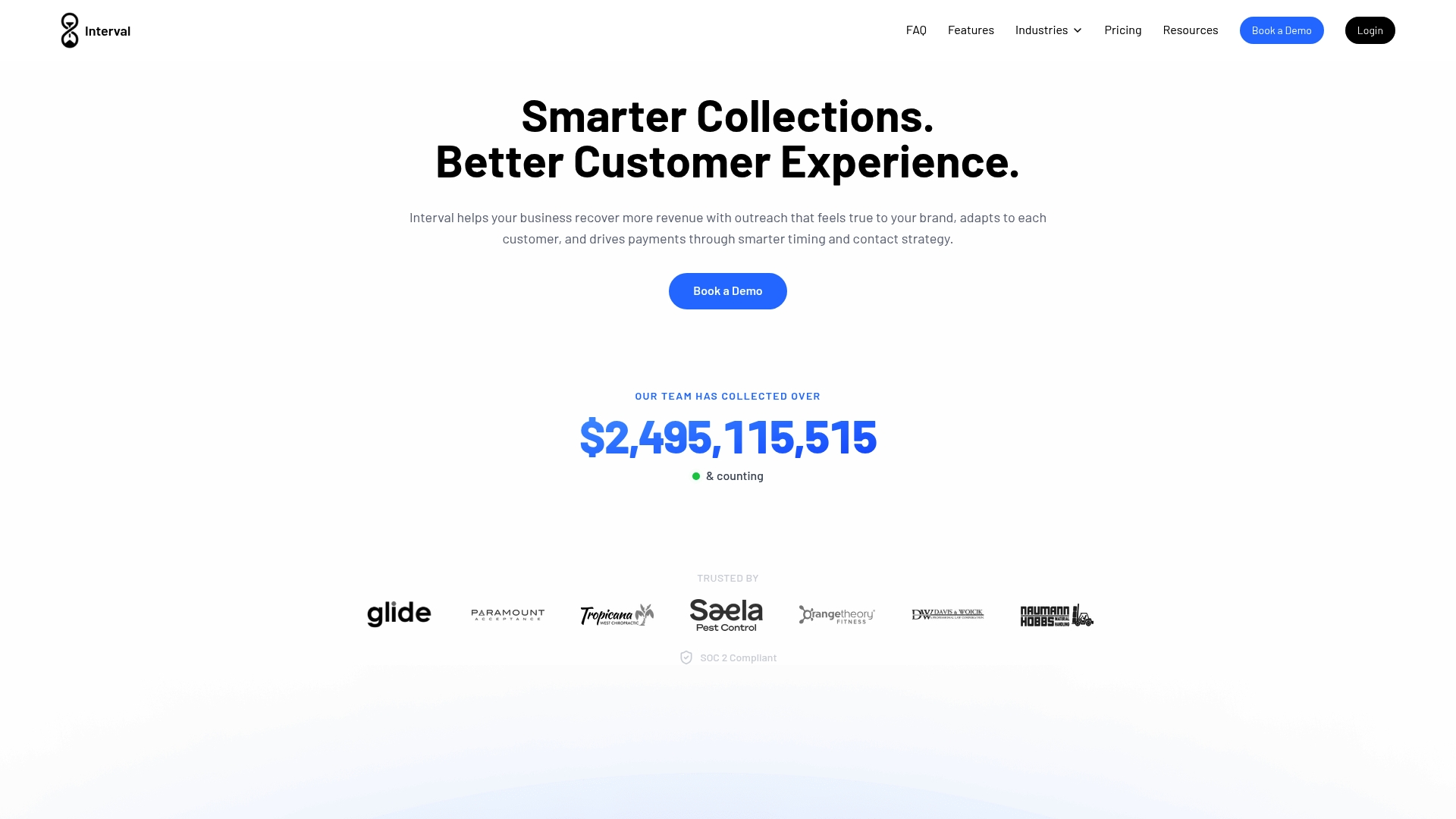
Interval-ai's platform uses historical payment data to tailor outreach across multiple channels, matching your brand voice instead of sounding like a collections agency. Clients report reducing days to payment by over 30 days and recovering significant revenue without adding staff. The system manages follow-up automatically, so your team focuses on running the business rather than chasing payments. If you want to see what consistent, automated collections looks like for a business your size, explore Interval-ai and see the specific features and pricing that fit your operation.
FAQ
What are the main benefits of AI-powered back-office tools?
The primary benefits include significant reductions in manual data entry (70-90%), faster invoice processing cycles, improved cash flow visibility, and measurable cost savings of 20-40% on back-office operations.
How long does it take to see ROI from AI back-office automation?
Payback timelines vary by approach. Embedded AI features can deliver returns within weeks, while more specialized automation platforms typically achieve payback within 5 to 9 months for use cases like compliance reporting.
Is agentic AI better than traditional RPA for back-office tasks?
For most SMB use cases involving variable or unstructured documents, yes. Agentic AI achieves straight-through processing rates of 85-92% compared to 40-60% for traditional RPA, and requires far less ongoing maintenance.
Will AI back-office tools reduce my headcount?
Rarely. Most organizations see workloads reduce by 20-40% while headcount stays stable. The real impact is staff reallocation toward higher-value work rather than workforce reduction.
Where should a small business start with AI back-office automation?
Start with accounts payable or collections. These workflows are high-volume, have clear metrics, and typically deliver the fastest, most measurable returns on your investment.
