
Benefits of Automated Collections for Finance Teams

Published: August 12, 2026 · 15–16 min read
Automated collections software reduces manual work, shortens days-to-payment (DSO), raises recovery rates, and improves the customer experience — all without adding headcount. If you're evaluating whether automation is worth the investment, here are the primary payoffs:
- Reduced manual effort: Automated reminders, follow-ups, and escalations replace hours of repetitive staff work each week.
- Faster cash flow: Consistent, timely outreach shortens the gap between invoice due date and payment receipt.
- Higher recovery rates: Segmentation and prioritization direct effort toward accounts most likely to pay, lifting overall recovery.
- Compliance safeguards: Built-in controls enforce FDCPA and FTC contact rules — consent, frequency limits, and audit logs — automatically.
- Customer self-service: Payment portals let customers resolve balances on their own schedule, reducing inbound calls.
- Scalability: Volume can grow without a proportional increase in collections staff.
- Analytics and forecasting: Real-time dashboards give finance teams accurate cash-position visibility for better decision-making.
Key Takeaways
Automated collections materially shortens days-to-payment, reduces manual work, and raises recovery rates — with measurable ROI typically visible within the first 90 days.
| Point | Details |
|---|---|
| DSO reduction potential | Industry benchmarks suggest 20–30% DSO reductions for businesses running unified automated workflows. |
| Payback timeline | Conservative ROI models show payback inside the first three months for mid-sized portfolios with prioritization applied. |
| Data quality first | Audit and clean your data before go-live; bad contact data undermines every automated workflow. |
| Compliance is built-in | FDCPA consent checks, contact-frequency limits, and audit logs must be configured at the workflow level, not added later. |
| Interval-ai | Claims reductions of over 30 days in days-to-payment and payroll savings for clients managing collections manually. |
What counts as an automated collections system?
Automated collections is software that combines rules-based workflows, channel orchestration, and system integrations to manage the full invoice-to-cash cycle without manual intervention at each step. The term covers more than a single scheduled reminder email. A complete system handles invoice reminders, payment processing, dispute routing, escalation to third-party agencies or legal, and closed-loop reporting.
Core capabilities that define the category:
- Workflow rules engine: Triggers actions (send reminder, pause outreach, escalate) based on account age, balance, segment, or payment history.
- CRM and accounting integration: Syncs customer records and invoice data so outreach is always current and reconciliation is automatic.
- Multichannel outreach: Reaches customers by email, SMS, phone, and self-service portal from a single orchestration layer.
- Payment portals: Lets customers pay, dispute, or update payment methods without calling your office.
- Dispute handling: Routes disputes to the right team member and tracks resolution status.
- Escalation rules: Automatically moves unresolved accounts to a collection agency, attorney, or write-off queue based on predefined criteria.
Where does it sit in the order-to-cash lifecycle? Automated collections picks up after invoicing and credit approval. It is not a one-off reminder tool, and it is not full outsourcing to a collection agency. It sits between those two extremes: your business retains control of the customer relationship and brand voice, while the software handles the repetitive execution. Guided workflows and embedded controls let collectors focus on complex recovery tasks rather than administrative routing.
What are the real benefits of automated collections?
Each benefit below connects to a specific mechanism and the KPI it moves. Understanding the mechanics helps you set realistic expectations and build an internal business case.
Efficiency: fewer manual hours, more consistent follow-up
Manual collections means someone on your team decides each day which accounts to call, drafts messages, logs activity, and reschedules follow-ups. Silence from a customer reads as permission to wait, and accounts age while staff attention drifts to other priorities. Automation removes that dependency. Rules fire on schedule regardless of workload, and every action is logged automatically.

The KPI impact is direct: average time per account drops, and contact-success rates rise because outreach goes out at optimal times rather than whenever someone gets to it.
Faster cash flow and lower DSO
Invoice automation and integrated reconciliation speed payment cycles and reduce errors. When reminders go out consistently and payment links are embedded directly in the message, customers pay faster because the path to resolution is frictionless. Industry benchmarking from TreviPay suggests that consolidated receivables workflows can produce DSO reductions in the range of 20–30% for businesses that run electronic invoicing and reconciliation consistently. That is a benchmark range, not a guarantee, but it gives you a realistic target for your business case.
Industry benchmark: Businesses that consolidate receivables into unified automated workflows have reported DSO reductions of 20–30%, according to TreviPay industry data. Results vary by portfolio size, industry, and baseline process maturity.
Improved recovery rates
End-to-end automation — CRM and billing integration, account segmentation, multichannel reminders, and escalation rules — reduces the rate at which receivables turn into bad debt. Predictive scoring routes high-value, high-probability accounts to your best collectors early, before balances age into write-offs. Lower-risk accounts get self-service options. The result is a higher recovery rate across the portfolio without adding staff.
Pro Tip: Personalize the tone and timing of your outreach sequences by customer segment. A long-standing customer who missed one payment responds better to a friendly reminder than a formal demand notice. Matching tone to relationship history protects the customer relationship while still moving the balance.
Compliance and risk reduction
Collections outreach in the United States is governed by the Fair Debt Collection Practices Act (FDCPA) and FTC rules that set limits on contact frequency, consent requirements, and recordkeeping. Manual processes make it easy to accidentally exceed contact limits or miss a consent flag. Automated systems enforce these rules at the workflow level — no outreach fires without checking consent status, and every action is logged in an audit trail. That reduces regulatory exposure and makes compliance reviews straightforward.
Better customer experience
Customers who receive consistent, professional communication and have a clear path to resolve their balance are more likely to pay and less likely to escalate to a dispute. Self-service payment portals let customers pay at midnight on a Sunday without calling your office. That convenience reduces inbound call volume for your team and friction for your customer simultaneously.

Scalability
A manual collections process scales linearly: double the overdue accounts, and you roughly double the staff time required. Automation breaks that relationship. Payment automation reduces reconciliation work and accelerates cash application, so your team handles significantly more volume without a proportional headcount increase. This matters most during growth phases or seasonal spikes when receivables volume surges unexpectedly.
Analytics and forecasting
Automating cash management and reporting gives finance teams accurate, real-time cash-position visibility. Instead of waiting for a weekly AR aging report, you see live data on which accounts are in which stage of the collections workflow, what cash is expected in the next 7–30 days, and where recovery rates are trending. That visibility improves treasury decisions and gives controllers the data they need for accurate forecasting.
How does automated collections work in practice?
The technology architecture behind a modern collections platform connects several systems into a single workflow. Here is how the components fit together:
| Component | Role | Integration points |
|---|---|---|
| Accounting / ERP system | Source of truth for invoices and balances | API or SFTP sync to collections platform |
| CRM | Customer contact data, relationship history | Bidirectional sync for contact preferences and notes |
| Collections rules engine | Triggers actions based on account age, balance, segment | Internal to platform; reads from accounting and CRM |
| Payment gateway | Processes payments from self-service portal | API integration; posts payments back to accounting |
| Communications stack | Delivers email, SMS, and voice outreach | Email/SMS APIs; auto-dialer or click-to-call |
| Reporting dashboard | Real-time AR aging, recovery rates, cash forecast | Reads from all connected systems |
The typical workflow
A representative collections cycle runs like this:
- Data sync: The platform pulls invoice and customer data from your accounting system on a scheduled or real-time basis.
- Triage and prioritization: Accounts are scored and segmented by balance, age, payment history, and risk. High-value aging accounts surface first.
- Outreach sequences: Automated reminders go out by email, SMS, or phone according to the rules you set. Each message includes a payment link.
- Self-service payment: Customers pay, dispute, or update payment methods through the portal. Payments post automatically to the accounting system.
- Monitoring and escalation: Accounts that don't respond within defined thresholds trigger escalation — to a senior collector, a third-party agency, or a legal queue.
- Closure or write-off: Resolved accounts close; unresolvable accounts move to write-off or reactivation workflows.
Common technical constraints
Data quality is the most common obstacle. If your accounting system has duplicate customer records, inconsistent contact information, or missing invoice dates, the rules engine fires on bad data. Reconciliation gaps — where payments post in one system but not another — create false-positive outreach on already-paid invoices. Timezone and contact-consent management require explicit configuration, especially for businesses with customers across multiple states. Mitigate these by auditing your data before go-live and building reconciliation checks into the workflow design.
What KPIs should you track, and what ROI can you expect?
Finance leaders need specific numbers to build a business case. The table below maps the primary KPIs to realistic improvement ranges and their business impact.
| KPI | Expected improvement range | Business impact |
|---|---|---|
| Days Sales Outstanding (DSO) | 20–30% reduction | Faster cash conversion, lower borrowing needs |
| Days-to-payment | Meaningful reduction | Earlier cash receipt per invoice |
| Recovery rate | Lift on overdue portfolio | Fewer write-offs, higher net revenue |
| Cost-to-collect | Lower per-account cost | More accounts handled per FTE |
| Contact success rate | Higher with optimized timing | More accounts resolved per outreach cycle |
| Average time per account | Significant reduction | FTE capacity freed for complex disputes |
Improvement ranges are industry benchmarks from TreviPay and Debtrak research. Actual results depend on portfolio size, data quality, and baseline process maturity.
Sample ROI calculation
Consider a business carrying $500,000 in overdue receivables. A 20% recovery lift on that portfolio recovers an additional $100,000 that would otherwise age toward write-off. If the platform costs $1,500 per month and the recovery improvement materializes within 90 days, the payback on three months of subscription cost ($4,500) is covered many times over by that single recovery gain. Conservative ROI models for modern platforms often show payback inside the first three months for mid-sized portfolios when prioritization and scoring are applied to high-value accounts.
Timeline to results
- Days 1–30: Data sync, rule configuration, and initial outreach sequences go live. Contact-success rates improve quickly once timing is optimized.
- Days 30–90: Prioritization and segmentation start moving high-value accounts through the workflow. DSO begins to decline.
- Months 3–6: ROI stabilizes as the full portfolio cycles through automated workflows. Recovery rate trends become measurable and reportable.
How to implement automated collections without common pitfalls
A structured rollout protects your customer relationships and your data integrity. Work through these steps in order:
- Audit your data. Clean duplicate customer records, verify contact information, and confirm invoice dates are accurate before connecting any system.
- Map your current workflow. Document every manual step your team currently takes, from first reminder to write-off. This becomes the blueprint for your automation rules.
- Define segments. Group accounts by balance size, age, customer type, and payment history. Each segment gets its own outreach cadence and tone.
- Configure integrations. Connect your accounting system and CRM to the collections platform. Test data sync in both directions before going live.
- Build and test rules. Set up workflow rules for each segment. Run test accounts through the full sequence before activating on live accounts.
- Train your team. Collectors need to understand what the system handles automatically and where their judgment is required (disputes, escalations, sensitive accounts).
- Set up compliance controls. Configure consent checks, contact-frequency limits, and audit logging to align with FDCPA requirements.
- Define escalation playbooks. Decide in advance which accounts go to a third-party agency, which go to legal, and at what threshold.
- Launch on a pilot segment. Start with one account segment — ideally mid-value, moderate-age accounts — before rolling out to the full portfolio.
- Review and iterate. After 30 days, review contact-success rates, payment rates, and any compliance flags. Adjust cadence and messaging before expanding.
Pro Tip: Pilot a single segment first and measure it for 30 days before rolling out to your full portfolio. Cadence and message tone that work for one customer type often need adjustment for another. A controlled pilot lets you tune the system without risking your most sensitive customer relationships.
Common pitfalls and how to avoid them
Poor data quality is the top cause of failed implementations. Outreach sent to wrong contacts or on already-paid invoices damages customer trust fast. Fix data before go-live, not after.
Over-aggressive contact cadence pushes customers to dispute or ignore rather than pay. Start with a conservative frequency and increase only if response rates justify it.
Missing consent checks expose you to FDCPA violations. Build consent verification into every outreach trigger, not just the initial setup.
Inadequate reconciliation means payments that post in the gateway don't update the collections workflow, triggering follow-up on settled accounts. Test reconciliation end-to-end before launch.
How Interval-ai delivers measurable results for clients
Interval-ai's AI-powered platform is built specifically for businesses that need to recover overdue payments without adding staff or damaging customer relationships. One client scenario that illustrates the platform's impact: a service business carrying a significant volume of overdue accounts was spending hours each week on manual follow-up calls and emails, with inconsistent results and no visibility into which accounts were most likely to pay.
After deploying Interval-ai, the business shifted from reactive manual outreach to a structured, automated workflow. The platform's AI decisioning engine segmented accounts by payment history and risk, then coordinated outreach across email, SMS, and self-service payment links. Staff time previously spent on routine follow-up was redirected to dispute resolution and customer negotiations — the work that actually requires human judgment.
The platform's multilingual communication support and brand-consistent messaging meant customers received professional, on-brand outreach rather than generic collection notices. Interval-ai attributes the results to its data-driven approach: tailoring outreach strategy to historical payment data rather than applying a one-size-fits-all cadence.
What most businesses get wrong about collections automation
The conventional wisdom treats collections automation as a cost-cutting exercise — fewer staff, lower overhead. That framing misses the bigger opportunity. The real leverage is in reallocation, not reduction. When automation handles triage, scheduling, and routine follow-up, your collectors can spend their time on the accounts where human judgment actually changes the outcome: a long-standing customer going through a cash-flow problem, a disputed invoice that needs negotiation, a high-value account on the edge of escalation.
Businesses that deploy automation purely to cut headcount often underinvest in rule design and segmentation, which limits recovery rates. The ones that see the strongest results treat automation as a way to make their existing team more effective — and then measure that effectiveness with the KPIs that matter: DSO, recovery rate, and cost-to-collect.
One more thing worth saying plainly: automation is not the right first move if your data is a mess. A rules engine running on bad contact information or unreconciled invoices creates more problems than it solves. Fix the data foundation first, then automate. The sequence matters more than the technology.
Risk tradeoffs and governance to keep in mind:
- Audit trails are non-negotiable. Every automated action must be logged for FDCPA compliance and internal review.
- Consent checks should be a hard gate, not a soft warning. If consent is missing, the outreach should not fire.
- Escalation rules need human review at least quarterly. Portfolio composition changes, and rules that made sense at launch may be too aggressive or too lenient six months later.
- Predictive scoring improves over time, but only if you feed it clean outcome data. Close the loop between payment results and the scoring model.
Interval-ai cuts the time between invoice and payment
If your team is spending hours each week chasing overdue accounts manually, the payoff from automation is immediate and measurable. Interval-ai's AI-powered collections platform handles multichannel outreach, dispute routing, payment processing, and real-time reporting — all configured to match your brand voice and customer communication standards.
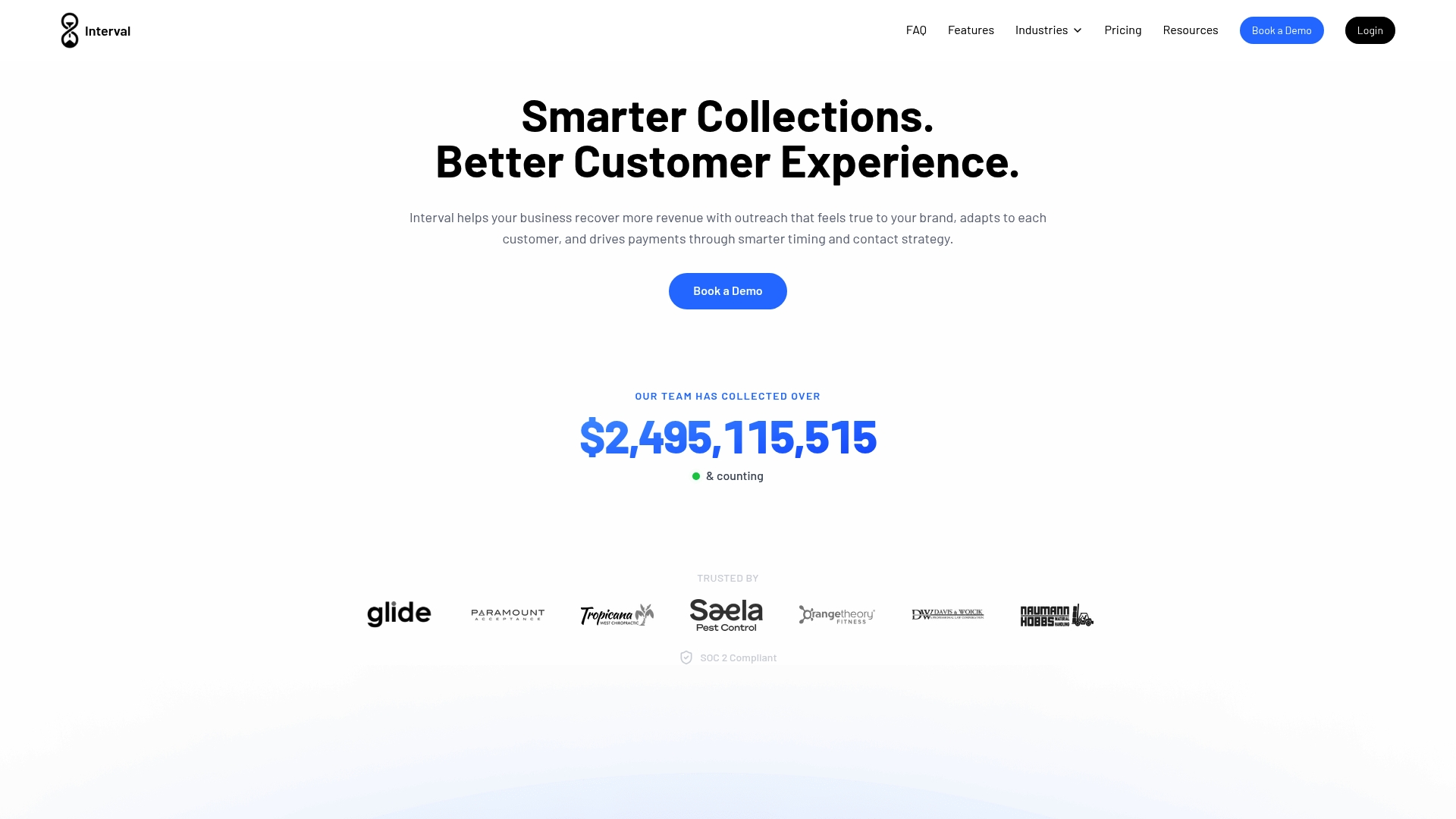
The platform integrates with your existing accounting and CRM systems, so setup does not require a long IT project. Pricing is subscription-based, scaled to your accounts receivable size and the volume of overdue customers you handle — no per-recovery fees, no agency commissions. Onboarding follows a demo, trial, and guided setup sequence so your team is running live workflows within weeks, not months.
Interval-ai claims reductions of over 30 days in days-to-payment and meaningful payroll savings for clients who previously managed collections manually. To see how those numbers translate to your portfolio, schedule a demo and bring your current DSO and overdue volume to the conversation.
Sources
- Ftc
- CGI — Collections automation workflows
- Improving cash flow with automation (AICPA-CIMA webcast)
- Strategies to improve business cash flow (Concur)
- Automation in Debt Recovery: Benefits for Your Business
- Paystand
This article is general information, not a substitute for advice from a qualified financial advisor. Consult a qualified financial professional about your own circumstances before acting on anything here.
FAQ
What are the main benefits of automated collections?
Automated collections reduces manual follow-up work, shortens DSO, raises recovery rates, and enforces compliance controls automatically. Finance teams also gain real-time cash-position visibility that manual processes cannot provide consistently.
How does automated collections work?
The system syncs invoice and customer data from your accounting and CRM systems, segments accounts by risk and balance, then fires outreach sequences by email, SMS, or phone according to rules you configure. Payments post automatically, and unresolved accounts escalate based on predefined thresholds.
Why is automating payments and collections beneficial for cash flow?
Consistent, timely outreach with embedded payment links removes friction from the payment process, so customers pay faster. Industry benchmarks suggest DSO reductions of 20–30% when electronic invoicing and automated follow-up run together.
Is automated collections effective for small and mid-sized businesses?
Yes. Automation is particularly effective for businesses with recurring billing, subscription models, or high volumes of overdue accounts, where manual follow-up creates a bottleneck. Interval-ai is designed specifically for small and mid-sized businesses that need to recover overdue payments without adding collections staff.
What compliance rules does an automated collections system need to follow?
In the United States, collections outreach is governed by the FDCPA and FTC rules, which set limits on contact frequency, require consent, and mandate recordkeeping. A compliant automated system enforces these rules at the workflow level, logging every action automatically.
