
Benefits of Early Dispute Intervention for SMB Finance Teams
Published: August 21, 2026 · 9–10 min read
Early dispute intervention recovers cash faster and keeps customers on your books. That's the bottom line: when a finance team catches a billing dispute in its first days rather than its ninetieth, invoices get paid sooner, fewer accounts get written off, and the customer relationship survives the disagreement instead of ending because of it.
Here's what backs that up:
- Accounts worked early keep more of their recovery probability intact. Once an invoice ages past 90 days, recovery probability drops roughly 10 to 15 percentage points for every additional 30 days it sits unworked.
- Waiting to act is often the reason debt becomes unrecoverable in the first place. Most bad debts turn permanent because intervention starts too late, not because the customer was unwilling to pay.
- Promise-to-pay rates and first-contact resolution both improve when outreach happens proactively instead of reactively, according to Riverty's analysis of early engagement tactics.
Key Takeaways
Early dispute intervention shortens DSO, protects recovery probability, and keeps disputed customers on your books instead of losing them to a slow, impersonal collections process.
| Point | Details |
|---|---|
| Act before 90 days | Recovery probability drops 10 to 15 percentage points every 30 days an account sits unworked past that mark. |
| Track DSO first | It's the fastest-moving KPI and predicts recovery-rate trends before they show up elsewhere. |
| Give agents real authority | First-contact resolution is more effective with staff empowered to approve credits or adjustments without escalating every case. |
| Document every exception | Undocumented deferrals let accounts drift indefinitely and turn recoverable debt into write-offs. |
| Automate with Interval-ai | Interval-ai's multichannel, brand-safe automation integrates with accounting and CRM systems and reports cutting days-to-payment by over 30 days. |
This article is general information, not a substitute for advice from a qualified financial advisor. Consult a qualified financial professional about your own circumstances before acting on anything here.
Why Early Dispute Intervention Matters for Cash Flow and Retention
The financial case for intervening early rests on four measurable outcomes, and each one connects directly to money you're either keeping or losing.
Reduced Days Sales Outstanding (DSO). Every day an invoice sits disputed and unaddressed adds to your DSO, and DSO is really just a proxy for how much of your own cash is sitting in someone else's bank account. Catching a billing question in week one instead of week eight shortens that gap dramatically.

Lower cost-to-collect and fewer write-offs. Disputes that go unresolved don't just delay payment. They eat staff time. Unresolved billing disputes can take up a significant portion of an accounts receivable team's daily workload, and that overhead compounds the longer an account drags on.
Higher PtP and right-party contact (RPC) rates. Proactive, well-timed outreach improves promise-to-pay and right-party contact rates because you're reaching the decision-maker before the invoice becomes a low priority buried under thirty other problems.
Stronger retention. A customer who gets a fair, fast explanation for a billing error often stays a customer. One who gets ignored for two months rarely does.
How Early Dispute Intervention Actually Works Day to Day
Early intervention isn't a single action. It's a sequence, and it starts before the customer even calls.
- Risk detection and triggers. Payment behavior flags, an account moving from auto-pay to manual, a support ticket tagged "billing," a sudden change in order volume. These signals tell you an account needs attention before it's 30 days overdue.
- Brand-safe outreach on the customer's preferred channel. Not every account responds to email. Some need a text, some need a portal notification, some need a phone call. Routing to the right channel is part of what reduces escalations before they start.
- Dispute triage. Every dispute gets captured, categorized (billing error, approval hold, service issue), and routed to the person actually authorized to fix it.
- Automation tied to your systems of record. Case creation, documentation retention, and escalation timing should live inside your accounting and CRM systems, not in a spreadsheet someone forgets to update.
AI-powered anomaly detection and centralized billing data reduce dispute incidence in the first place, which means fewer disputes ever reach a human at all.
Pro Tip: Route disputes by dollar value and account tenure, not just by whoever picks up the ticket first. A ten-year customer with a $200 discrepancy deserves a different response than a first-month account disputing a $12,000 invoice.
Measuring the ROI of Early Dispute Intervention
You can't manage what you don't measure, and dispute intervention gives you several clean numbers to watch.
Track these first:
- DSO (Days Sales Outstanding), your headline cash-flow indicator.
- Recovery rate, the percentage of disputed or overdue balances you actually collect.
- Dispute resolution time, from flag to close.
- Cost per dispute, staff hours plus system costs divided by disputes handled.
- PtP rate and RPC rate, how often you reach the right person and get a credible commitment.
- First-contact resolution, how many disputes close on the first interaction.
A simple ROI calculation: take your DSO reduction in days, multiply by average daily sales, and that's the cash you've freed up. If your business does $50,000 a day in revenue and early intervention cuts DSO by even five days, that's $250,000 in cash pulled forward, sitting in your account instead of a customer's.
Watch DSO first. It's the metric that tells you fastest whether your intervention program is actually working, because every other KPI eventually shows up inside it. Recovery rate lags behind because accounts lose 10 to 15 percentage points of recoverability for every 30 days they age past 90 days, so a DSO improvement today protects a recovery rate that would otherwise erode next quarter.
Building a Pilot: Steps and Timeline
You don't need to overhaul your whole receivables process on day one. Start small, prove it works, then scale.
- Pick a pilot segment. Choose high-value customers or a recurring-invoice product line where you can measure baseline DSO and dispute volume cleanly.
- Connect your systems. Integrate your accounting or ERP platform and your CRM so case creation and the audit trail happen automatically instead of manually.
- Design the process. Define your triggers, write your outreach templates, set authority limits for who can approve credits or adjustments, and document escalation gates.
- Train and assign ownership. Give front-line staff clear authority so they can resolve common disputes on first contact instead of bouncing the customer to a supervisor.
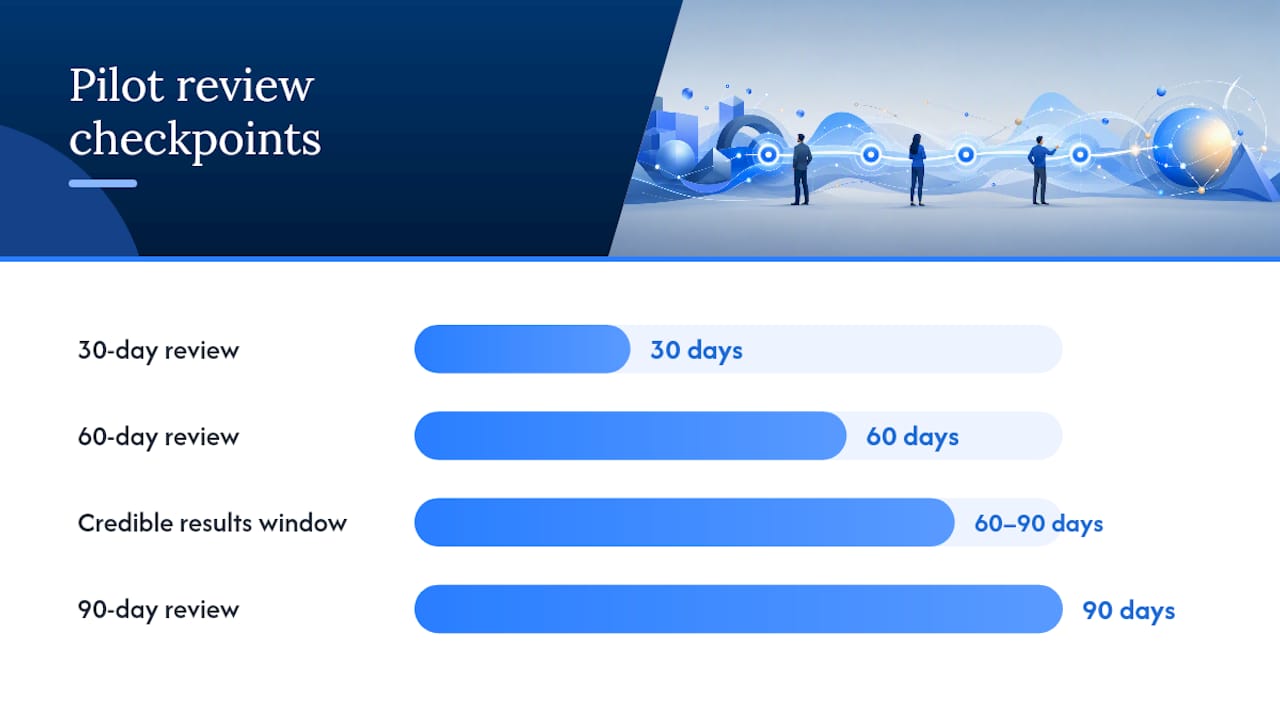
- Review at 30, 60, and 90 days. Check your pilot KPIs against baseline at each interval and adjust templates, triggers, or routing before rolling out company-wide.
Realistic expectations matter here. A pilot needs at least one full billing cycle, usually 60 to 90 days, before the DSO and recovery-rate numbers are credible. Rushing that review window gives you noise, not signal.
Documented milestones matter as much as the technology. Clear escalation protocols and milestone-based arrangements turn a vague "we'll figure it out" into a specific commitment with a date attached, which is what actually gets accounts paid.
When to Escalate: Compliance and Timing Guardrails
Early intervention has limits, and knowing when to stop working an account informally protects both your recovery odds and your compliance posture.
Escalate to formal collection or legal review when you see:
- Missing or incomplete documentation the customer can't or won't provide.
- Repeated missed promise-to-pay milestones with no credible new arrangement.
- Active avoidance: unreturned calls, ignored portal notices, no response across multiple channels.
- An account crossing 60 to 90 days without a documented, credible payment plan.
The 90-day mark isn't arbitrary. It's a common commercial threshold because recovery probability keeps falling the longer an account sits unworked past that point. Keep a clear audit trail and document every exception you grant. Undocumented deferrals are how accounts drift indefinitely, and indefinite drift is how recoverable debt becomes a write-off.
Common Mistakes That Undermine Early Intervention
Even well-intentioned programs fail for predictable reasons.
- Defaulting to the 90-day calendar. If your default policy is "we don't touch it until it's 90 days late," you've already given up 60 to 90 days of leverage.
- Letting urgency fade after the first outreach attempt. One unanswered email isn't a strategy. It's a starting point.
- Putting low-authority staff on the front line. Agents without the power to issue a credit or adjust a billing error can't resolve anything on first contact, and every re-contact adds cost and customer frustration.
- Ignoring data quality. If your billing records, contracts, and delivery confirmations aren't centralized, your team spends more time hunting for proof than actually resolving the dispute.
Best practice checklist: standardize your outreach templates so tone stays consistent with your brand, document every escalation decision, run outreach across multiple channels instead of just one, and review your KPIs on a fixed cadence, not whenever someone remembers to.
Pro Tip: Being fast isn't enough. Customers who feel genuinely heard during a billing dispute tend to stay, even if the resolution takes a day or two longer than a rushed, poorly explained fix.
Why Receivables Deserve the Same Discipline as Payroll
Predictable cash flow isn't a nice byproduct of good collections. It's what lets you make hiring decisions, negotiate better vendor terms, and avoid the panic-borrowing that eats margin. Treating dispute resolution as a governed process, not a fire you fight when the bank balance looks thin, is what separates businesses that grow steadily from ones that lurch quarter to quarter.
How Interval Puts Early Intervention on Autopilot
Building the pilot described above from scratch, triggers, templates, escalation gates, integrations, takes real time most finance teams don't have. That's the gap Interval-ai was built to close.
Interval-ai runs data-driven outreach that adjusts to each customer's payment history, sending brand-safe, multichannel communications across email, SMS, and portal without a human deciding each step manually. It connects directly to your accounting and CRM systems, so every dispute gets logged, categorized, and tracked with the same audit trail your pilot plan calls for. Clients using Interval-ai report cutting days-to-payment by more than 30 days and saving thousands in payroll costs they'd otherwise spend on manual follow-up. Those are exactly the kind of numbers worth testing against your own receivables. If your billing team is stretched thin chasing disputes that could have been caught weeks earlier, book a demo with Interval-ai and see what a pilot on your own accounts would look like. For businesses handling payment-related disputes, tools that address root causes of failed transactions are worth pairing with your outreach strategy, as covered on Demivolt's payments blog.
Sources
- Early Intervention: Prevent Aging Receivables from Write‑Offs
- Early Engagement in Debt Collection: 5 Key Advantages | Riverty
- billing dispute resolution best practices |Infosys BPM
FAQ
What Is Early Dispute Intervention?
It's the practice of flagging and addressing billing disputes or overdue invoices within days of the first warning sign, rather than waiting until an account is significantly overdue.
How Much Can Early Intervention Reduce DSO?
The exact reduction varies by business, but clients using automated platforms like Interval-ai have reported cutting days-to-payment by more than 30 days.
When Should a Dispute Escalate to Formal Collections?
Escalate when documentation is missing, promise-to-pay milestones are repeatedly missed, or an account crosses 60 to 90 days without a credible, documented payment arrangement.
What KPIs Should Finance Teams Track First?
Start with DSO, since it moves fastest and signals problems before recovery rate or cost-to-collect fully reflect them.
Can Automation Handle Dispute Triage Without Hurting Customer Relationships?
Yes, when it's designed to be brand-safe. Platforms like Interval-ai route outreach by customer preference and payment history so communications stay consistent with your brand instead of feeling like generic collections messaging.
