
How B2B AR Teams Win Payments by Calling Around Day 30
Published: August 31, 2026 · 9–10 min read
Call around the 30-day mark, and place that call late morning or early afternoon midweek. That single window converts more promises to pay than any other slot, because your customer's AP contact is at their desk, past the morning inbox triage, and not yet checked out for the weekend. Reserve email for the first two weeks past due; once an invoice crosses 30 days, a phone call gets you a real answer and, ideally, a documented payment date.
TL;DR:
- Phone calls become significantly more effective than emails around the 30-day past-due mark, as silence over two weeks indicates email is no longer enough.
- The best time to call accounts is midweek, between 10:00 to 11:30 a.m. or 1:30 to 3:30 p.m., on Tuesday through Thursday when answer rates are highest.
- Automating early reminders reduces manual workload, but human intervention is crucial for accounts over 30 days past due or involving large sums.
- Disputes must be paused and documented, with a typical resolution SLA of 5 to 10 business days, to preserve customer relationships.
- Tracking metrics like days sales outstanding and promise-to-pay conversion helps refine timing and improve collection success rates.
What Is the Best Time to Call for Collections?
The honest answer depends less on the clock than on where the invoice sits in its aging cycle. Calling too early feels aggressive and burns goodwill on an account that was probably just waiting on an approval. Calling too late means you've let a fixable cash gap turn into a write-off risk.
Here's the cadence that most AR teams converge on, and the one Interval-ai's automation is built around:
- Pre-due (3 days before to day 0): A brief email confirms the invoice, restates the amount, and includes a payment link. No call needed here.
- Early follow-up (3–7 days past due): A friendly email nudge. Most late payments at this stage are administrative, not financial.
- Second notice (14–30 days): Tone firms up. This is where you start phone attempts alongside email, since silence by day 14 usually means something other than "the invoice got lost."
- The call window (around day 30): This is the decisive point where phone contact outperforms email. A common structure is a first notice at 3–5 days, a second at roughly 15 days, and a phone call near day 30, according to one widely used collections template.
- Late-stage (45–60 days): Final written notice, paired with a credit hold discussion or a structured payment plan offer.
- Cutoff (60–90 days): Decide whether the account moves to a collections agency or gets written off. Waiting past 90 days rarely improves recovery odds.
Why switch from email to phone at day 30 specifically? Email is efficient but easy to ignore. By 30 days, a customer has had two written reminders and no consequence for silence. A phone call breaks that pattern because it requires a live response, and it lets you diagnose whether the holdup is a lost invoice, a budget freeze, or a dispute you haven't heard about yet.
Who Should You Call, and How Do You Structure the Conversation?
Start with the accounts payable contact. They process the invoice and usually know the real reason for delay. If AP gives you a vague answer twice in a row, jump to the person who originated the order or approved the purchase. Reserve the owner or CFO for accounts that are large, chronically late, or unresponsive after two failed AP conversations.
Your objective shifts by how many days past due the account is:
- 3–14 days past due: Confirm the invoice was received and is in the payment queue.
- 14–30 days past due: Diagnose the holdup. Is it a missing PO number, an internal approval delay, or a dispute?
- 30+ days past due: Negotiate a specific payment date and get it in writing, even if that writing is just a follow-up email confirming the call.
Every call needs a paper trail. At minimum, log who answered, their role, the commitment date they gave, the next action, and a timestamp. This documentation protects you if the account escalates to collections or legal review later, and it keeps your next caller from repeating the same conversation from scratch.
A short script beats a long one. Try something as direct as: "I'm calling about invoice #4521, thirty-two days past due. Can we confirm a payment date this week?" Follow-up emails should mirror that specificity, with subject lines like "Invoice #4521, confirmation of payment date requested."
Pro Tip: End every collections call with a question that requires a date, not a feeling. "When can we expect payment?" gets a real commitment. "Will you be able to pay soon?" gets a vague promise you can't hold anyone to.
When During the Day Should You Call Overdue Accounts?
Reach rates climb during two windows: 10:00 to 11:30 a.m. and 1:30 to 3:30 p.m., both on Tuesday through Thursday. Mondays get eaten by inbox catch-up and internal meetings; Fridays taper off early as attention shifts to the weekend. Early mornings before 9:30 and late afternoons after 4:30 tend to hit voicemail more than a live person.
The 30-Day Signal: Multiple collections strategy guides point to the 30-day past-due mark as the threshold where a phone call materially outperforms another email, because by that point silence has already told you email alone isn't working.
Segment your timing by customer type. A small business owner might answer their own phone at odd hours because they're wearing every hat in the company. An enterprise AP department runs on stricter internal cycles, often batching payments on set days of the month, so timing your call to land just before their batch run can matter more than the hour of day.
Don't guess when you can test. Run a simple A/B split: call half your past-due list in the late-morning window and the other half in early afternoon for a month, then compare answer rates and promise-to-pay conversion. Two variables to track:
- Percentage of calls answered live versus voicemail
- Percentage of answered calls that end with a specific payment date
When Should Outreach Be Automated, and When Does a Human Need to Step In?
Automation earns its keep in the early stages. Pre-due reminders, due-date notices, and the first follow-up email at 3–7 days are repetitive, low-emotion touchpoints that don't need a human voice behind them. Once an account crosses into mid or late stage, or once the dollar amount gets large enough to matter to your cash flow, a person needs to take over.
Set clear triggers instead of relying on memory or a spreadsheet flag:
- Days-past-due threshold: Automate through day 14; route to a human queue at day 15 or later.
- Invoice amount threshold: Any invoice above a set dollar figure skips straight to a human call regardless of aging.
- Broken promise-to-pay: If a customer misses a committed date, that account gets manual review immediately.
- Repeated-late history: Customers with three or more late payments in the past year get flagged for earlier human contact next time.
Interval-ai's approach applies these triggers automatically, tailoring send times and call scheduling based on each account's own payment history rather than a one-size-fits-all calendar. The system reportedly helps cut days to payment by more than 30 while keeping messaging consistent with a company's brand voice, so automated touches don't feel like they came from a stranger.
Pro Tip: Set a guardrail that automatically pauses outreach the second a customer replies with anything other than a payment confirmation. Nothing damages a relationship faster than an automated reminder landing in someone's inbox the same day they emailed you about a billing dispute.
How Should You Handle Disputes and Escalation?
The moment a customer raises a legitimate dispute or gives you a written promise to pay, pause the cadence. Continuing to send reminders or place calls after a dispute is logged reads as ignoring the customer, and it can damage a relationship you're trying to preserve.
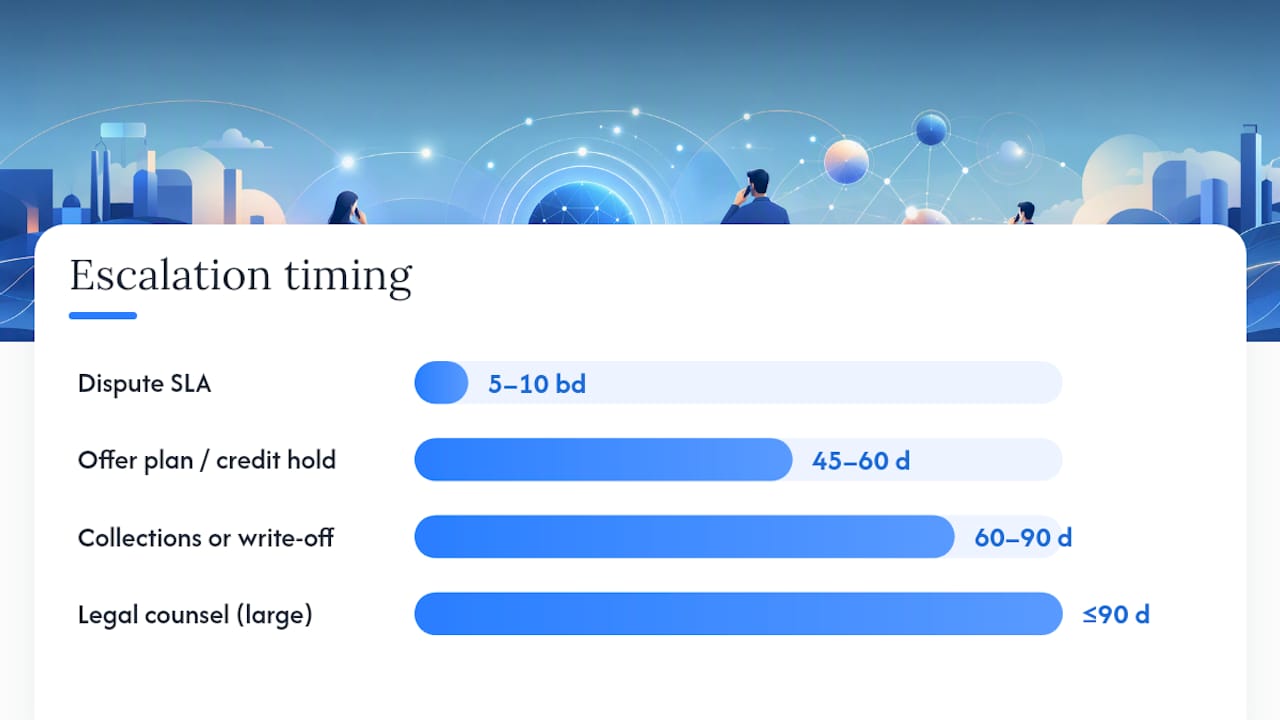
Set a dispute-resolution SLA, typically 5 to 10 business days, and require documentation from the customer, such as a discrepancy report or a copy of the disputed line item.
Escalation should scale with the stakes:
- 45–60 days, unresolved: Offer a structured payment plan or place a credit hold on new orders.
- 60–90 days, no resolution: Decide whether to refer the account to a collections agency or write it off.
- Large or complex accounts: Loop in legal counsel before the 90-day mark, not after.
What Metrics Tell You Your Timing Is Working?
Track Days Sales Outstanding (DSO), the distribution of accounts across aging buckets, promise-to-pay conversion rate, and answer rates by call window. If your 30-day call attempts are converting fewer than one in three answered calls into a firm payment date, your script or timing needs adjustment before you add more call volume.
Weekly aging reports paired with a touchpoint log let you spot accounts that need earlier phone intervention instead of another automated nudge. Run cohort analysis by customer size or industry. A staffing agency's clients may pay on a different internal cycle than a construction subcontractor's, and lumping them into one cadence hides which segment actually needs the call moved earlier.
- DSO trend (month over month)
- Promise-to-pay conversion (calls that end in a specific date)
- Touches per collected dollar (efficiency of your outreach)
What AR Teams Get Wrong About Timing
Most collections advice treats timing like a script to follow exactly, and that's the wrong frame. The 30-day call, the midweek window, the escalation ladder: these are starting points, not laws. What separates teams that recover cash fast from teams that chase it for months is whether they measure and adjust, not whether they memorized the "right" hour to dial.
Automation handles the repetitive, low-stakes touches well, but a five-figure invoice with a confused AP contact still needs a person who can read tone and adapt mid-call. The teams getting this right treat automation and human judgment as a division of labor, not a replacement. Test your own windows. Your customers might not match the averages.
— Tyler
Automate the Timing, Keep the Relationship
Interval-ai gives finance teams the option other paths can't: skip the manual guesswork of building and maintaining a cadence by hand, without handing the relationship over to a collections agency that doesn't know your brand voice. Interval-ai automates the pre-due reminders, follow-ups, and escalation timing described above, while adapting each account's contact schedule based on its own payment history.
Clients report reducing days to payment by more than 30 and saving thousands in payroll costs by removing the manual chase from their AR workflow. The system tracks touchpoints automatically, so you get the documentation trail your team needs without a spreadsheet. If your current process depends on someone remembering to make the day-30 call, see how Interval-ai's pricing works and book a walkthrough of the automation before your next aging report goes out.
Sources
- Beancount
- Past Due Invoice: Templates, Escalation Paths, and What Actually Works
- How to collect overdue invoices: templates, timing, and escalation | Rex
FAQ
What is the best time of day to call about overdue invoices?
Late morning (10:00 to 11:30 a.m.) and early afternoon (1:30 to 3:30 p.m.) on Tuesday through Thursday tend to produce the highest answer rates for collections calls.
At how many days past due should I switch from email to a phone call?
Most AR teams start phone attempts around 14 to 30 days past due, since email alone rarely moves an account that's gone silent for two weeks.
Who should make the first collections call?
Start with the accounts payable contact, then escalate to the order originator or a CFO/owner if the account remains unresponsive after two AP conversations.
Should I pause outreach if a customer disputes a charge?
Yes. Pause the cadence immediately when a legitimate dispute is raised, document the claim, and set a dispute-resolution SLA of roughly 5 to 10 business days.
Can automation replace phone calls in collections?
Automation works well for pre-due and early-stage reminders, but human calls still convert better for accounts past 30 days or above a set dollar threshold. Interval-ai combines both by automating early touches and flagging accounts that need a human call.
