
Build a Scalable AR Process Startups Can Trust

Published: August 22, 2026 · 9–10 min read
A scalable accounts receivable process comes down to three things: a repeatable workflow, clear ownership, and automation applied only where your data is already clean. Get those three right and you can grow your invoice volume tenfold without hiring a single collections specialist.
Start this week with four moves: a standard invoice template, default payment terms you enforce every time, a three-step collections cadence, and a weekly review of your aging buckets. Track Days Sales Outstanding (DSO) from day one. It's the single number that tells you whether your process is working or quietly falling apart.
- Standard invoice template with required fields (PO number, terms, due date)
- Default payment terms applied consistently, not negotiated case by case
- Three-step collections cadence: pre-due reminder, due-day notice, overdue escalation
- Weekly aging review sorted into 0-30, 31-60, 61-90, and 90+ day buckets
Quick benchmark: Startups that standardize invoicing and follow-up cadence typically see DSO drop by 8 to 14 days within a few months, without adding a single hire to the finance team.
Key Takeaways
A scalable AR process depends on standardized invoicing, one owner per workflow step, and automation applied only after your data and terms are clean.
| Point | Details |
|---|---|
| Fix invoicing first | Standardize fields, terms, and payment options before automating anything. |
| Assign named owners | Give invoicing, collections, disputes, and cash application each an owner and SLA. |
| Pilot before scaling automation | Test reminders and cash-application rules on one segment for 90 days. |
| Track five core metrics | Monitor DSO, CEI, unapplied cash rate, dispute rate, and aging distribution weekly. |
| Consider Interval for outreach | Interval automates brand-consistent collections outreach, with clients reporting DSO drops of over 30 days. |
Why Your AR Process Won't Scale
Unmanaged accounts receivable doesn't stay a bookkeeping annoyance. As invoice volume grows, it turns into a runway risk. What worked when you sent 15 invoices a month falls apart at 150, and by then the cash gap is already affecting hiring decisions.
Watch for these warning signs. Invoices go out whenever someone remembers, not on a fixed schedule. Follow-ups depend on one person's memory of who owes what. Payment terms shift customer to customer because nobody wrote down a standard. And leadership has no visibility into aging buckets, so a slow quarter looks like a sales problem when it's actually a collections problem.
Top-quartile accounts receivable operations run DSO in the 20 to 25 day range with a Collections Effectiveness Index above 90%. Startups without a defined process often run double that, and the gap comes from process choices, not customer quality.
That gap shows up fast in a board meeting. A founder who thought they had six months of runway discovers three of those months are sitting in unpaid invoices, and now a hiring decision has to wait.
How to Build a Scalable AR Process in 4 Steps
Answer first: fix your inputs before you fix your follow-up. Most AR breakdowns start upstream, with sloppy invoices and vague terms, not with a lazy collections effort.

Step 1: Standardize the upstream basics
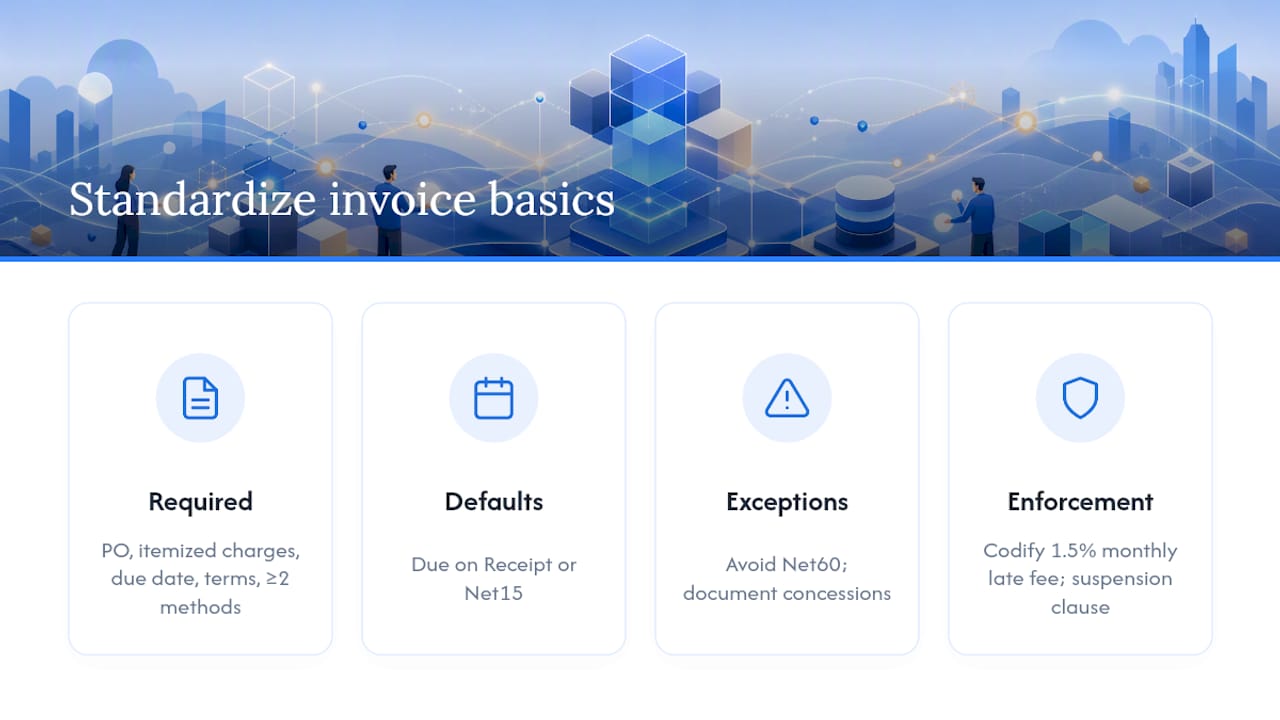
Every invoice should include the same fields every time: PO number if applicable, itemized charges, payment terms, due date, and at least two payment methods. For early-stage companies, default to Due on Receipt or Net 15 rather than the Net 60 terms sales reps love to offer to close a deal. Longer terms should be a documented concession, not a default. Codify a late fee, something like 1.5% monthly, and a service-suspension clause for accounts that go dark.
Step 2: Define who follows up, when, and how
Collections speed comes down to consistency of contact, not heroic effort from one overworked person. Assign a named owner for outreach, set a fixed cadence, and pick channels in advance instead of improvising per account.
A workable cadence looks like this:
- Three days before due date: Automated email reminder, friendly tone, invoice attached
- Due date: Second reminder confirming the amount and payment link
- 7 days overdue: Personal outreach from the account owner, phone or email
- 21 days overdue: Escalation to a manager with a firm deadline and consequence stated
- 45 days overdue: Formal notice referencing late fees or service pause
Pre-due template tone: Friendly, informational, no pressure. Due-day template tone: Neutral, confirms the ask, includes a direct payment link. Overdue template tone: Direct, states the amount and consequence, offers a resolution path.
Step 3: Pilot automation on a defined segment
Pick one customer segment, maybe your smallest 30% by invoice size, and automate reminder emails and invoice delivery for 90 days. Don't automate everything at once. Set success criteria before you start: DSO improvement of at least 5 days, no increase in disputes, and positive or neutral customer feedback.
Step 4: Roll out governance and connect AR to your forecast
Once the pilot clears its acceptance criteria, expand the workflow and feed your AR aging data directly into your cash-flow forecast. Treat expected receipts by due date, weighted by collection probability, as a live input rather than a static line item. This is where a documented, step-by-step AR process covering onboarding through reconciliation earns its keep. It gives you one source of truth instead of five spreadsheets that disagree with each other.
When Should You Automate Your Collections Process?
Automate the repeatable, low-judgment tasks, and only after your invoice quality and payment terms are already standardized. Automating a messy process just produces mistakes faster.
The clearest wins come from:
- Electronic invoice delivery timed to the day of shipment or service completion
- Reminder sequences for pre-due, due, and overdue stages
- ACH and card payment links embedded directly in invoices
- Cash-application rules that auto-match incoming payments to open invoices
A reasonable threshold for investing in automation: once you're issuing more than 50 invoices a month, or unapplied cash incidents are eating more than an hour of someone's week, the manual approach is costing you more than a tool would. Below that volume, a clean manual process with a good spreadsheet often outperforms a half-configured automation platform.
On the technical side, look for a connected data model where billing, collections, payments, and cash application share the same live feed rather than nightly batch exports. Zuora's architecture guidance frames this as a single AR subledger, which matters because reconciliation gets exponentially harder when your billing system and your bank feed disagree about what's outstanding.
Pro Tip: Pilot cash application automation before reminder sequences. Matching incoming payments automatically to open invoices reduces unapplied cash fast, and it proves the ROI case before you touch anything customer-facing.
What Metrics Actually Tell You AR Is Working?
Track five numbers: DSO, Collections Effectiveness Index (CEI), unapplied cash rate, dispute rate, and aging distribution across your buckets. Each one answers a different question, and together they tell you whether the whole system is healthy or just looks busy.
- DSO: Average days to collect payment. Early-stage startups should aim under 30; scaling companies chasing enterprise contracts may run higher but should trend down over time.
- CEI: Measures how much of what's collectible actually gets collected in a period. Above 80% is solid; top performers clear 90%.
- Unapplied cash rate: Payments received but not matched to invoices. Rising numbers signal a cash-application problem before it shows up anywhere else.
- Dispute rate: High dispute rates usually point back to invoice quality, not customer behavior.
- Aging distribution: Weekly review by finance; monthly summary to leadership; quarterly trend to the board.
Wire these into your forecast by weighting expected receipts by collection probability per bucket, not treating every open invoice as equally likely to land on time.
Who Owns Each Step of the Collections Process?
Assign named owners for invoicing, collections, disputes, and cash application, each with a service-level agreement. One person "handling AR when they have time" is how the process breaks the moment that person goes on vacation.
Exception workflows need the same rigor: extended terms require written approval, payment plans need documented schedules, and disputed invoices get logged with a resolution deadline. When sales hands off a new account to finance, a brief handoff note on negotiated terms prevents the collections team from damaging a relationship sales just built.
Keeping AR Data Secure as You Scale
Accounts receivable data includes customer banking details, payment history, and sometimes credit information, which makes it a compliance concern the moment you automate outreach across more customers. As invoice volume grows, so does your exposure if that data isn't handled correctly.
Any platform touching payment data should support PCI DSS compliance for card transactions and encrypt data both in transit and at rest. If you're collecting from customers across state or national lines, check that your provider supports region-specific regulations around debt communication, since rules on contact frequency and required disclosures vary by jurisdiction.
Access control matters as much as encryption. Not everyone on your finance team needs to see every customer's full payment history, and not every integration partner needs write access to your AR subledger. Limit permissions by role, and audit who has access quarterly, not annually.
Integrations introduce their own risk. Every connection between your invoicing tool, your CRM, and your payment processor is a potential point of failure or data leak. Favor providers that use established authentication standards like OAuth over static API keys, and confirm that any automated outreach tool you adopt keeps a clear audit trail of every customer communication. That trail protects you if a dispute ever escalates to a legal question.
Why Repeatable Workflows Beat Individual Effort
The startups that scale AR successfully never had a superstar collector. They had a process that worked the same way whether the founder was watching or not. Interval's data-driven approach to outreach reflects that same principle: consistency, not heroics, closes the DSO gap.
A Faster Path to Getting Paid on Time
If your team is stretched thin managing follow-ups manually, Interval is worth a look as the automation layer once you've standardized your invoicing and terms. It's built specifically for startups and SMBs that want AI-driven outreach without losing their brand voice or hiring a collections specialist.
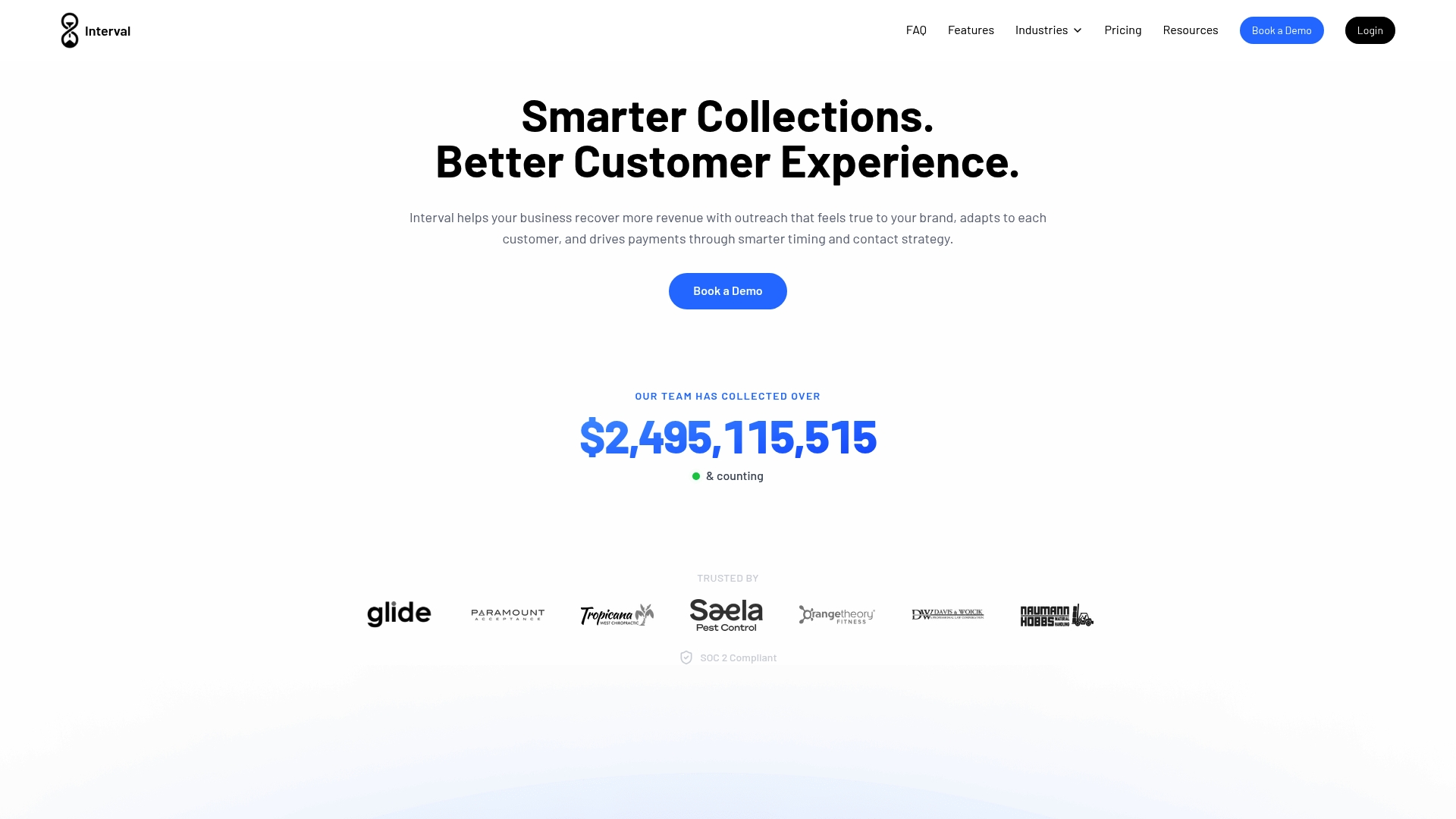
Interval's data-driven approach tailors outreach based on each customer's payment history, and clients report reducing time to payment by more than 30 days while saving thousands in payroll costs they'd otherwise spend on manual follow-up. For situations where your team needs extra hands during a transition, pairing automation with support from a resource like Patricia Barrios can cover the gap while your process matures.
Ready to see it on your own invoices? Book a demo through the Interval landing page and get a walkthrough of how the collections cadence maps to your current AR data.
Sources
- Startup Accounts Receivable Benchmarks 2026 | Stealth Agents
- Accounts Receivable Guide for Startups | Collect Cash Faster
FAQ
What Is a Scalable AR Process?
A scalable AR process is a repeatable system of standardized invoicing, defined collections ownership, and selective automation that handles growing invoice volume without adding staff.
How Long Should Payment Terms Be for a Startup?
Early-stage startups should default to Due on Receipt or Net 15, treating longer terms as a documented exception rather than a standard offer.
What DSO Is Considered Good for a Startup?
Top-quartile operations run DSO between 20 and 25 days; startups without a defined process often run well above that.
When Should a Startup Automate Collections?
Automation typically pays off once you're issuing more than 50 invoices a month or spending significant time weekly fixing unapplied cash, and only after your invoice data is clean.
Can AI Tools Like Interval Replace a Collections Hire?
Interval automates outreach across the collections cadence while preserving brand tone, and clients report payment timelines shortening by more than 30 days without adding headcount.
