
Call an ARM or Use AI Collections? A Decision Guide
Published: August 8, 2026 · 5–6 min read
TL;DR:
- Most small and mid-sized U.S. businesses should use AI-powered collections platforms for high-volume overdue accounts and contact traditional agencies only for complex, high-value cases. AI platforms recover faster and at lower costs, while traditional agencies excel at legal escalation and complex negotiations. Starting with AI and escalating specific accounts to a traditional ARM after 60 days optimizes recovery and resource use.
For most small and mid-sized U.S. businesses managing overdue accounts, the right call is straightforward: use an AI-powered collections platform for high-volume, everyday delinquencies, and call a traditional ARM (accounts-receivable management agency) only when an account needs legal escalation or bespoke negotiation. If your portfolio has dozens or hundreds of overdue customers, automation recovers more, faster, and at lower cost. If you have a handful of large, legally sensitive accounts, a human negotiator earns their fee.
Quick decision guide:
- High volume, moderate balances, brand matters: AI-first platform (Interval-ai)
- Low volume, high value, litigation likely: Traditional ARM
- Mixed portfolio: Start with AI, escalate select accounts to an ARM
Interval claims to reduce days-to-payment by over 30 days while saving payroll costs, all within FDCPA and TCPA compliance boundaries. Those two federal laws govern every collections contact in the U.S., whether a human or an algorithm sends it.
How do traditional ARM agencies and Interval compare?
| Dimension | Interval (AI-powered) | Traditional ARM (collections agency) |
|---|---|---|
| Best for | High-volume overdue accounts, brand-sensitive outreach | High-value, legally complex, or litigious accounts |
| Pricing model | Subscription SaaS (based on AR size and volume) | Contingency fee (% of recovered amount) |
| Time to payment | Faster; automated follow-up starts immediately | Slower; human scheduling and case assignment |
| Brand control | High; tone and messaging stay consistent | Low to moderate; agency controls contact style |
| Recovery effectiveness | Strong at scale; data-driven sequencing | Strong for complex negotiations; legal leverage |
| Staffing impact | Minimal; no additional headcount needed | Requires internal handoff coordination |
| Compliance & legal risk | Built-in FDCPA/TCPA controls | Varies by agency; verify certifications |
| Integrations | QuickBooks, Xero, major CRMs | Manual or limited; varies by agency |
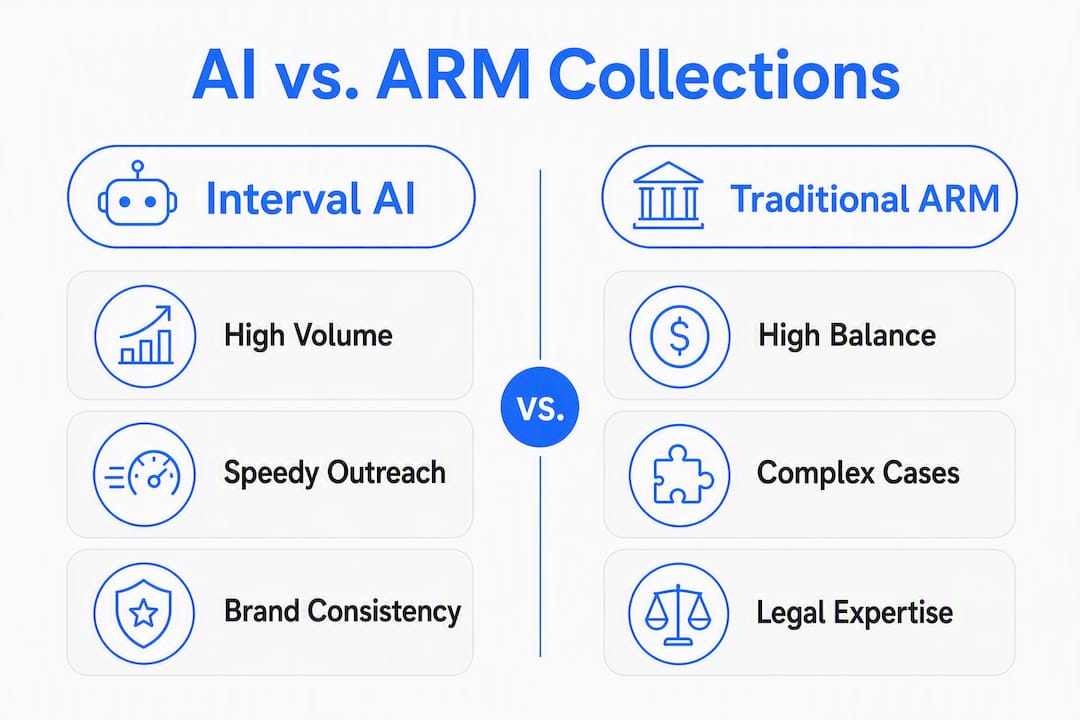
Traditional ARM agencies bring real muscle when an account has gone silent for months, the balance is large, or a lawsuit is on the table. For everything else, the contingency model means you pay a percentage of every dollar recovered, which adds up fast across a large portfolio. An AI platform like Interval-ai runs on a predictable subscription, keeps your brand voice intact, and handles multichannel outreach automatically.

Pro Tip: Start with AI-driven outreach for your full overdue portfolio. After 60 days, flag accounts with no response and balances above your threshold for ARM escalation. You capture the scale advantage of automation while preserving human expertise for the accounts that genuinely need it.
When should you call an ARM, and when should you rely on AI?
Pros of calling a traditional ARM:
- Legal escalation capability, including attorney referrals and litigation
- Experienced negotiators for high-balance, relationship-sensitive accounts
- Useful when your internal team has no bandwidth for any collections work
Pros of AI-first collections:
- Automated outreach across email, SMS, and other channels without adding staff
- Consistent, brand-aligned messaging at any volume
- Real-time tracking, dispute handling, and payment method updates
- Predictable monthly cost vs. contingency fees that scale with recovery
Cons and risks to weigh:
- Traditional ARM: Loss of brand control, contingency fees reduce net recovery, slower start
- AI platform: Less suited for legally complex accounts requiring negotiation or court filings
Three concrete triggers to help you decide:
- A significant portion of your accounts receivable is overdue and accounts are spread across many customers: AI automation handles the volume without burning staff time.
- Average balance is high and the customer has gone silent for a prolonged period: a human negotiator or legal escalation is worth the cost.
- Dispute rate is high: AI platforms with built-in dispute management (like Interval-ai) resolve routine disputes automatically; only genuinely contested accounts need ARM involvement.
Before engaging either option, align your data first. Clean customer contact records, current payment methods, and documented dispute history prevent missed recoveries and compliance failures down the line. FDCPA limits contact frequency and requires specific disclosures; TCPA governs automated calls and texts. Any platform or agency you use must document how they handle both.
For integrations, confirm your collections tool connects to QuickBooks, Xero, or your primary CRM before you sign anything. A clean data handoff is what separates a smooth pilot from a messy one.
Interval-ai is worth piloting before you commit to an agency
Skipping a contingency fee and keeping your brand voice intact are two concrete reasons to try Interval-ai before signing with a collections agency. A 30–90 day pilot on a sample segment of your overdue accounts gives you real data: days-to-payment, dollars recovered, and staff hours saved.
When you talk to sales, ask for a compliance statement covering FDCPA and TCPA, a full integration list (QuickBooks, Xero, your CRM), and their data handling and security documentation. Those three items tell you whether the platform is ready for your business or still a work in progress.
Start a pilot with Interval-ai and measure the results against your current recovery rate before committing to an agency contract.
FAQ
What does "call ARM" mean in a collections context?
"Call ARM" refers to engaging an accounts-receivable management agency to handle overdue accounts on your behalf, typically through phone outreach, letters, and legal escalation when needed.
When is an AI collections platform better than a traditional ARM?
AI-first platforms like Interval-ai are better for high-volume, moderate-balance portfolios where speed, brand consistency, and cost predictability matter more than legal escalation.
How does Interval-ai stay compliant with FDCPA and TCPA?
Interval-ai builds FDCPA and TCPA controls directly into its outreach workflows, managing contact frequency, required disclosures, and consent requirements automatically.
What integrations should I confirm before starting a collections pilot?
Confirm connections to your accounting software (QuickBooks or Xero) and your primary CRM before onboarding, so payment data and customer records stay synchronized without manual work.
Can I use both an ARM and an AI platform at the same time?
Yes. A hybrid workflow, where AI handles broad outreach and an ARM takes over legally complex or unresponsive high-value accounts, captures the advantages of both approaches.
Key Takeaways
For most U.S. businesses, AI-powered collections handles the majority of overdue accounts faster and at lower cost than a traditional ARM, which should be reserved for legally complex or high-value cases.
| Point | Details |
|---|---|
| AI-first for volume | Use an AI platform when overdue accounts are numerous and balances are moderate. |
| ARM for legal escalation | Call a traditional ARM when accounts need negotiation, litigation, or legal leverage. |
| Compliance is non-negotiable | Any collections approach must document FDCPA and TCPA adherence before outreach begins. |
| Prep your data first | Clean contact records and dispute history before onboarding either solution. |
| Interval-ai reduces days-to-payment | Interval-ai claims a reduction of over 30 days to payment, with payroll savings and no added headcount. |
This article is general information, not legal or financial advice. Confirm current FDCPA and TCPA requirements with a qualified attorney or the Consumer Financial Protection Bureau for your specific situation.
