
Cash Flow Management for Growth-Stage Companies
Published: August 12, 2026 · 18–19 min read
Build a rolling 13-week cash forecast, run it weekly, and attack your accounts receivable before anything else. That single combination does more to stabilize cash flow management for growth-stage companies than any other action you can take in the next 72 hours.
Your immediate checklist (next 24–72 hours):
- Pull your AR aging report and call every account more than 30 days overdue today.
- Pause all non-critical discretionary spend pending a budget review.
- Confirm your current runway in days: cash on hand ÷ average monthly burn.
- Set up or update a 13-week rolling cash forecast with actual bank balances as the starting point.
- Identify your three largest upcoming outflows and confirm their exact due dates.
Escalate immediately if you see any of these signals:
- Days Sales Outstanding (DSO) rising week over week for three or more consecutive weeks
- Runway dropping below 90 days with no financing in place
- A single customer representing a significant portion of outstanding AR with a payment overdue
Key Takeaways
Effective cash flow management for growth-stage companies requires a rolling 13-week forecast, disciplined AR follow-up, and a clear runway threshold that triggers action before a shortfall becomes a crisis.
| Point | Details |
|---|---|
| Build a 13-week forecast | Update weekly with actual bank balances, AR timing, and AP due dates. |
| Protect a 90-day runway floor | When runway drops below 90 days, activate your contingency plan immediately. |
| Attack AR first | Contact every account over 30 days overdue within the first week of your plan. |
| Segment vendors, extend terms | Prioritize critical vendors and negotiate net-45 or net-60 with negotiable ones. |
| Interval-ai for collections | A 60–90 day pilot on overdue AR can reduce days to payment by over 30 days. |
1. Why cash flow is uniquely fragile at the growth stage
Growth creates a structural timing problem. When you hire ahead of revenue, stock inventory before orders arrive, or spend on customer acquisition before those customers pay, you are funding a gap between outflows today and inflows tomorrow. NetSuite explains that cash flow management tracks actual money in and out, not profit, and recommends keeping reserves equal to roughly three to six months of operating expenses.
The confusion between profitability and cash is where most growth-stage companies get into trouble. You can show a healthy income statement while your bank account is nearly empty. A $500,000 contract booked in March does not help you make payroll in April if the customer pays on net-60 terms. That gap is working capital risk, and it compounds as you scale.
Common triggers that widen the gap:
- Rapid headcount growth where payroll runs every two weeks but new revenue takes 60–90 days to collect
- Inventory buildup ahead of a product launch or seasonal peak
- Customer acquisition costs paid upfront while subscription or service revenue arrives monthly
- Vendor payment terms that are shorter than your customer payment terms
- Unexpected seasonality that compresses revenue into a few months while fixed costs run year-round
Robert Half notes that building a cash-flow culture, where finance, sales, and operations share visibility, is a genuine competitive advantage. When your sales team knows that a net-90 deal creates a cash problem, they negotiate differently.
2. How to build a rolling cash-flow forecast that actually works
Use a rolling 13-week forecast updated every week for immediate liquidity management, paired with a monthly medium-term view for strategic decisions. You Need A CFO argues that forecasting loses value when treated as a finance-only, monthly exercise. When it is operationally connected and updated frequently, it becomes a leadership tool.
Step-by-step forecast construction:
- Starting cash: Pull the actual bank balance as of Monday morning, every week.
- Inflows: List every expected receipt by the date you realistically expect it to land, not the invoice date. Use AR aging and historical payment behavior to estimate timing.
- Outflows: Map every payment by its actual due date: payroll, rent, vendor invoices, debt service, taxes.
- One-off items: Flag large non-recurring items (equipment purchases, tax payments, annual insurance premiums) in their own row so they do not distort the weekly picture.
- Net cash position: Calculate the running balance after each week's inflows and outflows.
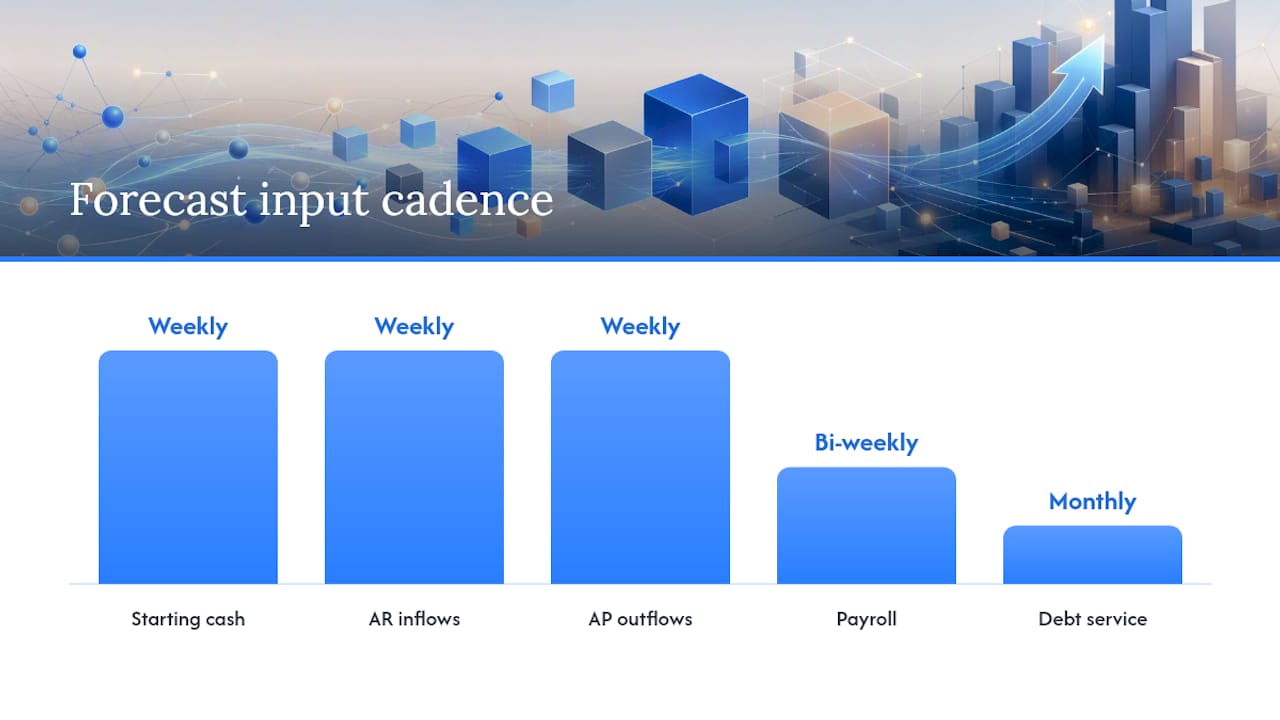
Where to pull each data input:
| Input | Source | Update frequency |
|---|---|---|
| Starting cash | Bank account (live feed or Monday pull) | Weekly |
| AR inflows | AR ledger, aged by expected payment date | Weekly |
| Payroll | Payroll calendar | Bi-weekly or per cycle |
| AP outflows | AP aging report, sorted by due date | Weekly |
| Debt service | Loan amortization schedule | Monthly |
| One-off items | Budget calendar, CFO notes | As scheduled |
Scenario planning: Build three versions of the same 13-week forecast: a base case using your most likely collection timing, a best case where all AR pays on time, and a downside case where your two largest customers pay 30 days late. The gap between base and downside tells you how much credit capacity you need to hold in reserve.
Bank of America recommends tracking cash flow weekly or monthly and using those forecasts to plan for payroll, taxes, and seasonal changes before they arrive as surprises.
Runway threshold to act on: When your base-case forecast shows runway below 90 days, activate your contingency plan. That means drawing on your credit line, accelerating collections, and pausing discretionary hiring, not waiting to see if things improve.
3. Accounts receivable tactics that accelerate cash without losing customers
The fastest cash you can access is already owed to you. Prioritize AR actions in this order: invoice the same day work is delivered, send automated reminders on a consistent schedule, and offer multiple payment methods so customers have no friction excuse.
Collections cadence that works:
- Day 1: Invoice sent immediately upon delivery or milestone completion
- Day 7: Friendly reminder if unpaid (automated)
- Day 21: Second reminder with a clear payment link
- Day 35: Personal call or email from the account owner
- Day 45: Escalation to a senior contact or collections process
Silence reads as permission to wait. Customers who receive no follow-up after day 7 will deprioritize your invoice in favor of vendors who do follow up.
Tactics that move cash faster:
- Require a deposit (25–50%) before starting work on new or high-value engagements
- Structure contracts with milestone billing rather than single end-of-project invoices
- Offer an early-payment discount (typically 1–2%) for payment within 10 days
- Accept ACH, credit card, and digital wallets, not just checks
- Give customers a self-service payment portal so they can pay at 9 PM on a Sunday
- Automate reminder sequences so no invoice falls through the cracks
That is expensive. Offer the discount only when the cash acceleration is worth more than the margin you give up, or when a customer is chronically late.*
Jumpstart Partners recommends accelerating inflows as the first of three core levers, with a focused 90-day plan to create momentum. The fastest operational win is issuing invoices immediately after delivery and automating consistent follow-up to reduce DSO.
4. How to manage accounts payable to buy time and capture discounts
Segment your vendors before you do anything else. Not every supplier deserves the same payment priority, and treating them identically wastes both cash and negotiating leverage.
Vendor segmentation:
- Critical vendors: Suppliers whose disruption would stop your operations (key software, sole-source materials, payroll processor). Pay these on time, every time.
- Negotiable vendors: Suppliers with whom you have a strong relationship and volume leverage. Request extended terms (net-45 or net-60 instead of net-30) in exchange for consistent on-time payment.
- Flexible vendors: Smaller or non-critical suppliers. Stretch payment to the last day of terms without penalty.
NetSuite notes that segmenting vendors by strategic importance lets you selectively prioritize payments while negotiating extended terms where the relationship and margin allow, preserving supply continuity while improving short-term cash.
Run this math before every discount decision.
Practical AP controls:
- Use virtual cards or scheduled ACH remittances to control the exact payment date
- Batch payments on a weekly schedule (Tuesdays, for example) rather than paying invoices as they arrive
- Set up staged payment agreements with larger vendors during cash-constrained periods
- Review recurring subscriptions and software licenses quarterly and cancel anything unused
5. Operational levers: pricing, inventory, and expense control that free up cash
The fastest operational wins are pricing adjustments and inventory turn improvements. Both can release meaningful cash within 30–60 days without requiring outside financing.

Inventory management:
Calculate your inventory turnover ratio: Cost of Goods Sold ÷ Average Inventory. A ratio of 4 means you turn inventory every 90 days. If your payment terms to suppliers are net-30 but you hold inventory for 90 days, you are financing 60 days of inventory yourself. Tighten reorder points to reduce that gap.
Set reorder points based on lead time demand plus a safety stock buffer, not on gut feel or "order when it looks low." Overstocking ties up cash in goods sitting on shelves. Understocking creates rush orders at premium prices. Neither is free.
Spend governance checklist:
- Set approval thresholds: any expense above $500 requires manager sign-off; above $5,000 requires CFO approval
- Run a monthly recurring-expense review to catch zombie subscriptions and auto-renewals
- Freeze discretionary travel and entertainment when runway drops below 120 days
- Require a business case for any new vendor relationship above $1,000 per month
Pricing and packaging moves that improve cash:
- Shift monthly billing to annual prepaid plans with a modest discount (10–15%). Annual prepays convert future revenue into immediate cash.
- Introduce a faster-delivery or priority-service tier at a premium price point.
- Review your lowest-margin service lines and either reprice them or discontinue them.
- Test a small price increase (5–8%) on your highest-demand offerings. Even modest increases on high-volume lines generate disproportionate cash improvement.
6. Financing options for growth companies: costs, timing, and when to use each
Prefer a revolving line of credit for predictable, recurring shortfalls. Use invoice financing selectively when you have a specific large receivable you need to convert immediately. Avoid merchant cash advances except as a last resort.
Financing instruments and when to use them:
-
Revolving line of credit: Best for bridging predictable timing gaps (payroll before collections). Typically takes 2–4 weeks to establish; draw and repay as needed. Cost: prime rate plus a spread, generally 7–12% annually for creditworthy businesses. Requires clean financials and a 13-week forecast when you apply.
-
Invoice financing / factoring: Converts a specific outstanding invoice into immediate cash (typically 80–90% of face value upfront). Best for a single large AR balance with a creditworthy customer. Cost: 1–5% of invoice value per month, which is expensive if held long. Time to fund: 24–72 hours once set up.
-
SBA loans (7a or 504): Lower cost (prime plus 2.25–2.75% for 7a loans), but slow. Approval takes weeks to months. Best for capital expenditures or long-term working capital, not immediate shortfalls.
-
Short-term business loans: Faster than SBA (1–2 weeks), higher cost. Use for a specific, defined need with a clear repayment source.
-
Revenue-based financing: Repayment tied to a percentage of monthly revenue. Useful for SaaS or subscription businesses with predictable recurring revenue. Cost varies widely.
SVB describes how integrated cash-management platforms that combine banking, spend management, and liquidity options help reduce burn and extend runway for growing companies.
Decision triggers:
- Runway below 90 days with no near-term revenue catalyst: open a credit line now, before you need it
- A single large invoice more than 45 days overdue representing more than 15% of monthly revenue: consider invoice financing
- Upcoming payroll or large CapEx with insufficient cash coverage: draw on existing credit line
Before you talk to a lender, prepare:
- Your 13-week rolling cash forecast
- AR aging report (current)
- A one-paragraph description of exactly what the funds will be used for and how they will be repaid
7. Which tools give you real-time cash visibility?
Integrated accounting plus bank connectivity plus AR automation gives the fastest visibility wins. J.P. Morgan recommends using dedicated cash-flow tools to automate data collection, improve forecasting accuracy, and support financing conversations.
Tool recommendations by company size and need:
- QuickBooks Online: Best for SMBs under $5M in revenue. Strong bank connectivity, basic cash-flow reporting, and a large ecosystem of integrations. Pairs well with Bill.com for AP automation.
- FreshBooks: Suited for service businesses and freelancers. Clean invoicing, time tracking, and payment collection in one place. Less robust for complex multi-entity reporting.
- Bill.com: Purpose-built for AP and AR automation. Automates invoice processing, approvals, and payments. Integrates with QuickBooks and NetSuite. Best for companies spending significant time on manual payment processing.
- NetSuite: Mid-market to enterprise ERP with native cash-flow dashboards, multi-entity consolidation, and real-time reporting. Implementation takes longer and costs more, but the visibility payoff is significant for companies above $10M in revenue.
- Bluevine: A business banking platform with built-in line of credit access, high-yield checking, and payment tools. Particularly useful for growth-stage companies that want banking and credit in one place.
- J.P. Morgan Cashflow360: A treasury and cash-management solution for mid-market and larger companies. Centralizes cash positioning across accounts, automates payments, and integrates with ERP systems.
- SVB cash management: SVB offers cash-management accounts, sweep accounts, and working capital tools designed specifically for venture-backed and growth-stage companies. Their platform connects banking with spend management and credit.
Integration criteria to evaluate any tool:
- Direct bank feed connectivity (not manual CSV imports)
- AR and AP sync with your accounting system
- Automated payment reminders and collections workflows
- Reporting API for custom dashboards
- Role-based access so your CFO, controller, and CEO each see the right level of detail
Implementation timeline: Expect 2–4 weeks for a QuickBooks or FreshBooks setup with bank connectivity. Bill.com integration with an existing accounting system typically takes 3–6 weeks. NetSuite implementations run 3–6 months. Start with the simplest tool that covers your current needs and migrate up as complexity demands it.
8. Evidence summary: how automation in collections moves cash
Vendor and industry reports consistently show that automation reduces DSO and cuts administrative cost, but you should validate those claims against your own AR mix before committing to a full rollout. The right approach is a time-boxed pilot with clear baseline metrics.
Robert Half highlights that automating routine finance tasks gives SMBs an operational advantage and moves teams from manual work to strategic scenario planning. Interval-ai, for example, claims to reduce days to payment by over 30 days and reports that clients save thousands in payroll costs by eliminating manual collections work.
Pilot metrics template (run for 60–90 days):
Caveat: Vendor-reported outcomes reflect their best-case customers. Your results will depend on your customer mix, invoice size, and current DSO baseline. Run the pilot on a defined segment (say, invoices 30–60 days overdue) before expanding to your full AR book.
Jumpstart Partners notes that short pilots of 30–90 days focused on AR automation provide measurable ROI and a defensible case for broader rollout.
9. Key metrics, reporting cadence, and how leadership should use them
Track DSO, DPO, cash conversion cycle (CCC), runway in days, burn rate, and weekly cash variance. Each metric belongs on a specific reporting cadence, and each one should trigger a defined leadership response when it crosses a threshold.
Core metrics with formulas and target ranges:
| Metric | Formula | Target range (growth stage) | Reporting cadence |
|---|---|---|---|
| DSO | (AR ÷ Revenue) × Days in period | 30–45 days | Weekly |
| DPO | (AP ÷ COGS) × Days in period | 45–60 days | Monthly |
| CCC | DSO + Inventory Days – DPO | As low as possible | Monthly |
| Runway | Cash on hand ÷ Monthly burn | 6–12 months | Weekly |
| Burn rate | Net cash used per month | Declining trend | Monthly |
| Weekly cash variance | Forecast vs. actual cash | Within ±5% | Weekly |
How leadership should act on thresholds:
- Runway > 12 months: Invest in growth; hire, market, expand.
- Runway 6–12 months: Maintain current trajectory; monitor weekly.
- Runway 3–6 months: Slow discretionary hiring; accelerate collections; open credit facility.
- Runway < 90 days: Activate contingency plan; pause all non-essential spend; consider bridge financing.
Reporting cadence recommendations:
- Weekly: 13-week rolling forecast update, cash variance review, DSO check
- Monthly: Full P&L, balance sheet, CCC calculation, burn rate trend
- Quarterly: Strategic cash planning, financing review, scenario modeling for next 12 months
10. Your 30/90-day cash action plan
Weeks 1–4 focus on immediate cash collection and cost control. Weeks 5–12 refine forecasting, vendor terms, and pilot automation. You Need A CFO confirms that operationally connected forecasting with frequent updates is the foundation of this kind of plan.
Weeks 1–4: Immediate actions
- Build or update your 13-week rolling cash forecast (owner: CFO or finance lead; success: forecast live by end of week 1).
- Pull AR aging and contact every account over 30 days overdue (owner: AR manager; success: 100% of overdue accounts contacted by day 5).
- Pause all discretionary spend above $500 pending review (owner: CFO; success: spend freeze confirmed in writing to all budget holders).
- Confirm your credit line availability or begin the application process (owner: CEO/CFO; success: credit capacity confirmed or application submitted).
- Segment vendors and identify two to three where you can request extended terms (owner: finance lead; success: outreach sent to target vendors by end of week 3).
Weeks 5–12: Refinement and automation
- Implement automated invoice reminders for all open AR (tool: Bill.com, QuickBooks, or dedicated AR automation)
- Negotiate extended payment terms with at least two non-critical vendors
- Launch a 60-day collections automation pilot on your 30–60 day overdue segment
- Review pricing on your top three service or product lines for potential adjustment
- Establish a weekly cash huddle (30 minutes, every Monday morning)
Quick templates:
Customer collection email (day 21): "Hi [Name], I wanted to follow up on invoice #[XXX] for $[amount], due on [date]. If you have any questions or need a different payment method, I am happy to help. You can pay directly at [link]. Thank you."
Vendor terms request: "We value our relationship and want to continue growing it. As we scale, we are standardizing our payment terms to net-45. Would you be open to updating our agreement to reflect this?"
Weekly cash huddle agenda:
- Actual vs. forecast cash variance (5 min)
- Top three AR risks this week (5 min)
- Upcoming large outflows (5 min)
- Any decisions needed (15 min)
Success metrics at 30 days: Forecast live, all overdue AR contacted, spend freeze in place, credit capacity confirmed. Success metrics at 90 days: DSO trending down, at least one vendor term extended, collections pilot showing measurable improvement in days-to-payment.
11. What a finance leader should actually say to the leadership team
The CFO's job during a cash-constrained growth phase is not just to track numbers. It is to translate those numbers into decisions the rest of the leadership team can act on.
My priorities right now are clear: protect runway, accelerate collections, and make sure every dollar we spend is tied to a near-term revenue outcome. Every week, I want a 30-minute cash huddle with the heads of sales, operations, and HR. Sales needs to tell me which deals are closing and when cash will land. Operations needs to flag any supply or inventory risk. HR needs to confirm headcount plans against our runway bands. The CFO's role in that room is to hold the line on the 90-day threshold and make the call when a decision needs to move from "we're thinking about it" to "we're doing it or we're not." Transparency is not optional during a scaling phase. When the team understands the cash picture, they make better decisions every day, not just in the weekly meeting.
Interval-ai can be part of your 30/90-day cash plan
Recovering cash from overdue invoices is the fastest lever in your 30/90-day plan, and it is also the one most companies under-execute because manual follow-up is inconsistent and time-consuming.
Interval-ai automates the entire collections outreach process: personalized reminders, multi-channel follow-up, dispute management, and payment method updates, all tailored to your brand voice and your customers' historical payment behavior. Clients report reducing days to payment by over 30 days and saving thousands in payroll costs by eliminating manual collections work. You do not need to hire a collections team or hand your customer relationships to a third-party agency. Run a 60–90 day pilot on your 30–60 day overdue segment, measure DSO improvement and staff hours saved against the baseline metrics in Section 8, and you will have a clear, defensible ROI before you commit to a full rollout. Book a demo to see how the pilot works and what setup looks like for your AR volume.
Sources
- Cash Flow Management: Definition, Importance, and Best Practices | NetSuite
- Cash Flow Forecasting for Growth Companies | You Need A CFO
- Maximizing cash flow management for SMBs: Strategy, optimization and flexible finance leadership | Robert Half
- How to Improve Cash Flow: A Founder's Playbook for Scaling Companies | Jumpstart Partners
- Cash Flow Management & Reporting Guide for Businesses | J.P. Morgan
- Strategic cash-flow management guide for growing businesses | SVB
FAQ
What is cash flow growth?
Cash flow growth refers to an increase in net cash generated by a business over time, typically measured by comparing operating cash flow across periods. It signals that a company is collecting revenue faster, controlling costs better, or both.
What is the best way to manage cash flow at the growth stage?
Build a rolling 13-week cash forecast updated weekly, prioritize AR collections on every overdue account, and maintain reserves equal to at least three to six months of operating expenses, as NetSuite recommends.
What metrics matter most for growth-stage cash management?
Track DSO (Days Sales Outstanding), DPO (Days Payable Outstanding), cash conversion cycle, runway in days, and monthly burn rate. Review DSO and runway weekly; calculate CCC monthly.
When should a growth-stage company seek outside financing?
Open a credit line before you need it, ideally when runway is still above six months. If runway drops below 90 days without a near-term revenue catalyst, activate financing conversations immediately rather than waiting for the situation to worsen.
How does collections automation improve cash flow?
Automated collections tools send consistent, timely reminders across multiple channels without manual effort, reducing the lag between invoice due dates and actual payment. Interval-ai, for example, tailors outreach to each customer's payment history and claims to reduce days to payment by over 30 days.
