
Collection Agency vs. Software: Which Fits Your Business?
Published: August 22, 2026 · 16–17 min read
Use collections software when your receivables are current-to-90-days-past-due, your team has bandwidth to manage the process, and you want predictable, subscription-based costs. Hire a collection agency when accounts are deep in delinquency, you've exhausted internal outreach, or you need legal leverage a software platform can't provide. Most finance teams end up needing both, just at different points in the aging cycle.
The trade-off comes down to this: software keeps you in control of the relationship and your margins, while agencies trade a chunk of the recovered dollar for speed and third-party pressure you can't replicate in-house. Neither is universally "better." The right call depends on how old the debt is, how much volume you're carrying, and how much you're willing to spend to get cash back faster.
Before you read another word, run these three checks:
- Count your 30 to 90-day AR balance. If it's a meaningful chunk of monthly revenue, software should be your first move, not your last resort.
- Age your delinquencies. Anything sitting past 120 days with no response usually needs an agency's leverage, not another automated reminder.
- Ask if anyone owns collections today. If the answer is "kind of, when there's time," that's your sign you need a system, not another manual task bolted onto someone's job.
Key Takeaways
Collections software works best for current-to-90-day receivables because it preserves customer relationships and keeps costs predictable, while agencies remain the stronger tool for aged, unresponsive debt.
| Point | Details |
|---|---|
| Match the tool to account age | Use software for 0 to 90-day accounts and agencies for 90+ or 120+ day accounts with no response. |
| Know the cost trade-off | Agencies charge a contingency percentage of recovery; software runs on a fixed subscription regardless of outcome. |
| Protect brand tone early | Automated, in-house outreach preserves customer relationships longer than third-party agency contact. |
| Validate vendor claims | Ask any software or agency for their methodology on recovery rates, compliance posture, and integration proof before signing. |
| Consider Interval-ai for the 0 to 90-day book | Interval-ai automates multi-channel outreach and integrates with accounting/CRM tools, with clients citing reduced days-to-payment and lower staffing costs. |
Collection Agency vs. Software: A Quick Side-by-Side
The fastest way to see the difference is to look at what each approach optimizes for. Agencies optimize for recovery on hard cases. Software optimizes for volume, consistency, and cost control on everything else.
- Cost shape: Agencies charge a cut of what they collect; software charges a flat or tiered subscription regardless of outcome.
- Customer relationship: Software lets you control tone and timing; agencies introduce a third party whose name isn't yours.
- Speed to cash: Agencies often move faster on accounts that have already gone cold; software works best when it starts early, before an account goes cold in the first place.
- Lifecycle fit: Software dominates the 0 to 90-day window. Agencies typically enter after 90, sometimes after 120, once internal efforts have stalled.
- Staffing impact: Software reduces the manual workload on your AR team; agencies remove the workload entirely but hand over control.
Here's the hard trade-off nobody likes to say out loud: if you wait until an account is agency-ready, you've usually already lost 60 to 90 days of cash flow you could have recovered with earlier automated outreach. The flip side is just as real. Software doesn't scare anyone. Once a customer decides to ignore you, a polite automated text isn't going to change their mind. That's when a human voice, or the mere existence of a third-party agency on the account, does the work software can't.
What Is a Collection Agency and How Do Agencies Work?
A collection agency is a third-party firm that pursues payment on your behalf, usually after your own attempts have failed. Agencies fall into a few categories: traditional contingency-based firms, digital-first agencies that blend human agents with automated outreach tools, and legal or debt-buying firms that either sue on your behalf or purchase the receivable outright at a discount.
The process typically follows a predictable arc:
- First notice: The agency sends a formal demand letter, often within days of receiving the account.
- Active outreach: Phone calls, letters, and sometimes email or text attempts continue for several weeks.
- Escalation: If the debtor stays unresponsive, the account may move to legal review or get flagged for potential litigation.
- Resolution or write-off: The agency either secures payment, negotiates a settlement, or returns the account to you as uncollectible.
Contingency fees are the standard pricing model, and they vary widely depending on the age and size of the debt. Fresher, smaller-balance accounts often carry lower percentages, while old, hard-to-collect debt can run considerably higher because the agency is taking on more risk for a lower probability of success. Some agencies also charge flat fees for legal escalation regardless of outcome, so ask about that structure before you sign anything.
Pro Tip: *Ask any agency you're evaluating for their average time-to-resolution on accounts similar in age and size to yours, not just their overall recovery rate.
Agencies generally shine on speed once an account is already stale, since they've built escalation infrastructure you'd have to construct from scratch. The FDCPA governs what third-party collectors can and can't do when contacting your customers, which matters because their conduct still reflects on your brand even though you're not the one making the calls.
The downside is real: you lose direct control over tone, timing, and message, and a heavy-handed agency can damage a customer relationship you might have wanted to preserve. Outsourcing collections often speeds up recovery on stalled accounts precisely because agencies have dedicated legal processes and staff capacity most businesses don't maintain internally, but that speed comes at the cost of both the fee and some reputational risk.
What Is Collections Software and How Does It Work?
Collections software, sometimes called debt-recovery software, automates the outreach, tracking, and follow-up work that used to fall on an AR clerk or office manager juggling spreadsheets. Instead of a human deciding when to send the next reminder, the system runs a structured sequence based on invoice age, customer history, and payment behavior.
Core features you'll find across most platforms include:
- Multi-channel outreach across email, SMS, and sometimes automated voice or IVR calls.
- Self-service payment portals where customers can pay or update payment methods without a phone call.
- Dispute workflows that flag and route contested invoices instead of letting them stall silently.
- Reporting and analytics that show which messages, channels, and timing windows actually get customers to pay.
- A/B testing on subject lines, message tone, and send times to improve response rates over time.
Integration matters more than most buyers expect going in. A platform that doesn't sync cleanly with your accounting system or CRM just becomes another manual data-entry task, which defeats the purpose. Look for native connections to common accounting and ERP tools, since debt-collection software generally earns its value by automating outreach and consolidating reporting without forcing your team to re-key data.
Pricing usually runs on a subscription model, often tiered by the size of your AR book or the number of overdue accounts actively being worked. Vendor sales pages are a reasonable starting point for understanding pricing tiers and feature claims, but validate those numbers against your own AR volume during a pilot before signing an annual contract.
The main risk with software isn't cost. It's underuse. A platform configured once and never tuned becomes background noise your customers learn to ignore, the same way an unread newsletter gets deleted without opening. Implementation timelines typically run two to six weeks, and the biggest variable isn't the software itself. It's how clean your customer data is and how many custom outreach templates and escalation rules you need before going live.
Comparing Cost, Recovery, Relationship Impact, and Speed
Numbers make the trade-off concrete. Here's how the two approaches stack up across the dimensions that actually drive a finance team's decision.
| Dimension | Collection Agency | Collections Software |
|---|---|---|
| Cost/pricing model | Contingency fee, a percentage of what's recovered | Subscription, typically tiered by AR size or account volume |
| Control over customer relationship | Limited; a third party represents your brand | High; you control tone, timing, and channel |
| Typical recovery timeline | Weeks to months, faster on already-stale accounts | Days to weeks, most effective started early |
| Receivables lifecycle stage | Best suited to 90+ day, often 120+ day accounts | Best suited to 0 to 90-day accounts |
| Scalability/staffing impact | Removes workload entirely; no internal hiring needed | Reduces manual workload without adding headcount |
| Compliance & data security | Governed by FDCPA and agency's own compliance program | Vendor should meet PCI DSS and Regulation F standards |
| Accounting/ERP/CRM integration | Rare; agencies work off exported account lists | Native integrations common, syncs invoice and payment data |
| Predictability of cash flow/ROI | Variable; depends on debtor responsiveness | High; fixed cost regardless of recovery outcome |
A small business with a handful of overdue accounts a month might not need either option, just a better spreadsheet and a calendar reminder. But once your delinquent AR crosses a few dozen accounts monthly, or your team is spending real hours chasing payments manually, the math flips fast in favor of automation. Larger AR books with a mix of fresh and aged debt often need both: software running continuously on the current book, with an agency on standby for the small percentage of accounts that go dark past 90 or 120 days.
Pro Tip: Track four numbers before and after any pilot: days sales outstanding, days-to-payment after your first automated or agency contact, overall recovery percentage, and cost per dollar recovered. Run the pilot for at least 60 days on a defined account segment before deciding to scale it, since anything shorter won't capture a full billing cycle's worth of behavior.
When Should You Use an Agency vs. Software?
The decision usually comes down to five factors, and you can walk through them in order:
- Volume. Under roughly 20 delinquent accounts a month, manual effort plus light automation may suffice. Above that, software earns its subscription fast.
- AR age mix. If most of your overdue balance sits under 90 days, software should be doing the heavy lifting. If a chunk is aging past 120 days with zero response, that's agency territory.
- Cost tolerance. A contingency fee eats into recovered revenue directly. A subscription cost is fixed and often cheaper per dollar recovered once you're above a certain volume.
- Brand sensitivity. If your customers are also your referral network, as in service businesses like pest control or fitness studios, you'll want to protect tone longer before escalating to a third party.
- Compliance risk tolerance. Businesses in regulated spaces need airtight documentation regardless of which route they choose; software tends to leave a cleaner audit trail by default.
If you're evaluating an agency or a software vendor, ask these questions directly:
- What's your average recovery rate and time-to-resolution on accounts similar in size and age to mine?
- How is pricing structured, and are there flat fees on top of contingency or subscription costs?
- What compliance certifications or data-security practices do you maintain?
- Can I see a sample report before committing to a contract?
- How does your system integrate with my existing accounting or CRM platform?
Watch for these red flags, any one of which should slow you down:
- Vague or evasive answers about compliance with the FDCPA or Regulation F.
- No willingness to provide sample recovery reports or references.
- Pricing that isn't disclosed until after you've handed over account lists.
- No clear data-security posture around cardholder or payment information.
A common hybrid workflow looks like this: keep every account in software from day one of delinquency through day 90, automating reminders, payment links, and dispute routing. At day 90 or 120, flag any account with zero engagement and route it to an agency for escalation, while everything else stays in the automated flow. This keeps most of your book cheap and controlled while still giving you a legal-pressure option for the accounts that need it.
How AI-Driven Collections Software Changes the Outcome
AI-driven platforms take the core idea of collections software, structured, automated outreach, and add a layer of personalization that static rule-based systems can't match. Instead of sending the same reminder sequence to every overdue account, an AI system adjusts message tone, channel, and timing based on that specific customer's payment history and past response patterns.

That distinction matters in practice: Interval AI describes its platform as one that automates multi-channel outreach while adapting the approach account by account, aiming to reduce days-to-payment by more than 30 days according to the company's own reporting. Clients cited by the company report saving on payroll costs by avoiding additional collections hires, since the automation absorbs work that would otherwise require a dedicated staff member.
If you're piloting an AI-driven platform, expect a rollout that looks roughly like this:
- Data connection. The platform syncs with your accounting or CRM system to pull current AR status.
- Template and policy setup. You define brand voice, escalation rules, and channel preferences.
- Segment testing. A limited account segment runs through the automated flow while you monitor results.
- Full rollout. Once tuned, the system expands to the full delinquent book with ongoing reporting.
Before you commit to any AI collections vendor, validate these claims yourself rather than taking a sales deck at face value:
- Ask for the methodology behind their days-to-payment or recovery-rate figures, not just the headline number.
- Confirm their data-security posture, including PCI DSS compliance if the platform touches payment card data.
- Request proof of integration with your specific accounting or CRM tool, not a generic capability list.
- Ask to see a sample report from a client in a similar industry and AR size to yours.
Digital-first platforms in this space, whether agency-adjacent or pure software, tend to shift the success metrics away from call-center KPIs toward digital engagement metrics like portal logins, payment-link clicks, and message response rates. That shift is worth understanding because it changes what "good performance" looks like on a vendor's dashboard.
Balancing Cash Flow Urgency Against Customer Relationships
The tension every finance leader feels here is real, and it doesn't resolve neatly. You need cash now, but the customer sitting on that overdue invoice might also be your best referral source next quarter. Escalate too aggressively too early, and you risk burning a relationship over an invoice that might have paid on its own with one more polite nudge. Wait too long out of relationship caution, and that same invoice ages into the 120-day bucket where recovery odds drop and your only real option becomes an agency taking a cut of whatever's left.
The businesses that navigate this well tend to separate the two concerns instead of treating them as one decision. They automate the early, low-stakes stage of collections so tone stays consistent and non-confrontational, and they reserve human judgment, whether internal or an agency's, for the accounts that have genuinely gone quiet. Silence past 60 or 90 days with no response usually means the automated reminders aren't the problem; the relationship or the customer's ability to pay is.
This week, try this: pick one segment of your 30 to 60-day past-due accounts and put them on a fully automated reminder sequence you haven't tried before, whether that's adding SMS to an email-only flow or introducing a self-service payment link. Measure the response rate against your current manual process for two weeks. You'll learn more about what your customers actually respond to than any amount of theorizing about the agency-versus-software question.
Interval AI: Fitting the Decision Framework
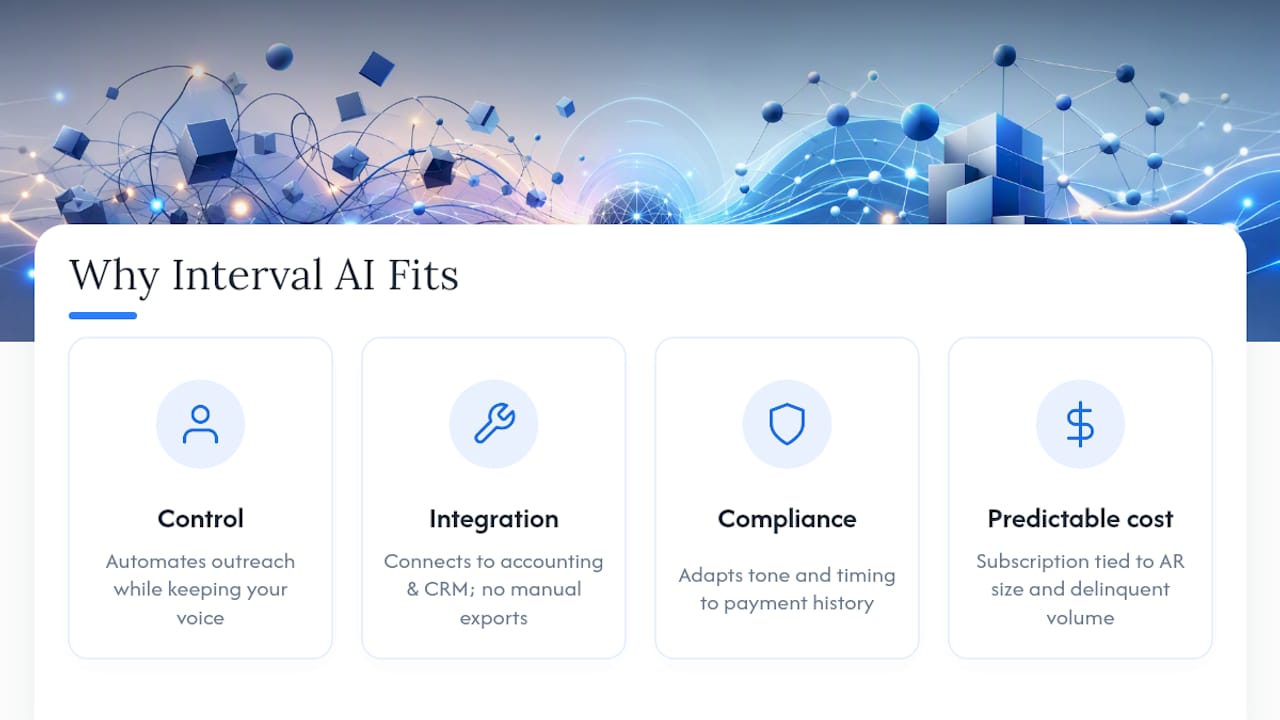
If the framework above points you toward software, and for most current-to-90-day AR, it should, Interval AI is built specifically around the decision dimensions that matter most: control, integration, compliance, and predictable cost. Rather than replacing your customer relationships with a third-party voice, Interval AI automates outreach across email, SMS, and other channels while adapting tone and timing to each customer's payment history, so the communication still sounds like it's coming from you.
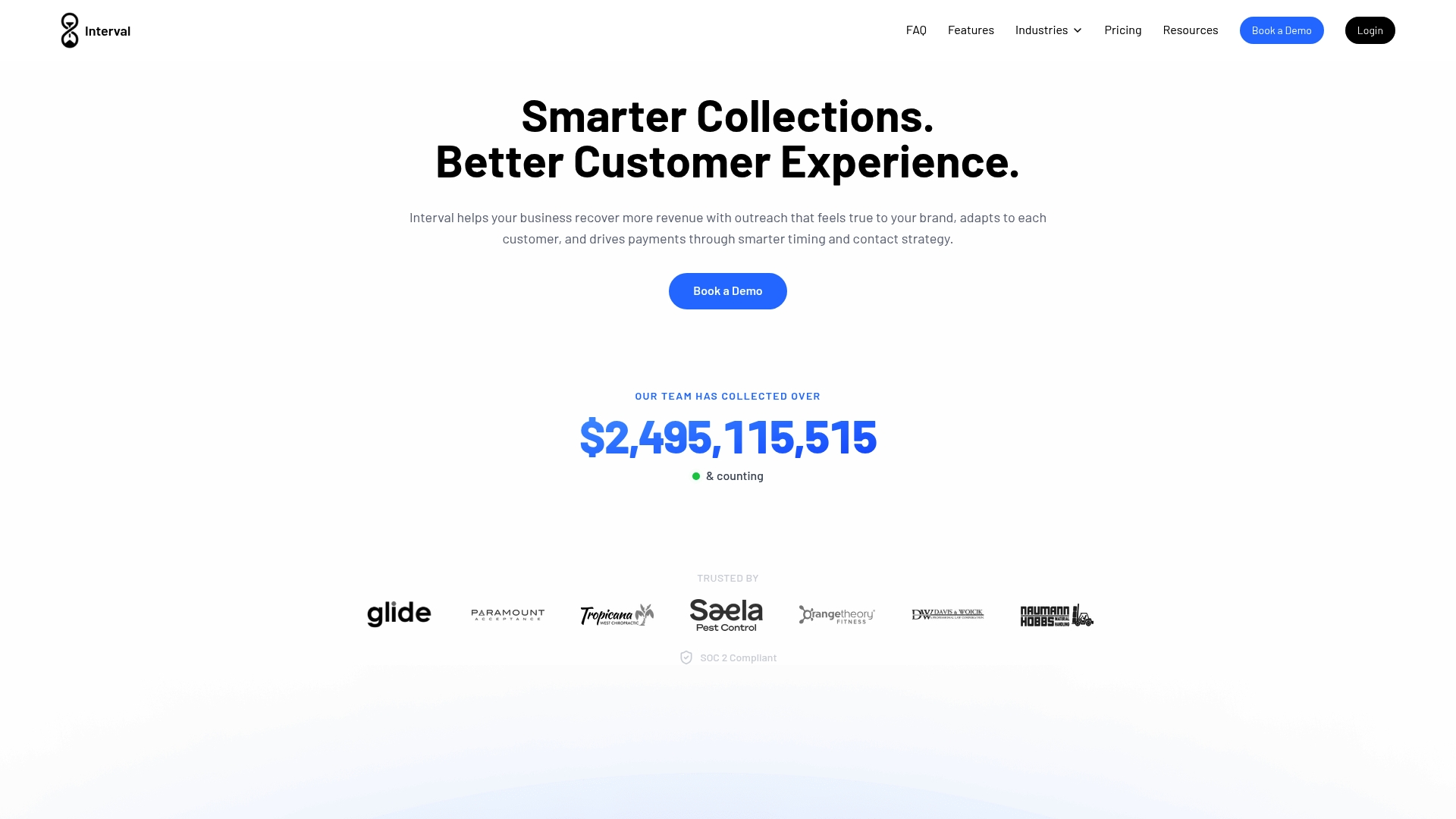
The platform connects to your existing accounting and CRM systems, which means you're not manually exporting account lists or re-keying payment updates. Interval-ai's pricing runs on a subscription tied to your AR size and delinquent account volume, giving you the fixed-cost predictability that a contingency-fee agency simply can't offer. Clients cited by the company report reducing days-to-payment by more than 30 days and recovering meaningful balances without adding collections staff, which aligns with the staffing-impact and cash-flow-predictability advantages described in the comparison table above.
If you're ready to see how this fits your own AR book, book a demo with Interval AI and ask specifically how it would handle your current 30 to 90-day segment. A real pilot on a defined account group will tell you more in two weeks than any amount of vendor comparison shopping. For a broader look at vendor-evaluation criteria across financial software generally, this loan-processing software comparison offers a useful checklist framework worth adapting to your own search.
Primary Sources and Further Reading
Before signing any contract with an agency or software vendor, check these primary sources yourself rather than relying on a sales pitch:
- Fair Debt Collection Practices Act (FDCPA) text: the federal law governing what third-party collectors can and can't do, essential reading if you're outsourcing to an agency.
- Regulation F compilation (CFPB): covers electronic contact rules and dispute procedures relevant to both automated software and agency communication.
- PCI Security Standards Council (PCI DSS): the technical standard any vendor handling payment card data should be able to demonstrate compliance with.
- Debt collection software overview (Experian): a useful industry reference point for understanding common software features and integration claims.
This is general business information, not legal advice. Confirm current compliance obligations with a qualified attorney or compliance professional before finalizing any collections process.
Sources
- Fair Debt Collection Practices Act (FDCPA) — text (FTC)
- Regulation F compilation (CFPB)
- PCI Security Standards Council (PCI DSS)
- Debt collection software (Experian)
FAQ
Is It Better to Not Pay a Collection Agency?
Ignoring a collection agency rarely helps; unresolved debt can affect your credit standing and may lead to legal action, so it's generally better to negotiate a payment plan or settlement than to avoid contact entirely.
What Is the 7-7-7 Rule for Debt Collectors?
Definitions of this informal rule vary across sources, and there is no single federal standard with that name. Regulation F sets its own specific limits on call frequency, so check the CFPB's Regulation F compilation directly for the actual contact-frequency rules that apply.
How Serious Is a Collection Agency?
A collection agency account can affect your credit report and, in some cases, lead to legal escalation if the debt remains unresolved, making it more serious than a routine internal payment reminder.
Should I Pay the Company or the Collection Agency?
Once an account has been formally transferred to a collection agency, you typically need to pay the agency directly, since the original company may no longer hold the receivable; confirm which entity currently owns the debt before sending payment.
Do I Need Both an Agency and Software?
Many businesses use both: software handles automated outreach on current 0 to 90-day accounts, while an agency takes over accounts that stay unresponsive past 90 or 120 days, and platforms like Interval-ai are built specifically for that earlier, software-driven stage.
