
Collections Outreach Cadence Setup: Your 2026 Guide
Published: August 9, 2026 · 14–15 min read
What is a collections outreach cadence, and why does it matter?
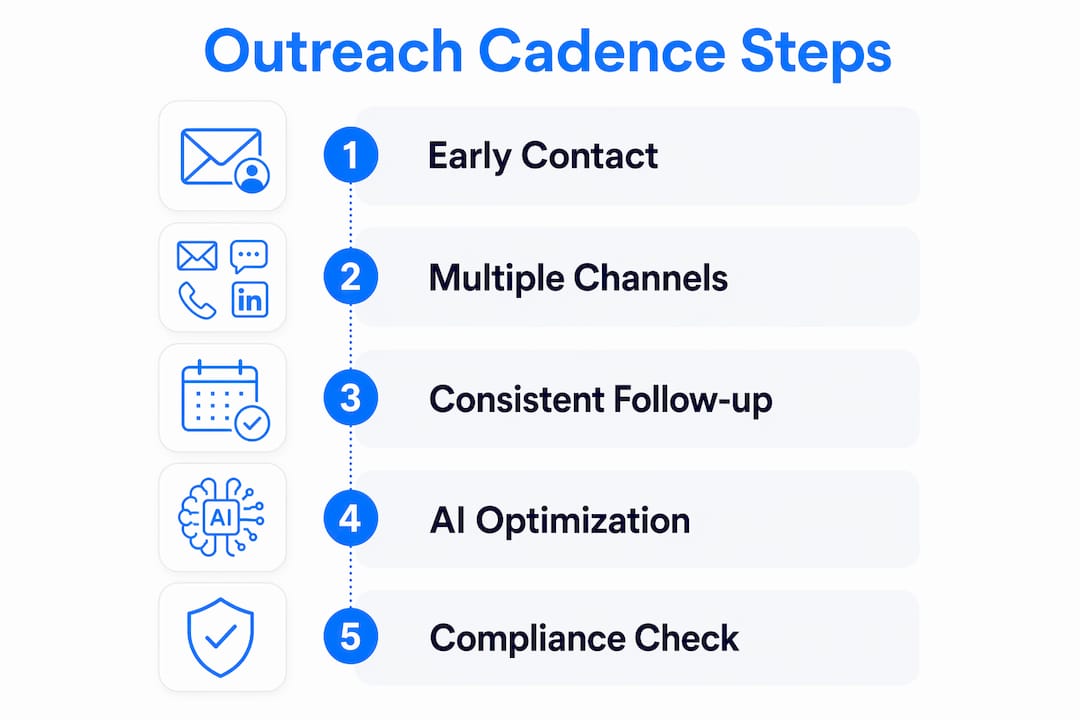
A collections outreach cadence is a planned sequence of timed, multi-channel communications designed to recover overdue payments consistently and professionally. Think of it as your follow-up schedule with structure: each touchpoint has a purpose, a channel, and a message calibrated to where the customer sits in the delinquency timeline.
The core elements of an effective cadence include:
- Timing and frequency: How many days between each contact, and how that spacing shifts as an account ages
- Channel mix: Email, phone, LinkedIn, fax, and formal letters each play a different role at different stages
- Message progression: Tone escalates from friendly reminder to formal demand, matching the urgency of the situation
- Response handling: Clear protocols for disputes, payment arrangements, and escalation decisions
- Segmentation logic: High-risk accounts get more frequent, assertive touches; low-risk customers receive softer reminders
Without a defined cadence, accounts slip through the cracks. Silence reads as permission to wait, and customers who might have paid with a timely nudge end up aging into serious delinquency. A structured collections outreach cadence setup directly reduces days sales outstanding and protects your cash flow before small balances become write-offs.
Why a structured cadence pays off for your collections team
A well-designed cadence does more than recover money. It changes how your entire collections operation runs.
- Higher collection rates: Consistent follow-up catches accounts before they age past the point of easy recovery. Multi-channel outreach can significantly increase response rates compared to email alone.
- Fewer accounts falling through the cracks: Automated scheduling means every invoice gets attention, not just the ones a collector happens to remember.
- Stronger customer relationships: Professional, empathetic communication preserves goodwill even during difficult conversations. Customers who feel respected are more likely to engage and pay.
- Team efficiency: When your process is defined, collectors spend time communicating rather than researching aged balance reports and deciding who to call next.
- Better prioritization: Segmenting accounts by risk and exposure lets your team focus energy where it matters most, rather than treating a $500 balance the same as a $50,000 one.
- Reduced delinquency periods: Starting outreach the moment an account becomes past due shortens the average time to resolution.
The National Association of Credit Management notes that proactive, consistent follow-up beginning immediately when accounts become delinquent minimizes aging and supports better recovery outcomes.
How to build an effective collections outreach cadence step by step
Building a cadence that actually works takes more than picking a few email templates. Here is a practical sequence to get it right.
-
Define your goals. Decide what success looks like: reduced days sales outstanding, higher promise-to-pay rates, fewer write-offs, or all three. Your goals shape every decision that follows.
-
Segment your accounts. Group customers by risk level, payment history, balance size, and relationship value. High-risk accounts need more frequent and assertive touchpoints; long-standing customers with a single late invoice need a softer approach.
-
Choose your channels. Match channels to customer preferences and past responsiveness. Some customers respond to email immediately; others only pick up the phone. Build your channel mix around what actually works for each segment.
-
Design your touchpoint sequence. Space contacts logically. Early touches should be soft and informational. As days past due increase, tone and urgency escalate. A typical cadence runs for several weeks with multiple touches across channels.
-
Write tailored messages for each step. Generic scripts underperform. Each message should reference the specific invoice, the amount, and the customer's name. Adjust tone based on where you are in the sequence and the customer's risk profile.
-
Set up monitoring metrics. Track response rates, promise-to-pay conversions, and dispute resolution times from day one. Without data, you cannot tell what is working.
-
Build in feedback loops. Review cadence performance monthly. Adjust timing, channel order, or message tone based on what the numbers show.
Pro Tip: Start aggressively early. The National Association of Credit Management specifically recommends that an initial, assertive follow-up can uncover customer disputes or invoicing errors before aging continues. Catching a billing mistake at day 3 is far easier than untangling it at day 45.
Which channels should you use, and in what order?

Single-channel outreach leaves money on the table. Combining email, phone, LinkedIn, and formal letters in a deliberate sequence reaches customers through the path of least resistance, whichever that happens to be for them.
Common channels and their roles:
- Email: Low friction, easy to document, ideal for early reminders and formal notifications. Keep messages to 3–5 sentences for best read rates.
- Phone calls: High-impact for securing commitments. Best used after an initial email has been sent, so the call does not feel unexpected.
- LinkedIn messages: Effective for B2B collections, particularly when reaching decision-makers who are unresponsive by email. A LinkedIn sequence combining connection requests and personalized follow-ups typically yields a 25–35% connection acceptance rate and up to 6% positive replies with targeted personalization.
- Fax: Still relevant in certain industries and for formal legal notices.
- Formal letters: Reserved for serious delinquency stages, credit hold notifications, and final demand communications.
Tips to avoid over-contacting:
- Set quiet-day rules so a customer is not contacted more than once within a defined window. Microsoft Dynamics 365 Finance, for example, uses a configurable quiet-days parameter to prevent over-contact in automated processes.
- Rotate channels rather than repeating the same one back to back.
- Limit total touches to what your cadence framework specifies; more is not always better past a certain point.
Sample 2–3 week channel sequence:
| Day | Channel | Purpose |
|---|---|---|
| Day 1 | Friendly invoice reminder | |
| Day 4 | Second reminder, payment options included | |
| Day 7 | Phone call | Live conversation, confirm receipt of invoices |
| Day 10 | LinkedIn message | Reach decision-maker directly |
| — | Formal overdue notice | |
| — | Phone call | Escalation call, payment commitment request |
| — | Formal letter | Written demand, credit hold warning |
How to write messages that actually get a response
Personalization is the single biggest lever in collections messaging. A generic "your invoice is overdue" email gets ignored. A message that names the invoice number, the amount, and references a prior conversation gets read.
- Use the customer's name and specific invoice details in every message. Customers know when they are receiving a mass blast, and it signals that the relationship does not matter to you.
- Lead with empathy in early-stage messages. Acknowledge that oversights happen and make it easy to pay or raise a dispute. A tone that feels accusatory at day 5 damages relationships unnecessarily.
- Shift tone as the account ages. By day 30, the message should be direct and clear about consequences. By day 60, formal language and documented communications are appropriate.
- Offer options. Payment plan arrangements, ACH or wire transfer instructions, and clear dispute resolution paths reduce friction and increase the chance of a positive response.
- Avoid generic scripts. Adapt your message to the customer's segment and history. A long-standing customer with one late invoice deserves a different message than a new account that has never paid on time.
The National Association of Credit Management recommends that ethical conduct statements be embedded in collection procedures to maintain professionalism throughout every customer interaction. That standard applies to every message in your cadence, not just the formal letters.
Pro Tip: For follow-up calls, end with a specific commitment: "May I call you on Thursday to confirm payment?" Securing a concrete date dramatically increases follow-through compared to a vague agreement to pay "soon."
How to test, monitor, and improve your cadence over time
A cadence you set once and never revisit will decay. Customer behavior changes, and what worked last quarter may underperform today.
Key metrics to track:
- Response rate: What percentage of contacts reply to each touchpoint?
- Promise-to-pay rate: How many customers commit to a payment date after contact?
- Resolution time: How many days from first contact to payment or formal escalation?
- Dispute rate: Are disputes surfacing early (good) or late (a sign your early messaging is unclear)?
- Channel performance: Which channel generates the most responses at each stage?
How to run A/B tests on your cadence:
- Test one variable at a time: subject line, send time, message length, or channel order.
- Run each test for a statistically meaningful period before drawing conclusions.
- Document results and apply the winning version before testing the next variable.
Tracking response rates, promise-to-pay, and dispute resolution unlocks the insights needed to continuously refine your cadence. Regular data review, at minimum monthly, keeps your process aligned with what customers actually respond to.
What do effective cadence workflows look like across risk levels?
Cadence design is not one-size-fits-all. A customer who is 5 days past due on a $1,200 invoice needs a different workflow than one who is 60 days past due on $85,000. Here is how workflows typically vary by risk and aging stage.
Cadence length and touchpoints by risk level:
| Risk Level | Cadence Length | Total Touches | Escalation Trigger |
|---|---|---|---|
| Low risk | 20 business days | 5–7 | 45 days past due |
| Medium risk | 15–20 business days | 7–10 | 30 days past due |
| High risk | 10–15 business days | 10–12 | 15 days past due |
Day-by-day workflow example for a medium-risk account:
| Day | Action | Channel | Message Focus |
|---|---|---|---|
| Day 1–3 | Pre-dunning notice | Invoice due soon, payment options | |
| Day 5 | First overdue reminder | Invoice past due, easy payment link | |
| Day 8 | Follow-up call | Phone | Confirm receipt, secure commitment |
| Day 12 | Second email notice | Formal overdue, dispute option offered | |
| Day 15 | LinkedIn outreach | Reach decision-maker directly | |
| — | Escalation call | Phone | Payment plan discussion |
| — | Formal demand letter | Letter/Email | Credit hold warning, final payment request |
| At a later stage, a credit hold notification is sent via email or fax to customer and sales. |
The NACM's sample collection process shows that escalation from early reminders to credit holds and final demand letters typically spans 0 to 90+ days past due, with the cadence intensity increasing at each stage. For high-risk accounts, very frequent contact becomes appropriate as delinquency lengthens.
Customizing workflows by business type matters too. A B2B services firm dealing with net-60 payment terms needs a different starting point than a retail supplier on net-30. Build your cadence around your actual contract terms, not a generic template.
Understanding the full credit card collections process can also inform how you structure escalation timelines, particularly when consumer accounts are part of your receivables portfolio.
How AI is changing the way collections cadences work
AI-driven cadence management is moving collections from reactive to predictive. Instead of applying the same schedule to every account, AI systems analyze historical payment behavior, communication patterns, and account characteristics to determine the best time, channel, and message for each customer.

The practical impact is significant. Interval-ai uses data-driven automation to adjust cadence sequences based on individual customer behavior, reducing days to payment by over 30 days compared to manual methods. That kind of improvement does not come from sending more emails. It comes from sending the right message through the right channel at the moment a specific customer is most likely to respond.
Machine learning also helps predict which accounts are at highest risk of non-payment before they become seriously delinquent. Microsoft Dynamics 365 Finance, for example, includes a Customer payment predictions feature that uses AI to prioritize collections activities based on predicted payment behavior. Acting on those predictions earlier shortens resolution time and reduces write-offs.
The ethical dimension matters here too. AI-driven outreach should still reflect your brand's voice and values. Automated does not mean impersonal. The best AI cadence platforms maintain professional, empathetic communication aligned with your brand identity throughout every touchpoint.
What compliance rules govern collections outreach in the United States?
Collections outreach in the United States operates under a clear legal framework, and violating it carries real financial and reputational risk.
The Fair Debt Collection Practices Act (FDCPA) is the primary federal law governing third-party debt collectors. It prohibits harassment, false statements, and unfair practices. Key restrictions include:
- No contact before 8:00 AM or after 9:00 PM local time
- No contact at a consumer's workplace if the employer prohibits it
- Mandatory cease-communication upon written request from the consumer
- Prohibition on threatening legal action the collector does not intend to take
The Fair Credit Reporting Act (FCRA) governs how collection activity is reported to credit bureaus and requires accuracy in reporting.
The Telephone Consumer Protection Act (TCPA) restricts automated calls and text messages, requiring prior express consent for certain types of contact. Violations carry per-call penalties that add up quickly.
For B2B collections, the FDCPA does not apply in the same way, but state laws and contract terms still govern acceptable conduct. Many states have their own consumer protection statutes that extend beyond federal minimums.
Practical compliance steps for your cadence:
- Document every contact attempt and outcome for audit purposes.
- Train your team on FDCPA requirements before they make a single call.
- Build time-of-day restrictions directly into your automated scheduling.
- Include opt-out mechanisms in email communications.
- Review your cadence against state-specific rules, particularly for consumer accounts in California, New York, and Texas, which have stricter requirements.
The NACM recommends that ethical conduct statements be embedded in your collections policy to reinforce professionalism and legal compliance at every stage of the process.
Key Takeaways
A structured, multi-channel collections outreach cadence setup is the most direct path to shorter payment cycles, fewer write-offs, and a collections team that works efficiently rather than reactively.
| Point | Details |
|---|---|
| Start early and stay consistent | Begin follow-up the moment an account becomes past due; early contact uncovers disputes before they age. |
| Use multiple touches across channels | Effective cadences typically run 15–20 business days with 7–12 touches for medium-risk accounts, integrating email, phone, LinkedIn, and letters in a coordinated sequence. |
| Segment by risk level | High-risk accounts need more frequent touches over shorter periods; low-risk accounts can follow a softer, longer schedule. |
| Test and optimize continuously | Track response rates, promise-to-pay, and resolution times monthly to keep your cadence performing. |
| Interval-ai reduces days to payment | Interval-ai's AI-driven cadence automation reduces days to payment by over 30 days compared to manual methods, according to client reports leveraging historical payment data. |
The case for treating your cadence as a system, not a script
The collections professionals who consistently outperform their peers share one habit: they treat their follow-up process as something to be measured and improved, not just executed. Most teams set up a cadence once, train staff on it, and then leave it unchanged for years. That approach works until it does not, and by the time the numbers show it is failing, months of recoverable revenue have already aged past the point of easy collection.
What gets overlooked in most cadence discussions is the relationship between timing precision and customer psychology. Sending a follow-up email at day 7 because "that is what the template says" is fundamentally different from sending it because your data shows that 73% of customers in a specific segment respond within 48 hours of a day-7 contact. The first is a habit. The second is a system.
The shift toward AI-driven cadence management is not about replacing collectors. It is about giving them better information. When a collector knows that a particular customer historically responds to phone calls on Tuesday mornings and ignores emails entirely, that collector can focus energy where it will actually produce a result. Automation handles the scheduling and the documentation; the human handles the conversation that closes the deal.
Compliance is the other piece that teams underestimate until they face a TCPA or FDCPA complaint. Building legal guardrails directly into your cadence architecture, not as an afterthought, protects your organization and keeps your process running without interruption. A single class-action TCPA case can cost far more than any efficiency gain your cadence produces.
The teams that will lead collections performance in 2026 and beyond are the ones building cadences that are data-informed, legally sound, and genuinely personalized. That combination is harder to build than a generic follow-up schedule, but the gap in outcomes between the two approaches is not small.
Interval-ai cuts days to payment without adding headcount
Most collections teams face the same problem: the manual work of researching accounts, deciding who to contact, and tracking follow-ups consumes time that should be spent actually communicating with customers. Interval-ai solves that problem directly.
Interval-ai uses AI trained on historical payment data to build and execute personalized outreach cadences for each customer automatically. The system manages multi-channel communications across email, phone, and other channels, adjusting timing and messaging based on how each customer has responded in the past. Clients report reducing days to payment by over 30 days and recovering substantial balances without adding staff or payroll costs. For collections teams that want a process that runs consistently, adapts to customer behavior, and keeps every account moving toward resolution, Interval-ai is worth a close look.
FAQ
What does outreach cadence mean in collections?
A collections outreach cadence is a planned sequence of timed contacts across multiple channels designed to recover overdue payments consistently. It defines when to reach out, which channel to use, and how the message tone should escalate as an account ages.
How long should a collections cadence run?
Effective cadences typically run 15–20 business days with 7–12 touches for medium-risk accounts, though high-risk accounts may require a compressed 10–15 day schedule with more frequent contact.
What is a good collections contact frequency?
Collections contact every 3–5 days is appropriate for accounts in the 30–60 day past-due range, with daily or every-other-day contact becoming reasonable past 60 days. The National Association of Credit Management recommends this escalating frequency as a standard practice.
How many channels should a collections cadence use?
At minimum, two channels across at least five touchpoints. Research shows that combining email, phone, and LinkedIn significantly outperforms single-channel outreach, with coordinated multi-channel sequences producing up to 287% higher response rates than email alone.
Can Interval-ai automate a multi-channel collections cadence?
Yes. Interval-ai uses AI-driven automation to manage outreach across multiple channels, adjusting cadence timing and messaging based on each customer's historical payment behavior, with clients reporting a reduction in days to payment of over 30 days.
