
Collections Software Features Checklist for SMEs
Published: May 25, 2026 · 10–11 min read
TL;DR:
- A solid collections software checklist emphasizes core features like automated invoicing, centralized customer data, and real-time aging views to enhance payment recovery. Automation, AI scoring, and reliable integrations are critical for reducing manual effort and ensuring data accuracy. Support quality, transparent pricing, and user-friendly design determine long-term success and adoption among small teams.
Choosing collections software sounds straightforward until you open the first vendor comparison page and find yourself staring at 40 features you may or may not need. A solid collections software features checklist cuts through that noise. It tells you what actually moves the needle on payment recovery, what protects your data, and what you can safely deprioritize when you are working with a limited budget and a small team. This guide gives you that checklist, organized by priority, so you can evaluate any collections management tool with confidence and stop second-guessing your decision.
Key takeaways
| Point | Details |
|---|---|
| Start with core AR features | Automated invoicing, centralized records, and real-time aging views are non-negotiable foundations. |
| Automation reduces manual effort | Configurable dunning sequences and AI scoring free your team to focus on accounts most likely to pay. |
| Integration quality determines data trust | Real-time sync with your accounting or ERP platform prevents costly data errors and missed follow-ups. |
| Reporting drives strategy | DSO tracking, aging buckets, and cash flow forecasts turn raw data into decisions your team can act on. |
| Vendor support matters as much as features | Onboarding quality, support response times, and transparent pricing determine long-term success. |
1. Your collections software features checklist starts here
Before comparing vendors, you need a clear picture of what every solid collections platform must do at its core. These are the features that affect daily operations and payment recovery the most. Miss one, and you will feel it in your cash flow within weeks.
Automated invoice creation and delivery tracking. Automated invoice creation that pulls clean data and tracks delivery reduces manual errors and speeds up dispute resolution. If a customer claims they never received an invoice, you need a timestamped record to prove otherwise. That one capability alone prevents weeks of back-and-forth.
Centralized customer records. Fragmented data slows resolution and causes missed context. Your software needs a single record per customer that includes payment history, every communication sent, and any open disputes. When your collector opens an account, they should see the full picture in one place, not three tabs across two systems.

Real-time AR aging views. Live aging calculations with filters by region, customer, or business unit let you prioritize collections accurately. A dashboard that updates once a day is not enough. You need to know right now which accounts crossed into the 60-day bucket.
Security and access controls. Encryption for data in transit and at rest, combined with granular user permissions, protects your financial data and limits exposure. Not every team member needs access to every account. Role-based controls reduce the risk of internal errors and unauthorized actions.
Pro Tip: When evaluating any platform, ask the vendor to show you a live aging dashboard filtered by a single customer. If they cannot do it in under 30 seconds, the interface will slow your team down every single day.
2. Automation and AI capabilities that reduce manual work
Once you have the core features confirmed, the next layer is automation. This is where features for debt collections software start to separate average tools from genuinely useful ones.
Automated dunning sequences. Reminders that adjust based on payment behavior and pause automatically for disputed accounts are a must. A customer who always pays on day 45 should not receive the same aggressive reminder schedule as one who is 90 days overdue for the first time. Configurable sequences let you match tone and timing to the situation.
AI-based account scoring. AI-powered prioritization helps your team focus on accounts most likely to respond, rather than working through a list alphabetically. The best systems show you why an account is ranked high, which builds trust in the tool and encourages your team to actually use the recommendations.
Smart segmentation. Grouping customers by payment behavior, account size, or relationship type lets you tailor outreach without manually sorting every record. A long-standing customer who missed one payment deserves a different message than a new account that has never paid on time.
Dispute management workflows. Collections should pause the moment a dispute is logged. If your software does not handle this automatically, your team will either forget to pause outreach or spend time managing exceptions by hand. That is time they could spend on accounts that are ready to pay.
Pro Tip: Ask vendors how their AI scoring model handles new customers with no payment history. A good system will tell you. A system that cannot answer that question is using a black box, and black boxes erode team confidence fast.
3. Integration features that keep your data accurate
The best collections management tool in the world is only as good as the data feeding it. If your software does not sync reliably with your accounting platform or ERP, you will spend more time reconciling records than collecting payments.
Here is what to look for on your checklist for collections software:
- Real-time or near-real-time sync with your existing systems. Stable connectors with documented sync frequency and conflict handling prevent data silos and build trust in your collections data.
- Support for your specific platforms. Confirm compatibility with QuickBooks, NetSuite, Xero, Sage, or whichever tools you already use. Generic "integration available" language in a sales deck is not the same as a tested, maintained connector.
- API access and webhook support. If you have custom workflows or plan to build them, open API access is not optional. Webhooks let your system react to events in real time rather than waiting for scheduled syncs.
- Vendor integration documentation. Ask to see the integration setup guide before you sign anything. If the documentation is thin or outdated, maintenance will fall on your IT team. For SMEs without a dedicated developer, that is a real risk.
When evaluating bookkeeping tools for SMEs, integration depth consistently ranks as one of the top reasons businesses switch platforms. The same principle applies to collections software. A tool that does not talk to your existing stack creates more work, not less.
4. Reporting and analytics that guide your strategy
You cannot manage what you cannot measure. The reporting features in your collections software determine whether your finance team is reacting to problems or getting ahead of them.
| Metric | What it tells you | Priority |
|---|---|---|
| Days Sales Outstanding (DSO) | Average time to collect payment after invoice | Must-have |
| Aging bucket breakdown | Volume and value of overdue accounts by time range | Must-have |
| Cash flow forecast | Expected collections over next 30, 60, 90 days | Must-have |
| Collector performance | Activity and recovery rates by team member | Nice-to-have |
| Promise-to-pay tracking | Accounts with agreed payment dates and follow-up status | Nice-to-have |
Real-time dashboards with customizable views by role let your collectors see their own workload while your finance manager sees the full AR health picture. Those are two different views, and a good platform supports both without requiring a custom report every time.
Exportable reports matter too. When your CFO asks for an overdue summary before a board meeting, you should be able to pull it in two minutes, not two hours.
Pro Tip: Set up automated alerts for accounts that cross aging thresholds. If a $50,000 account moves from 30 to 60 days overdue, you want to know the moment it happens, not when you run your weekly report.
5. Support, deployment, and pricing considerations
Features get the attention, but support and pricing determine whether your team actually uses the software long term. Onboarding assistance, SLAs, training materials, and transparent total cost awareness all improve adoption and reduce implementation risk.
When you are building your checklist for collections software evaluation, include these questions:
- What does onboarding look like? Is there a dedicated onboarding team, or do you get a link to a knowledge base and a 30-minute call? For SMEs, hands-on onboarding is the difference between a two-week ramp and a two-month one.
- What are the support SLAs? Find out the guaranteed response time for critical issues. A 48-hour response window for a billing dispute that is blocking a major account is not acceptable.
- What is the total cost of ownership? Setup fees, per-user licensing, integration costs, and annual price increases all add up. Ask for a full cost breakdown for year one and year two before you commit.
- Is the platform cloud-native? Cloud-native deployment means faster updates, better uptime, and no infrastructure costs on your end. Confirm whether the platform is truly cloud-native or just hosted on a server somewhere.
6. Must-have vs. nice-to-have features comparison
Use this table as a quick reference when comparing vendors. Organizing features into must-have vs. nice-to-have categories by functional area helps clarify evaluations and gives you clear criteria to walk away from vendors missing core capabilities.
| Category | Must-Have | Nice-to-Have |
|---|---|---|
| Core AR | Automated invoicing, centralized records, real-time aging | Multi-currency support, custom invoice templates |
| Automation | Configurable dunning sequences, dispute pause workflows | AI-generated email content, predictive payment dates |
| AI and scoring | Account prioritization, segmentation by behavior | Sentiment analysis, churn risk scoring |
| Integration | Real-time ERP/accounting sync, API access | Pre-built marketplace connectors, EDI support |
| Reporting | DSO tracking, aging dashboards, exportable reports | Benchmark comparisons, industry-level analytics |
| Security | Encryption, role-based access, audit logs | SOC 2 Type II certification, SSO support |
| Support | Onboarding assistance, documented SLAs, transparent pricing | Dedicated account manager, 24/7 phone support |
Walk away from any vendor that cannot confirm the must-have column. The nice-to-have features are worth discussing, but they should never distract you from the non-negotiables.
What I have learned about choosing collections software
I have seen finance teams spend months evaluating platforms, comparing feature lists that run to three pages, only to choose a tool their collectors barely use six months later. The problem is almost never the features. It is the experience of using them.
In my experience, the single biggest predictor of successful adoption is how fast a new user can get something done on day one. If your collector has to click through five screens to log a payment promise, they will start keeping notes in a spreadsheet instead. That is not a training problem. That is a design problem, and no feature list will fix it.
What I have found actually works is narrowing your evaluation to three vendors max, running a real pilot with your own data, and asking your collectors what they think after two weeks. Their feedback will tell you more than any demo.
I am also skeptical of platforms that lead with AI as their headline feature. AI scoring is genuinely useful when it is transparent and built on your own historical data. But if a vendor cannot explain how their model works in plain language, the feature is more marketing than utility.
The tools that deliver real results tend to be the ones with fewer features, not more. They do the core things well, they integrate cleanly, and they do not require a consultant to configure. For most SMEs, that is exactly what you need.
— Tyler
See how Interval-ai handles this checklist
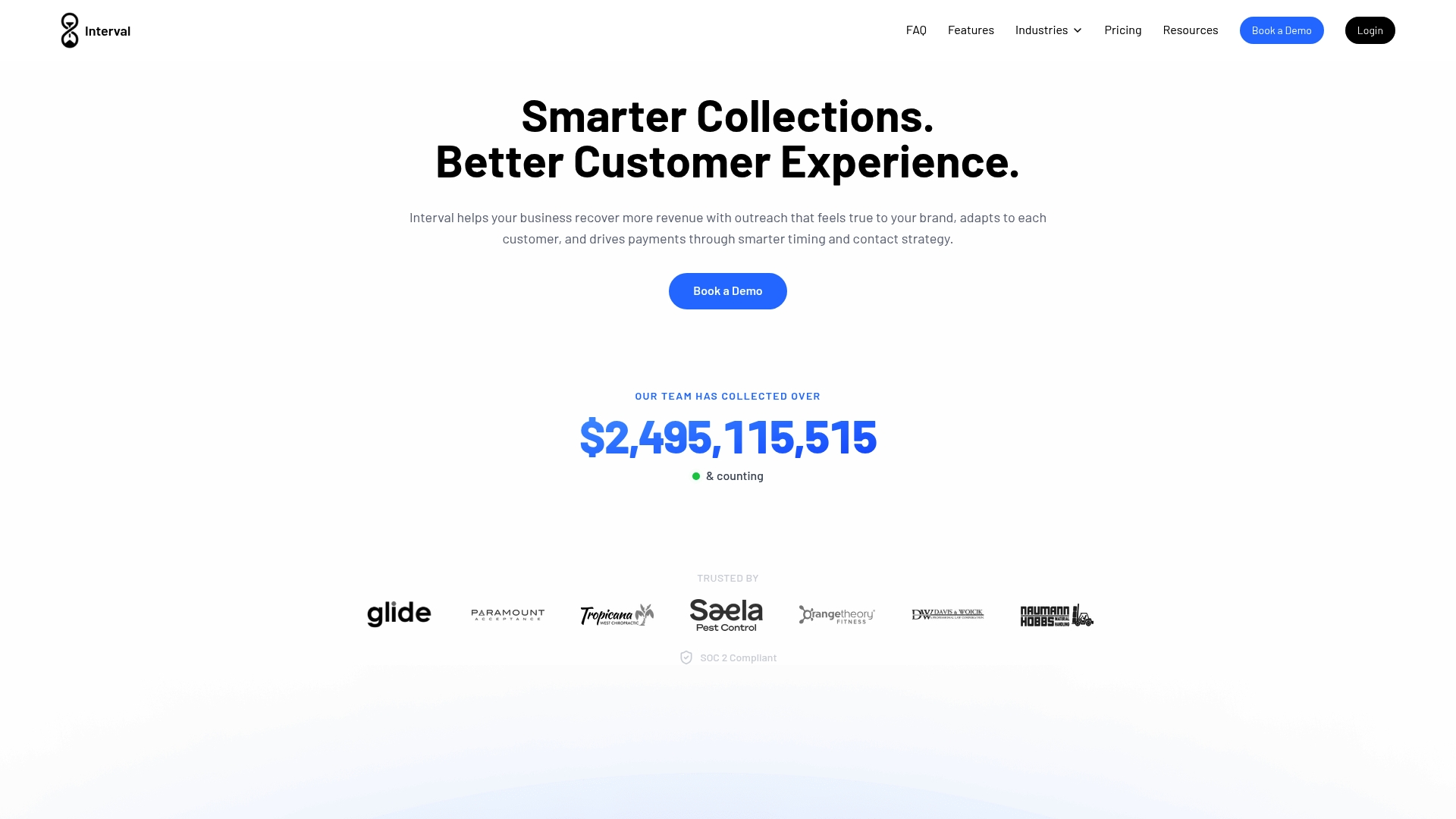
If you have worked through this checklist and want to see a platform that covers the must-haves without the complexity, Interval-ai is worth a close look. Interval-ai delivers real-time AR aging views, configurable dunning workflows, and AI-driven account prioritization built specifically for SMEs. It integrates with the accounting platforms you already use, gives your team role-based dashboards, and is designed to reduce days to payment by over 30 days without adding headcount. Clients report recovering significant overdue balances while cutting payroll costs. The onboarding process is hands-on, the pricing is transparent, and the support team is responsive when you need them.
FAQ
What features should every collections software have?
Every collections platform needs automated invoicing, centralized customer records, real-time AR aging views, configurable dunning sequences, and role-based security controls. These are the foundation features that directly affect payment recovery and daily workflow efficiency.
How do I choose collections software for a small business?
Start with a features checklist organized by must-have and nice-to-have, confirm integration with your existing accounting tools, and run a two-week pilot with real data before committing. Support quality and ease of use matter as much as the feature list itself.
What is DSO and why does it matter in collections software?
DSO stands for Days Sales Outstanding and measures the average number of days it takes to collect payment after an invoice is issued. A lower DSO means faster cash flow, and your collections software should track it in real time so you can spot trends before they become problems.
How important is AI in collections management tools?
AI is useful for account prioritization and smart segmentation, but only when the scoring model is transparent and based on your own payment history data. Avoid platforms where AI recommendations cannot be explained, as your team will not trust or use them consistently.
What integration should collections software have?
At minimum, your collections software should sync in real time with your accounting platform or ERP, support API access for custom workflows, and provide documented integration guides. Confirmed compatibility with tools like QuickBooks, Xero, or NetSuite is a baseline requirement, not a bonus.
