
Examples of Automated Invoicing Systems for SMBs
Published: May 23, 2026 · 10–11 min read
TL;DR:
- Manual invoicing increases cash flow delays, while automated systems streamline billing and follow-ups effectively. Selecting the right tool depends on your business scale, client base, and billing complexity, with features like recurring billing and integration being crucial. When overdue payments persist despite automation, dedicated collection tools, such as Interval-ai, can help recover overdue balances efficiently.
Manual invoicing costs you more than time. Late payments pile up, follow-ups get forgotten, and cash flow suffers while you wait for checks that should have arrived weeks ago. If you're evaluating examples of automated invoicing systems to fix this, you're already ahead of most small business owners who keep tolerating the problem. This article walks you through the features that actually matter, seven concrete systems worth your attention, a side-by-side comparison, and scenario-based recommendations so you can make a confident decision.
Key takeaways
| Point | Details |
|---|---|
| Recurring billing is the foundation | Scheduling invoices automatically reduces payment delays more than almost any other single feature. |
| Match the tool to your scale | Choose based on your billing complexity and growth plans, not just the feature list or price alone. |
| Integration saves hours weekly | Automatic reconciliation with your accounting software eliminates manual data entry and improves accuracy. |
| Free trials are worth using | Test the system with real clients before committing to a paid plan to verify fit. |
| Overdue payments need a separate layer | Invoicing software handles sending; a dedicated collections tool handles what happens when clients still don't pay. |
What to look for in examples of automated invoicing systems
Not every automated billing solution does the same job. Before you pick one, get clear on which part of your billing workflow actually breaks down. Recurring invoices and automated reminders do more to reduce payment delays than almost anything else, so those two features should be non-negotiable.
Here's what to evaluate before you commit to any system:
- Recurring billing and scheduling. Can you set up invoices to send automatically on a fixed cadence, weekly, monthly, or project-based?
- Automated payment reminders. Does the system send follow-ups before and after the due date without you lifting a finger?
- Embedded payment links. Clients pay faster when a "Pay Now" button is right in the invoice. Look for support for credit cards, ACH, and digital wallets.
- Invoice status tracking. Real-time dashboards that show sent, viewed, and paid status remove the guesswork from your collections process.
- Accounting sync and reconciliation. Automatic payment reconciliation reduces manual data entry and keeps your books accurate without extra steps.
- Mobile access. If you're running a field-based business, mobile invoicing matters.
- Scalability. Will the system handle your client volume in two years, not just today?
One distinction worth understanding: AR automation (accounts receivable) focuses on sending invoices and collecting payment. AP automation (accounts payable) focuses on processing invoices you receive, using tools like OCR and approval workflows. Most SMBs need AR automation first. IBM describes AP automation as a separate workflow involving data extraction, validation, and routing for inbound invoices. Know which problem you're solving before you shop.
Pro Tip: Set your billing cadence before you configure any automation. Consistent timing and stable payment terms programmed into your system are what make automation effective. Automation that sends invoices on an erratic schedule can actually slow collections down.
1. QuickBooks Online
QuickBooks Online is the most recognized name in small business accounting, and its invoicing automation is genuinely well-built. QuickBooks sends invoices automatically on schedule, includes a "Pay Now" button, and uses AI-powered reminders to follow up with clients without manual input. Payments made through the platform are automatically recorded and reconciled, which means your books stay current without extra work.

It's best suited for businesses already using QuickBooks for accounting, since the integration is native and tight. Pricing starts at around $35 per month for the Simple Start plan, with invoicing automation available across most tiers.
2. Invoice Ninja
Invoice Ninja serves over 200,000 small businesses and offers a free self-hosted plan alongside affordable cloud options. Its standout feature is flexibility. You get built-in payment gateway integrations with 1-click payment options, client portals, and the ability to auto-convert quotes into invoices.
Where Invoice Ninja really shines is workflow automation. It integrates with hundreds of apps through Zapier and Make, letting you build custom billing workflows without writing a single line of code. You can set up bulk email sends, auto-billing for recurring clients, and token billing for subscription-style revenue. For a tech-comfortable SMB owner who wants control over every step, this is a strong pick.
3. Zoho Invoice
Zoho Invoice is free. Not a free trial, not a freemium plan with limits that force an upgrade. Free. That makes it the best free plan option for cost-conscious small businesses that still want professional-grade invoicing.
The platform includes customizable templates, automatic payment reminders, and client portals. It syncs with the broader Zoho ecosystem, including Zoho Books and Zoho CRM, which is a real advantage if you're already in that world. The only trade-off is that Zoho Invoice works best when you stay within the Zoho product family.
4. Stripe Invoicing
If you bill international clients, Stripe Invoicing deserves serious attention. It's built for multi-currency and multi-language invoicing, which makes it the practical choice for businesses with clients across different countries.
Stripe handles tax calculations automatically in supported regions, supports dozens of payment methods, and integrates directly with Stripe's payment infrastructure. The invoicing feature is available within the Stripe platform at 0.4% per paid invoice (capped at $2), which keeps costs low for high-volume senders. It's developer-friendly, so businesses with technical resources can customize workflows significantly.
5. FreshBooks
FreshBooks earns its reputation as one of the most user-friendly invoicing tools available. It offers the best free trial among leading platforms, giving you a real chance to test it with actual clients before paying anything.
The interface is clean and intuitive, which matters if you're not a finance professional. FreshBooks handles recurring invoices, automated late payment reminders, and time-tracking integration, making it particularly well-suited for service businesses and freelancers who bill by the hour. Paid plans start at around $19 per month.
6. Square Invoices
Square Invoices offers unlimited invoicing on its free plan, which is rare. You can send invoices via email, SMS, or shareable link, which increases the chance your client actually sees and acts on them.
It integrates naturally with Square's point-of-sale and payment ecosystem, making it a practical fit for businesses that also do in-person transactions. Automated reminders, recurring billing, and milestone-based invoices are all available. The paid plan adds more customization and reporting, but the free tier is genuinely functional for most SMBs.
7. Salesforce Revenue Cloud Billing
Salesforce Revenue Cloud Billing sits at the more sophisticated end of the spectrum. It's built for businesses that need CRM and ERP integration alongside invoicing, particularly those managing complex, usage-based, or subscription billing at scale.
The platform supports AI-powered invoice generation, centralized billing management, and customized approval workflows. It's not the right fit for a five-person service company, but if you're managing dozens of enterprise clients with complex contracts, it's one of the few tools that can handle that without workarounds.
Comparing the top invoicing systems at a glance
Use this table to quickly contrast the seven systems across the factors that matter most for your decision.
| System | Pricing | Best for | Automation strength | International support |
|---|---|---|---|---|
| QuickBooks Online | From ~$35/mo | Existing QuickBooks users | AI reminders, auto-reconciliation | Moderate |
| Invoice Ninja | Free to ~$14/mo | Tech-savvy SMBs | Zapier/Make workflows, token billing | Good |
| Zoho Invoice | Free | Budget-conscious businesses | Reminders, Zoho ecosystem sync | Moderate |
| Stripe Invoicing | 0.4% per invoice | International billers | Payment automation, tax calculation | Excellent |
| FreshBooks | From ~$19/mo | Service businesses, freelancers | Recurring billing, time tracking | Moderate |
| Square Invoices | Free to ~$20/mo | Retail and in-person businesses | Multi-channel sending, recurring billing | Limited |
| Salesforce Revenue Cloud | Custom pricing | Complex enterprise billing | AI generation, ERP/CRM integration | Excellent |
The right choice depends less on which system has the longest feature list and more on which features match your actual billing workflow. SMBs should select invoicing software based on scale and billing complexity, not feature checklists alone.
Matching the right system to your business situation
Once you know what each system does, the question becomes which one fits your situation. Here's a practical breakdown by common SMB scenarios.
- Freelancer or solopreneur with simple billing. FreshBooks or Square Invoices. Both are easy to set up, offer free or low-cost entry points, and handle recurring billing without complexity.
- Business with international clients. Stripe Invoicing. Multi-currency support, automatic tax handling, and global payment methods make it the clear choice.
- Budget-conscious SMB wanting professional invoicing for free. Zoho Invoice. No cost, no catch, and it handles the core automation features well.
- Tech-savvy owner who wants customized workflows. Invoice Ninja. The integration depth via Zapier and Make gives you control that most other platforms don't offer at this price point.
- Business already using QuickBooks for accounting. QuickBooks Online. Native integration means no data gaps and automatic reconciliation without extra setup.
- Growing business with complex contracts or subscription tiers. Salesforce Revenue Cloud Billing. It's a bigger investment, but it's built for complexity that simpler tools can't handle.
Pro Tip: Before finalizing any choice, map out your expected client volume and billing complexity 18 months from now, not just today. A tool that works perfectly at 20 clients may create friction at 100. Most platforms offer free trials. Use them with real invoices and real clients to find out where the friction actually appears.
One more thing worth saying clearly: invoicing automation handles the sending side. When clients still don't pay after multiple reminders, you need a separate layer for collections. That's a different problem requiring a different tool.
My honest take on choosing invoicing automation
I've seen a lot of business owners pick invoicing software the wrong way. They compare pricing pages, pick the cheapest option with the most features listed, and then wonder why their cash flow hasn't improved six months later.
Here's what I've learned from watching this play out repeatedly: the tool matters far less than the billing cadence you program into it. Consistent, predictable invoicing with clear payment terms is what actually moves clients to pay on time. Automation just makes that consistency effortless. But if your billing timing is erratic or your payment terms are vague, automation will reliably deliver that inconsistency at scale.
The other thing that gets overlooked is automatic reconciliation. Most business owners focus on getting invoices out the door and forget that matching payments to invoices manually is where hours disappear. A system that reconciles payments automatically is worth paying more for, because it gives you accurate financial data without the manual work.
My advice: spend an hour mapping your actual billing workflow before you evaluate any tool. Know where the delays happen. Then pick the system that solves those specific delays, not the one with the most impressive demo.
— Tyler
How Interval-ai helps when invoices go unpaid
Even the best invoicing software has a limit. Once a payment is overdue and reminders have gone unanswered, you need more than a scheduled email. That's where Interval-ai comes in.
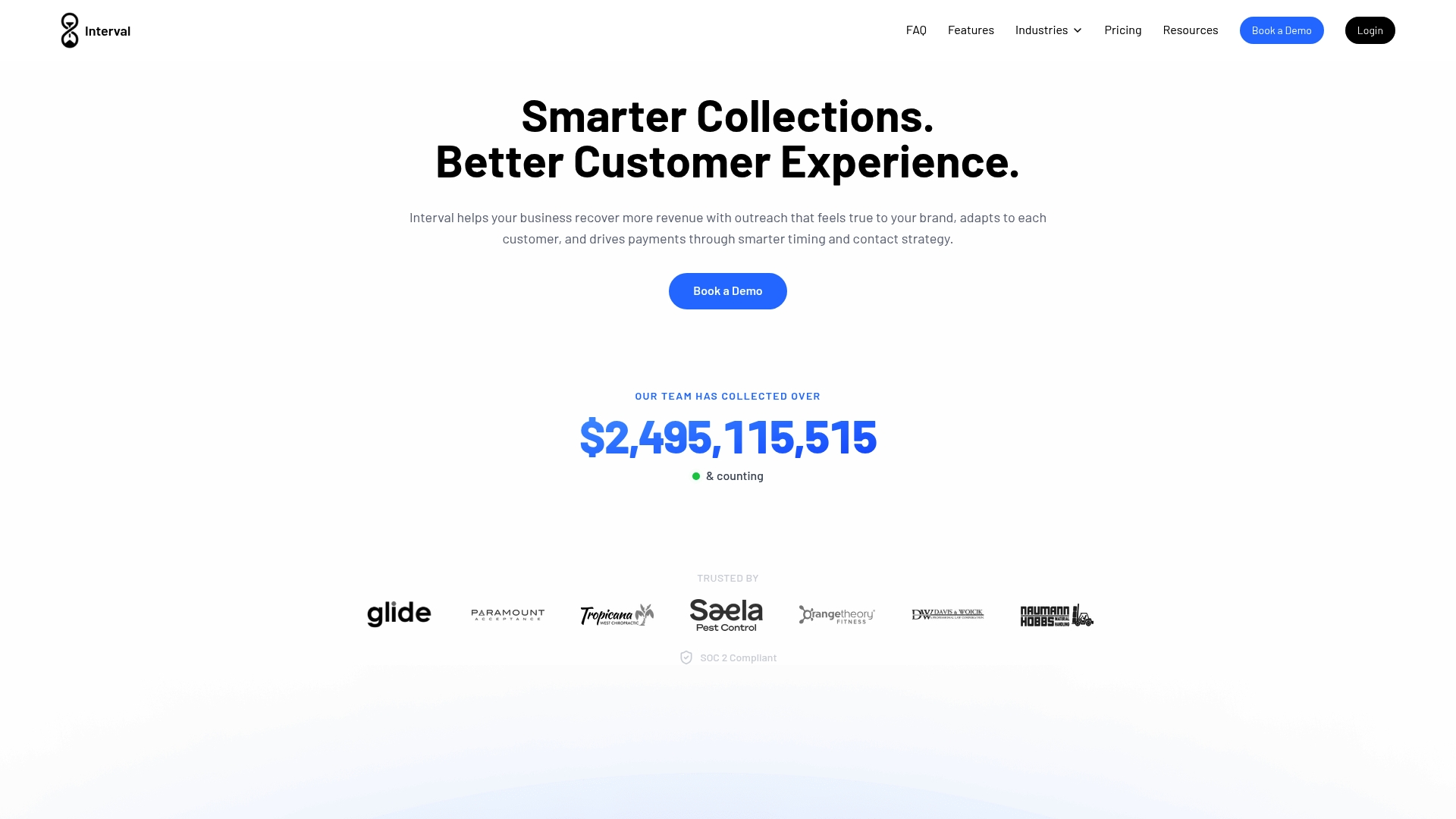
Interval-ai uses AI to manage the collections process after an invoice goes past due, tailoring outreach across multiple channels based on your client's payment history. It's not a collection agency. It's a data-driven system that communicates professionally, on your behalf, in a way that fits your brand. Clients report recovering significant overdue balances while reducing days to payment by over 30 days, without adding staff. If you want to see how it fits your billing setup, explore Interval-ai's pricing and find the right plan for your volume.
FAQ
What are the best free automated invoicing tools?
Zoho Invoice offers a genuinely free plan with automatic reminders and recurring billing. Square Invoices also provides unlimited invoicing on its free tier, including multi-channel sending via email, SMS, and link.
How does automated invoicing improve cash flow?
Automated invoicing reduces payment delays by sending invoices on a consistent schedule and following up with payment reminders automatically. Recurring invoices and reminders remove the gaps that typically slow collections when billing is handled manually.
What is the difference between AR and AP invoice automation?
AR automation handles outbound invoicing and payment collection. AP automation processes inbound invoices using OCR and approval workflows. IBM outlines AP automation as a distinct workflow focused on validating and routing invoices you receive from vendors.
Which invoicing system works best for international clients?
Stripe Invoicing is the strongest option for businesses billing across multiple countries. It supports multi-currency invoicing, multiple payment methods, and automatic tax calculations in supported regions.
When does invoicing software stop being enough?
When clients consistently ignore reminders and invoices go significantly past due, standard invoicing tools reach their limit. At that point, a dedicated collections solution that manages personalized, multi-channel outreach becomes necessary to recover payment without damaging the client relationship.
