
Recovering Failed Membership Payments Before They Cost You
Published: August 22, 2026 · 10–11 min read
Recover most failed membership payments by combining decline-code classification, Account Updater, and a short smart-retry plus dunning sequence. Do this now:
- Classify every decline using the merchant advice code before you retry blindly.
- Retry or route: soft declines get a timed retry; hard declines skip straight to dunning.
- Enable Account Updater and a one-click billing link so customers can fix cards in seconds.
A well-run recovery program can recover 50 to 70% of failed payments, and finance teams that skip classification typically recover far less.
Key Takeaways
A working recovery program pairs decline-code classification with timed retries and staged dunning to recover the majority of failed membership payments.
| Point | Details |
|---|---|
| Classify before retrying | Use merchant advice codes to separate soft declines (retry) from hard declines (route to dunning). |
| Time retries to paydays | Schedule attempts around the 1st, 15th, and month-end, spaced across 10 to 14 days. |
| Cap attempts at 3 to 5 | Excessive retries risk card-network fines and merchant account scrutiny. |
| Reconcile to the original invoice | Age failed charges as AR and match recovered payments to the original billing date. |
| Automate with Interval-ai | Interval-ai classifies declines, times retries, and runs multichannel dunning without adding staff. |
Why Membership Payments Fail in the First Place
Roughly 15% of recurring revenue gets lost to payment declines at a typical subscription business, and most of that is recoverable if you handle it correctly. The trick is knowing which declines to chase and which ones to leave alone.
Soft declines are temporary. Think insufficient funds, a bank's system hiccup, or a card issuer flagging a routine security check. These often clear on their own within a day or two.

Hard declines are permanent until the customer acts. A closed account, a reported stolen card, or a "do not honor" instruction from the issuer falls here. Retrying a hard decline wastes a retry attempt and can flag your merchant account for excessive retry behavior.
Merchant advice codes tell you which bucket you're in:
- 05 (Do Not Honor): hard decline, route straight to dunning.
- 51 (Insufficient Funds): soft decline, schedule a retry.
- 54 (Expired Card): fixable with Account Updater, not a retry.
- 41/43 (Lost or Stolen Card): hard decline, never retry.
Expired or reissued cards alone account for a meaningful slice of preventable declines, which is exactly why prevention deserves as much attention as recovery logic.
How To Stop Cards From Expiring Before They Fail
Prevention beats recovery every time, because a payment that never fails doesn't need a dunning sequence at all. Three moves cut expired-card failures dramatically.
- Turn on Account Updater. Visa Account Updater and Mastercard's Automatic Billing Updater sync new card numbers and expiration dates automatically when a bank reissues a card. Account Updater alone eliminates a significant share of preventable declines tied to expired plastic.
- Send pre-expiry alerts at 45, 30, and 14 days out. Staggered reminders give members time to update on their own schedule instead of scrambling after a decline.
- Offer a backup payment method and a one-click billing portal link. A mobile-friendly update flow that requires no login and no app download removes almost every excuse for letting a card lapse.
Pro Tip: Route your billing portal link through SMS as well as email. Card update pages opened on mobile convert faster because members fix it the moment they see the text, rather than saving the email for "later."
When Should You Retry a Failed Payment?
Timing decides whether a retry recovers money or just annoys a member who was always going to pay. The decline code tells you whether to try again; the calendar tells you when.
Soft declines respond best when retries land near a payday window. Many billing teams schedule attempts for the 1st, 15th, and end of month, since that's when checking accounts actually have funds. Day of week matters too. Retries on Monday or Tuesday tend to outperform weekend attempts, when balances are lower and support lines are quiet.
- Space retries across 10 to 14 days, not back to back.
- Cap attempts at 3 to 5 tries per failed charge.
- Never retry a code flagged "do not retry," even once. Excessive retries can trigger fines or scrutiny on your merchant account from Visa or Mastercard.
- Stop retrying and move to dunning the moment a hard decline code appears.
Pro Tip: Run retry-timing changes as an A/B test for four to eight weeks before rolling them out fully. Measure net recovered dollars, not just the retry success rate, since a higher retry count can look good on a dashboard while barely moving revenue.
What Should a Dunning Sequence Actually Say?
Retries handle the technical fix; dunning handles the human one. The tone matters as much as the timing, because service-continuity messaging outperforms accusatory payment language at every stage.
A practical four-stage cadence:
- Day 0, friendly notice. "We had trouble processing your membership payment. No action needed yet, we'll try again shortly."
- Day 3, reminder with a link. Include the one-click billing portal URL directly in the email or SMS.
- Day 7, final notice. State clearly what happens if the account isn't updated, framed around keeping access rather than threatening a cutoff.
- Day 10 to 14, escalation. For high-value accounts, add a phone call or white-glove outreach instead of another automated touch.
Channel choice should track urgency. Email carries the early stages; SMS earns its place at the reminder and final-notice stages, where open rates matter more than politeness.
- Offer a pause option before cancellation for members who signal they'll return.
- Segment high-lifetime-value members into a faster, more personal escalation path.
- Never let every member get the identical generic sequence. A member paying for a $200 monthly plan deserves a different touch than one on a $15 tier.
Which Metrics Actually Prove Your Recovery Program Works
Four numbers tell you whether your program is working or just generating activity: recovery rate (percentage of failed charges eventually collected), recovered revenue (actual dollars), time-to-recovery (days from failure to successful charge), and decline-code distribution (which failure types dominate your losses).
Recovered payments still need to hit your books correctly. Treat every failed charge as an open accounts receivable item the moment it fails, not a canceled invoice. Age it normally in your AR aging report, and when the retry or dunning sequence succeeds, reconcile the payment against the original invoice date rather than the recovery date. That keeps your revenue recognition and churn reporting honest.
| Metric | What it tells you |
|---|---|
| Recovery rate | Share of failed charges eventually collected |
| Recovered revenue | Actual dollars returned to cash flow |
| Time-to-recovery | Days between failure and successful charge |
| Decline-code mix | Which failure types deserve the next fix |
Use the decline-code breakdown to prioritize. If expired cards dominate, fix Account Updater coverage before tweaking retry timing.
Your Quarter-One Checklist for Fixing Payment Recovery
Three groups of tasks, roughly two weeks apart, get a recovery program live without overwhelming your billing team.
- Technical setup (week one). Enable Account Updater, configure webhooks for payment-failed events, generate one-click billing portal session URLs, and confirm backup payment methods are collected at signup.
- Operational rules (week two). Build decline-code routing so soft declines trigger retries and hard declines skip to dunning. Set retry windows, cap attempts at 3 to 5, and define a grace period of 3 to 7 days before service pauses.
- Measurement (week three). Instrument recovery rate, recovered revenue, and time-to-recovery dashboards. Launch your first A/B test on retry timing and set an escalation threshold, like accounts above $500 in monthly value, for manual follow-up.
Pro Tip: Don't launch all three groups at once. Technical setup that isn't fully wired before you turn on aggressive retry rules just produces noisy failure data you'll have to clean up later.
What Compliance Rules Apply to Payment Recovery?
Retry logic isn't just a technical decision. Card networks set hard limits on how many times you can attempt a charge, and ignoring "do not retry" instructions on a decline code can put your merchant account at risk of fines or increased scrutiny from your processor. Visa and Mastercard both monitor excessive-retry patterns at the merchant ID level, and a pattern of ignoring hard declines is one of the fastest ways to draw that attention.
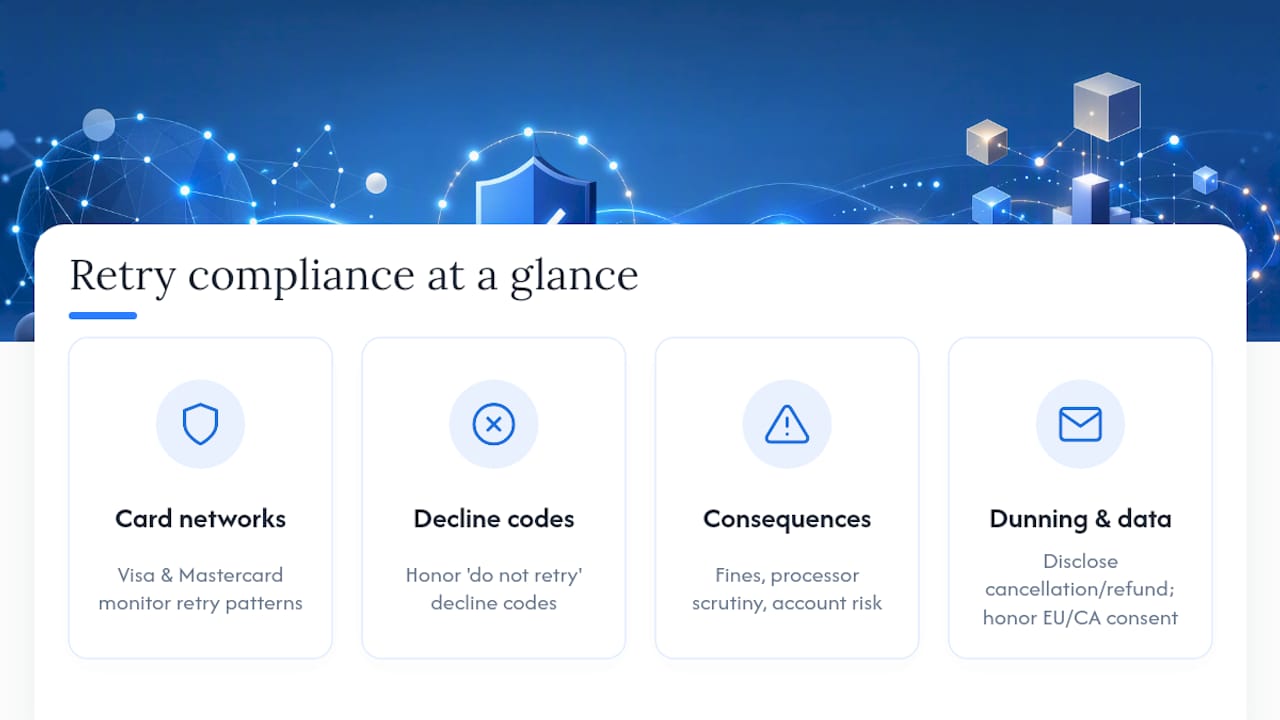
Dunning communications carry their own obligations. If your membership involves recurring billing disclosed at signup, most states require clear terms about cancellation rights and refund policies, and your dunning messages should never misrepresent what happens if a member doesn't act. Avoid language that implies legal consequences for a missed payment unless that's actually true for your business model. Framing messages around service continuity, rather than threats, keeps you on the right side of both tone and compliance.
Refunds tied to failed-then-recovered payments also need clean documentation. If a member disputes a recovered charge, you need a record showing when the original charge was attempted, when it failed, and when it succeeded, tied to the original invoice. That audit trail matters if a cardholder files a chargeback months later and your processor asks for proof of authorization.
Finally, if your membership serves customers in the EU or California, data handling rules around stored card details and customer contact information apply to your dunning outreach the same way they apply to marketing emails. Build consent and opt-out handling into your SMS and email sequences from the start rather than retrofitting it later.
Why Interval-ai Is Built for This Exact Problem
Everything covered above, decline-code classification, payday-aligned retry timing, and staged dunning, is exactly what Interval-ai automates for membership and subscription businesses.

Interval-ai's AI reads the merchant advice code on every failed charge and routes it automatically: soft declines get scheduled retries timed to payday windows, hard declines skip straight to a dunning sequence with no wasted attempts. That classification step alone is what separates a program that quietly recovers revenue from one that just fires the same retry at every failure and burns goodwill along the way.
The system runs outreach across email, SMS, and in-app messaging, keeping tone and timing consistent with your brand rather than sounding like a generic collections notice. It also connects to your existing accounting and CRM tools, so recovered payments reconcile against the original invoice without manual cleanup. Interval-ai reports clients cutting days-to-payment by more than 30 days and recovering revenue without adding collections staff, freeing up payroll budget that would otherwise go toward chasing declined cards by hand.

If your team is still handling failed membership payments with a single retry rule and a form email, see how Interval-ai's recovery platform works and book a demo to see your own decline-code breakdown analyzed.
A closing note on automation and revenue you already earned
The biggest mistake finance teams make with failed payments is treating every decline the same way. Codes exist because issuers are telling you exactly what to do next, and ignoring that signal wastes retries and burns member goodwill in equal measure.
Test retry timing the way you'd test any pricing change: in small increments, measured against recovered dollars, not just attempt volume. A failed membership payment isn't lost revenue. It's revenue still sitting on the table, waiting for the right code, the right day, and the right message.
— Tyler
Sources
- Dunning Management: How to Build a Recovery Process That Actually Works (May 2026)
- Dunning Management: The Complete Guide for SaaS (2026)
- Beancount
FAQ
What causes most failed membership payments?
Insufficient funds and expired or reissued cards cause most failures, with insufficient funds typically resolving on a timed retry and expired cards requiring Account Updater or a manual card refresh.
How many times should you retry a failed payment?
Most billing teams cap retries at 3 to 5 attempts spaced 10 to 14 days apart, timed near paydays, and never retry a charge flagged with a hard decline code.
What percentage of failed payments can be recovered?
A complete program combining Account Updater, smart retries, and dunning can recover 50 to 70% of failed payments, though results depend on decline-code mix and how quickly you act.
Does Interval-ai help with failed membership payments specifically?
Yes. Interval-ai classifies each decline by code, schedules retries around pay cycles, and runs multichannel dunning while syncing recovered payments to your accounting system.
Should you pause or cancel a membership after repeated failures?
Offer a pause option before cancellation, especially for members with a strong payment history, since a pause preserves the relationship while giving them time to update billing details.
