
Gym Membership Collections: Finance Teams Cut 30+ Days, Keep Members
Published: September 6, 2026 · 8–9 min read
The most effective approach to gym membership collections combines automated, AI-driven dunning with self-service payment update links, escalating to human review only when retries stall. This recovers the vast majority of failed payments without a single collections call. Interval-ai and similar operator-focused platforms build this exact workflow, cutting days-to-payment while protecting the member relationship that a collections agency would burn.
TL;DR:
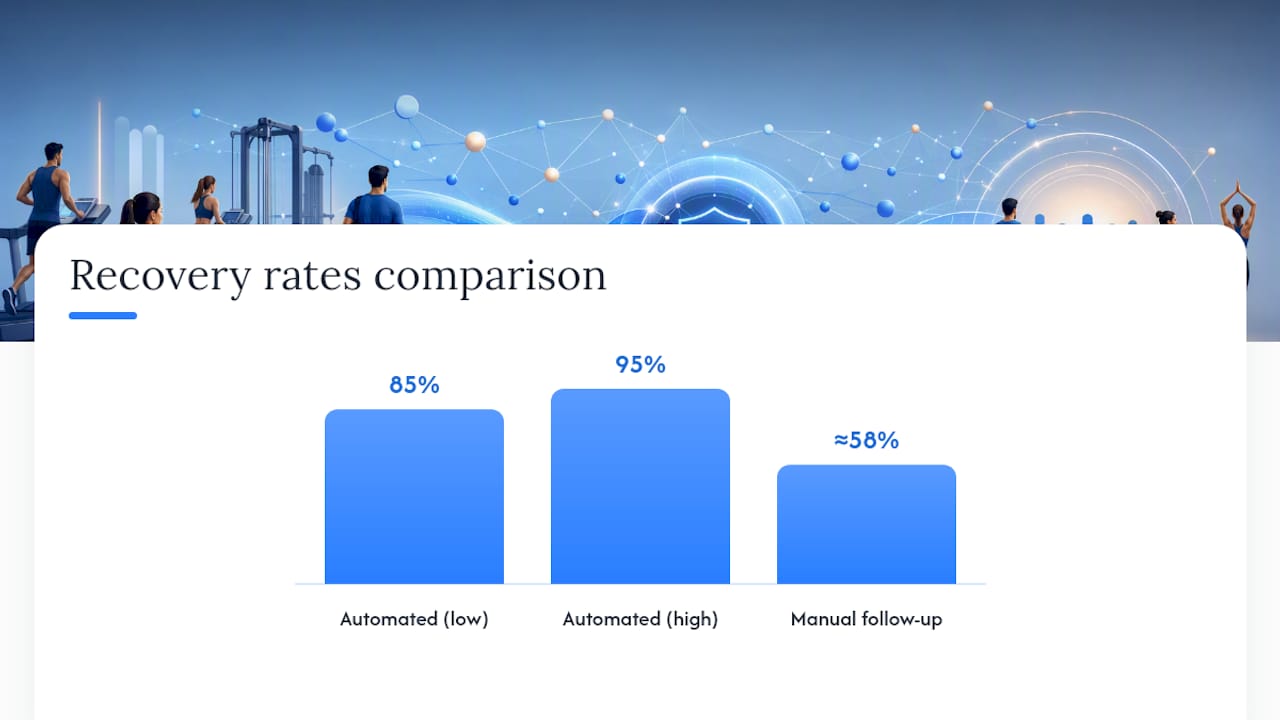
- Automated retry systems paired with member self-service links recover between 85% and 95% of failed payments, significantly higher than manual follow-up.
- A typical dunning sequence schedules retries and reminders from Day 0 to Day 30, employing SMS, email, and in-app messages with clear instructions and secure links.
- Before automation, gyms must ensure support for account updater services, PCI compliance, a tested self-service portal, and documented retry and access rules.
- Integrations should include membership software, payment processors, accounting platforms, access controls, and CRM for smooth data flow and accurate reporting.
- Automated recovery is most effective within the first 30 to 45 days; after that, escalation to human review or collections is recommended, especially for disputed charges or repeated declines.
How Do Automated Gym Membership Collections Actually Work?
A failed charge triggers a chain of events, not a single action. The card declines, the system checks whether an updated card number exists through an account-updater service, then schedules a retry at a calculated interval rather than an arbitrary next billing date. If the retry fails, the member gets a message. If it succeeds, the account reconciles automatically and access resumes without a staff member touching the file.
That lifecycle depends on a few core components working together:
- Payment gateway and tokenization: stores card data securely and enables retries without asking the member to re-enter anything.
- Retry scheduler: times attempts based on when a card is likely to have available funds, not a fixed daily loop.
- Communication engine: sends SMS, email, or in-app alerts tied to the retry schedule.
- Self-service update pages: let members fix a card in one tap instead of calling the front desk.
- Access-control integration: syncs membership status so gate access updates automatically when payment resolves.
- Accounting sync: pushes reconciled payments into your books without manual entry.
AI enters at the optimization layer. Instead of retrying every failed card on day three, machine learning models look at historical payment patterns for that member and predict when a retry is most likely to clear. That same logic segments members by risk, so a first-time decline gets a gentle nudge while a repeat offender gets flagged for human review sooner.
Statistic to know: Systems that pair retry logic with automated member outreach report recovery rates between 85% and 95%, compared with roughly 58% for manual follow-up. That gap alone often justifies the switch before you even factor in staff time saved.
What Should a Gym Dunning Sequence Look Like?
Dunning is the structured sequence of retries and reminders that happens before anyone escalates a case. Get the timing and tone right, and most declines resolve themselves within a couple of weeks.
- Day 0. Card declines. System checks the account updater for a fresh card number and retries immediately if one exists.
- Day 2 to 3. First member message. Short SMS with a one-tap secure link works best here since the goal is urgency and speed.
- Day 7. Second retry attempt, paired with an email that includes the amount owed, the reason for the decline, and a clear link to update payment.
- Day 14. Third message across a different channel. If SMS and email haven't worked, try in-app notification tied to the member's next check-in attempt.
- Day 21 to 30. Final automated notice before the account moves to human review, stating the consequence plainly (suspension or hold on access).
Channel choice matters more than most operators assume; effective communications and retention strategies are key, as explained in Gym SEO Services. SMS works best for urgent, one-tap fixes, email is better for anything the member might need as a record later, and in-app messages catch people at the moment they're already engaging with your gym. Every message should include four things: the reason for the charge, the exact balance, a secure link to update payment, and a confirmation once the account resolves.
Pro Tip: Send the resolution confirmation even when the member fixes it themselves through the self-service link. Silence after a payment update reads as uncertainty, and uncertainty is what drives a support call you didn't need to field.
What Do You Need to Set Up Before Automating Collections?
Before you flip the switch on automated retries, a few contract and technical items need to be locked down. Skipping this step is the single biggest reason automation rollouts create more support tickets instead of fewer.
- Contract language: explicit payment consent at signup, clear cancellation terms, and a stated fee for failed payments or suspended accounts.
- Gateway and tokenization: confirm your payment processor supports account-updater services and PCI-compliant card storage.
- Secure update pages: test that the self-service link actually works on mobile, since most members will click it from a phone.
- Test matrix: run scenarios for freezes, cancellations, refunds, and membership upgrades before launch, since these are where automation most commonly breaks.
- Retry schedule: decide how many attempts happen before escalation and document it.
- Suspension and access rules: define exactly when access control locks a member out and who can override it.
- Payment-plan option: build a path for members who need to spread a balance rather than pay it all at once.
- Staff roles: assign who reviews flagged accounts and who has authority to waive a fee.
Get these documented once, and the automation runs on rails instead of guesswork.
Which Integrations and KPIs Actually Matter?
Collections automation only works as well as the systems it's connected to. At minimum, connect your billing or membership software, payment gateway, accounting platform (QuickBooks or Xero are the common choices), access control system, and CRM. Miss the access-control link and you'll still have staff manually locking out delinquent accounts, which defeats the point of automating anything.
Track a short list of numbers weekly, not dozens:
- Failed-payment recovery rate: the percentage of declined charges eventually collected.
- Days to payment: the average time from decline to resolution.
- Involuntary churn: members lost specifically to failed payments, not voluntary cancellations.
- Staff hours saved: a rough estimate of manual follow-up time eliminated.
- Recovered revenue: the dollar total collected through automated retries and outreach.
Statistic to know: For enterprise clubs, pairing intelligent retry timing with a managed recovery service tends to outperform automation alone, particularly on accounts that need a human touch.
Daily dashboards should flag new declines. Weekly reports should show recovery rate trends. Monthly reviews are where you catch slow creep in involuntary churn before it shows up in your revenue line.
When Should You Escalate Beyond Automation?
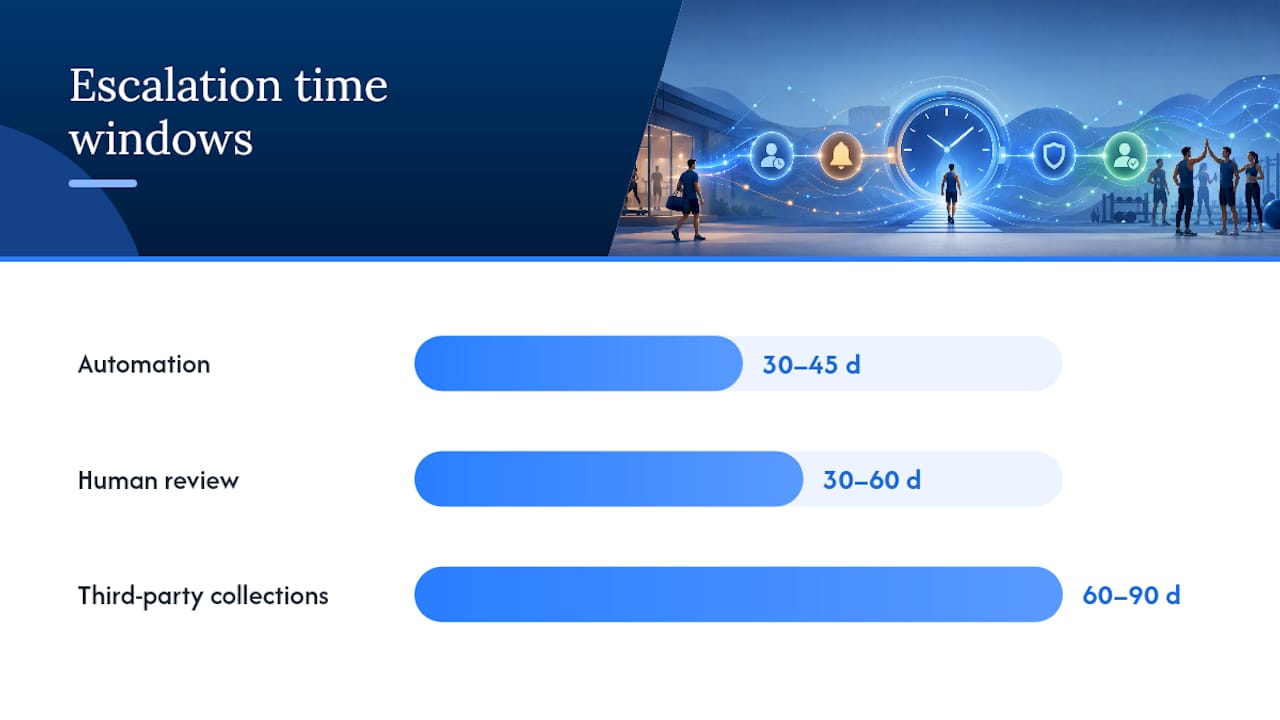
Automation should handle the first 30 to 45 days. Human review takes over from roughly day 30 to 60, and third-party collections only enters the picture past 60 to 90 days, depending on your policy.
Escalate to a human when you see:
- Repeated failed retries with no card update after multiple attempts.
- A disputed charge or a member claiming fraud.
- A broken promise to pay after a scheduled arrangement.
Before handing anything to a collections agency, consider a structured payment plan or promise-to-pay arrangement, a partial settlement, or a temporary access suspension. Third-party collections often recovers only 10 to 30 cents on the dollar and tends to damage the relationship for good.
What Kind of ROI Should You Expect?
The math is straightforward once you have your numbers.
Statistic to know: Clients using AI-driven collections platforms like Interval-ai report reducing days-to-payment by more than 30 days compared with manual chasing, and some report saving thousands in payroll costs by removing the need for dedicated follow-up staff. Model your own recovered revenue using your decline rate, average dues, and current days-to-payment as the baseline.
What I'd Tell Any Gym Owner Turning This On
The biggest mistake is skipping the test matrix. Freezes and cancellations break more automated workflows than actual bad cards do. Start small: turn on the account updater first, add mobile one-tap links second, then run a 30-day pilot on one location before rolling out everywhere. Watch days-to-payment weekly. If it hasn't moved by day 60, something in your retry timing or messaging tone needs adjusting, not scrapping.
— Tyler
A Faster Way to Recover Gym Membership Dues
Most gyms patch this together with a payment gateway's basic retry settings and a front-desk manager sending manual texts. That works until volume grows, and then it quietly costs you staff hours you never budgeted for. Interval-ai is built specifically for this problem: AI-tailored outreach that adjusts tone and timing per member, multi-channel automation across SMS, email, and in-app, and integrations that sync directly with your billing and accounting stack.

Some clients report recovering meaningful revenue with fewer payroll costs, attributing days-to-payment improvements to retry intelligence rather than expanding collections staff. If your current process still relies on someone manually chasing declined cards, a demo of Interval-ai's platform will show you exactly where the automation gap is costing you.
Sources
For deeper implementation detail, see the gym billing automation guide and the operator's guide to payment collection.
- Gym Billing Automation: Recover 95% of Failed Payments
- Automated Payment Collection for Gyms: The Operator's Guide | Fitness GM
- Fitness Club Billing Software: The 2026 Buyer's Guide for Enterprise Health Clubs | Club Automation
FAQ
What Is the Best Way to Recover Unpaid Gym Membership Fees?
Automated dunning that combines retry scheduling, account-updater services, and multi-channel outreach recovers the most revenue while keeping the member relationship intact, typically outperforming manual collection by a wide margin.
How Long Should Automated Retries Run Before Escalating?
Most operators run automated dunning for 30 to 45 days, move to human review between day 30 and 60, and reserve third-party collections for accounts past 60 to 90 days.
What Integrations Does Gym Membership Billing Software Need?
At minimum, connect your billing or membership platform, payment gateway, accounting software like QuickBooks or Xero, access control system, and CRM so payment status updates flow automatically.
Can AI Actually Improve Gym Payment Recovery Rates?
Yes.
What Happens If a Member Disputes a Charge?
Route disputed charges to human review immediately rather than continuing automated retries, since repeated attempts on a disputed charge can escalate the conflict instead of resolving it.
