
How AI Collections Technology Works for Finance Teams

Published: June 12, 2026 · 11–12 min read
TL;DR:
- AI collections technology integrates machine learning, real-time data, and automated outreach to optimize overdue payment recovery. It uses customer ranking and channel preference models, continuously retrained, to prioritize efforts and adapt strategies instantly based on live engagement data. Built-in compliance enforcement and seamless ERP or CRM integration ensure efficient, legal, and customer-sensitive debt recovery processes.
AI collections technology is defined as the integration of machine learning models, real-time data processing, and automated omnichannel outreach to predict, prioritize, and recover overdue payments at scale. If you manage cash flow for a business, understanding how AI collections technology works gives you a direct advantage over competitors still relying on manual follow-up and generic payment reminders. Platforms like EXL PayMentor and Microsoft's AI-assisted finance workflows have already demonstrated what this technology can do in production environments. The core components are customer ranking models, channel preference prediction, real-time engagement tracking, and compliance enforcement built directly into the infrastructure. Together, they replace guesswork with data.
What are the core machine learning models in AI collections?
The two primary models powering AI collection systems are the Customer Ranking Model and the Channel Preference Model. Each serves a distinct purpose, and together they determine who gets contacted, when, and how.

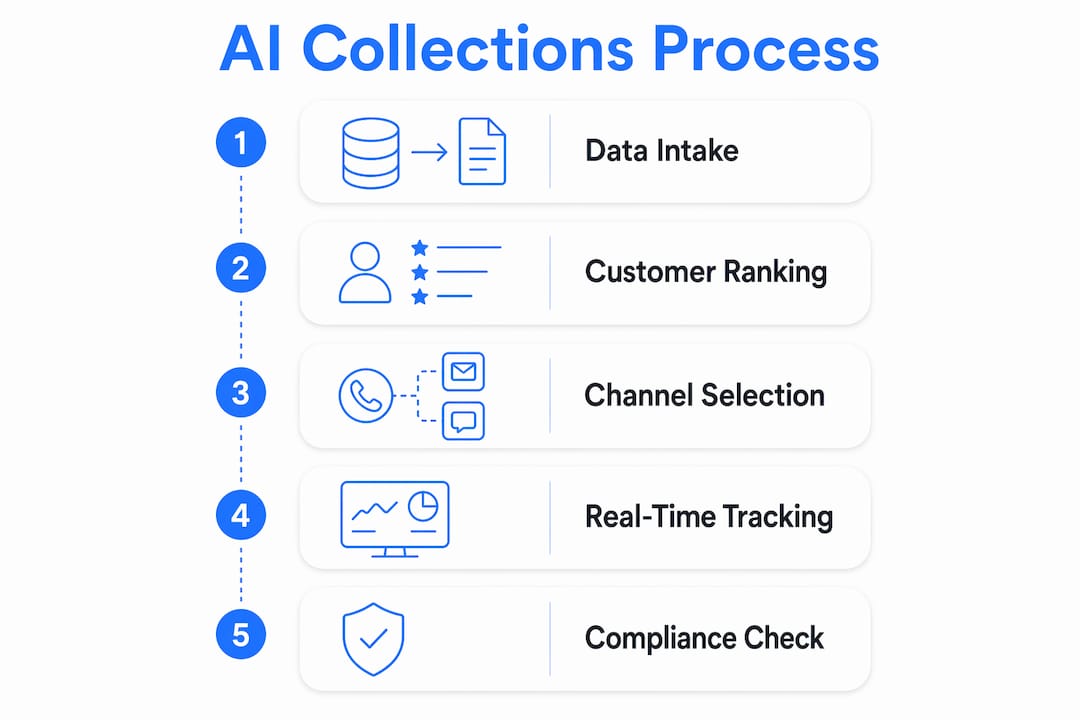
The Customer Ranking Model predicts the probability that a specific customer will pay and estimates the most likely timing of that payment. It draws on payment history, days past due, account balance, and behavioral patterns like whether a customer opened a previous email or responded to a prior call. The output is a ranked list of accounts, so your collections team focuses effort on accounts most likely to convert rather than working through a flat spreadsheet in alphabetical order.
The Channel Preference Model works alongside the ranking model to recommend the best outreach method for each customer. One customer may respond consistently to SMS. Another may only engage after a formal email. A third may require a voice call. AI models in collections use payment history, engagement signals, and behavioral patterns as inputs to make these recommendations with measurable accuracy.
Both models are retrained on a weekly cycle to incorporate the latest customer interaction data. This matters because customer behavior shifts. A contact method that worked three months ago may now go ignored. Weekly retraining keeps the models current without requiring manual reconfiguration from your team.
Pro Tip: Before deploying any AI collection system, audit the quality of your historical payment and engagement data. Models trained on incomplete or inconsistent records produce unreliable rankings, no matter how sophisticated the underlying algorithm.
The practical result of these two models working together is a prioritized, personalized outreach queue. Your team stops wasting time on low-probability accounts and stops sending the wrong message through the wrong channel. That combination alone reduces cost per dollar recovered and shortens the average days to payment.
How does real-time engagement tracking improve collections outcomes?
Real-time engagement tracking is the mechanism that allows an AI collection system to adapt its strategy within minutes of a customer interaction rather than waiting until the next business day. The difference between minute-level feedback and 24-hour batch processing is not just technical. It directly affects how much money you recover and how quickly.
Traditional collections platforms process engagement data in batches, often overnight. If a customer clicks a payment link but does not complete the transaction, that signal may not reach your strategy engine until the following morning. By then, the window for a timely follow-up has closed. Amazon Kinesis streaming reduces that feedback latency from up to 24 hours to minutes, capturing SMS, email, and voice interactions as they happen.
The table below illustrates the operational difference between batch and streaming architectures in collections:
| Feature | Batch processing | Streaming (e.g., Amazon Kinesis) |
|---|---|---|
| Feedback latency | Up to 24 hours | Minutes |
| Strategy update timing | Next-day | Near real-time |
| Channel optimization | Static per cycle | Dynamic per interaction |
| Compliance monitoring | Retrospective | Continuous |
| Customer experience | Delayed responses | Timely, relevant outreach |
Serverless components like AWS Lambda and AWS Step Functions handle the logic that fires after each engagement event. When a customer opts out of SMS, that preference propagates immediately across all active outreach sequences. When a customer opens an email but does not click, the system can escalate to a voice attempt within the same day rather than repeating the same email the following week.
Streaming long-term AI memory architecture also allows AI agents to maintain chronological context across sessions. The system remembers that a customer promised to pay on a specific date, that a previous call ended in a dispute, or that a particular message format consistently generates responses from this account. That memory is stored in vector databases for fast retrieval and used to personalize every subsequent interaction.
Pro Tip: Ask any AI collections vendor specifically how their system handles opt-out propagation. If the answer involves a manual step or a delay longer than a few minutes, that is a compliance risk you cannot afford.
What compliance and security measures are built into AI collections?
Compliance in AI collections is not a feature you add on top of the system. It is enforced at the infrastructure and dialer level before any outreach is triggered. This distinction matters because it removes the risk of human error in a regulatory environment governed by the FDCPA, Regulation F, and the TCPA.
Compliant debt collection AI enforces call frequency caps, validation notice delivery, and opt-out request propagation automatically and with full audit trails. Every contact attempt is timestamped. Every consent check is logged. Every opt-out is recorded and propagated in real time. These logs are exportable for legal defensibility, which is critical if a regulator or attorney requests documentation of your outreach history.
The architecture that makes this possible separates the ML scoring layer from the deterministic strategy engine. Separate ML scoring layers and rule-based strategy engines allow regulatory caps, consent enforcement, and escalation thresholds to be applied before any outreach action is triggered. The ML model recommends. The strategy engine decides whether the recommendation is legally permissible given the current consent state and contact history.
The comparison below shows how compliance is handled in traditional versus AI-native collections systems:
| Compliance control | Traditional system | AI-native system |
|---|---|---|
| Call frequency caps | Manual tracking | Automated enforcement |
| Opt-out propagation | Batch update | Real-time across all channels |
| Consent verification | Agent-dependent | Infrastructure-level check |
| Audit trail | Partial, manual | Timestamped, exportable |
| Sensitive case handling | Supervisor escalation | Human-in-the-loop checkpoint |
Security controls include encryption at rest and in transit, multi-account isolation to prevent data bleed between clients, and certifications like PCI-DSS and SOC 2. For financial managers, these certifications are not just checkboxes. They are the baseline requirement for any vendor handling payment data on your behalf.
Human-in-the-loop checkpoints are preserved for sensitive cases, such as accounts in active dispute or customers who have indicated financial hardship. Automation handles the routine. Humans handle the exceptions. That balance protects both your recovery rate and your customer relationships.
How is AI integrated into collections workflows and systems?
AI integration in collections goes beyond standalone scoring tools. The most effective implementations embed AI directly into the ERP and CRM systems your finance team already uses, so insights translate immediately into action without requiring a separate platform login.
Microsoft's own finance team provides one of the clearest documented examples of what this looks like in practice. Here is how their AI-assisted collections workflow operates:
- Data unification. SAP and Dynamics 365 data are consolidated into a single source of truth. Data integration into a single source is as important as the machine learning itself for reducing manual overhead and improving workflow efficiency.
- AI-assisted prioritization. Copilot surfaces the highest-priority accounts each morning based on payment probability scores, outstanding balance, and aging data. Collectors no longer decide where to start. The system decides for them.
- Automated dispute routing. Incoming dispute emails are classified by AI and routed to the correct resolution team without manual triage. This eliminates a common bottleneck that delays resolution and extends days sales outstanding.
- Payment matching. Microsoft improved payment matching accuracy from 40% to 90% and applied 98% of payments within 48 hours using AI-enabled workflows. That improvement directly reduces the time your team spends reconciling accounts manually.
- Conversational AI agents. AI agents embedded in ERP systems like Oracle E-Business Suite can query AR analytics using natural language and execute actions such as credit holds and dunning letters without leaving the system. A collector can ask "Which accounts over 60 days have not responded to any contact in the last two weeks?" and receive an answer in seconds.
The productivity gains from this level of integration are not marginal. Fewer errors in payment matching, faster dispute resolution, and automated prioritization each reduce the administrative burden on your team. The result is more accounts managed per collector and faster average resolution times across your portfolio.
Key takeaways
AI collections technology works because machine learning models, real-time data pipelines, and compliance-enforced strategy engines work together to replace manual guesswork with automated, personalized, and legally defensible payment recovery.
| Point | Details |
|---|---|
| Two core ML models | Customer ranking and channel preference models drive prioritization and personalized outreach. |
| Real-time feedback loops | Streaming architectures like Amazon Kinesis reduce strategy latency from 24 hours to minutes. |
| Compliance at infrastructure level | FDCPA, Regulation F, and TCPA controls are enforced automatically before outreach is triggered. |
| ERP/CRM integration | Embedding AI in systems like SAP and Dynamics 365 turns insights into immediate action. |
| Data quality is the foundation | Unified, accurate historical data determines how well every downstream model performs. |
What I've learned from watching AI collections mature in practice
The technology described in this article is real, proven, and already deployed by organizations like Microsoft and EXL. But the businesses that get the most from it are not the ones with the most sophisticated models. They are the ones that did the unglamorous work first.
Before any machine learning model can rank your customers accurately, your payment history data needs to be clean, complete, and consistently structured. I have seen finance teams invest in AI platforms and then spend six months untangling inconsistent invoice records before the system could produce reliable output. The AI did not fail. The data infrastructure was not ready.
The second thing I would tell any financial manager considering this path is to take compliance seriously from day one. The FDCPA and TCPA carry real penalties, and the "we didn't know" defense does not hold up when you are using an automated outreach system. Verify that your vendor enforces compliance at the infrastructure level, not just through agent training or conversation scripts.
The third observation is about change management. Collections teams are often skeptical of AI prioritization because it removes the autonomy they have built their workflows around. The teams that adopt fastest are the ones where managers explain the logic behind the ranking, show collectors the data behind the recommendations, and treat the AI as a tool that supports their judgment rather than replaces it. Automation handles volume. Human judgment handles nuance. That combination is more effective than either alone.
The future direction is toward tighter memory models and more transparent AI. Systems that remember the full history of a customer relationship, not just the last 30 days, will produce better recommendations. And as regulators pay closer attention to automated outreach, the ability to explain exactly why a system made a specific decision will become a competitive requirement, not just a nice feature.
— Tyler
See how Interval-ai puts these principles into practice
If you are ready to move from understanding AI collections technology to actually deploying it, Interval-ai is built for exactly that transition.
Interval-ai consolidates your payment history, builds customer context automatically, and manages outreach across email, SMS, and voice without adding headcount. Clients report reducing days to payment by over 30 days and recovering significant balances without hiring additional staff. The platform handles compliance monitoring, channel optimization, and follow-up sequencing so your finance team focuses on exceptions, not repetitive tasks. If you want to see how the system adapts to your specific customer base and payment patterns, request a demo directly through the Interval-ai website.
FAQ
What is AI collections technology?
AI collections technology is the use of machine learning models, real-time data processing, and automated communication tools to predict payment likelihood, personalize outreach, and recover overdue accounts at scale. It replaces manual follow-up with data-driven, automated processes that adapt based on customer behavior.
How does AI decide which customers to contact first?
A Customer Ranking Model scores each account based on payment history, days past due, balance, and behavioral signals to predict payment probability. Accounts with the highest likelihood of paying are prioritized, so collections effort is concentrated where it produces the most return.
How does AI collections technology stay compliant with FDCPA and TCPA?
Compliance is enforced at the infrastructure and dialer level, with automatic frequency caps, real-time consent checks, and opt-out propagation built into the system before any outreach is triggered. Timestamped audit logs provide legal defensibility if your practices are ever reviewed.
What results can businesses expect from AI-enabled collections?
Microsoft's implementation improved payment matching accuracy from 40% to 90% and applied 98% of payments within 48 hours. Interval-ai clients report reducing days to payment by over 30 days without adding staff.
Do you need technical expertise to implement AI collections tools?
Most modern AI collections platforms integrate directly with existing ERP and CRM systems like SAP, Dynamics 365, and Oracle E-Business Suite. The setup requires clean historical data and clear workflow mapping, but does not require a dedicated data science team to operate day to day.
