
How AI Handles Business Communications in 2026
Published: May 29, 2026 · 9–10 min read
TL;DR:
- AI in business communications operates across three distinct workflow roles: lead, assist, and follow, each shaping response times, agent productivity, and data quality. Implementing a comprehensive governance structure with human oversight is essential to maintain compliance and customer trust, especially in high-stakes interactions. Hybrid AI-human workflows improve speed, accuracy, and customer satisfaction, extending staff capabilities without replacing personnel.
Most business leaders assume AI in communications means a chatbot answering FAQs. The reality is far more layered. Understanding how AI handles business communications today means recognizing that AI operates across three distinct workflow stages: before the conversation begins, during live interactions, and after the exchange ends. These stages, collectively described in the field as AI-augmented communication workflows, affect response times, agent productivity, compliance exposure, and customer experience all at once. This guide breaks down each layer so you can make genuinely informed decisions about where and how to deploy AI tools for business interactions.
Key Takeaways
| Point | Details |
|---|---|
| AI plays three workflow roles | Lead, assist, and follow roles each address a different stage of the communication process. |
| Virtual agents outperform chatbots | Only virtual agents can execute multi-system actions like retrieving CRM data and filing tickets autonomously. |
| Governance is non-negotiable | Human-in-the-loop approval workflows protect quality and compliance, especially for high-stakes messages. |
| Hybrid workflows deliver the best results | AI drafting combined with human review produces higher throughput and better customer experience than either approach alone. |
| Agentic AI adoption is accelerating fast | Integrated agentic architectures are expected in 40% of enterprise applications by the end of 2026. |
How AI handles business communications: the three-role framework
Most descriptions of AI in business messaging focus on automation as if it were a single switch you flip. It is not. According to communication technology analysts, AI operates across three roles in any given workflow: lead, assist, and follow.
The lead role is what most people picture. AI takes the first interaction, handles customer-facing touchpoints, routes inquiries, and manages initial responses without any human involvement. Virtual agents, automated SMS replies, and AI-powered phone receptionists all belong here.
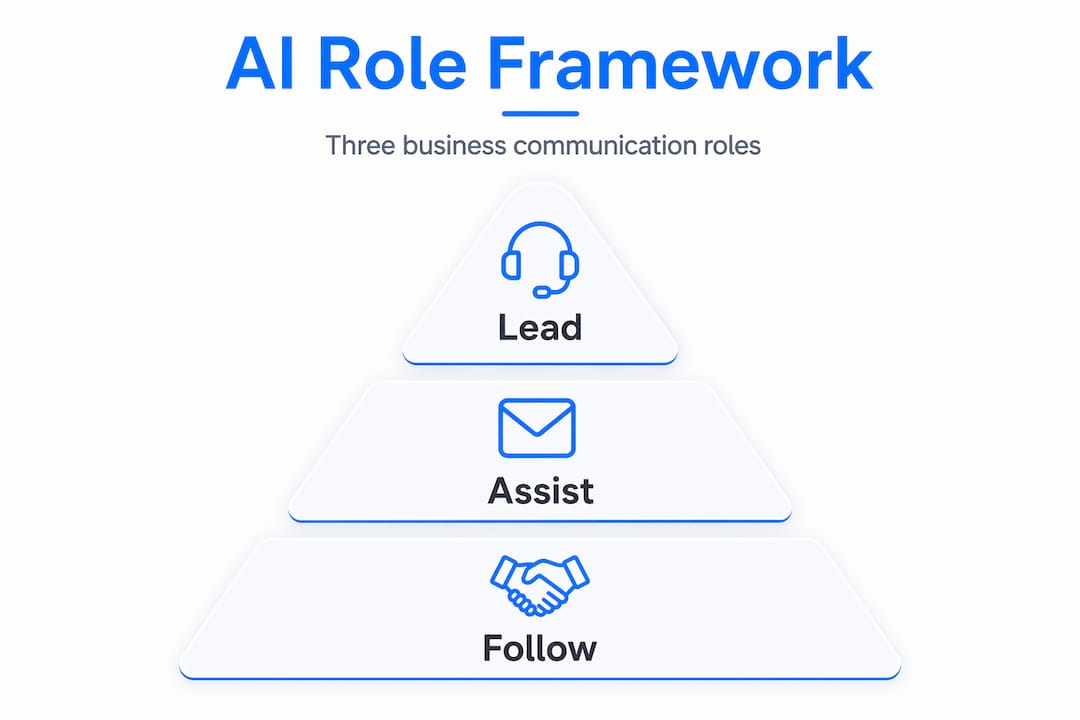
The assist role is less visible but arguably more impactful for your team. Here, AI works alongside your staff in real time during live interactions. Think transcription running in the background during a call, suggested reply prompts appearing as an agent types, and sentiment analysis flagging frustration before it escalates. AI improves communication quality here without replacing the human doing the work.
The follow role is where a lot of ROI gets left on the table. After a conversation ends, AI can generate summaries, update CRM records, trigger next-step workflows, and produce analytics that inform future interactions. This turns every completed conversation into structured data your business can act on.
- Lead role reduces wait times and handles volume spikes without adding headcount
- Assist role gives agents better information faster, cutting handle time and errors
- Follow role produces consistent records and removes the manual work of post-call documentation
Pro Tip: Map your current communication workflow against these three roles before purchasing any AI tool. Most businesses have gaps in the follow role, which is where manual effort quietly accumulates.
Chatbots vs. virtual agents vs. agentic architectures
The terminology here trips up a lot of smart leaders. These three categories are not interchangeable, and choosing the wrong one for your use case costs real time and money.
| Type | Scope | Multi-system actions | Best for |
|---|---|---|---|
| AI chatbot | Single channel | No | Simple FAQs, lead capture |
| Virtual agent | Multi-channel | Yes | CRM lookups, ticket filing, follow-ups |
| Agentic architecture | Cross-workflow | Yes, coordinated | End-to-end process automation |
AI chatbots typically operate within a single channel and handle limited, scripted tasks. Virtual agents go further. They can retrieve CRM records, file support tickets, send follow-up emails, and take action across multiple systems without waiting for a human prompt. That distinction matters enormously when your goal is reducing handle time rather than just deflecting simple questions.
Agentic architectures take this a step further by coordinating multiple task-specific AI agents working in parallel across your workflows. One agent handles intent detection, another pulls account data, a third drafts the response, and a fourth logs the outcome. Agentic systems are projected to appear in 40% of enterprise applications by end of 2026, up from under 5% just 18 months ago.
A strong real-world example is how AI receptionists now handle overflow calls and SMS inboxes by interpreting customer intent, maintaining context across the conversation, and escalating to a human only when truly necessary. That is a virtual agent, not a chatbot, and the operational difference shows up directly in customer satisfaction scores.
Pro Tip: If you are evaluating AI tools for your communications team, ask vendors specifically whether their product can execute multi-system actions. If it cannot, you are buying a chatbot, not a virtual agent, regardless of what the marketing says.
Governance and human oversight in automated communications
Automating business communications without a clear governance structure is one of the fastest ways to damage customer trust and create compliance exposure. This is not a theoretical risk. It is a well-documented failure pattern.
The best-designed systems place AI between content creation and delivery, with explicit validation and human approval gates before anything reaches your customer. Here is how a practical governance framework works in practice:
-
Set urgency-based approval tiers. High-stakes messages, like payment disputes or service terminations, require synchronous human review before sending. Routine follow-ups can be approved asynchronously or sent autonomously. Timeout thresholds tied to email urgency prevent bottlenecks while maintaining appropriate oversight.
-
Separate AI agent inboxes from personal staff inboxes. Dedicated AI mailboxes with approval gates contain the blast radius of any errors. When an AI-drafted message has an issue, it affects only the AI mailbox, not a staff member's primary correspondence.
-
Build explicit escalation paths. Every automated communication workflow needs a defined path to a human reviewer when the AI's confidence is low or the topic is sensitive. Reliable systems require explicit SLAs and fallback escalation routes to prevent silent queues that erode trust over time.
-
Plan for regulatory compliance now. The EU AI Act takes full effect August 2026, requiring businesses using AI in high-risk communication contexts to maintain documentation, conformity assessments, and incident reporting procedures.
"Starting AI transformation with clear outcomes and redesigning decision rights, governance, and accountability shifts AI communications from productivity hacks to full process transformation." — BCG, 2026
The human-in-the-loop (HITL) model is not a sign that your AI is immature. It is a sign that your organization is managing AI responsibly. The goal is not to remove humans from the process entirely. The goal is to put humans where their judgment adds the most value.
Practical benefits of AI-augmented communication workflows
When the three-role framework and governance structures are in place, the operational benefits become measurable and significant. Here is what businesses are actually seeing:
-
Faster response times. AI handling first-contact responses around the clock eliminates the delay that occurs between a customer message and a staff member opening their inbox the next morning. Silence reads as permission to wait, and customers act on that.
-
Higher agent productivity. Real-time assist tools reduce the cognitive load on your team. Agents spend less time searching for account information and more time resolving issues. This directly affects how many interactions a single team member can handle per day.
-
Better decisions from better data. The follow role produces structured summaries and conversation analytics that manual processes simply do not generate at scale. When every interaction is documented consistently, you can actually see patterns in why customers contact you, what resolves their issues, and where your process breaks down.
-
Stronger cross-channel records. Unified contact records threading messages across channels prevent the fragmented experience that causes silent customer churn. A customer who emailed last week and calls today expects you to know both interactions. AI systems preserving context across WhatsApp, SMS, email, and voice make that possible.
Research on hybrid AI-human communication models shows that AI drafts roughly 78% of first-pass replies, with humans approving, editing, or escalating the remainder. This split delivers throughput that neither a fully automated nor a fully manual team can match.
The economic case is direct. You are not replacing staff. You are extending what your existing staff can accomplish per hour while maintaining the quality and personal touch that automated-only systems consistently fail to deliver.

My honest take on AI in communications
I've worked with enough teams adopting AI in business messaging to say this clearly: the biggest failure I see is not technical. It's organizational. Leaders buy AI tools expecting them to work like a new hire who figures things out. They do not.
What I've learned is that every successful AI communication deployment I've encountered had one thing in common. Someone sat down, mapped every step of the existing communication workflow, and deliberately decided where AI would lead, where it would assist, and where a human would always be in control. That decision-making work happened before any software was purchased.
I've also seen what happens when organizations skip the governance design. The AI sends a confident but wrong reply to a high-value client. No escalation path existed, no one reviewed it, and the relationship took months to repair. The technology was not the problem. The missing human oversight structure was.
My advice to communication professionals reading this: measure success by more than cost savings. Track resolution rates, customer satisfaction scores, and escalation frequency. Those numbers tell you whether your AI is actually improving the experience or just moving volume through faster. Speed without quality is not progress.
— Tyler
How Interval-ai fits into your communication strategy
If you are looking to put these principles into practice, Interval-ai is built for exactly this kind of AI-augmented communication workflow. Interval-ai manages outreach across voice, SMS, and multi-channel touchpoints using a data-driven approach that adapts to your customers' actual payment behavior and communication history. The platform includes built-in approval logic and escalation workflows, so you get the speed of automation with the control your business requires. Clients using Interval-ai report recovering significant overdue balances while cutting days to payment by more than 30 days, without adding staff. If you want to see how AI-managed communications translate to real cash flow improvement, explore Interval-ai and see what a well-governed AI communication system looks like in action.
FAQ
What are the three roles AI plays in business communications?
AI operates in lead, assist, and follow roles. The lead role handles initial customer-facing interactions, the assist role supports staff in real time during conversations, and the follow role automates post-conversation documentation and reporting.
How is a virtual agent different from a chatbot?
A virtual agent can perform multi-system actions like pulling CRM data, filing tickets, and sending follow-ups autonomously. A chatbot typically operates within a single channel and handles only scripted, limited tasks.
What is human-in-the-loop (HITL) in AI communications?
HITL means AI-generated messages are paused for human review before delivery. High-stakes messages get synchronous approval, while routine messages may send autonomously, with timeout and escalation rules preventing delays.
What regulations apply to AI in business communications?
The EU AI Act, fully effective August 2026, requires businesses using AI in high-risk communication contexts to maintain documentation, conduct conformity assessments, and report serious incidents to regulators.
Do hybrid AI-human workflows actually outperform full automation?
Yes. Research shows AI drafts approximately 78% of first-pass replies in hybrid workflows, with humans handling escalations. This approach consistently outperforms both full automation and fully manual processes in throughput and customer satisfaction.
