
How Automated Dispute Workflows Work in 2026
Published: August 8, 2026 · 16–17 min read
Automated dispute workflows are systematic, AI-powered sequences that handle payment disputes from intake through resolution with minimal manual effort. Instead of chasing emails and spreadsheets, your finance team gets a structured pipeline: disputes are detected, categorized, enriched with evidence, and resolved or escalated based on defined rules and machine learning models. Platforms like HighRadius, Solidgate, and Interval-ai each bring this model to life differently, but the core mechanics are consistent across the industry.
Here is what that looks like in practice:
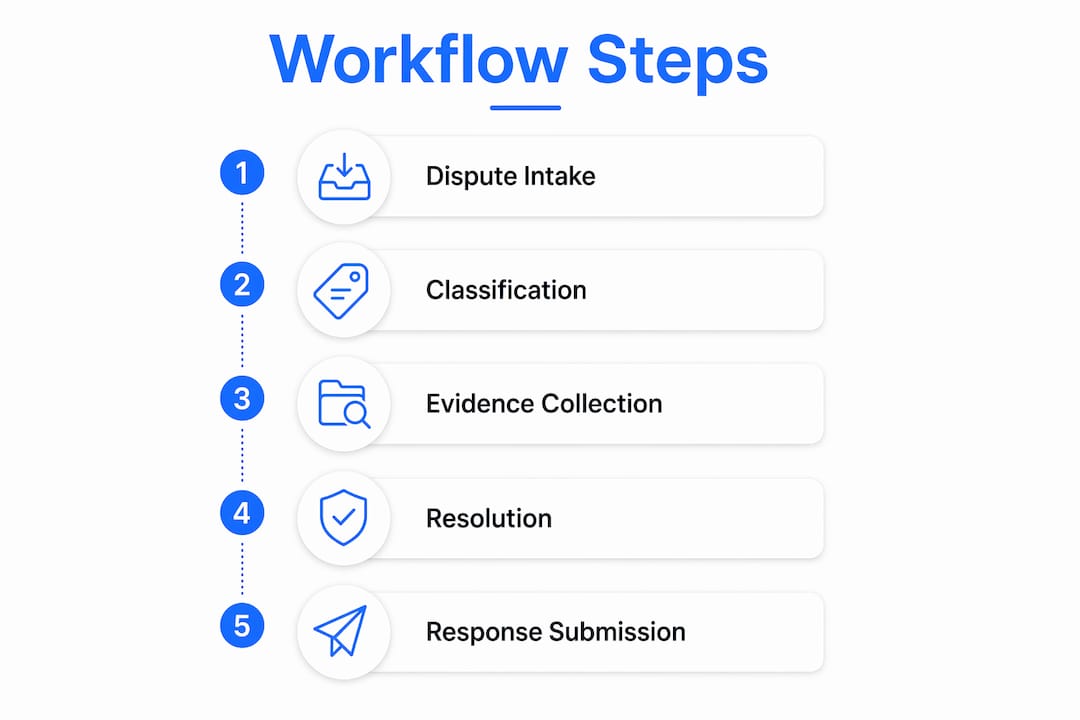
- Dispute intake: Structured capture of dispute details via chatbot, portal, or API feed from payment processors
- Classification: AI categorizes the dispute type, assigns priority, and scores win likelihood
- Evidence assembly: The system pulls transaction records, delivery confirmations, and communication logs automatically
- Auto-resolution or escalation: Simple cases resolve instantly; complex ones route to a human reviewer
- Response submission: Evidence packages are submitted to card networks or counterparties on time, every time
- Outcome tracking: Results feed back into the model to improve future decisions
The payoff is real. Automated pipelines reduce average dispute resolution time from 23 days to 6 days, a 74% improvement that frees cash 17 days earlier per resolved case. Human-in-the-loop design keeps the process trustworthy for complex cases where AI alone should not have the final word.
How automated dispute workflows operate step by step
Every effective automated dispute resolution process follows a defined sequence. Skipping or collapsing steps is where most implementations run into trouble.
-
Dispute detection and intake — The workflow begins the moment a dispute signal arrives, whether from a card network chargeback notification, a customer email, or an ERP mismatch flag. AI-powered chatbots collect dispute details interactively, verify invoice and order data in real time, and resolve simple discrepancies instantly, cutting intake from days of back-and-forth email to minutes.
-
Categorization and classification — Once captured, the dispute is classified by type: billing error, service not rendered, duplicate charge, or friendly fraud, among others. Machine learning models assign a category and a win-likelihood score based on historical outcomes for similar cases.
-
Evidence collection and enrichment — This is where automation earns its keep. The system queries ERP, CRM, order management, and payment processor APIs simultaneously, pulling delivery confirmations, signed contracts, communication logs, and transaction records. Automated platforms can gather over 1,000 data points per case and submit evidence 100% on time, eliminating the deadline slips that cost teams winnable disputes.
-
Auto-resolution or escalation — Low-complexity disputes with clear evidence resolve automatically. Cases that fall outside confidence thresholds, or that involve fraud indicators, route to a human reviewer with a pre-built case summary already waiting.
-
Response submission — The system packages and submits the dispute response to the relevant card network, counterparty, or internal approver. Submission timestamps are logged for compliance.
-
Resolution tracking and feedback loop — Outcomes are recorded, win/loss data feeds back into classification models, and the system refines its evidence strategy over time.
Pro Tip: Use progressive disclosure during intake. Start with the dispute type and invoice number before asking for supporting documents. Structured intake reduces incomplete submissions and speeds up evidence assembly in every downstream step.
| Workflow Step | Primary Technology | Data Sources Involved |
|---|---|---|
| Dispute intake | Chatbot, API feed | Payment processor, customer portal |
| Classification | ML classification model | Historical dispute data, case attributes |
| Evidence collection | API orchestration, RPA | ERP, CRM, order management, logistics |
| Auto-resolution | Rule engine, ML scoring | Policy rules, win-likelihood model |
| Response submission | Workflow automation | Card network APIs, internal approval queue |
| Outcome tracking | Analytics dashboard | Resolution database, feedback loop |
What AI and automation actually do inside these workflows
The phrase "AI-powered dispute management" gets used loosely. Here is what the technology specifically does at each stage.

Natural language processing drives dispute intake chatbots, parsing unstructured customer complaints into structured fields. A customer types "I was charged twice for my March order," and the NLP layer extracts the charge type, date reference, and likely dispute category without human involvement.
Machine learning classification models evaluate incoming disputes against thousands of resolved cases to assign category labels and win-likelihood scores. These scores determine routing: high-confidence, high-win-probability cases go straight to automated representment; borderline cases go to a human queue.
Large language models draft rebuttal letters and evidence summaries. Instead of a specialist writing each response from scratch, the LLM generates a structured argument based on the assembled evidence, which a reviewer can approve or edit in minutes.
Modular AI agent architectures assign specialized agents to individual tasks: one agent parses claims, another validates evidence, a third checks rule compliance. This separation makes the system easier to update when card network rules change, without retraining the entire model.
"AI in arbitration refers to the use of software that uses artificial intelligence to assist processes during arbitration or make arbitration more efficient. It does not replace a human arbitrator. Rather, AI helps facilitate the initial case review and analysis so the human arbitrator can focus on the decision-making process." — American Arbitration Association, AI Arbitrator overview
That principle applies directly to payment dispute workflows. Human-in-the-loop checkpoint designs present AI analysis to a human reviewer before any consequential action, which is what drives adoption in finance teams that are rightly skeptical of black-box automation.
| Task | AI Handles | Human Handles |
|---|---|---|
| Dispute intake | Structured data capture, NLP parsing | Exception cases, missing data |
| Classification | Category assignment, win scoring | Ambiguous or novel dispute types |
| Evidence assembly | API queries, document retrieval | Verification of sensitive records |
| Rebuttal drafting | LLM-generated letter | Review, edit, approval |
| Resolution decision | Auto-resolve for clear cases | Complex, high-value, fraud-related cases |
Pro Tip: Design your automation to separate representment (fighting disputes) from deflection (preventing them). They require different data, different logic, and different success metrics. Mixing them in a single workflow creates accuracy problems and makes ROI measurement harder.
What you actually gain by deploying automated dispute workflows
The operational benefits of automating dispute management are measurable, not theoretical.
Resolution speed is the most immediate gain. Automated workflows reduce average resolution time from 23 days to 6 days, a 74% improvement that directly accelerates cash flow. For a finance team managing hundreds of open disputes, that is a meaningful shift in working capital — for detailed guidance on financial dispute resolution automation, see Tax Preparation in Boise, Meridian & Garden City.
Beyond speed, the financial impact compounds. Firms that automate dispute handling see a noticeable improvement in realization rates over time, driven by a substantial reduction in dispute volume and fewer write-downs from poorly documented cases. That is not a one-time gain; it accumulates every quarter the system runs.
Win rates improve too. AI-powered dispute management yields a strong ROI and a large increase in win rates by continuously analyzing outcomes and refining evidence packages. The system gets better the longer it runs.
Labor costs drop in parallel. Manual dispute handling pulls in staff from finance, sales, customer service, and operations. Automation cuts the repetitive coordination work, reducing cost per case and freeing your team for higher-value tasks. Firms that have deployed these systems report saving thousands in annual payroll costs that previously went toward dispute administration.
Statistic callout: Automated dispute pipelines cut resolution time from 23 days to 6 days, a 74% speed improvement that frees cash 17 days earlier per resolved case.
How dispute workflows connect with your broader finance operations
Automated dispute management does not operate in isolation. Its value multiplies when it is wired into the finance systems your team already uses.

The most direct integration points are ERP and billing platforms. When a dispute arrives, the workflow pulls invoice data, payment history, and contract terms directly from your ERP, eliminating the manual lookup that slows down evidence assembly. Order management systems contribute shipping confirmations and delivery records. Payment processors provide transaction timestamps and authorization codes. All of this happens in seconds via API, not over two days of email requests.
That real-time data access also enables proactive dispute deflection. When the system detects a pattern, say, a specific customer repeatedly disputing the same line item, it can trigger a proactive credit memo or outreach notification before the dispute is formally filed. Deflection through pattern analysis prevents disputes from entering the workflow at all, which is the highest-ROI stage of the entire automation strategy.
Downstream, dispute resolution outcomes feed directly into collections, cash application, and credit management workflows. A resolved dispute updates the accounts receivable balance, triggers a payment application, and adjusts the customer's credit risk profile, all without a manual handoff.
Key considerations for smooth integration:
- Data consistency: Dispute records must use the same invoice IDs, customer IDs, and date formats as your ERP to avoid matching failures
- API reliability: Build retry logic and error handling for payment processor API calls, which can time out during high-volume periods
- Access controls: Limit which systems can write to dispute records; read-only access for most integrations reduces compliance risk
- Audit trails: Every data pull and decision should be logged with timestamps for regulatory review
- Change management: Card network rule updates and ERP schema changes need a defined process for propagating into the dispute workflow without breaking integrations
| Integration Layer | Connected System | Data Exchanged |
|---|---|---|
| Dispute intake | Payment processor, card network | Chargeback notifications, transaction IDs |
| Evidence assembly | ERP, order management, CRM | Invoices, delivery records, communication logs |
| Resolution output | Accounts receivable, cash application | Payment status, write-off amounts |
| Deflection triggers | Billing, customer portal | Credit memos, proactive notifications |
| Reporting | Finance analytics platform | Resolution rates, cycle times, win rates |
Best practices for implementing automated dispute workflows
Getting the technology right is only half the job. How you deploy it determines whether you see the ROI the research promises.
Start with data quality. Automation amplifies whatever is already in your systems. If your invoice records are inconsistent or your evidence retention policy is informal, the workflow will assemble weak evidence packages. Before you automate, audit your data sources and establish clear retention rules for contracts, delivery confirmations, and communication logs.
Segment your dispute types before you build. Not every dispute belongs in an automated pipeline. Fraud-driven disputes are poorly suited for automated workflows because the evidence requirements are fundamentally different from friendly fraud or billing error cases. Build separate routing logic for fraud cases from day one.
"Effective automation requires a dual approach: fast AI processing for common cases and manual review for nuanced disputes." — PaymentBrief, AI Chargeback Representment
Use a modular architecture. Specialized AI agents assigned to discrete tasks, claim parsing, evidence validation, rule checking, are far easier to update than monolithic systems. When Visa or Mastercard changes a chargeback reason code, you update one agent, not the entire workflow.
Build human checkpoints deliberately. Transparency in AI decision-making is what drives adoption in finance teams. Present the AI's analysis and evidence summary to a human reviewer before submission on any case above a defined dollar threshold or complexity score. This is not a workaround for weak AI; it is good design.
Prioritize upstream deflection. The highest ROI in any dispute automation strategy comes from preventing disputes before they enter the workflow. Analyze recurring dispute patterns, identify root causes, and fix them at the source, whether that is a billing error, a shipping delay, or a miscommunication in your customer portal.
Track the right metrics from day one:
- Average resolution time (target: under 7 days)
- Dispute win rate by category
- Cost per dispute case
- Realization rate improvement over baseline
- Repeat dispute rate by customer and issue type
- Deflection rate (disputes prevented vs. filed)
| Implementation Stage | Key Action | Success Indicator |
|---|---|---|
| Pre-deployment | Data quality audit, evidence retention policy | Clean, consistent records across ERP and CRM |
| Workflow design | Dispute type segmentation, routing rules | Separate tracks for fraud vs. friendly fraud |
| AI configuration | Modular agent setup, checkpoint design | Agents independently updatable; checkpoints logged |
| Go-live | Pilot with one dispute category | Win rate and resolution time vs. manual baseline |
| Optimization | Outcome feedback loop, deflection analysis | Realization rate improvement, dispute volume decline |
Pro Tip: Run your first automated workflow on a single, high-volume, low-complexity dispute category, such as duplicate charge claims. You will build confidence in the system, generate clean performance data, and identify integration gaps before scaling to more complex dispute types.
Common challenges and pitfalls in implementing automated dispute workflows
Even well-resourced finance teams run into predictable problems when automating dispute management. Knowing them in advance saves significant time and money.
Over-automating complex cases is the most common mistake. Teams eager to reduce manual work push fraud-related disputes and high-value contract disagreements into automated pipelines that were not designed for them. The result is weak evidence packages, lost disputes, and eroded trust in the system. Only a minority of disputes are genuinely suited for full automation; the rest need human involvement at some point.
Poor integration with legacy ERP systems creates data gaps that undermine evidence assembly. If your ERP cannot respond to API queries in real time, the workflow either waits or submits incomplete evidence. This is a technical problem that needs to be solved before go-live, not after.
Ignoring card network rule changes is a slow-burning risk. Visa, Mastercard, and American Express update chargeback reason codes and evidence requirements regularly. A workflow built on last year's rules will generate non-compliant submissions. Assign ownership of rule monitoring to a specific team member and build a process for propagating updates into the workflow.
Treating automation as a set-and-forget system kills long-term ROI. The feedback loop, where outcome data refines classification models and evidence strategies, only works if someone is actively reviewing performance metrics and making adjustments. Schedule monthly reviews of win rates, resolution times, and repeat dispute rates.
Underestimating change management is a people problem, not a technology problem. Finance teams that have managed disputes manually for years will be skeptical of AI recommendations. Involve them in checkpoint design, show them the evidence the system assembles, and let them override decisions with documented reasoning. Adoption follows transparency.
Real-world applications and case studies
The mechanics of automated dispute workflows are clearest when you see them applied to specific operational contexts.
Travel and transport arbitration at scale. The Arbitration Board for the Travel and Transport Sector (SRUV) deployed AI-powered Legal Bots built on the Lexemo platform to handle tens of thousands of arbitration cases annually. The bots read both the traveler's complaint and the company's response, identify disputed versus undisputed elements, assign the case to the correct category, and generate a transparent reasoning chain. Processing time dropped from 5–7 minutes to approximately one minute per case, and over 45,000 cases per year are now automatically analyzed, linked, and documented. Human arbitrators remain in the loop for evaluation-relevant decisions.
Chargeback representment in e-commerce. High-volume online retailers use automated dispute management platforms to collect transaction data, delivery confirmations, and customer communication logs automatically, then submit evidence packages to card networks before deadline. The consistent, complete evidence packages produced by automation outperform manually assembled ones in win rate, and the system improves with each resolved case.
Invoice dispute resolution in B2B finance. Accounts receivable teams at mid-market companies use chatbot-driven intake to capture dispute details from customers in minutes rather than days. The chatbot verifies invoice data against the ERP in real time and resolves simple discrepancies, such as a misapplied payment or a quantity mismatch, instantly. Complex cases escalate to a specialist with a pre-built case file already assembled.
AI-assisted arbitration with human oversight. The American Arbitration Association's AI Arbitrator parses claims, summarizes evidence, and drafts proposed awards for human arbitrators to review and finalize. Parties can validate AI summaries of their submissions before the arbitrator sees them. The AAA's design keeps humans accountable for every final decision while AI handles the analytical heavy lifting.
Which disputes are best suited for automation versus manual handling?
Not every dispute type belongs in an automated pipeline. Getting this segmentation right is what separates high-performing implementations from expensive disappointments.
Best suited for automation:
- Duplicate charge disputes — Clear transaction data, straightforward evidence, high volume, and consistent resolution logic make these ideal for full automation.
- Item not received claims — Delivery confirmation data from logistics APIs resolves most of these without human involvement.
- Billing error disputes — Invoice mismatches against ERP records are easy to detect and document automatically.
- Low-value recurring disputes — Pattern analysis identifies root causes; deflection automation prevents reoccurrence.
- Friendly fraud (first-party misuse) — Machine learning models trained on behavioral signals can identify and build strong representment packages for these cases.
Better handled with human involvement:
- Actual fraud disputes — Evidence requirements differ fundamentally from friendly fraud. Automation is ineffective here because the signals that matter, account takeover indicators, device fingerprints, and fraud network patterns, require specialized analysis.
- High-value contract disputes — Dollar thresholds above which a wrong decision carries significant financial or relationship risk warrant human review, even when AI assembles the evidence.
- Novel dispute types — When a dispute category lacks sufficient historical data for the classification model to score confidently, route it to a human who can establish the precedent.
- Disputes involving regulatory complexity — Cases touching consumer protection regulations, FCRA requirements, or industry-specific compliance rules need legal review before response submission.
The practical split: a significant portion of disputes in a well-segmented workflow can be handled with full or near-full automation. The remainder benefit from AI-assisted preparation with human decision-making at the resolution stage.
Interval-ai cuts the time between dispute and recovered payment
Finance teams that have mastered dispute workflow automation often discover a related problem: overdue payments that never became formal disputes but still sit unresolved in accounts receivable. That is the gap Interval-ai is built to close.
Interval-ai uses a data-driven approach to collections that tailors outreach based on historical payment behavior, not generic follow-up templates. The system manages communications across multiple channels automatically, adapting its strategy to each customer's payment patterns. Clients report reducing days to payment by over 30 days and recovering substantial balances without adding headcount. For finance and operations teams already investing in dispute automation, Interval-ai handles the adjacent challenge: getting paid faster on the accounts that are overdue but not yet in dispute. If you want to see how it fits your receivables process, visit Interval-ai and explore what the platform can do for your team.
Key Takeaways
Automated dispute workflows reduce average dispute resolution time from 23 days to 6 days, a 74% improvement that frees cash 17 days earlier per resolved case, improve realization rates noticeably, and deliver strong ROI when AI handles high-volume cases and humans manage complex ones.
| Point | Details |
|---|---|
| Resolution speed | Automation reduces average dispute resolution from 23 days to 6 days, freeing cash 17 days earlier. |
| Financial impact | Firms see a 4–6 point realization rate improvement and a substantial dispute volume reduction over time. |
| Dispute segmentation | Only a minority of disputes suit full automation; fraud-driven and high-value cases need human oversight. |
| Integration is critical | Connecting dispute workflows to ERP, order management, and payment processors is what enables real-time evidence assembly and deflection. |
| Interval-ai for collections | Interval-ai addresses overdue payments adjacent to dispute workflows, reducing days to payment by over 30 days without added staffing. |
FAQ
What are the main steps in an automated dispute workflow?
The core steps are dispute intake, classification, evidence collection, auto-resolution or escalation, response submission, and outcome tracking. Each step uses API integrations with ERP, CRM, and payment processor data to operate without manual handoffs.
How much can automation reduce dispute resolution time?
Automated pipelines reduce average resolution time from 23 days to 6 days, a 74% improvement that frees cash 17 days earlier per resolved case.
Which dispute types should not be fully automated?
Actual fraud disputes, high-value contract disagreements, and cases involving regulatory complexity are poorly suited for full automation. These require human judgment at the resolution stage, even when AI assembles the evidence.
How does human-in-the-loop design work in dispute automation?
Human-in-the-loop checkpoints present the AI's analysis and assembled evidence to a human reviewer before any consequential action is taken. The AAA's AI Arbitrator is a clear example: AI parses and summarizes claims, but a human arbitrator always issues the final decision.
How does Interval-ai relate to dispute workflow automation?
Interval-ai addresses the collections challenge adjacent to dispute management, using historical payment data to tailor outreach and reduce days to payment by over 30 days, helping finance teams recover overdue balances without additional staffing.
