
How Automation Affects Startup Profitability: A Founder's Guide

Published: August 8, 2026 · 14–15 min read
TL;DR:
- Automation boosts startup profitability mainly by reducing costs, reclaiming operational capacity, and enabling faster product delivery. It is especially effective at early stages for back-office workflows and supporting data-driven revenue strategies as companies grow. Proper planning, measurement, and system maintenance are essential to realize and sustain its benefits.
Automation typically improves startup profitability by lowering unit operating costs, delaying costly hires, and unlocking revenue operations that scale without proportional headcount growth. For most early-stage founders, the immediate payoff shows up as reclaimed capacity: hours your team was spending on manual follow-up, data entry, or repetitive reporting get redirected toward work that actually moves the business forward. The supporting evidence is consistent. Founders report that a significant portion of operational capacity is routinely consumed by tasks that automation can handle, and focused pilots on support or back-office workflows frequently pay back within 60–90 days. That said, automation is not automatic ROI. The choice of workflow, how you measure outcomes, and whether you maintain the system over time all determine whether you come out ahead.
How does automation increase startup profitability?
The profit impact of automation runs through five concrete levers, and which ones matter most depends on where you are in your company's growth.
- Cost reduction and delayed hires. Every automated workflow is a task your next hire does not need to perform manually. At seed stage, this is the most direct lever: you defer a substantial salary by automating the work that hire would have done. Startups deploying AI-driven automation on routine workflows typically see notable productivity gains and payback within a few months on focused pilots.
- Reclaimed capacity. A three-person team automating accounts receivable or invoice processing can reclaim many hours per week, roughly equivalent to adding a full-time employee in output without the payroll cost.
- Faster time-to-market. CI/CD pipelines, automated QA, and analytics automation compress product cycles. Agentic AI takes this further by enabling coordinated autonomous workflows that shrink prototype and iteration costs, producing what researchers describe as a "second great compression" of entrepreneurship.
- Revenue enablement. Automated lead qualification, personalized outreach sequences, and predictive churn alerts each lift conversion or retention without adding sales or customer success headcount. These levers matter most at Series A and beyond, when you are trying to prove scalable unit economics.
- Data-driven pricing and upsell. Automated analytics pipelines surface usage patterns that inform pricing decisions and upsell triggers. This is often the most underused lever at early stage, and one of the highest-margin ones.
At seed stage, focus on cost reduction and reclaimed capacity. At Series A, layer in revenue enablement and retention automation. By growth stage, the data and pricing levers start to compound.
What should you budget, and how do you measure payback?
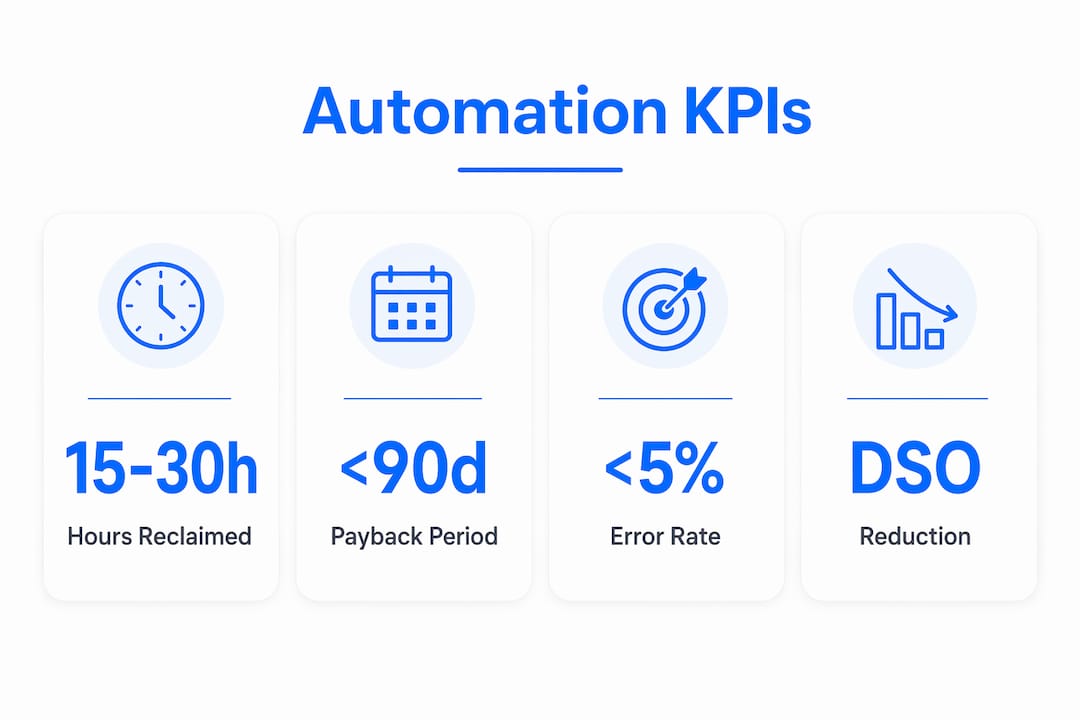
Getting the ROI math right before you build saves you from the most common mistake: spending more on the automation than the problem was costing you.
Implementation cost categories
- Tooling and licensing. SaaS automation platforms, API costs, and any AI model access fees. These are often the most visible line item but rarely the largest.
- Integration and engineering time. Connecting your automation to existing CRM, accounting, or data systems is where most of the real cost lives. Budget 2–4 weeks of engineering time for a well-scoped pilot.
- Data cleanup. Automation amplifies whatever is in your data. If your contact records or invoice data are inconsistent, you will spend time fixing that before the automation runs reliably.
- Monitoring and maintenance. A set-and-forget mindset is how automations break quietly. Budget 2–4 hours per week for a designated owner to review error logs, quality metrics, and edge cases.
KPIs that actually measure profitability impact
| KPI | What it measures | Target signal |
|---|---|---|
| Reclaimed FTE hours/week | Capacity freed for higher-value work | 15+ hours/week for a 3-person team |
| Payback period | Weeks until cumulative savings exceed build cost | Under 90 days for operational pilots |
| Days Sales Outstanding (DSO) reduction | Speed of cash collection | Measurable drop within 60 days |
| CAC efficiency | Cost to acquire a customer | Declining trend as outreach scales |
| Retention / LTV lift | Customer lifetime value change | Positive shift within one quarter |
| Margin per customer | Net revenue minus direct service cost | Improving as support costs fall |
A simple ROI calculation
Suppose your team spends 20 hours per week on manual AR follow-up at a blended cost of $35/hour. That is $700/week, or roughly $36,400/year. A focused collections automation pilot costs $4,000–$8,000 to build and integrate. At full recapture, payback lands in a matter of weeks. Even at partial recapture, you are profitable on the automation within a quarter.
Pro Tip: Set a baseline measurement for at least two weeks before you build anything. Without a documented baseline, you cannot prove the automation worked, and you cannot justify scaling it.
For measurement discipline, run a 30–90 day test window, define quality tolerances upfront (acceptable error rate, escalation thresholds), and review outcomes on a fixed cadence, weekly during the pilot, monthly after it stabilizes.
Where does automation deliver the biggest gains by function?
Not every function benefits equally. Here is where the highest-impact pilots tend to live for startups.

Sales and marketing. Lead qualification routing, automated nurture sequences, and personalized outreach are the most common starting points. When done well, these reduce CAC and compress the sales cycle. GenAI adoption correlates with a 42% increase in initial venture launches and a 17% reduction in time-to-launch in some analyses, which signals that founders who automate early move faster and spend less per experiment.
Customer success and support. Triage automation, predictive churn alerts, and automated onboarding sequences reduce support cost per customer and improve retention. Retention improvements compound directly into LTV, which is one of the cleanest ways automation feeds profitability.
Finance and collections. Automated invoicing, dispute triage, and payment reminder sequencing reduce DSO and free your finance team from manual follow-up. This is one of the highest-ROI pilots for early-stage companies because the cash flow impact is immediate and measurable. Practical fintech workflow automation examples show consistent DSO reductions and reclaimed finance hours across companies of similar scale.
Product and engineering. CI/CD automation and automated QA reduce the time between a feature decision and a customer-facing release. Faster cycles mean faster feedback, which means fewer expensive wrong turns.
Operations. HR and payroll automation, automated reporting, and vendor workflows reduce overhead and improve forecast reliability. These are not glamorous, but they are often where the most hours are quietly disappearing.
How does automation change hiring and org design?
Automation does not eliminate the need for people. It changes which people you need and what they spend their time doing.

The shift is away from generalist entry-level roles that handle high-volume, repetitive tasks, and toward what practitioners are calling "architect" hires: mid-career operators who can design, build, and maintain automation layers. Hiring trends reflect this, with startups increasingly prioritizing people who can multiply output through systems rather than through individual effort.
For org design, the practical guideline is simple: assign one person as the automation owner for each live workflow. That person is responsible for monitoring, maintaining, and iterating. Without a named owner, automations drift, break quietly, and erode the ROI you built.
The human side of this transition is often underestimated. Staff who see their tasks being automated sometimes interpret it as a signal that their work is not valued. Transparent communication about what is being automated and why, paired with retraining toward higher-value responsibilities, makes the difference between a team that embraces the change and one that quietly resists it. Frame automation as a tool that handles the tedious work so your team can focus on the work that actually requires judgment.
Pro Tip: Before launching any automation pilot, brief the team members whose workflows are affected. Explain what changes, what stays the same, and what the freed capacity will be used for. This one conversation prevents most of the morale friction founders encounter.
What risks and compliance issues should you watch for?
Automation creates real operational and legal exposure if you skip the guardrails. The most common failure modes are automating poorly defined workflows, neglecting data hygiene, and treating automation as a one-time build rather than an evolving capability.
Before any pilot, run through this checklist:
- Is the underlying process well-defined? If your team cannot describe the current workflow in a clear step-by-step format, the automation will encode the confusion.
- Is your data clean enough? Inconsistent contact records, duplicate entries, or missing fields will cause errors at scale.
- Do you have a rollback plan? Define what triggers a pause or reversal before you go live, not after something breaks.
- Have you set quality thresholds? Decide upfront what error rate is acceptable and what triggers a human review.
- Is there a monitoring owner? Name the person responsible for reviewing logs and escalating issues.
On the compliance side, U.S. startups need to be aware of a few specific areas. For consumer-facing outreach, including collections and marketing sequences, the Telephone Consumer Protection Act (TCPA) and CAN-SPAM Act govern messaging frequency, consent, and opt-out handling. For data handling, the California Consumer Privacy Act (CCPA) applies if you have California-based customers, and it carries real enforcement teeth. Automated systems that process personal data need documented retention policies and audit trails. Ignoring these requirements does not just create legal risk; it creates downstream costs in remediation and customer trust that can wipe out early ROI entirely.
A practical 90-day automation roadmap for startups
This roadmap is designed for a single high-impact pilot. Run it once, prove the model, then replicate.
The four phases
- Weeks 0–2: Discovery and baseline. Identify the target workflow. Map every step, measure the current time and cost, and document the error rate. This baseline is your proof of ROI later.
- Weeks 3–6: Build the minimum viable automation (MVA). Build the simplest version that handles 80% of cases. Integrate with your core systems (CRM, accounting, communication channels). Define success thresholds before you go live.
- Weeks 7–10: Controlled test. Run the automation on a narrow cohort. Collect quality metrics and financial KPIs weekly. Iterate on edge cases. Do not scale until the numbers hold.
- Weeks 11–13: Scale and hand off. Expand to the full workflow. Onboard the operations owner. Add monitoring to your sprint cadence so maintenance is a recurring task, not an afterthought.
Pilot milestones and scale signals
| Phase | Milestone | Scale signal |
|---|---|---|
| Weeks 0–2 | Baseline documented | Time/cost per task measured |
| Weeks 3–6 | MVA live on test cohort | Integration confirmed, thresholds set |
| Weeks 7–10 | KPIs collected for 30 days | Error rate below threshold, payback on track |
| Weeks 11–13 | Full rollout, owner assigned | Payback under 90 days, error rate under 5% |
The two numbers that tell you it is safe to scale: payback period under 90 days and error rate under 5%. If either is off, iterate before expanding.
How collections automation improves cash flow: the Interval-ai example
Collections is one of the clearest before-and-after automation stories in startup finance, because the financial impact is direct and measurable.
The typical manual collections workflow looks like this: a finance team member reviews an aging report, drafts follow-up emails, sends them manually, tracks responses in a spreadsheet, and escalates disputes by hand. On a three-person finance team, this can consume 15–30 hours per week, and the results are inconsistent because the timing and tone vary by who is doing the follow-up that day.
Interval-ai automates this entire workflow. The system analyzes historical payment data to tailor outreach timing and messaging for each customer, manages follow-up across email, SMS, and other channels, handles dispute triage, and updates your accounting and CRM systems in real time. The result is consistent, professional communication that reflects your brand, not a generic collections agency tone.
Interval-ai reports significantly reducing days to payment for clients, with companies recovering substantial overdue balances without adding collections staff. Clients have reported saving thousands in payroll costs as a direct result. The operational change that produces this outcome is the combination of data-driven targeting, automated sequencing, and multilingual communication support, which together ensure that every overdue account receives timely, appropriate outreach regardless of team capacity.
Automation also surfaces something less obvious: consistency improvements and diagnostic visibility. When you document and automate a collections workflow, you often discover that certain customer segments were being contacted too late, or that dispute categories were going untracked. Fixing those blind spots improves forecasting and cash flow beyond what the automation alone delivers.
Key Takeaways
Automation improves startup profitability most reliably when you target a well-defined, high-volume workflow, measure a clear baseline, and assign a named owner to maintain the system.
| Point | Details |
|---|---|
| Start with reclaimed capacity | Automating back-office tasks can free 15–30 hours per week, equivalent to an extra FTE in output. |
| Expect payback in 60–90 days | Focused operational pilots typically pay back within 60–90 days when scoped and measured correctly. |
| Prioritize adaptive systems | Rule-based automation breaks at scale; invest in systems that handle unstructured inputs and exceptions. |
| Measure before you build | A two-week baseline before any pilot is the only way to prove and scale ROI with confidence. |
| Interval-ai for collections | Interval-ai automates AR follow-up and dispute triage, reducing days to payment by over 30 days without adding staff. |
The real lesson most founders learn too late
Founders tend to underestimate how much automation teaches them about their own business. The discipline of documenting a workflow well enough to automate it almost always reveals something you did not know: a step that was redundant, a data field that was inconsistently filled, a customer segment that was being handled differently by different team members.
The conventional wisdom frames automation as a cost-cutting tool. That framing is too narrow. The founders who get the most out of it treat it as a diagnostic instrument first and an efficiency tool second. When you automate a collections workflow, you do not just save hours. You discover which customers pay late for structural reasons versus which ones just needed a better-timed reminder. That distinction changes how you price, how you onboard, and how you forecast.
The practical micro-advice: before you automate anything, write down every assumption you are making about how the current process works. Then run the automation for 30 days and compare your assumptions to what the data shows. The gap between the two is where your next improvement lives.
Automated collections: a low-risk pilot worth running
Cash flow problems are one of the top reasons early-stage startups stall, and overdue receivables are often the most fixable part of that problem. Automated collections is a high-ROI pilot precisely because the financial impact is direct, the baseline is easy to measure (your current DSO), and the scope is narrow enough to run in 30–60 days.
Interval-ai gives you a concrete alternative to manual AR follow-up: an AI-powered system that reduces days to payment by over 30 days, handles dispute triage automatically, and keeps your brand voice consistent across every customer touchpoint. You do not need to add collections staff or hand your accounts to a third-party agency. The pilot scope is manageable: a defined cohort of overdue accounts, a 30–60 day window, and clear KPIs (DSO reduction, recovered balance, hours reclaimed). To see what a pilot looks like for your business, visit Interval-ai and request a demo.
Useful sources and further reading
- How Agentic AI Supercharges Startups and Threatens Incumbents — Harvard Business Review analysis of agentic AI as a structural enabler for startups.
- How Founder Expertise Shapes the Impact of Generative AI on Digital Ventures — Research on GenAI adoption, venture launch rates, and founder skill amplification.
- How AI Automation Helps Early Stage Startups Reduce Burn Rate — Practical guidance on reclaimed capacity and payback timelines for early-stage founders.
- AI Automation ROI: What Startups Actually Gain — Productivity gain ranges and common failure modes for startup automation pilots.
- Startup Automation Success Stories: Lessons and Unexpected Benefits — Case examples covering consistency improvements, diagnostic visibility, and hiring shifts.
- AI Automation Guide for Startups (2026) — Reclaimed hours data and practical automation frameworks for small teams.
- Fintech workflow automation examples that drive real ROI — Applied fintech examples relevant to AR, collections, and finance automation.
FAQ
How quickly can automation improve startup profitability?
Focused operational pilots, such as AR follow-up or support triage, typically pay back within 60–90 days. Broader revenue automation (lead qualification, retention) tends to show measurable impact within one quarter.
Is automation worth it for a pre-revenue or seed-stage startup?
Yes, when scoped narrowly. The highest-value pilots at seed stage are back-office and operational workflows where reclaimed hours translate directly into deferred hires or more founder time on product.
What KPIs should founders track to measure automation's effect on profitability?
Track reclaimed FTE hours per week, payback period, DSO reduction, and margin per customer. These four metrics cover both the cost and revenue sides of the profitability equation.
How does Interval-ai help with cash flow specifically?
Interval-ai automates collections outreach, dispute triage, and payment follow-up sequences, reducing days to payment by over 30 days and recovering overdue balances without proportional staffing increases.
What is the biggest risk when automating startup workflows?
Automating a poorly defined or broken process. If the underlying workflow is inconsistent or the data is messy, automation scales the problem rather than solving it. Always document and clean the process before you build.
