
How Communication Automation Scales Your Business
Published: June 10, 2026 · 10–11 min read
TL;DR:
- Communication automation enables businesses to handle high-volume, repetitive interactions efficiently while maintaining human oversight. Its hybrid human-in-the-loop model offers cost-effective, scalable responses that improve customer satisfaction and reduce operational expenses. Implementing structured workflows based on proven expertise and consolidating messaging channels maximizes growth potential and sustains quality.
Communication automation is the process of using AI-powered tools and workflows to handle business communication tasks consistently, rapidly, and at scale while keeping a human in the loop for quality assurance. If you manage a growing business and still rely on manual follow-ups, individual emails, or reactive customer outreach, you are leaving measurable revenue on the table. The good news is that how communication automation scales business is no longer a question reserved for enterprise teams with large budgets. Platforms like Intercom, Twilio, and Interval-ai have made scalable automated communication accessible to businesses of every size, and the results are hard to ignore.
What are the key benefits of communication automation for scaling businesses?
Communication automation delivers four measurable benefits that directly affect your bottom line: lower operating costs, faster response times, higher customer satisfaction, and better team productivity.

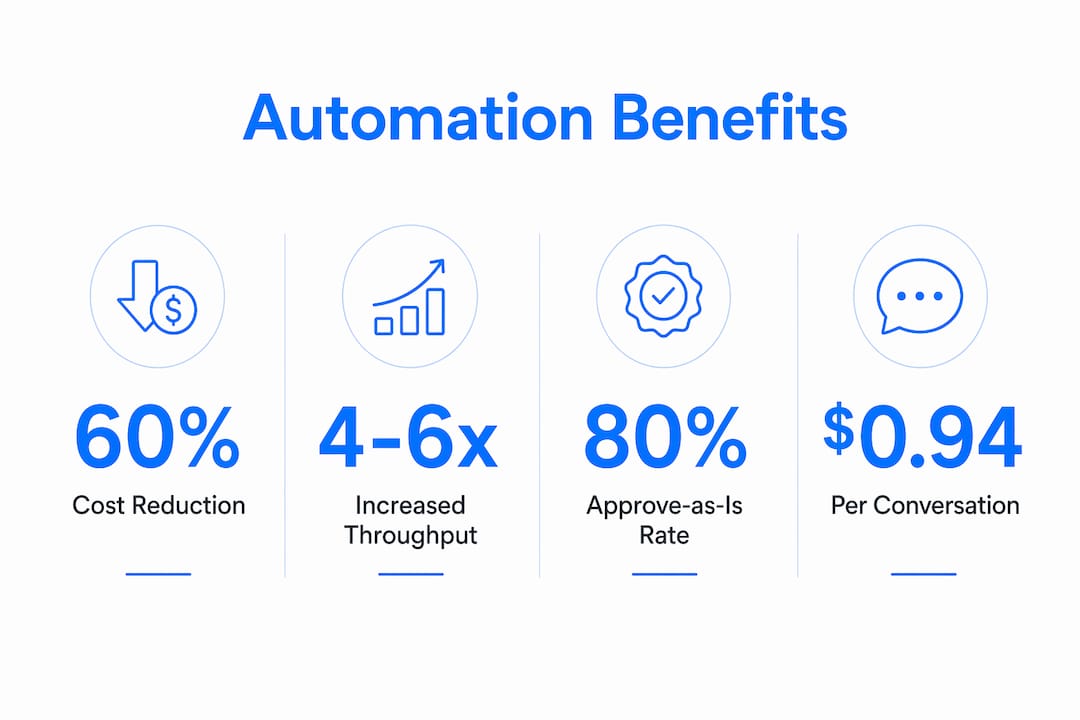
On the cost side, the numbers are striking. AI-driven automation reduces customer service operational costs by about 60% and triples response speed within six months. That kind of cost reduction does not come from cutting corners. It comes from removing the manual labor attached to repetitive, predictable tasks so your team can focus on work that actually requires judgment.
Speed matters more than most business owners realize. Responding to leads within five minutes using AI yields 100 times the effectiveness compared to a 30-minute delay. Traditional call centers scale linearly, meaning every new customer requires proportionally more staff. AI scales logarithmically, meaning you can handle 10 times the volume without 10 times the headcount. That difference is the core of why automated communication strategies change the economics of growth.
Customer satisfaction also improves. Intercom reports that its AI resolves over 81% of support volume, absorbing a 300% increase in demand without adding headcount and saving millions annually. Most customers receive faster first responses and 24/7 coverage. That consistency builds trust, and trust reduces churn.
"26% of customers abandon brands for lack of personalized experience. Automation enables real-time action on customer data, turning every interaction into a retention opportunity."
Finally, your team benefits directly. When automated systems handle routine queries, your staff spends less time context-switching between inboxes and more time on strategic work. That productivity gain compounds as you grow.
How does the hybrid human-in-the-loop model work?
The hybrid model is the most practical and sustainable approach to communication automation for most businesses. It works like this: AI drafts the reply, a human reviews it, and the human sends or approves it. Over time, as the AI learns your tone and your customers' patterns, the approve-as-is rate climbs and review time drops.
The numbers behind this model are compelling. A hybrid AI-human review approach brings conversation cost to about $0.94, compared to $4.80 for full human handling and $0.12 for full automation. Full automation is cheapest on paper, but it carries real risks. Customers who receive robotic, context-free replies disengage. That silent churn is expensive and hard to detect until it shows up in your retention numbers.
Here is how the hybrid model works in practice:
- AI drafts a reply based on the customer's message, your historical data, and your brand guidelines.
- A human operator reviews the draft in under six seconds on average, according to the State of AI Customer Communication Report 2026.
- The operator approves, edits, or escalates depending on the complexity of the request.
- The system logs the outcome, refining future drafts based on what was approved or changed.
- Key metrics are tracked weekly: approve-as-is rate, average review time, and escalation rate.
This model increases throughput by four to six times without degrading customer satisfaction. It also protects your brand. A poorly worded automated reply can do real damage to a customer relationship. The human review step is your quality gate.
Pro Tip: Set a target approve-as-is rate of 80% or higher within 90 days of launching your hybrid model. If you are below that threshold, your AI needs more training data or your reply templates need refinement.
Which channels and tools drive scalable communication automation?
The channel mix for business communication has shifted significantly. Email is no longer the primary channel for many customer interactions. Messaging apps like WhatsApp, SMS, and in-app chat now carry the majority of time-sensitive customer conversations, and customers on these platforms expect responses in under 30 seconds.
The practical challenge is managing multiple channels without creating chaos for your team. The answer is a unified dashboard that consolidates all channels into one interface. One case study found that consolidating communication channels into an AI-prioritized dashboard cut daily notification management from 2.5 hours to 30 minutes per employee, saving 2 hours daily. Communication costs dropped from $52,000 annually to about $4,200, a 30x return on investment.
Here is a comparison of the most common communication channels and their automation fit:
| Channel | Best use case | Automation fit | Key tool examples |
|---|---|---|---|
| Invoices, follow-ups, campaigns | High | HubSpot, Mailchimp | |
| SMS | Payment reminders, alerts | Very high | Twilio |
| Customer support, updates | High | Twilio, Intercom | |
| In-app chat | Real-time support | High | Intercom |
| Phone | Complex escalations | Low | Human-led |
Beyond the channel itself, the technology layer matters. AI chatbots handle first-contact resolution. Intelligent routing sends complex queries to the right human. Automation workflows trigger follow-ups based on customer behavior, not manual scheduling. Tools like Intercom and Twilio have built these capabilities into platforms that integrate with your existing CRM and billing systems.
The business growth through automation that most owners want does not come from any single tool. It comes from connecting these tools into a workflow where each step feeds the next automatically.
What practical steps should you follow to implement communication automation?
Scaling communication automation without a clear plan is how businesses waste money. The steps below give you a structured path from first implementation to full-scale operation.
-
Validate your unit economics first. Before you invest in automation, confirm that your LTV/CAC ratio exceeds 3.0 and your customer acquisition cost pays back within 12 months. Automating a business with poor unit economics accelerates losses, not growth.
-
Start with one high-impact use case. Lead response and payment follow-up are the two highest-ROI starting points. Lead response automation captures revenue that would otherwise go to a faster competitor. Payment follow-up automation recovers cash that would otherwise sit as receivables.
-
Build your AI on real expertise. The most effective AI agents are built by codifying the judgment of your top performers into structured workflows. Sit down with your best customer service rep or collections manager and document exactly how they handle each scenario. That tacit knowledge becomes the training foundation for your AI.
-
Run a phased rollout. Start with one channel and one use case. Measure approve-as-is rate, resolution time, and customer satisfaction weekly. Expand to additional channels only after the first use case is performing consistently.
-
Optimize based on data, not assumptions. Review your key performance indicators monthly. If escalation rates are rising, your AI needs more training. If review time is increasing, your operators need better tooling. The data tells you exactly where to focus.
Pro Tip: Do not automate a process you have not already documented manually. If your team cannot describe the exact steps they follow, your AI will not be able to replicate them reliably.
Communication efficiency in scaling comes from discipline in implementation, not just from the technology itself. The businesses that see the best results treat automation as an ongoing practice, not a one-time setup.
Key takeaways
Communication automation scales business by replacing manual, repetitive outreach with AI-driven workflows that maintain human oversight, reduce costs, and accelerate response times across every customer touchpoint.
| Point | Details |
|---|---|
| Cost reduction is measurable | AI automation cuts customer service costs by about 60% while tripling response speed within six months. |
| Hybrid models outperform extremes | A human-in-the-loop approach costs $0.94 per conversation versus $4.80 for full human handling. |
| Speed to lead is the highest-impact use case | Responding within five minutes yields 100x effectiveness compared to a 30-minute delay. |
| Channel consolidation multiplies ROI | Unified dashboards have delivered 30x ROI by cutting notification management from 2.5 hours to 30 minutes daily. |
| Unit economics must come first | Validate LTV/CAC and retention rates before scaling to avoid accelerating losses through automation. |
Where I land on automation and the human touch
The uncomfortable truth about communication automation is that most businesses implement it backwards. They automate first and ask questions later, then wonder why customer satisfaction drops or why their collections rate does not improve.
What I have seen work consistently is the opposite approach. You start by documenting what your best people do, then you build the automation around that knowledge. The technology is not the strategy. The strategy is the expertise of your team, and the technology is how you scale it.
The concept of agentification, turning the tacit knowledge of top performers into AI workflows, is the most significant shift in how businesses grow right now. It means a small team can operate at the capacity of a much larger one without the overhead. But it only works if the underlying knowledge is sound. Garbage in, garbage out applies here more than anywhere.
I also want to be direct about over-automation. Businesses that remove the human review step entirely often see short-term cost savings followed by a slow erosion of customer trust. That erosion does not show up immediately. It shows up six months later in your churn numbers. The hybrid model is not a compromise. It is the right answer for most businesses at most stages of growth.
The cultural side of this is underestimated too. Your team needs to understand that automation is not replacing them. It is handling the repetitive work so they can focus on the conversations that actually require a human. That framing matters for adoption.
> — Tyler
How Interval-ai helps you scale communication without adding headcount
If you are managing overdue payments or struggling to maintain consistent follow-up across a growing customer base, Interval-ai is built for exactly that challenge. Interval-ai uses a hybrid AI-human model to manage collections communications across email, SMS, and other channels, tailoring outreach based on your historical payment data so every message fits your brand and your customer's behavior. Clients report reducing days to payment by over 30 days and recovering substantial receivables without adding staff. The platform handles the volume so your team handles the exceptions. If you want to see what that looks like for your business, Interval-ai is worth a close look.
FAQ
What is communication automation in business?
Communication automation is the use of AI-powered tools and workflows to handle routine business messages, follow-ups, and customer interactions at scale. It replaces manual outreach with consistent, data-driven communication that runs continuously without requiring staff time for every interaction.
How does automation improve communication for scaling businesses?
Automation removes the bottleneck of manual follow-up by handling high-volume, repetitive tasks like lead responses, payment reminders, and customer updates automatically. This allows your team to focus on complex interactions while the system manages routine touchpoints around the clock.
What is the hybrid human-in-the-loop model?
The hybrid model pairs AI-drafted replies with human review before sending, bringing conversation cost to about $0.94 per interaction while maintaining quality. Human operators spend an average of six seconds reviewing each draft, making it a fast and cost-effective way to scale without sacrificing accuracy.
Which communication channels are best for automation?
SMS and messaging apps like WhatsApp deliver the highest automation fit for time-sensitive interactions because customers expect responses in under 30 seconds on these platforms. Email remains strong for structured outreach like invoices and campaigns, while phone calls are best reserved for complex escalations that require human judgment.
How do I know if my business is ready to scale communication automation?
Validate your unit economics before scaling. If your LTV/CAC ratio exceeds 3.0 and your customer acquisition cost pays back within 12 months, you have the financial foundation to invest in automation. If those numbers are not yet solid, fix the underlying business model first.
