
Cut 30+ Days: Enforceable Late Fee Policy for U.S. AR Teams
Published: August 30, 2026 · 8–9 min read
A late fee policy is the set of rules your business applies to overdue invoices: the grace period, the fee type and rate, when the clock starts, and what happens if the customer still doesn't pay. The one thing that makes it enforceable is disclosing it in writing, in the contract and on every invoice, before you try to collect it.
TL;DR:
- Late fees must be disclosed in writing at the contract and invoice level to be enforceable and avoid disputes.
- The standard late fee rate is around 1% to 1.5% per month, roughly 18% annual percentage rate, aligned with legal reasonableness.
- Automating reminders and fee applications ensures consistent enforcement and reduces legal risks arising from manual, uneven handling.
- The late fee typically starts on the day after the invoice due date, which must be specified identically in the contract and invoice.
- Automated systems like Interval-ai help maintain policy consistency, cut overdue days by over 30, and save on collections costs.
What Should a Late Fee Policy Actually Include?
A late fee policy only works if every part of it is written down and consistent. Verbal agreements or fees added after the fact rarely survive a dispute, and they erode trust with customers who feel ambushed.
Run through this checklist before you finalize or revise your terms:
- Contract-level disclosure: the fee terms appear in the signed agreement, not just buried in a policy PDF.
- Invoice-level reminder: the same rate and start date repeat on every invoice, near the due date.
- A defined rate or flat fee: pick a specific number, not a vague "fees may apply."
- A clear start date: most policies trigger on the first day after the due date, not after a delay.
- A documented grace period: even a 3 to 5 day buffer, and a record of any exceptions you grant.
- Escalation triggers: the point where a reminder becomes a fee, and a fee becomes a collections call.
- Recordkeeping: dated logs of communications and a clear line item for fee income at tax time.
Miss any one of these and you weaken your position if a customer challenges the charge.
What Rate Structure Holds Up Legally?
You generally have three options: a flat fee, a percentage-based monthly rate, or compounding interest. Flat fees are simple to communicate but don't scale with invoice size. Percentage-based fees, applied monthly, are the standard for B2B because they scale fairly and read as proportionate. Compounding interest on top of a percentage rate is legal in most states but invites more scrutiny.
The reasonableness test matters more than the number itself. Courts distinguish between liquidated damages, a reasonable estimate of the harm caused by late payment, and a penalty, which exists mainly to punish. A fee that looks punitive can be struck down as unenforceable, even if the customer signed the contract.
Benchmark to build around: 1% to 1.5% per month, or roughly 18% APR, is widely treated as a de facto U.S. standard for commercial invoices when it's written into the agreement. Businesses that include this kind of written clause tend to collect faster on average than those that don't.
If you skip a written clause entirely, you're not necessarily out of options. Most states allow you to pursue statutory prejudgment interest instead, but the rate is set by state law rather than your contract, and it commonly runs anywhere from 4% to 12% annually depending on the state.
Sample Late Fee Clause Language You Can Adapt
You don't need a lawyer to draft a workable clause, though one is worth consulting before you roll out a new rate across a large customer base. Start with language that ties the fee to your actual costs, not a round number picked for convenience.
A simple percentage clause:
A combined flat fee plus interest version:
Your invoice itself should echo the same terms in plain text: "Payment due within 30 days.
How Do You Escalate Overdue Payments Step by Step?
A predictable sequence protects the relationship and your cash flow at the same time. A graduated timeline works better than jumping straight to threats.
- Days 1 to 7 past due: send a friendly reminder, framed as a heads-up rather than a demand.
- Days 8 to 14: send a second notice, referencing the invoice terms and the approaching fee.
- Day 15: apply the late fee exactly as written, no exceptions unless documented.
- Days 30 to 60: escalate to a formal demand letter, and consider pausing future service or shipments.
- Past 60 days: evaluate collections or legal action based on the amount at stake.
Pro Tip: Automate the first three steps so the fee gets applied the same way every time, for every customer. Manual enforcement is where policies quietly fall apart, one manager decides to "let it slide" for a good client, and now your written policy doesn't match your actual behavior.
How Do You Communicate Fees Without Alienating Customers
Frame the fee as standard business practice, not a punishment aimed at a specific customer. Businesses that position late fees this way see better compliance without damaging the relationship, largely because the language matters as much as the fee itself.
- Use neutral wording: "Per our agreement, a late fee now applies to this balance" instead of "You're late, so we're charging you."
- Offer a payment plan before the balance grows unmanageable, especially for otherwise reliable customers hitting a rough patch.
- Consider early-payment discounts, such as 2% off for payment within 10 days, as the positive mirror image of your late fee.
- Document every waiver or exception in writing, even a one-line internal note, so your enforcement stays consistent and defensible.
How Should You Record Late Fees for Tax Purposes?
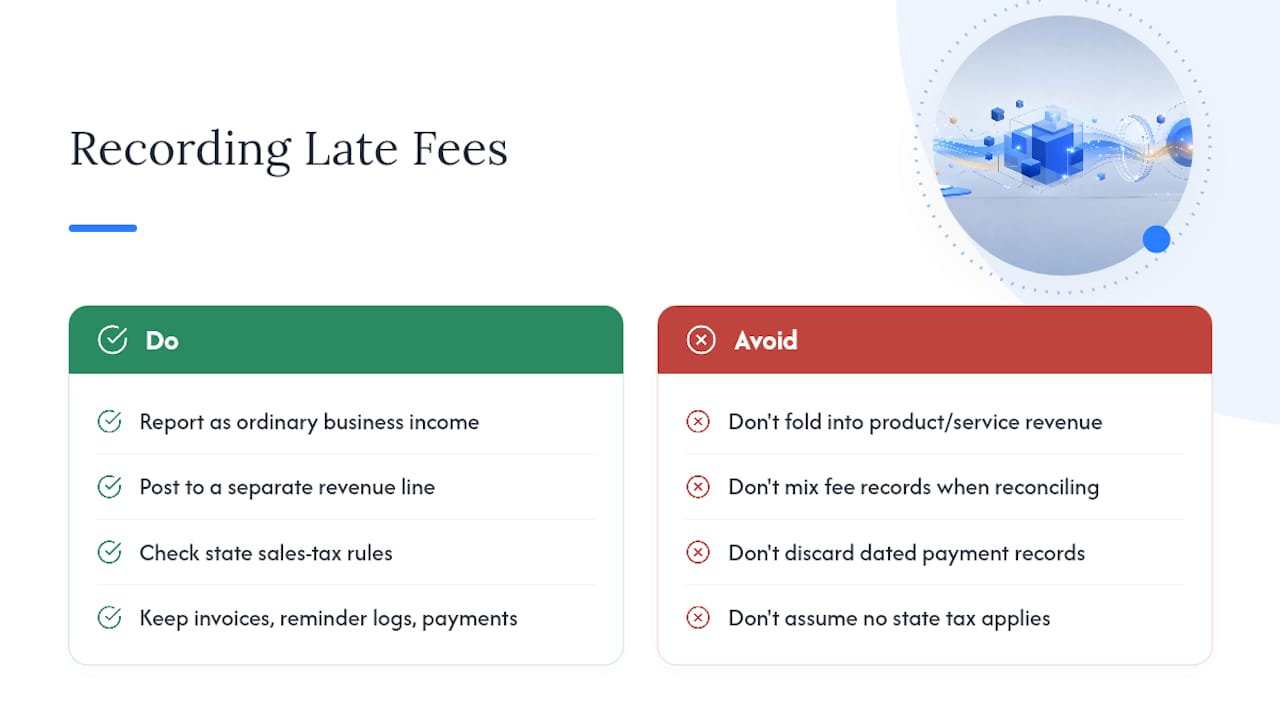
The IRS treats late fees and interest as ordinary business income, reportable in the year you receive or accrue them, depending on your accounting method. Post them to a separate revenue line in your general ledger rather than folding them into product or service revenue; it makes reconciliation and future audits far easier. Check whether your state treats late fees as taxable for sales tax purposes, since a few do. Keep dated invoices, reminder logs, and payment records on file. If a dispute ever reaches small claims court, that paper trail is your case.
When Should You Stop Chasing an Overdue Invoice?
Not every unpaid invoice is worth pursuing indefinitely. At some point the cost of collecting exceeds what you'll recover, and it's worth having triggers instead of letting each case drag on by instinct.
- At 30 days: apply the fee and escalate communication, but keep the relationship intact.
- At 60 days: send a formal demand and calculate what a collections agency or attorney would cost against the balance owed.
- At 90 days: decide between a negotiated settlement, a structured payment plan, or writing off the debt if collection costs would exceed the recovery.
Document every call, email, and letter along the way. That record is what preserves your legal options if you ultimately need them.
Why Automated Enforcement Beats Manual Policy Management
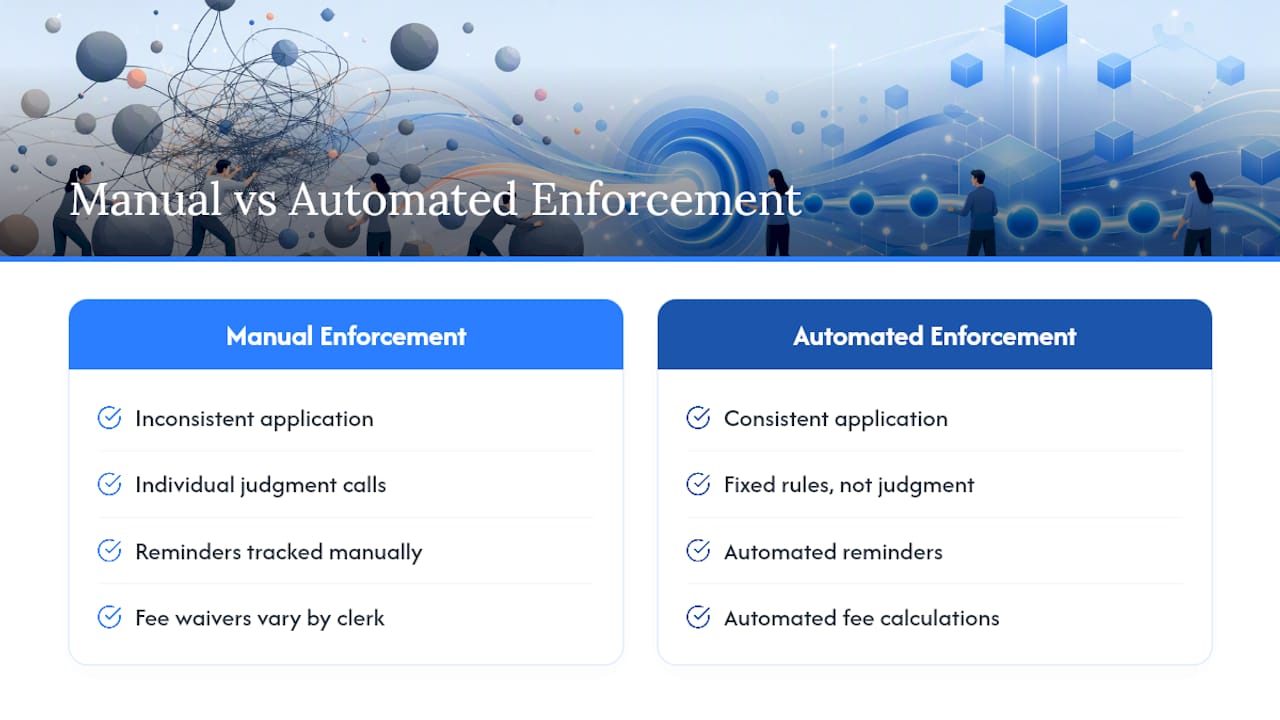
Most late fee policies fail not because the terms are wrong, but because enforcement is inconsistent. One AR clerk waives a fee for a friendly client; another applies it strictly. That inconsistency is what actually creates legal risk, because a policy applied unevenly looks discretionary, and discretionary fees are easier to challenge as arbitrary rather than a genuine pre-estimate of harm.
Automation closes that gap. When reminders, fee calculations, and escalation triggers run on fixed rules instead of individual judgment calls, every customer gets the same treatment, which is exactly what strengthens your position if a fee is ever disputed. It also frees your team from the manual grind of tracking due dates across hundreds of accounts, work that rarely justifies dedicated headcount but eats hours every week when done by hand.
How Interval-ai Helps You Apply Your Late Fee Policy Consistently
Writing a strong late fee policy is only half the job. Applying it the same way, on every invoice, every month, without someone manually deciding who gets a pass, is where most businesses lose ground. Interval-ai automates the exact workflow this guide describes: pre-due reminders, rule-based fee application at your specified rate, and escalation to formal demand language when an account crosses your threshold, all timed to match the policy you've already written.

Because the outreach runs across channels automatically and adapts based on each customer's payment history, businesses using Interval-ai report cutting days-to-payment by more than 30 days without adding collections staff, and some clients have saved thousands in payroll costs they would have otherwise spent chasing invoices by hand. If your current process depends on someone remembering to send the next reminder, book a demo with Interval-ai and see what consistent, automated enforcement looks like for your accounts receivable.
Sources
Confirm your state's usury and prompt-payment rules before locking in a rate, since limits and statutory interest vary. The BBB's guide to setting and enforcing late fees and the U.S. Chamber's collection best practices are solid starting points. For anything involving large balances or a pattern of disputes, loop in a local business attorney before you enforce.
- Late Payment Fees on Invoices: Legal Rates, State Laws, Sample Clauses | American Invoice Generator
- Demandpay
- BBB Business Tip: How to set and enforce late payment penalties
- Late fee clauses for overdue invoices: rules and limits | LegalClarity
FAQ
What Is a Reasonable Late Fee Percentage for Invoices?
Most U.S. businesses use 1% to 1.5% per month, roughly 18% APR, since it's widely accepted as a reasonable, defensible rate for commercial invoices when disclosed in writing.
Do I Need a Written Contract to Charge a Late Fee?
Yes, in practice. Without a written clause, you generally can't enforce your own rate and may only be able to pursue statutory prejudgment interest under your state's law instead.
When Does a Late Fee Legally Start Accruing?
It starts on whatever date your contract and invoice specify, typically the first day after the due date, and that date must match across both documents to hold up if challenged.
Can a Late Fee Be Too High to Enforce?
Yes. Courts can strike a fee as an unenforceable penalty if it doesn't function as a reasonable estimate of actual harm rather than a punishment.
How Does Interval-ai Support Late Fee Enforcement?
Interval-ai automates reminders, applies fee rules consistently across every account, and escalates unresolved balances, which keeps enforcement even and helps reduce days-to-payment without adding staff.
