
Free $137,000 on $10M Revenue: Cut DSO by 5 Days for Finance Teams

Published: August 27, 2026 · 11–12 min read
The three levers that move days sales outstanding fastest are accurate on-time invoicing, frictionless payment options with auto-pay enrollment, and automated, segmented dunning. Get invoicing and payment friction fixed and you'll often see measurable movement within a few billing cycles; credit policy and segmentation changes take longer to show up in your average. If you run finance, start with invoicing accuracy below. If you own sales or customer success, jump straight to collections workflows.
TL;DR:
- Improving invoice accuracy and offering multiple payment methods with auto-pay can lead to measurable DSO reductions within a billing cycle or two.
- Fast-acting tactics like fixing invoicing errors and frictionless payment options yield quick cash flow benefits, while longer-term credit and segmentation policies take longer to impact DSO.
- Setting realistic DSO benchmarks based on industry norms and company-specific cash needs ensures targets are meaningful and achievable.
- Automated collection workflows, integrated with ERP and CRM, significantly reduce manual effort and prevent discrepancies that cause delays.
- Successful DSO reduction requires alignment across sales, finance, and customer success teams before deploying automation tools or policy changes.
What Is DSO and Why It Matters for Cash Flow
Days sales outstanding measures the average number of days it takes your business to collect payment after you've sent an invoice. When DSO climbs, cash flow tightens and operational risk rises because money you've technically earned is sitting in someone else's bank account instead of yours. DSO is one leg of the cash conversion cycle, alongside days inventory outstanding and days payable outstanding, and understanding how these pieces fit together helps you see why a receivables problem can quietly become a working capital crisis.
Not every business needs to obsess over shaving DSO down. A company with strong margins, healthy cash reserves, and stable customer payment habits can tolerate a flat DSO for years. But if you're funding growth out of pocket, sitting on thin margins, or watching your credit line get tapped more than you'd like, lowering DSO becomes one of the highest-leverage moves available to you.
The business impacts show up in a few concrete places:
- Working capital: every day of DSO you shave off frees up cash you'd otherwise borrow to cover
- Investment ability: lower DSO means more cash on hand for inventory, hiring, or opportunistic spending
- Risk exposure: rising DSO often signals disputes, credit problems, or process breakdowns before they show up elsewhere
How to Calculate DSO (Formula, Example, and Pitfalls)
The standard formula is: DSO = (Accounts Receivable ÷ Net Credit Sales) × Number of Days in Period. Use net credit sales, not total revenue, since cash sales don't belong in a collections metric.
Here's a worked example using a 30-day period:
Three common mistakes distort this number. First, switching between 30, 90, and 365-day periods without noting which one you used makes trend comparisons meaningless. Second, leaving disputed invoices in the receivables balance inflates DSO even though that cash was never truly collectible on schedule. Third, revenue recognition timing mismatches, especially in subscription businesses recognizing revenue ratably while invoicing upfront, can make DSO look worse than your actual cash position.
What DSO Benchmarks Should You Target?
Industry medians vary widely, so compare your DSO to peers in your own sector rather than a generic number pulled from a finance blog. A construction subcontractor working on 60-day terms and a SaaS company billing monthly have entirely different "good" DSO figures, and treating them the same leads to unrealistic targets.
Before setting a target, run through this checklist:
- How many months of cash runway do you have, and does DSO reduction meaningfully extend it?
- Are your margins thin enough that carrying costs on receivables actually hurt profitability?
- Do your customers' typical payment norms make your current terms competitive or generous?
- Would sales resist tighter terms enough to risk deal velocity?
Once you've answered those, set incremental goals tied to real dollars unlocked. A modest DSO reduction on multi-million dollar annual revenue can free up a meaningful amount of cash, a target that's far more motivating to a CFO than an abstract "days" number.
Prioritized Checklist to Reduce DSO Fast
Not every lever pays off at the same speed. Following a structured, five-step sequence, starting with the decision to act, then payment terms, credit strength, early-payment incentives, and finally fast action on overdue invoices, creates compounding improvement rather than a scattershot list of fixes.
- Fix invoice accuracy and timing (Finance, 1 to 2 billing cycles). Errors and late sends are the single most fixable source of delay.
- Enable more payment methods and auto-pay (Finance/RevOps, 1 to 2 billing cycles). Removing friction at the point of payment moves faster than almost anything else.
- Automate dunning sequences (RevOps/Collections, 2 to 4 weeks to deploy, results within one cycle). Consistent, well-timed reminders recover balances that would otherwise age.
- Segment customers by risk and value (Finance/Sales, 1 to 2 quarters). Tiered treatment prevents both wasted effort and missed high-value follow-up.
- Tighten credit policy and approval governance (Finance/Sales leadership, 2 to 3 quarters). Slower to show results but prevents future DSO drag.
Quick wins live in invoicing and payment friction. Structural changes, credit policy and segmentation, take longer but protect the gains you make early.
Pro Tip: Don't wait for a full credit policy overhaul before turning on auto-pay and better invoicing. Sequence the fast levers first so leadership sees momentum while the slower structural work is still underway.
Fixing Invoicing Errors That Delay Payment
Invoice mistakes are one of the most preventable causes of late payment, and they're often self-inflicted. Faster, more accurate invoicing paired with centralized monitoring closes the gap between delivery and cash in hand.

For subscription and usage-based businesses specifically, billing complexity tied to plan changes, prorations, and mid-cycle upgrades is a primary driver of disputes that stall payment. Lifecycle-aware billing that reflects the customer's actual usage avoids that friction entirely.
Practical fixes worth implementing:
- Include PO numbers, itemized line items, and contact details on every invoice
- Attach supporting documentation (delivery confirmations, signed work orders) upfront to preempt disputes
- Set an internal SLA that invoices go out within 24 to 48 hours of delivery or service completion
- Use e-invoicing and PO-matching automation to catch discrepancies before the invoice reaches the customer
- Standardize invoice templates so AP teams at customer companies process them without back-and-forth
Which Payment Options Actually Speed Up Collection?
Give customers more ways to pay and more of them pay faster. Card payments, ACH transfers, virtual cards, pay-by-link options, and self-service payment portals each remove a different kind of friction, and offering several at once covers the preferences of a wider customer base.
Early-pay discounts work, but design them carefully.
- Offer ACH as the default recommended option since it's typically cheaper to process than cards
- Make auto-pay enrollment part of onboarding, not an afterthought pitched months later
- Send a one-time incentive (a small discount or fee waiver) specifically to drive enrollment in auto-pay
- Keep payment portal messaging simple: one link, one click, no login wall if you can avoid it
Building Credit Policies That Prevent Future DSO Drag
Credit decisions made at the point of sale determine how much collections work you'll be doing six months later. Running credit checks before extending terms, then assigning tiered limits based on that risk profile, keeps you from discovering a customer's payment problems after the invoice is already thirty days overdue.
Segment your customers into risk and value cohorts, and let terms differ accordingly:
- High-value, low-risk accounts can get longer terms and dedicated account management
- New or unproven accounts start on shorter terms or partial upfront payment
- Review credit limits on a set cadence, quarterly for active accounts, rather than only when a problem surfaces
- Require sales leadership sign-off on any non-standard term outside your default policy
DSO drag frequently originates in sales, where reps grant extended terms to close a deal faster. Governance that requires approval for exceptions closes that gap without slowing down legitimate negotiations.
How Collections Automation Cuts Manual Work and DSO
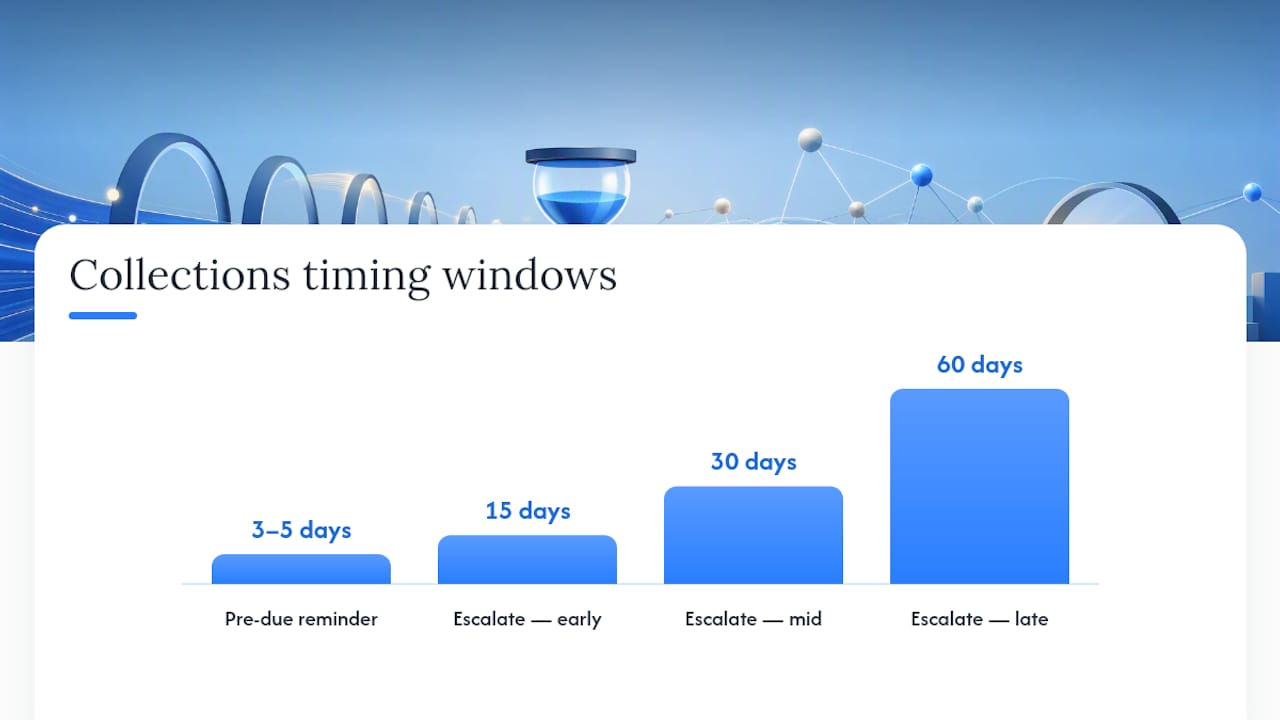
Manual collections work doesn't scale, and it burns staff hours that could go toward higher-value tasks. Automated dunning sequences, pre-due reminders, due-date nudges, and tiered post-due escalation, handle the repetitive follow-up so your team focuses on the accounts that actually need a phone call.
Automation combined with segmentation tends to produce the best results: routine flows manage the long tail of smaller accounts while your highest-value customers still get personal attention.
- Set pre-due reminders 3 to 5 days before the due date to catch issues before they become late payments
- Escalate tone and channel automatically as an invoice ages past 15, 30, and 60 days
- Route disputed invoices to a separate workflow immediately so they don't clog standard dunning
- Enable smart retries on failed auto-pay attempts instead of waiting for the customer to notice
- Integrate collections tools with your ERP and CRM so payment status stays accurate everywhere at once
Pro Tip: Reconciliation gaps between your ERP and your collections tool are the number one reason automated dunning sends embarrassing "you still owe us" emails to customers who already paid. Fix the integration before you scale the automation.
Which KPIs Show Whether Your DSO Strategy Is Working
DSO alone doesn't tell the whole story. Track it alongside the Collection Effectiveness Index (CEI), your dispute rate, aging bucket distribution, and write-offs to see whether improvement is real or just a timing artifact.
Report these metrics on a monthly cadence at minimum, with quarterly drilldowns by payment term, product line, and region to catch problems hiding inside an otherwise healthy average.
- DSO: your headline trend, tracked monthly
- CEI: measures how much of what's collectible you actually collected in a period
- Dispute rate: rising disputes often precede a DSO spike by a month or two
- Aging buckets: shows whether problems concentrate in 30, 60, or 90+ day territory
- Write-offs: the ultimate cost of DSO left unmanaged too long
To build the business case for new tools or headcount, calculate unlocked cash directly: a five-day DSO reduction on $10 million in annual revenue frees up roughly $137,000, a number that speaks louder to leadership than a percentage.
How Interval AI Puts These Levers Into Practice
Interval AI operationalizes most of the tactics above inside a single platform. It uses historical payment data to tailor outreach timing and tone per customer, automates multi-channel communication across email, text, and other channels, and routes disputes without manual triage, all while integrating with your existing accounting and CRM systems so records stay accurate.
Businesses using Interval report saving thousands in payroll costs by automating work that previously required dedicated collections staff, while recovering balances that would otherwise have aged into write-off territory.
If you're evaluating any AR automation partner, run through this checklist:
- Does it integrate with your existing ERP and CRM without manual data entry?
- Can outreach be customized to match your brand voice rather than sounding like a generic collection agency?
- Does it support multilingual communication if you serve customers across regions?
- Is it compliant with payment collection regulations in your market?
Where Most DSO Rollouts Actually Go Wrong
The technical fixes, better invoices, more payment options, and automated dunning are the easy part. The rollouts that stall almost always fail on governance. Sales keeps granting exceptions to terms nobody documented, collections doesn't know which accounts are "special," and the CRM and ERP disagree about what's actually been paid.
Start with alignment before automation. Get sales, finance, and customer success agreeing on standard terms and exception approval before you turn on a single automated sequence. The earliest sign you're on track isn't a lower DSO yet, it's fewer disputes and cleaner data between systems. That consistency is what lets automation actually compound instead of just working faster on a broken process.
If your receivables process feels like it's held together with spreadsheets and tribal knowledge, that's usually the first thing worth fixing, before you buy any tool at all.
— Tyler
Interval AI: Turning This Playbook Into an Automated System
Running every tactic in this article manually, segmented dunning, auto-pay enrollment, dispute routing, credit tier reviews, takes a dedicated team most SMBs don't have. Interval AI is built to run that entire playbook automatically, adjusting outreach based on each customer's payment history instead of sending the same generic reminder to everyone.
Interval AI's collections platform handles pre-due reminders, escalating post-due sequences, and dispute routing across email and other channels, while keeping outreach consistent with your brand instead of sounding like a third-party agency. Pricing scales with your accounts receivable size and the volume of overdue accounts you manage, so smaller AR books aren't paying enterprise rates. Companies using the platform report significantly reducing days to payment without adding collections staff. If you want to see how it would work against your own receivables, book a demo of Interval AI and bring your current aging report to the call.
Sources
For deeper benchmarking data, review Allianz Trade's DSO guide. For AR software selection criteria, see this accounts receivable software overview. For escalation and third-party collections practices, consult the Debt Recovery Hub.
This article is general information, not a substitute for advice from a qualified financial advisor. Consult a qualified financial professional about your own circumstances before acting on anything here.
- Cfo
- Five Steps to Improve Days Sales Outstanding - Atradius
- How to reduce DSO + improve cash flow | Intuit
FAQ
What Does It Mean to Reduce DSO?
Reducing DSO means shortening the average number of days it takes your business to collect payment after invoicing, which frees up cash that would otherwise sit in accounts receivable.
What Strategies Work Best to Reduce DSO?
The fastest results come from accurate invoicing, expanded payment options with auto-pay enrollment, and automated dunning sequences; credit policy and customer segmentation add longer-term protection against DSO creep. Platforms like Interval AI bundle most of these levers into one automated workflow.
Is a Lower DSO Always Better?
Generally yes, since lower DSO means faster access to cash, but a business with strong margins and ample reserves may not need to aggressively chase a lower number if current collection speed already supports its operations.
What Causes a High DSO?
High DSO usually stems from invoicing errors or delays, limited payment options, inconsistent or absent collections follow-up, and overly generous credit terms extended without proper review.
