
Cut 30+ Days to Payment: Spanish Payment Reminders for SMB Finance
Published: September 1, 2026 · 9–10 min read
Use short, brand-consistent Spanish reminders on an automated cadence, add a direct payment link to every message, and escalate to a phone call once an invoice hits 14 days overdue. Interval-ai's collections data shows automated, well-timed follow-ups can cut days to payment by more than 30 days without adding headcount. Send the first reminder 3 to 7 days before the due date, then let the templates below carry the rest.
TL;DR:
- Automated reminders can reduce overdue days by more than 30 days if timed correctly and paired with direct payment links.
- Sending the initial reminder 3 to 7 days before the due date, followed by a series of escalating messages, significantly improves collection success.
- For overdue accounts, switching from automated messages to a personal phone call at 14 days is crucial to recover lingering balances.
- Using formal "usted" in Spanish improves professionalism across markets, and native speaker review helps maintain natural phrasing.
- Integrating these reminders with automation tools and tracking key metrics like days sales outstanding enables scaling and continuous optimization.
Ready-to-Use Spanish Payment Reminder Templates
Every stage of collections needs its own tone. A reminder sent before the due date should feel like a courtesy; one sent at 30 days overdue should feel like a final notice. These five templates cover the full arc and drop straight into your invoicing or CRM automation.
1. Upcoming (3-7 days before due date)
Subject: Recordatorio: su factura #[número] vence pronto
"Hola [nombre], le escribo para recordarle que la factura #[número] por $[monto] vence el [fecha]. Puede pagar directamente aquí: [enlace de pago]. Gracias por su confianza." Sign off: "Saludos, [Empresa]."
2. Due date Subject: Su factura #[número] vence hoy "Hola [nombre], hoy vence la factura #[número] por $[monto]. Pague en un clic aquí: [enlace de pago]. Si ya realizó el pago, ignore este mensaje."
3. 7 days overdue (friendly) Subject: Factura #[número] pendiente de pago "Hola [nombre], notamos que la factura #[número] ($[monto], desde el [fecha]) AUN está pendiente. ¿Puede confirmarnos el estado del pago? Enlace: [enlace de pago]."
4. 14 days overdue (firm) Subject: Action requerida: factura #[número] vencida hace 14 días "Hola [nombre], la factura #[número] por $[monto] tiene 14 días de vencida. Le pedimos regularizar el pago antes del [fecha] para evitar cargos adicionales. Pague aquí: [enlace de pago]."
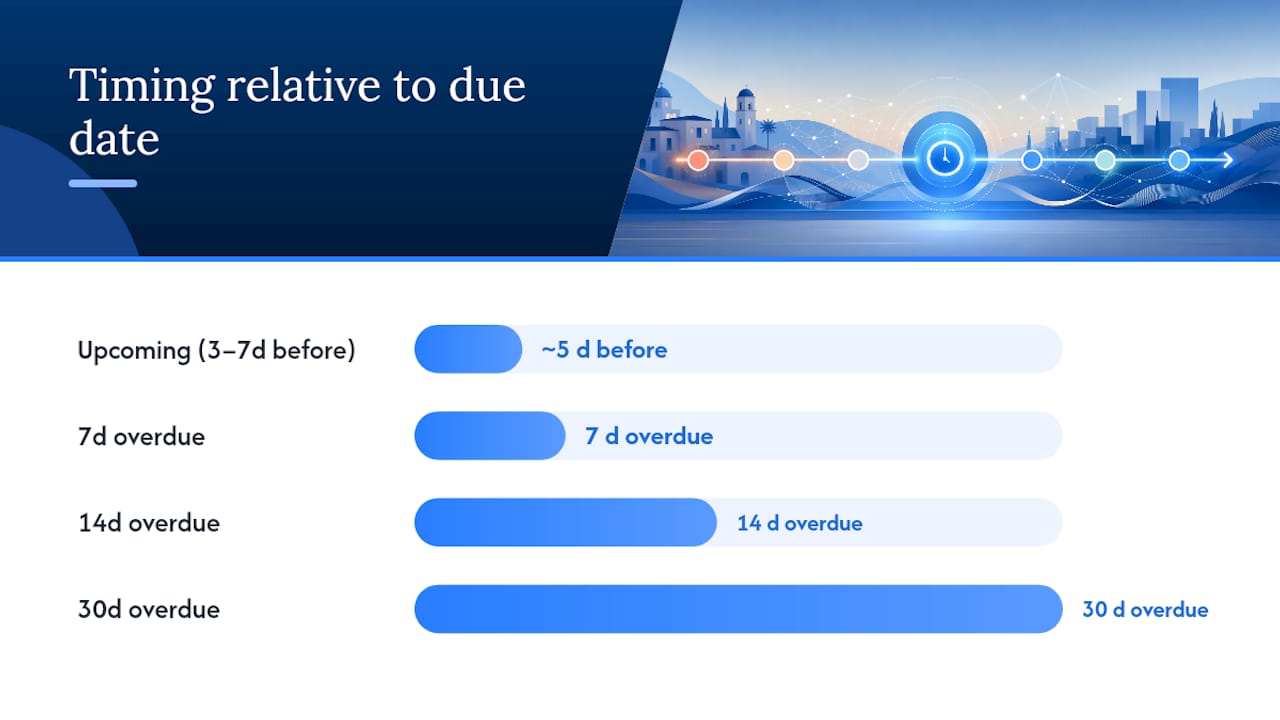
5. 30 days overdue (final) Subject: Aviso final: factura #[número] vencida hace 30 días "Hola [nombre], esta es nuestra notificación final para la factura #[número] ($[monto]). De no recibir el pago antes del [fecha], escalaremos el caso. Pague ahora: [enlace de pago]."
SMS/WhatsApp short versions:
- Upcoming: "Recordatorio: factura #[número] vence el [fecha]. Pague aquí: [enlace]."
- 7 days: "Factura #[número] vencida. Confirme su pago: [enlace]."
- 14 days: "Urgente: factura #[número], 14 días vencida. Pague hoy: [enlace]."
Required fields in every message:
- Invoice number
- Amount owed (with currency)
- Original due date
- Direct payment link
- A named contact or company sign-off
When Should You Send Payment Reminders?
Timing beats wording almost every time. A well-timed generic reminder outperforms a beautifully written one sent too late or too often.
- 3-7 days before due date: send the upcoming reminder by email.
- Due date: send a same-day nudge, ideally paired with SMS.
- 1-7 days overdue: friendly follow-up, same channel as before.
- 7-14 days overdue: firmer tone, added urgency, second channel (SMS or WhatsApp).
- 14 days overdue: this is your trigger point for a phone call, not another automated message.
- 30+ days overdue: final notice, then move to the escalation steps covered later.
This cadence mirrors what Stripe recommends for businesses managing recurring receivables, and for good reason: automated reminders catch the customers who simply forgot, while phone calls do the heavier lifting once an invoice clears the two-week mark. If an account is relationship-sensitive, a long-term client or a referral source, stretch the cadence slightly and route the 14-day step to a call from someone the customer already knows rather than a generic collections line.
Getting the Tone Right in Spanish
Formality matters more in Spanish than in English, and getting it wrong reads as either stiff or disrespectful depending on which way you err.
- Use usted for B2B collections by default. It's the safer, more professional register across nearly every Spanish-speaking market, even in countries where tú is common in casual business chat.
- Never machine-translate a reminder without a native-speaker check. Literal translations of English collections phrasing ("please remit payment") often sound stilted in Spanish; "le pedimos regularizar el pago" reads far more naturally than a word-for-word rendering.
- Avoid slang or regional idioms. What's warm in Mexico can sound off in Argentina or Spain. Keep phrasing neutral and businesslike.
- Preserve your brand's actual voice, not a generic collections voice. If your English reminders are warm and plain-spoken, the Spanish version should read the same way, not suddenly formal or bureaucratic.
Editing checklist before you send: invoice reference correct, amount matches the invoice exactly, payment link tested and working, a real contact name or department, and a sign-off that matches your brand's other communications.
Pro Tip: Run your Spanish templates past a native speaker once, save the approved wording, and reuse it. Rewriting from scratch each time is how tone drifts and errors creep in.
Which Channel Should You Use for Each Stage?
Channel choice should track urgency, not convenience. Email works well when there's no pressure yet; phone works when there is.
- Email: best for the upcoming and due-date stages, and for anything requiring detail (full invoice breakdown, attached PDF).
- SMS/WhatsApp: short nudges at 7 and 14 days overdue. Keep these under 160 characters for SMS, and always lead with the invoice number.
- Phone: reserved for 14+ days overdue or high-value accounts where a written message alone isn't moving the needle.
- Payment links: every message, every channel, should include one. Direct payment links measurably increase completion rates compared to messages that just list bank details and expect the customer to log in somewhere else.
Automating This at Scale: Integrations, KPIs, and a Pilot
Templates only work if they fire on schedule without someone remembering to click "send." That means connecting your reminder system to the places where invoice and payment data actually live.
- Invoicing/accounting software: triggers reminders the moment an invoice is created or a due date passes.
- CRM: flags relationship-sensitive accounts so they get a softer cadence or a human touch earlier.
- Payment links: embedded directly in every message so customers pay in one click.
- Two-way messaging: lets customers reply "ya pagué" or ask a question without starting a new thread.
Track four numbers to know if it's working: days sales outstanding (DSO), click-to-pay rate, reply rate, and total recovered amount. Run a pilot on your 20 to 30 highest-value overdue Spanish-speaking accounts first, test two tone variants (formal vs. slightly warmer usted), and measure results over a 60-day window before rolling out further.
Early pilots combining AI-driven tone calibration with automated follow-ups have shown meaningful improvements in reply and payment rates for small businesses, though the long-term durability of those gains is still being studied.
Interval-ai's own clients report recovering overdue balances without hiring additional collections staff, largely because the system adjusts tone and cadence automatically instead of relying on someone manually tracking spreadsheets.
What Happens When Automation Doesn't Work?
Automated reminders solve forgetfulness. They don't solve disputes, cash-flow problems on the customer's end, or accounts that are quietly going dark. When a Spanish-speaking customer stops responding past 14 days, move through these steps in order:
- Call. A human voice gets answers automation can't.
- Offer a payment plan if the customer indicates a temporary shortfall.
- Pause future work or deliveries if the relationship allows it and the amount justifies it.
- Send a final written demand, referencing all prior communication.
- Escalate to collections or legal counsel only after the above steps are exhausted.
Two practical notes: late fees and interest charges are capped differently state by state in the U.S., so confirm your state's limit before adding one to an invoice. And keep a written record of every reminder sent, since documented outreach protects your business if a dispute ever surfaces.
Rolling This Out on a Small Finance Team
Don't try to automate every account on day one. Start with your highest-value overdue Spanish-speaking customers, run the cadence above for 60 to 90 days, and adjust tone and timing based on what actually gets replies versus what gets ignored. Most teams overbuild the system before they've learned what their own customers respond to. Fix that order, and the rest gets easier.
— Tyler
How Interval-ai Puts This Into Practice
Building and maintaining Spanish templates, tracking cadence manually, and remembering when to escalate to a call is exactly the kind of repetitive work that erodes a finance team's time. Interval-ai runs the entire cadence for you, calibrated to your brand's actual tone in both English and Spanish, and adjusts automatically based on how each customer responds.
Interval-ai's clients report significant days-to-payment improvements and describe recovering thousands of dollars in overdue receivables without adding a single hire to their AR team. The system handles the templates, the timing, the channel switching between email, SMS, and WhatsApp, and flags accounts that need a human call instead of another automated nudge. If you're managing overdue Spanish-speaking accounts by hand right now, schedule a demo to see how a pilot on your highest-value accounts could look within 60 days.
Sources
For deeper reading on cadence design and collections mechanics, Stripe's payment reminder guide covers timing benchmarks in detail, while GoCardless breaks down documentation and consistency practices. Beancount's 2026 collections playbook is useful for escalation and leverage tactics, and the Crono follow-up template library offers additional structures worth adapting into Spanish.
- Payment reminders: A guide for businesses | Stripe
- Get paid faster: Strategies for collecting money from customers | GoCardless
- The B2B Late Payment Crisis: A 2026 Collections Playbook for Small Businesses
- How To Use Tone And Automation To Accelerate SMB Payments - StrongMocha
FAQ
Should Spanish payment reminders use formal or informal language?
Use usted, the formal register, for B2B collections in Spanish. It's the safer default across Spanish-speaking markets, even where informal speech is common elsewhere in business.
When should I switch from automated reminders to a phone call?
Switch to a phone call once an invoice hits 14 days overdue. Automated messages handle forgetfulness well, but unresolved accounts past that point usually need a human conversation.
What should a Spanish SMS reminder include?
Keep it under 160 characters and include the invoice number, the amount owed, and a direct payment link. Skip lengthy explanations for SMS; save those for email.
Do I need a native Spanish speaker to write these templates?
You don't need one for every message, but have a native speaker review your core templates once before automating them. Machine-translated collections language often sounds stiff or oddly formal in Spanish.
Can Interval-ai handle Spanish and English reminders in one workflow?
Yes. Interval-ai calibrates tone and cadence per customer and supports multilingual outreach across email, SMS, and WhatsApp within a single automated workflow.
