
TCPA SMS Reminders: The 2026 Compliance Checklist
Published: August 23, 2026 · 8–9 min read
If you send SMS reminders to customers, here's the core rule: your consent requirement depends on whether the message is informational or marketing, and if a customer replies STOP by any reasonable means, you must honor that revocation within ten business days. Everything else in TCPA compliant messaging builds on those two facts.
Most businesses get tripped up because they treat all texts the same way. A payment reminder and a promotional blast carry different consent standards, different documentation requirements, and different penalty exposure if you get it wrong.
Before you send another message, do these three things:
- Stop sending marketing texts to anyone without documented prior express written consent.
- Turn on real-time STOP suppression across every system that touches your customer list.
- Tag every consent record with a timestamp, source, and collection method.
Per-text violations run $500 to $1,500, and class actions scale that number fast. Interval-ai builds these controls into its automated reminder workflows, which is where a lot of the checklist below becomes easier to execute than it looks on paper.
Key Takeaways
TCPA compliance for SMS reminders depends on matching consent type to message type, honoring revocation within a reasonable timeframe, not to exceed ten business days, and keeping detailed, retrievable consent records.
| Point | Details |
|---|---|
| Match consent to message type | Informational reminders need prior express consent; marketing texts require prior express written consent. |
| Honor revocation fast | Process opt-outs by any reasonable means within a reasonable timeframe, not to exceed ten business days, per current FCC rules. |
| Document everything | Store phone number, timestamp, disclosure text, source, and campaign ID for at least four years. |
| Sync suppression everywhere | A single real-time suppression list across every vendor prevents most TCPA lawsuits. |
| Automate with built-in controls | Interval-ai enforces consent, suppression, and time-zone rules while integrating with AR and CRM systems. |
Priority Compliance Checklist for TCPA SMS Reminders
Fixing your SMS reminder program doesn't require a legal team. It requires working through these steps in order, because each one depends on the last.
- Capture and store consent properly. Log the phone number, the exact disclosure text shown, the timestamp, the source (web form, in-store signup, verbal), and the collection method. Attach this record to the customer profile, not a spreadsheet nobody checks.
- Separate your message streams. Informational reminders (appointment confirmations, payment due dates) need their own consent trail, distinct from marketing promotions. Mixing them in one thread is one of the fastest ways to lose a TCPA defense.
- Automate suppression across every vendor. If a customer opts out through your CRM but your SMS platform doesn't know, you're still texting someone who revoked consent. Sync suppression lists in real time, not overnight batches.
- Enforce time-zone-aware sending. Quiet hours run from 8 AM to 9 PM in the recipient's local time zone, not yours. Use area-code inference at minimum; contact-based time zones are more reliable.
- Scrub against the National DNC Registry and maintain your own internal do-not-call list, updated regularly rather than as an annual afterthought.
- Set a retention schedule and run monthly audits. Test your opt-out flow the same way you'd test a payment form: send a STOP, confirm suppression, check every downstream system.
Pro Tip: Run a "silent audit" quarterly: pick 20 random contacts flagged as opted out, and confirm none of them received a message in the last 90 days. This catches sync failures before a regulator or plaintiff's attorney does.
What Consent Standard Applies to Your Message?
The TCPA splits consent into two tiers, and mixing them up is the single most common compliance mistake business owners make.
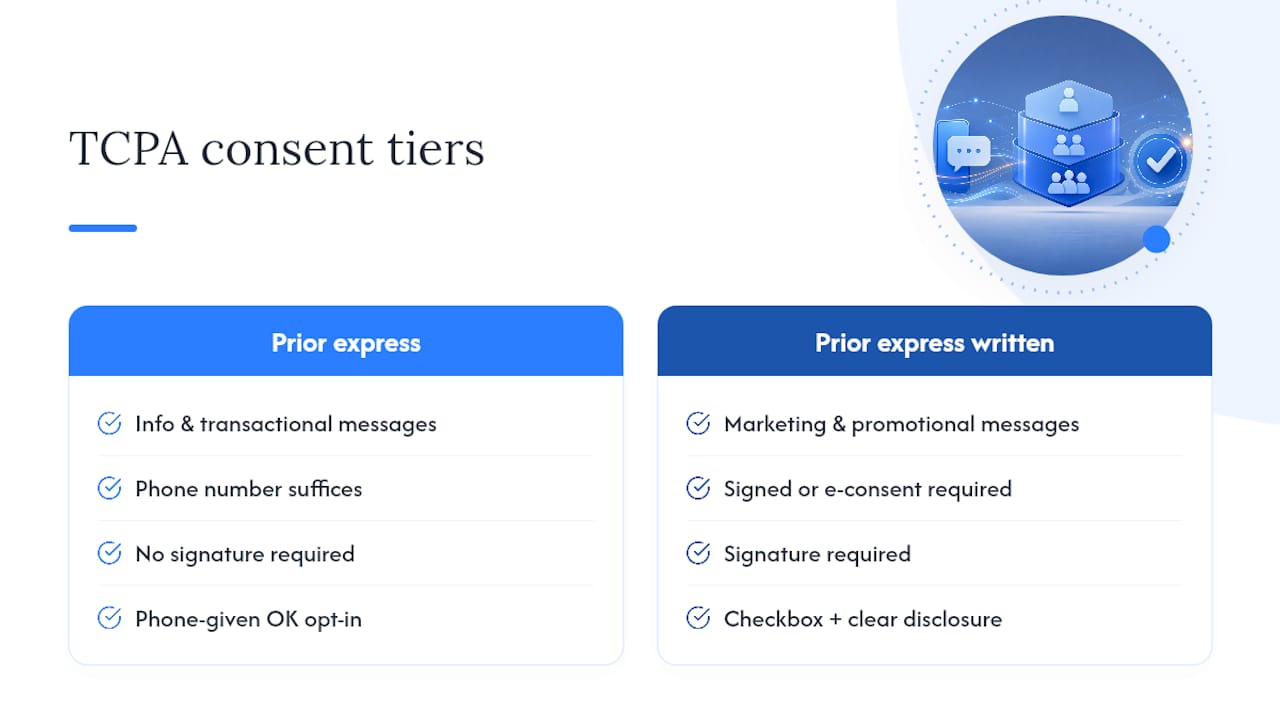
Prior express consent covers informational and transactional messages, things like appointment reminders, payment due notices, delivery updates, and account alerts. Giving a business their phone number for a transaction generally satisfies this standard.
Prior express written consent applies to marketing and promotional messages. This requires a signed or electronic agreement that clearly discloses what the customer is signing up for, and it can't be buried in fine print.
A compliant web-form opt-in typically reads something like this:
By checking this box, you agree to receive SMS reminders and account updates from [Business Name] at the number provided. Message and data rates may apply. Message frequency varies. Reply STOP to opt out at any time. Reply HELP for assistance.
Healthcare reminders get a narrow exemption, but it comes with strict guardrails: no more than one message per day and three per week, plus clear provider identification in every text. Exceed that frequency and the exemption stops protecting you.
How Do You Handle Opt-Outs and Revocation Requests?
The FCC doesn't require customers to text the exact word "STOP." Revocation made by any reasonable means, a phone call, a reply in plain English, an email, counts, and businesses must process it.
- Honor revocation within a reasonable timeframe, not to exceed ten business days. That's the current federal deadline, effective since April 2025.
- Send one confirmation text, if you want. You're allowed a single confirmation message within five minutes of the opt-out, and it doesn't count as an unsolicited send. Anything beyond that one confirmation risks violating the revocation itself.
- Build a webhook-driven suppression pipeline. When a STOP arrives, it should hit a central suppression API instantly, not queue for manual review.
- Test edge cases. Reassigned phone numbers and known-litigator lists both need active screening, since a number that opted out six months ago may now belong to someone else entirely.
Twilio's Compliance Toolkit logs opt-out and litigator-check events through specific error codes like 21610 and 30640, which gives you an audit trail without building one from scratch.
What Records Do You Need to Defend a TCPA Claim?
If a compliance complaint or lawsuit shows up, your consent records are the entire defense. Vague documentation loses cases that solid documentation wins outright.
Store these fields for every contact, every time:
- Phone number and the exact timestamp consent was given
- The disclosure text shown to the customer at the moment of opt-in
- Source of the consent (web form, point-of-sale, verbal agreement)
- Collection method and the IP address, when applicable
- Campaign ID tying the consent to a specific messaging program
Keep these records for a minimum of four years in a searchable format, not a static PDF archive. Link each consent record to your provider's delivery logs and the customer's account history, so if a dispute reaches discovery, you can produce a complete chain in minutes instead of weeks.
What Happens If You Get TCPA Compliance Wrong?
Statutory damages run $500 to $1,500 per text, and that number multiplies fast once a plaintiff's attorney turns one complaint into a class action covering thousands of messages. A private right of action means individual consumers, not just regulators, can sue.
Most violations trace back to a handful of repeat mistakes:
- Opt-outs that sync to one system but not others
- Marketing and transactional content mixed in the same message thread
- Consent records that are incomplete or missing entirely
- No known-litigator screening before sending high volumes
Courts have also interpreted TCPA provisions differently than the FCC's own guidance in some cases, which is exactly why conservative list segmentation and airtight documentation matter more than chasing the minimum legal bar.
How Do You Implement TCPA-Compliant SMS Automation?
Building this yourself means stitching together consent capture, suppression sync, and time-zone logic across separate tools. Platforms built for compliant messaging handle these as a single workflow instead.
Look for these capabilities before you pick a system:
- Consent attachments tied to each contact record, not stored separately
- A suppression API that every connected channel checks before sending
- Time-zone-aware scheduling that respects the recipient's local quiet hours
- Audit logs capturing every send, bounce, opt-out, and error code
- Webhook-based opt-out handling that updates suppression in real time
The strongest setups integrate directly with your accounting or CRM system, so a reminder triggers automatically when an invoice ages past due, and the outcome (paid, disputed, opted out) writes back to the same record. Interval-ai's automated outreach follows this pattern, applying consent and suppression rules while adjusting outreach based on each account's payment history.
Pro Tip: Roll out any new reminder automation in a small pilot group first. Monitor opt-out rates and error logs for two weeks before expanding to your full customer list, so you catch a sync failure while it affects 50 accounts instead of 5,000.

Compliance Is a Collections Strategy, Not Just a Legal Checkbox
Businesses that treat consent and suppression as an afterthought pay for it twice, first in complaints, then in slower collections once customers distrust the messages they're getting. Get the fundamentals right, roll out changes gradually, and watch your opt-out and complaint rates as closely as you watch payment velocity.
— Tyler
Automate Compliant SMS Reminders With Interval AI
Interval-ai gives you the payment-collection speed you want without the manual work of tracking consent records, suppression lists, and quiet hours across separate tools.
Instead of managing opt-in disclosures in one system and payment reminders in another, Interval-ai ties consent, suppression, and time-zone-aware scheduling into a single automated workflow that connects directly to your accounting or CRM system. The platform adjusts outreach based on each customer's payment history, applies revocation rules automatically, and logs every send for audit purposes. Interval-ai reports reducing days-to-payment by more than 30 days for its users, without adding collections staff. If your current reminder process is a patchwork of spreadsheets and manual STOP tracking, visit Interval AI to request a demo and see how the compliance controls map to your existing accounts receivable workflow.
Sources
This article is general information, not a substitute for advice from a qualified lawyer. Consult a qualified legal professional about your own circumstances before acting on anything here.
FAQ
What Counts as Prior Express Written Consent?
It's a clear, signed, or electronic agreement specifically disclosing that the customer will receive marketing texts, including the business name and opt-out method, distinct from the lighter standard for transactional messages.
How Fast Must You Process a STOP Request?
Within ten business days of receiving it through any reasonable means, though most compliant systems, including Interval-ai's suppression workflow, process it instantly.
Can You Send Both Payment Reminders and Promotions to the Same List?
Yes, but they need separate consent records and ideally separate message threads, since mixing informational and marketing content in one stream is a common trigger for TCPA disputes.
Are Healthcare Appointment Reminders Exempt From TCPA Rules?
They get a narrow exemption if they meet strict limits, generally one message per day and three per week, with clear provider identification included.
