
The Role of AI in Dispute Identification for Businesses
Published: May 25, 2026 · 9–10 min read
TL;DR:
- AI detects payment disputes early by analyzing behavioral and transactional signals in real time. It classifies issues accurately and supports human judgment, preventing small billing problems from escalating into major disputes. Effective AI implementation relies on high-quality data, explainability, and clear role boundaries within payment workflows.
Payment disputes don't announce themselves. They show up as patterns in your data, buried in transaction logs, customer emails, and billing records that no human team can realistically scan in real time. That's exactly where the role of AI in dispute identification becomes a genuine business advantage. AI doesn't replace the people who resolve disputes. It spots the signals faster, classifies the problem accurately, and hands your team a clear picture before a small billing issue becomes a formal complaint or a collections headache. This article breaks down how it works, what it can and can't do, and how to put it to work in your payment workflows.
Key takeaways
| Point | Details |
|---|---|
| AI detects disputes earlier | Machine learning models analyze behavioral and transactional signals in real time, catching issues before they escalate. |
| Data quality drives accuracy | Well-structured input documentation improves AI classification accuracy more than model sophistication alone. |
| Human oversight remains critical | AI handles volume and speed; humans handle judgment, nuance, and final decisions in complex cases. |
| Explainability is non-negotiable | Tools that surface why a dispute was flagged protect you legally and make AI outputs auditable. |
| Implementation is a process | Successful AI adoption requires phased rollout, staff training, and continuous monitoring of model outputs. |
The role of AI in dispute identification explained
The technology behind AI dispute detection is more accessible than most business owners realize. You don't need a data science team to benefit from it. What you do need is a clear understanding of which tools do what.
Natural language processing (NLP) reads and interprets text. In a payment dispute context, that means scanning customer emails, chat transcripts, and support tickets for language that signals dissatisfaction, billing confusion, or a refusal to pay. NLP can flag a message like "I never authorized this charge" in milliseconds and route it to the right queue automatically.
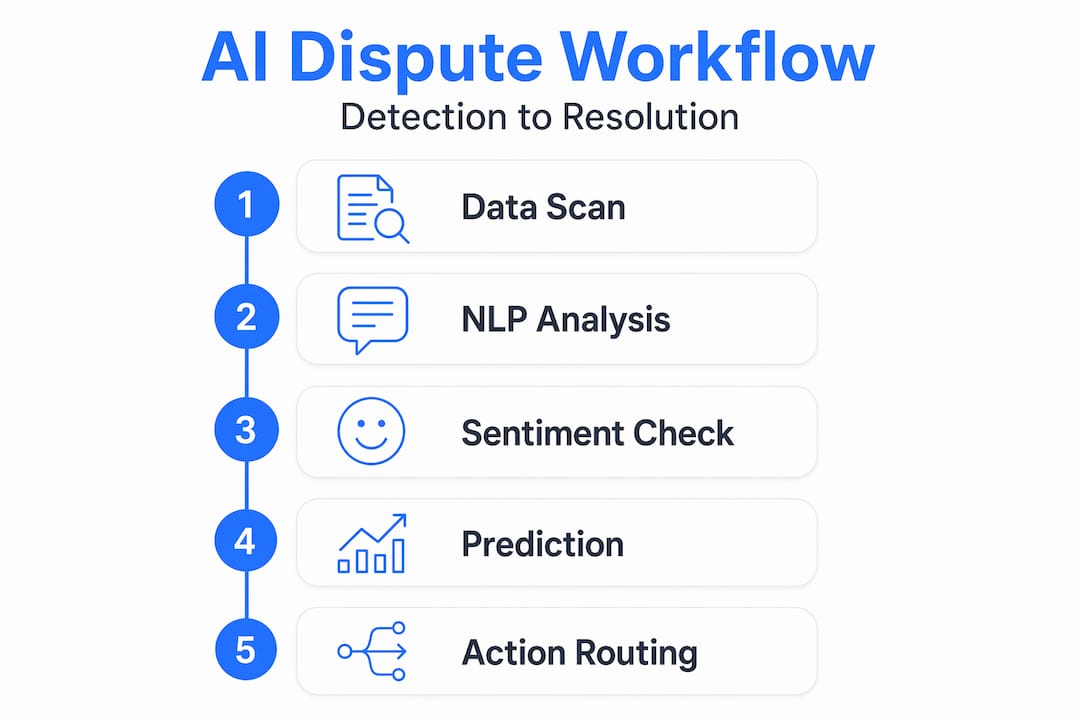
Sentiment analysis goes one layer deeper. It doesn't just read words. It reads tone. A customer who writes "I'm sure this is just a misunderstanding" is in a very different place than one who writes "I've already contacted my bank." Sentiment analysis helps you prioritize which disputes need immediate human attention.
Machine learning models are where the real power sits. Unlike rule-based systems that only catch what you've already defined as a problem, adaptive ML models learn from historical data. ML-based detection systems reduce false positives by 50 to 60% and improve true detection rates by 25 to 40% compared to rule-based approaches. These systems evaluate over 200 behavioral features simultaneously in under 50 milliseconds, which means real-time identification at a scale no human team can match.
One distinction worth understanding: rule-based systems are fast to set up and easy to explain, but they break down when dispute patterns change. ML models adapt over time, which makes them far more durable in dynamic payment environments.
Pro Tip: When evaluating AI tools, ask vendors specifically whether their system uses adaptive machine learning or static rules. The answer tells you a lot about how the tool will perform six months after implementation.
Explainability features like SHAP values are also worth prioritizing from day one. These tools show your team exactly why a dispute was flagged, which matters for legal defense, regulatory compliance, and building internal trust in AI outputs.
Real-world AI applications in payment disputes
The gap between AI theory and AI practice has closed significantly in 2026. Here's what actual deployment looks like across industries.

Large-scale conciliation at volume. Companies in Brazil are using AI platforms to conduct 500 to 600 conciliation sessions daily, automatically classifying dispute categories and sending virtual invitations to parties. What used to take weeks now happens in near real time. The AI handles identification, classification, and routing. Humans step in for resolution.
Predictive dispute modeling. In construction and contract-heavy industries, ML algorithms predict dispute outcomes with nearly 87% accuracy after litigation begins, using 24 legal factors across dispute stages. For payment-focused businesses, the same predictive logic applies. If a customer's payment behavior matches a pattern your model has seen before, you can intervene early rather than waiting for a formal chargeback.
AI-assisted arbitration. The AAA's AI Arbitrator tool processes document-only disputes by summarizing claims and exhibits to assist human arbitrators with case analysis. This is artificial intelligence in arbitration working as a support layer, not a replacement. The tool speeds up case preparation and reduces the cognitive load on human decision-makers.
Here's a quick comparison of what AI handles well versus where human involvement stays critical:
| Dispute type | AI effectiveness | Human role |
|---|---|---|
| High-volume, routine billing disputes | High | Oversight and exception handling |
| Fraud and chargeback pattern detection | High | Final authorization and escalation |
| Contract interpretation disputes | Moderate | Primary decision-maker |
| Complex subjective or emotional disputes | Low | Full ownership |
| Document-only arbitration cases | High | Review and final ruling |
The pattern is consistent across industries. AI tools for dispute resolution perform best when the dispute is document-heavy, data-rich, and follows recognizable patterns. AI mediation tools can suggest neutral recaps, propose offers, and assess willingness to settle. Final decisions still rest with people.
Limitations and risks you need to know
No tool is without trade-offs. Understanding where AI struggles helps you deploy it where it works and keep humans in the loop where it doesn't.
-
Subjective disputes resist automation. AI currently performs best in straightforward, document-focused disputes and is less suited for complex cases involving live testimony, emotional context, or competing interpretations of intent. If a customer dispute hinges on what was said in a phone call, AI can transcribe and flag it. Deciding what it means is still a human job.
-
Over-reliance erodes human skills. This one catches organizations off guard. Frictionless AI risks eroding your team's ability to navigate conflict directly. When AI resolves everything automatically, your staff loses practice with negotiation and judgment calls. Building intentional friction into your AI workflow, meaning requiring human review at key decision points, preserves those skills.
-
Poor input quality breaks the model. This is the most underestimated risk. Structured templates with clear headings and logically ordered exhibits improve AI accuracy significantly. If your dispute documentation is inconsistent or incomplete, the AI will misclassify. Garbage in, garbage out is not a cliché here. It's a real operational risk.
-
Explainability gaps create compliance exposure. If your AI flags a dispute and you can't explain why, you have a problem in a legal or audit context. Absence of explainability features is one of the primary reasons AI adoption stalls in regulated industries.
Pro Tip: Before deploying any AI dispute tool, audit your existing documentation practices. If your team can't describe a dispute consistently in writing, the AI will struggle to classify it correctly.
How to implement AI in your dispute workflow
Getting AI into your payment dispute process doesn't require a complete technology overhaul. A phased, practical approach works better than trying to automate everything at once.
-
Start with a dispute audit. Categorize your last 90 days of disputes by type, volume, and resolution time. This tells you where AI will have the most immediate impact. High-volume, repetitive disputes are your best starting point.
-
Define AI's role clearly. Decide upfront what AI will do and what it won't. Will it flag disputes for human review, or will it also trigger automated responses? Setting these boundaries prevents scope creep and keeps your team confident in the system.
-
Standardize your documentation. Create templates for how disputes are recorded, including customer name, transaction date, amount, dispute reason, and any supporting evidence. Consistent structured inputs are the single biggest driver of AI accuracy in dispute workflows.
-
Choose tools with explainability built in. When your AI flags a dispute, your team needs to see why. SHAP values and similar tools make AI outputs auditable and defensible. This is non-negotiable for compliance.
-
Monitor and retrain regularly. Dispute patterns change. A model trained on last year's data may miss new fraud patterns or misclassify disputes that look different from historical cases. Schedule quarterly reviews of model performance and update training data accordingly.
-
Train your staff on collaboration, not replacement. Your team needs to understand what the AI is doing and why. When staff trust the system, they use it well. When they don't, they work around it, which defeats the purpose.
Financial services firms that apply AI to proactive detection before issues escalate consistently see better outcomes than those using AI only for post-dispute analysis. The earlier in the workflow AI gets involved, the more value it delivers.
My take on AI and human judgment in disputes
I've watched a lot of organizations get excited about AI and then quietly scale it back six months later. Not because the technology failed, but because they didn't think through the human side of the equation.
Here's what I've learned: AI is a rehearsal partner. It helps your team prepare, spot patterns, and walk into a dispute conversation with better information. AI as a fourth party in negotiations reduces ambiguity and stress-tests arguments before anyone picks up the phone. That's genuinely useful. But the moment you treat it as the decision-maker, you've handed over something you'll want back.
The organizations that get this right treat AI outputs the way a good lawyer treats a legal brief. It's a starting point, not a verdict. They also invest in data quality before they invest in model sophistication. In my experience, a well-structured dataset and a mid-tier model will outperform a cutting-edge model fed inconsistent data every time.
The ethical dimension matters too. As AI tools become more capable, the temptation to automate more of the resolution process grows. My caution is this: keep humans accountable for outcomes. AI can identify the dispute. People should own the resolution.
— Tyler
See how Interval-ai handles dispute identification
If you're managing overdue payments and want AI working for you before disputes escalate, Interval-ai was built for exactly that.

Interval-ai uses machine learning to analyze your historical payment data and identify at-risk accounts before they become formal disputes. The platform automates outreach across multiple channels, routes cases based on dispute type, and gives your team clear, explainable recommendations. Clients report reducing days to payment by over 30 days and recovering significant revenue without adding headcount. If you want to see how AI dispute identification works in a real payment workflow, Interval-ai is worth a close look.
FAQ
What is the role of AI in dispute identification?
AI analyzes transactional, behavioral, and textual data to detect dispute signals early, classify dispute types, and route cases to the right team. It works fastest on high-volume, document-heavy disputes where patterns are recognizable.
How does machine learning improve dispute detection accuracy?
ML-based systems reduce false positives by 50 to 60% and improve true detection rates by 25 to 40% compared to rule-based approaches, by evaluating hundreds of behavioral features simultaneously in real time.
Can AI replace human judgment in dispute resolution?
No. AI performs well in identification, classification, and routing. Complex, subjective, or testimony-based disputes still require human judgment, and final resolution decisions should remain with people to maintain accountability.
What makes AI dispute tools fail in practice?
Poor input quality is the leading cause of failure. Inconsistent or incomplete dispute documentation prevents AI from classifying cases correctly. Standardized templates are the most effective fix before any AI tool is deployed.
How does predictive analytics help with payment disputes?
Predictive analytics in disputes uses historical payment behavior to flag accounts at risk before a formal dispute is filed. Predictive modeling has shown up to 87% accuracy in forecasting dispute outcomes, giving businesses time to intervene early and reduce escalation rates.
