
The Role of Automation in Financial Health
Published: June 28, 2026 · 9–10 min read
TL;DR:
- Automation in finance uses technology to execute tasks like budgeting and reporting without manual intervention. It improves accuracy and speed while allowing teams to focus on decision-making rather than data entry. Successful implementation requires clean data, clear workflows, and measured, phased adoption.
Automation in finance is defined as the use of technology to execute financial tasks, including budgeting, reporting, collections, and forecasting, without manual intervention at every step. The role of automation in financial health is to convert slow, error-prone processes into consistent, data-driven operations that free your team to focus on decisions rather than data entry. 58% of finance functions had adopted AI by 2024, and that number is climbing fast. Businesses that adopt automated financial management report measurable gains in accuracy, speed, and cash flow. This article gives you a practical, honest look at what automation delivers, where it can go wrong, and how to make it work for your organization.
How does automation improve budgeting, forecasting, and financial reporting?
Automated financial management cuts reporting cycle times and reduces the manual errors that distort your numbers. When your finance team spends less time compiling spreadsheets, they spend more time interpreting results and acting on them. That shift alone changes the quality of decisions your business makes.

Manual vs. automated process efficiency
The contrast between manual and automated finance workflows is significant in both speed and accuracy.
| Process | Manual approach | Automated approach |
|---|---|---|
| Budget variance reporting | Analyst compiles data, writes commentary manually | AI drafts commentary for human review in minutes |
| Rolling forecasts | Updated quarterly with static assumptions | Updated continuously with live data inputs |
| Month-end close | 5–10 business days average | Reduced to 1–3 business days with automation |
| Expense tracking | Receipts collected, coded by hand | Auto-categorized and flagged in real time |
| Collections follow-up | Manual calls and emails, inconsistent timing | Automated outreach across channels, policy-driven |
Variance commentary is the highest-ROI starting point for automation because AI can draft it accurately and quickly, leaving your analysts to review and refine rather than write from scratch. That single change saves analysts hours per reporting cycle.
Finance leaders who adopt automation move from static annual budgets to agile, AI-updated rolling forecasts. Rolling forecasts respond to real business conditions rather than assumptions made six months ago. That agility is a direct competitive advantage.
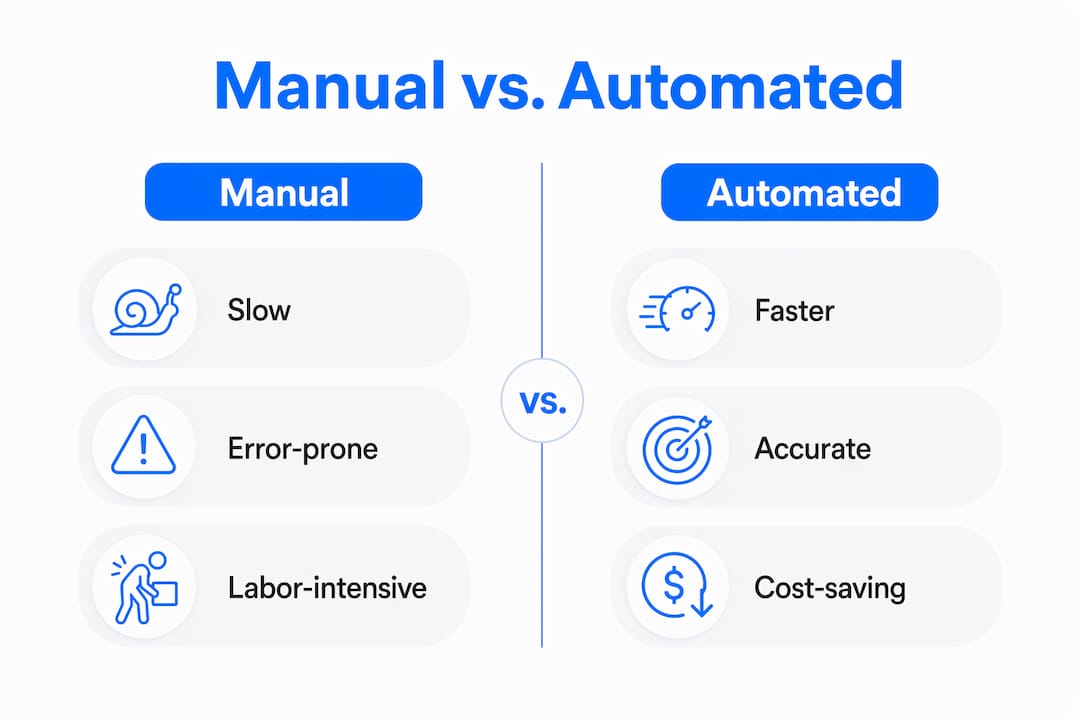
The financial impact is concrete. Individuals and businesses save an average of $2,100 per year through AI-assisted financial tools, driven by better expense tracking and smarter tax strategies. For a business managing dozens of cost centers, the savings compound quickly.
Pro Tip: Start your automation rollout with variance commentary and month-end close. These two workflows deliver fast, visible wins that build internal confidence and justify further investment.
What challenges and pitfalls should businesses avoid when implementing financial automation?
The biggest mistake in financial automation is automating a broken process. Automating inefficient manual processes amplifies errors rather than fixing them. Before you connect any automation tool to your ERP, CRM, or HRIS systems, you need clean data and documented workflows.
Common implementation risks
Watch for these failure points before and during your rollout:
- Dirty data pipelines. Integrations with ERP, CRM, and HRIS systems carry over existing data quality problems. Audit every data source before connecting it to an automated workflow.
- Shadow spreadsheets. Finance teams that reject new automated workflows revert to personal spreadsheets. This splits your data, undermines reporting accuracy, and erases the ROI you expected.
- Skipping process documentation. Automation requires clear, written rules. If your current process lives in someone's head, the automation will reflect that ambiguity.
- Underestimating change management. Technology adoption fails when people are not trained, involved, or shown why the change benefits them personally.
- No monitoring plan. Automated systems drift. Without regular audits of outputs and exception reports, errors accumulate silently.
The cultural risk is underrated. A finance team that does not trust the automated output will work around it. That parallel process costs time, creates inconsistencies, and defeats the purpose of automation entirely.
Pro Tip: Run a two-week parallel test where your team uses both the old process and the new automated workflow simultaneously. This builds trust in the output and surfaces data quality issues before they become real problems.
How does the human-AI hybrid model enhance financial decision-making?
Automation transitions finance professionals into a human-AI hybrid role, where AI handles data-heavy tasks and humans provide interpretation, judgment, and accountability. This is not a threat to finance jobs. It is a redefinition of what finance professionals do with their time.
What AI handles vs. what humans own
The division of labor in a well-functioning human-AI finance model looks like this:
- AI handles: data aggregation, variance detection, report drafting, anomaly flagging, collections outreach scheduling, and real-time forecast updates.
- Humans own: strategic interpretation, stakeholder communication, ethical judgment, exception decisions, and governance of AI outputs.
Agentic AI in autonomous finance goes further. It senses market changes, reasons about risks, and executes workflows within pre-set policies without waiting for a human to trigger each step. That capability compresses response time from days to minutes.
Consider a practical example. Your AI system detects a revenue variance of 12% against forecast in a specific product line. It drafts a variance commentary, flags three possible causes from historical data, and alerts your FP&A lead. Your analyst reviews the draft, applies business context the AI cannot know, and sends a final report to leadership. The analyst's time on that task drops from four hours to forty minutes.
The accountability question matters here. AI executes within rules you define. Your team sets those rules, reviews outputs, and owns the decisions. That governance structure is what separates effective automation from risky automation.
The role of technology in financial planning is not to replace judgment. It is to give your team better information, faster, so their judgment is applied to the right problems.
What practical steps can business owners and financial managers take to maximize the benefits of automation?
Successful automation adoption follows a phased approach. Trying to automate everything at once creates confusion, resistance, and poor results. Start narrow, prove value, then expand.
-
Audit your current workflows. Map every manual finance process. Identify where errors occur most often and where your team spends the most time. These are your highest-priority automation targets.
-
Measure your baseline. Record current cycle times, error rates, and costs for the processes you plan to automate. You cannot demonstrate ROI without a starting point. Finance automation projects pay for themselves within 6–18 months with disciplined change management, but only if you track the right metrics from day one.
-
Start with high-ROI workflows. Variance commentary, collections follow-up, and month-end close are proven starting points. Each delivers fast, measurable results that build organizational confidence.
-
Train your team before go-live. Involve finance staff in the configuration process. People support systems they helped build. Training should cover both how the tool works and why it improves their day-to-day work.
-
Run sensitivity analyses on your forecasts. Automated forecasting tools let you model multiple scenarios quickly. Use that capability to stress-test assumptions and prepare your leadership team for a range of outcomes.
-
Monitor outputs consistently. Set up exception reports and review them weekly. Automated systems require ongoing oversight. Catching a data drift early costs far less than correcting months of compounded errors.
Pro Tip: Assign a dedicated automation owner on your finance team. This person monitors outputs, manages exceptions, and acts as the internal advocate for adoption. Without clear ownership, automation tools get underused and undervalued.
The impact of automation on budgeting is most visible when you compare your planning cycle before and after. Teams that once spent three weeks building an annual budget now run rolling forecasts that update weekly. That shift changes how your business responds to market conditions.
Key takeaways
Automated financial management delivers the most value when it combines clean data, clear governance, and a finance team trained to work alongside AI rather than around it.
| Point | Details |
|---|---|
| Start with variance commentary | AI-drafted variance reports are the fastest, highest-ROI entry point for finance automation. |
| Clean data before automating | Audit ERP, CRM, and HRIS integrations before connecting them to any automated workflow. |
| Expect ROI within 6–18 months | Mid-market businesses recover automation costs within this window with consistent change management. |
| Assign an automation owner | A dedicated internal owner prevents tool underuse and keeps outputs accurate over time. |
| Human judgment stays central | AI handles data tasks; your team owns interpretation, governance, and final decisions. |
Why automation ROI is more personal than most vendors admit
I have seen businesses invest in finance automation and walk away disappointed, not because the technology failed, but because they skipped the unglamorous work that makes it succeed. Data quality is the part no vendor puts in the headline. Your automation is only as good as the data feeding it.
The businesses I have watched get the most out of automated financial management share one trait: they treated the rollout as a people project first and a technology project second. They involved their finance teams early, ran parallel tests, and gave staff time to trust the new outputs. The teams that skipped that step ended up with expensive tools running alongside the same spreadsheets they had always used.
The human-AI hybrid model is real, and it works. But it requires finance professionals who are willing to shift from doing the data work to owning the interpretation. That mindset shift is harder than any software implementation. The good news is that once your team experiences the time savings firsthand, the resistance usually disappears on its own.
My honest recommendation: do not measure success by how much you automated. Measure it by how much better your financial decisions became. Automation is the means. Better decisions are the goal.
— Tyler
Interval-ai and automated collections for better cash flow
If overdue payments are draining your cash flow and consuming your team's time, Interval-ai addresses that specific problem with a data-driven approach to collections.
Interval-ai uses AI to tailor outreach strategies based on historical payment data, managing communications across multiple channels without additional staffing. Clients report reducing days to payment by over 30 days and recovering significant revenue while cutting payroll costs. The system works within your brand identity, so customer interactions stay professional and consistent. If you want to see how automated collections work in practice, Interval-ai is worth a close look.
FAQ
What is the role of automation in financial health?
Automation in finance improves financial health by reducing manual errors, accelerating reporting cycles, and freeing finance professionals to focus on analysis and decisions. The result is faster, more accurate financial operations and better cash flow management.
How long does it take to see ROI from finance automation?
Finance automation projects in mid-market businesses typically pay for themselves within 6–18 months when paired with disciplined change management and consistent team adoption.
What is the biggest risk when implementing financial automation?
The biggest risk is automating a broken or poorly documented process. Errors in your existing workflows will be amplified, not corrected, by automation. A data audit and process review before implementation are non-negotiable.
What does the human-AI hybrid model mean for finance teams?
In the human-AI hybrid model, AI manages data-heavy tasks like report drafting and anomaly detection, while finance professionals focus on interpretation, governance, and strategic decisions. Roles shift rather than disappear.
Where should a business start with financial automation?
Variance commentary and month-end close are the highest-ROI starting points. Both deliver fast, visible results and build the internal confidence needed to expand automation across other workflows.
