
The Role of Automation in Startup Scaling: 2026 Guide
Published: July 10, 2026 · 9–10 min read
TL;DR:
- Automation allows startups to increase output without adding staff by replacing repetitive tasks with reliable systems. It shifts hiring focus toward higher-value roles and requires careful documentation, testing, and human oversight for success. Effective automation depends on choosing the right tools for workflow complexity and measuring results to ensure continuous improvement.
Automation is the primary mechanism by which early-stage startups grow output without growing headcount. The role of automation in startup scaling is to replace repetitive, rules-based work with systems that run consistently, accurately, and at volume, so your team can focus on decisions that actually require judgment. 88% of small business owners report that automation improves their ability to compete against larger companies. That statistic reflects a real shift: automation is no longer a luxury for funded companies. It is foundational infrastructure for any startup that wants to scale without burning out its team or blowing up its budget.
How does automation increase operational leverage in startups?
Operational leverage is the ability to grow output faster than you grow costs. Automation is the most direct path to it for a lean startup team.

When you automate routine workflows, you remove the manual drag that slows every growing operation. Tasks like lead qualification, invoice matching, data entry, and customer follow-up each consume hours per week. Individually, they seem manageable. At scale, they become the reason you hire before you are ready.
The numbers make this concrete. Founders who automate routine workflows reclaim an average of 6–10 hours weekly. That time goes back into product decisions, investor conversations, and customer relationships. Advanced workflow automation can also save 45–90 minutes of founder time per qualified lead, which is equivalent to one full-time sales hire at 20 leads per week. That is not a productivity gain. That is a hiring decision you do not have to make.
Automation also changes what your team is capable of. One employee can manage workloads that previously required multiple hires when the right systems are in place. This shifts your hiring profile toward higher-value roles rather than volume roles.
The key distinction founders miss is the difference between task automation and autonomous agents. Task automation handles a single, defined action, like sending a payment reminder or routing a support ticket. Autonomous multi-agent systems plan, act, and adapt across entire workflows with minimal human input. Both have a place, but they require very different levels of process maturity to deploy well.
- Lead qualification: Automated scoring and routing removes hours of manual triage from your sales team.
- Invoice matching and approval routing: 40% of CEOs now prioritize AI adoption specifically for transaction-heavy workflows like these.
- Customer communication: Automated follow-up sequences maintain consistency at volume without additional staff.
- Data entry and reporting: Eliminating manual data transfer reduces error rates and frees analyst time for interpretation.
Pro Tip: Before automating any workflow, map it manually first. If you cannot describe the process in five steps or fewer, it is not ready to automate.
What common pitfalls should startups avoid when adopting automation?
The biggest mistake founders make is automating too early. Premature automation of chaotic or poorly documented workflows does not create efficiency. It scales confusion and builds operational debt that becomes expensive to unwind.
A workflow earns the right to be automated only after it runs consistently in manual form. If your process changes every two weeks, automating it locks in the wrong version. You end up maintaining broken logic instead of fixing the underlying problem.
Three pitfalls show up repeatedly in early-stage automation efforts:
- Automating unstable processes: Any workflow that is still being designed should stay manual. Automation should preserve a working process, not define one.
- Skipping human-in-the-loop design: Effective human-in-the-loop systems have AI handle repetitive tasks while humans manage exceptions, approvals, and quality control. Removing humans entirely from consequential decisions creates downstream rework and erodes trust.
- Measuring the wrong outcomes: Founders often track whether automation is running rather than whether it is producing better results. Output per employee and error rates are the metrics that matter.
The cultural risk is just as real as the technical one. Teams sometimes resist automation because they fear it signals their role is at risk. Top startup operators are clear that AI should increase output per employee, not replace people. Communicating that framing early prevents friction during rollout.
Pro Tip: Run every automation candidate through a simple test: Can a new hire follow this process without asking questions? If not, document it further before you automate it.
What automation tools and AI systems work best for startup scaling?
Startups have access to three distinct levels of automation technology, and choosing the wrong level for a given workflow wastes time and money. Matching automation level to workflow needs is the decision that separates efficient scaling from over-engineered systems that nobody uses.
| Automation level | Complexity | Typical use cases | Best for |
|---|---|---|---|
| Task automation | Low | Email triggers, form routing, data sync | High-volume, single-step workflows |
| Workflow orchestration | Medium | Multi-step approval chains, CRM updates, billing cycles | Cross-functional processes with defined rules |
| Autonomous multi-agent AI | High | Lead research, content generation, financial reconciliation | Complex, adaptive workflows requiring judgment |
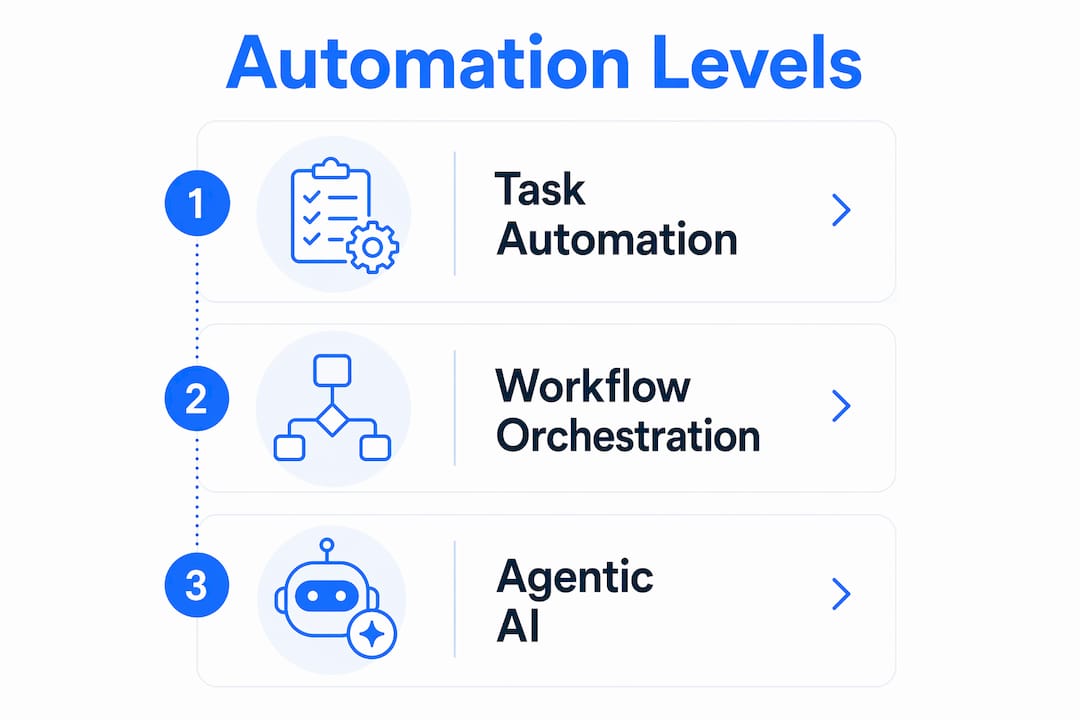
Task automation tools handle discrete actions triggered by a defined event. They are fast to deploy and easy to maintain. Workflow orchestration platforms connect multiple tools and steps into a single managed process. They require more setup but eliminate the manual handoffs that slow cross-functional work.
Agentic AI systems sit at the top of this stack. Agentic AI enables startups to compress build and scale timelines by coordinating autonomous agents that plan, act, and adapt with minimal human intervention. This model reduces the time and capital required compared to building traditional teams. For fintech founders specifically, agentic AI systems are reshaping how financial transactions and payment workflows get processed at scale.
Across sales, marketing, operations, and product management, the highest-ROI automation targets share three characteristics: they are high-volume, they follow consistent rules, and they do not require nuanced judgment on every instance. Customer communication, subscription billing, and lead routing all fit this profile. Financial operation automation like subscription billing improves both processing time and accuracy, which compounds as transaction volume grows.
The practical guidance is simple. Start with the workflow that consumes the most time and follows the most predictable rules. Prove ROI there before expanding to more complex systems.
How can startup founders implement automation to scale effectively?
Effective implementation follows a sequence. Skipping steps in that sequence is where most automation projects fail.
-
Audit your workflows by repeatability and volume. List every recurring task your team performs weekly. Rank them by how often they happen and how rule-based they are. The top of that list is your automation roadmap.
-
Document before you automate. Write out each workflow step in plain language. If the documentation reveals inconsistencies, fix them manually first. Automation investment should focus on high-volume, strategically critical, and low-complexity workflows first for maximum return.
-
Design human-in-the-loop checkpoints. Every automated workflow needs at least one point where a human reviews output, approves an exception, or flags an error. This is not a weakness in the design. It is what keeps the system trustworthy as it scales.
-
Set measurable success criteria before launch. Define what good looks like: a target error rate, a time saved per week, or a volume threshold the system must handle. Without a baseline, you cannot prove the automation is working.
-
Start small, prove it, then expand. Deploy automation on one workflow, measure results for 30 days, and use that data to justify the next phase. This approach prevents resource overextension and builds internal confidence.
Pro Tip: Treat your first automation as a pilot, not a permanent system. Build in a review date at 60 days to assess whether the workflow has changed enough to require an update.
Successful automation is a foundational operational infrastructure, not a one-time project. Early adoption improves unit economics significantly before growth strains appear. The founders who build automation into their operations early spend less time firefighting and more time building.
Key Takeaways
Automation scales startup output without proportional headcount growth, but only when applied to stable, well-documented workflows with human oversight built in.
| Point | Details |
|---|---|
| Automation is foundational infrastructure | Build automated workflows early to improve unit economics before growth creates strain. |
| Document workflows before automating | Unstable or undocumented processes scale confusion, not efficiency. |
| Match automation level to workflow needs | Task automation, workflow orchestration, and agentic AI each suit different complexity levels. |
| Human-in-the-loop design is non-negotiable | Keep humans in approval and exception roles to maintain accuracy and trust. |
| Measure output per employee, not just activity | Track error rates and time saved to confirm automation is delivering real results. |
Why I think most founders automate in the wrong order
The conventional advice is to automate whatever takes the most time. That sounds right, but it misses the more important question: is the process stable enough to automate at all?
I have watched founders spend weeks building automation for workflows that changed the following month. The result is a system that nobody trusts and everyone works around. The better instinct is to automate what is boring and proven, not just what is slow.
The human-in-the-loop principle is the one I would defend most strongly. Removing humans entirely from consequential decisions is not efficiency. It is a liability. The best automated systems I have seen treat human review as a feature, not a workaround. They route exceptions to the right person quickly, log decisions for learning, and get smarter over time because of that human input.
Automation also changes who you hire, and founders underestimate that shift. When one person can manage the workload of three, you stop hiring for volume and start hiring for judgment. That is a better team. But it requires you to communicate clearly why roles are evolving, not disappearing.
My honest advice: treat automation as an experiment with a defined hypothesis. "If we automate this workflow, we expect to save X hours and reduce errors by Y." Then measure it. The founders who iterate on that loop build operations that actually scale.
— Tyler
Interval-ai automates the workflows that drain your team
Collections and overdue payment follow-up are exactly the kind of high-volume, rule-based workflows that automation handles better than people. Interval-ai applies AI-driven outreach to the collections process, tailoring communication strategies to each customer's payment history and behavior. The system manages follow-up across multiple channels without additional staffing, and clients report reducing days to payment by over 30 days.

For startup founders who are scaling revenue but watching cash flow lag behind, Interval-ai addresses the gap directly. The platform handles the repetitive work of payment recovery while preserving your brand's tone and customer relationships. You get faster collections and fewer hours spent chasing invoices.
FAQ
What is the role of automation in startup scaling?
Automation enables startups to grow output without proportional headcount increases by handling repetitive, rule-based tasks at volume. This frees founders and teams to focus on strategic decisions that require human judgment.
When should a startup start automating its workflows?
Automate only after a workflow runs consistently in manual form and is fully documented. Automating an unstable process scales confusion rather than efficiency.
What types of automation tools work best for early-stage startups?
Task automation tools work best for high-volume, single-step workflows. As processes mature, workflow orchestration platforms and agentic AI systems handle more complex, multi-step operations with greater ROI.
How does automation affect startup hiring?
Automation shifts hiring away from volume roles toward judgment-heavy positions. One employee can manage workloads that previously required multiple hires, which improves team quality and reduces payroll costs.
How do I measure whether automation is working?
Track output per employee, error rates, and time saved per week against a pre-launch baseline. If those metrics do not improve within 60 days, the workflow or the tool needs adjustment.
