
Top Payment Recovery Tools for SaaS & Subscription Businesses
Published: August 8, 2026 · 20–21 min read
TL;DR:
- Interval-ai is the leading choice for US SaaS and subscription companies, offering per-customer AI decisioning and automated collections. It outperforms native retries by personalizing outreach and integrating with financial systems, reducing days to payment significantly. For multi-gateway setups, FlyCode enhances authorization rates through advanced ML and routing capabilities.
Interval-ai is the strongest pick for most U.S.-based SaaS and subscription businesses because it combines per-customer AI decisioning, automated multi-channel outreach, and integrated AR workflows that align directly with how recurring revenue businesses lose and recover money. If you're evaluating payment recovery solutions to reduce involuntary churn, here's where to start:
- Best overall: Interval-ai. Per-customer AI decisioning, CRM and accounting integrations, multilingual outreach, and a pricing model tied to accounts receivable volume.
- Best for multi-gateway orchestration: FlyCode. Per-merchant ML models with multi-PSP routing for merchants running more than one gateway.
- Best embedded/bundled option: Stripe Smart Retries / Stripe Billing. Zero-friction baseline for merchants already on Stripe who want recovery without adding a vendor.
- Best for enterprise: Vindicia Retain. Deep analytics, compliance posture, and professional services for complex billing environments.
- Best low-touch option: Slicker or Churnbuster. Fast onboarding and pay-for-success pricing for teams that want a quick pilot with minimal setup.
| Decision axis | What to look for |
|---|---|
| Recovery approach | Per-merchant ML outperforms global models for most SaaS stacks |
| Integration fit | Confirm native support for your billing platform (Stripe, Chargebee, Recurly) |
| Pricing alignment | Pay-on-recovery aligns vendor incentives with your outcomes |
| Measurement standard | Demand A/B or randomized lift testing, not just historical case studies |
| Ease of integration | No-code pilots reduce time-to-value; API integrations offer more control |
Demo Interval-ai first if you run a U.S. subscription or SaaS business and want per-customer AI decisioning with integrated collections automation. If you're on multiple gateways and need orchestration above all else, add FlyCode to your shortlist.
How we evaluated these payment recovery tools
Every tool in this comparison was assessed on the same set of criteria, weighted toward what actually moves the needle for a subscription business: provable incremental lift, integration depth, and pricing that rewards outcomes.
Evaluation criteria:
- Integration compatibility: — Native support for Stripe, Chargebee, Recurly, Zuora, and other common billing platforms. Vendors that list these integrations as documented, tested connections score higher than those offering generic API access.
Recovery percentages reported by vendors vary widely by baseline and measurement method. Vendor case study claims should be verified through randomized testing rather than accepted at face value. When a vendor shows you a recovery rate, ask: compared to what baseline, over what window, and was it randomized?
Pro Tip: Ask every vendor for their A/B test methodology before you discuss pricing. Vendors that only provide historical case studies may be selecting for favorable cohorts. The willingness to run a controlled lift test on your live traffic is itself a signal of confidence in the product.
What each payment recovery tool does and who it's built for
Interval-ai
Interval-ai automates the full collections and payment recovery workflow: outreach, follow-up, dispute management, payment method updates, and real-time tracking of overdue accounts. It integrates with accounting and CRM systems, supports multilingual communication, and tailors contact strategies to match your brand voice. The platform claims to reduce days to payment by over 30 days and allows businesses to recover revenue without adding headcount. For SaaS and subscription businesses, the combination of per-customer AI decisioning and integrated AR workflows makes it the most complete option in this comparison.

Best for: U.S.-based SaaS and subscription businesses that need automated collections with CRM and accounting integration. Pricing model: Subscription SaaS, billed based on accounts receivable size and volume of overdue customers handled. Integrations: Accounting and CRM systems; multilingual and multi-channel outreach. Pros: Per-customer AI decisioning; brand-consistent outreach; integrated AR tracking; no additional staffing required. Cons: Pricing scales with AR volume, so very early-stage businesses with low overdue volume may find it over-specified.
FlyCode
FlyCode builds per-merchant ML models and multi-PSP routing to maximize authorization rates across gateways. For merchants running more than one payment processor, orchestration across PSPs can materially increase authorization rates by routing each transaction to the highest-approval path. That makes FlyCode a strong second pick for any SaaS business with a multi-gateway setup.

Best for: Merchants on multiple gateways who need orchestration and per-merchant modeling. Pricing model: Not publicly listed; contact vendor. Pros: Per-merchant ML; multi-PSP routing; strong technical depth. Cons: Overkill for single-gateway merchants; integration complexity is higher.
Stripe Smart Retries / Stripe Billing
Stripe's native retry logic uses global ML models trained across the entire Stripe merchant base. It's free for Stripe Billing users and requires no additional vendor relationship. The trade-off is that global models don't adapt to your specific issuer patterns the way per-merchant models do. One important technical note: stacking a third-party retry tool on top of Stripe's native retries without coordination can create conflicting schedules that suppress authorization rates. If you add a specialist tool, confirm it replaces rather than stacks on top of Stripe's retry engine.
Best for: Merchants already on Stripe Billing who want a zero-friction baseline. Pricing model: Included in Stripe Billing fees. Pros: No additional vendor; global model; zero setup. Cons: Global model only; no per-merchant adaptation; limited A/B testing visibility.
Butter Payments
Butter uses invisible retries and global ML models with pay-on-recovery pricing. The performance-based model is appealing for mid-market DTC and subscription brands that want to test recovery without a fixed monthly fee. Recovery is handled silently, preserving the customer relationship.
Best for: Mid-market subscription and DTC brands seeking a performance-based recovery layer. Pricing model: Pay-on-recovery. Pros: Aligned pricing; silent recovery approach; global ML. Cons: Global model limitations; less suited to complex billing stacks.
Churnkey
Churnkey combines cancellation flow optimization with dunning and basic retry capabilities. It's designed for self-serve SaaS companies that want to address both voluntary and involuntary churn in one tool. The cancellation flow features are genuinely differentiated; the retry capabilities are more basic than specialist tools.
Best for: Self-serve SaaS companies that need cancellation flow optimization alongside recovery. Pricing model: Subscription tiers. Pros: Dual-purpose (cancellation + dunning); good UX for self-serve flows. Cons: Recovery features are secondary to the cancellation tooling.
Churnbuster
Churnbuster focuses on subscription-tailored decline management and customer outreach flows. Setup is fast, and the product is purpose-built for subscription recovery rather than broader billing. A practical choice for subscription businesses that want a focused dunning and retry product without the overhead of a full billing platform.
Best for: Subscription businesses that want a focused dunning and retry product. Pricing model: Subscription tiers. Pros: Subscription-specific; fast onboarding; clean outreach flows. Cons: Narrower feature set than full-platform options.
Revaly (formerly FlexPay)
Revaly targets merchants with complex risk profiles, offering last-mile retry strategies and credit-risk-aware decisioning. It's positioned for merchants where standard retry logic consistently underperforms due to unusual decline patterns or high-risk card profiles.
Best for: Merchants with complex risk profiles needing specialized last-mile retry strategies. Pricing model: Not publicly listed. Pros: Credit-risk-aware decisioning; specialized retry logic. Cons: Narrower applicability; less relevant for standard SaaS billing.
Paddle Retain
Paddle Retain is the dunning and retention module built into Paddle's subscription stack. If you're already on Paddle, it's the natural embedded option. Outside of Paddle, it doesn't apply.
Best for: Merchants using Paddle who want an embedded retention and recovery layer. Pricing model: Included within Paddle's platform. Pros: Zero additional vendor for Paddle users; integrated dunning sequences. Cons: Only available within the Paddle ecosystem.
Vindicia Retain
Vindicia Retain is an enterprise-grade recovery system with deep analytics, compliance certifications, and professional services. Enterprise recovery solutions emphasize deep analytics, compliance, and integration with complex billing systems, and Vindicia is the clearest example of that positioning in this list. The right fit for large subscription businesses with regulatory requirements and multi-system billing environments.
Best for: Large enterprise subscription businesses with complex billing and compliance needs. Pricing model: Enterprise contract; not publicly listed. Pros: Enterprise analytics; compliance posture; professional services. Cons: Cost and complexity are mismatched for small and mid-market teams.
Slicker
Slicker leads with fast onboarding and pay-for-success pricing. It's positioned for SaaS teams that want to run a quick pilot without committing to a long contract. The trade-off is a less mature feature set compared to specialist platforms.
Best for: SaaS firms seeking quick pilots and simple pay-for-performance setups. Pricing model: Pay-for-success. Pros: Fast setup; aligned pricing; low commitment. Cons: Feature depth is limited relative to more established tools.
Checkout Champ
Checkout Champ focuses on retry optimization and improving authorization rates for recurring transactions. A practical option for merchants looking for a focused retry and recovery product without broader billing features.
Best for: Merchants looking for a focused retry and recovery product. Pricing model: Not publicly listed. Pros: Retry-focused; merchant-oriented tooling. Cons: Limited public documentation on A/B testing capability.
Chargebee
Chargebee is a subscription billing platform with built-in dunning and retry logic. Recovery is a feature within the broader billing product, not the primary focus. For teams already committed to Chargebee, the built-in recovery features reduce vendor count. For teams evaluating recovery in isolation, a specialist tool will outperform.
Best for: SaaS companies that want recovery as a feature within their billing platform. Pricing model: Subscription tiers based on billing volume. Pros: Integrated billing and recovery; mature platform. Cons: Recovery features are secondary to billing; less specialized than dedicated tools.
Recurly
Recurly offers mature subscription management with decline-management features built in. Like Chargebee, it's a billing-first platform where recovery is part of the package. The decline-management capabilities are solid for a billing platform but won't match the lift of a specialist recovery tool.
Best for: Subscription businesses that want integrated billing and decline management. Pricing model: Subscription tiers. Pros: Mature billing; integrated decline management; established integrations. Cons: Recovery is not the primary product; limited per-merchant ML.
GoCardless
GoCardless is built around bank-debit payments and recurring bank-based collections. It's the right tool when direct debit is your primary payment method, particularly for B2B recurring billing. For card-based subscription businesses, it's not a direct substitute for a card-retry recovery tool.
Best for: Merchants relying on bank-debit payments and recurring bank-based collections. Pricing model: Per-transaction fees. Pros: Direct debit focus; strong for B2B recurring billing. Cons: Not applicable to card-based subscription recovery.
Redux Payments
Redux targets high-volume merchants with retry optimization focused on card-on-file recoveries. It's a recovery layer rather than a full collections platform, suited to merchants who want to improve approval rates on declined recurring charges without changing their billing stack.
Best for: High-volume merchants who want a retry-focused recovery layer. Pricing model: Not publicly listed. Pros: Retry optimization; card-on-file focus. Cons: Narrower scope than full-platform options.
| Tool | Best for | Recovery approach | Integration fit | Pricing model | A/B testing |
|---|---|---|---|---|---|
| Interval-ai | U.S. SaaS/subscription, AR automation | Per-customer AI + dunning + outreach | Accounting, CRM, multi-channel | Subscription (AR volume) | Yes |
| FlyCode | Multi-gateway merchants | Per-merchant ML + multi-PSP routing | Multi-PSP, API | Not public | Yes |
| Stripe Smart Retries | Stripe Billing users | Global ML retries | Stripe native | Included in Stripe Billing | Limited |
| Butter Payments | Mid-market DTC/subscription | Global ML, silent retries | API | Pay-on-recovery | Limited |
| Churnkey | Self-serve SaaS | Dunning + cancellation flows | Stripe, others | Subscription | Limited |
| Churnbuster | Subscription businesses | Dunning + retries | Stripe, others | Subscription | Limited |
| Revaly | Complex risk profiles | Last-mile retry + credit-risk decisioning | API | Not public | Limited |
| Paddle Retain | Paddle users | Embedded dunning | Paddle only | Included in Paddle | Limited |
| Vindicia Retain | Enterprise | Analytics + compliance + dunning | Enterprise billing | Enterprise contract | Yes |
| Slicker | Quick pilots | Pay-for-success retries | API | Pay-for-success | Limited |
| Checkout Champ | Retry-focused merchants | Retry optimization | API | Not public | Not public |
| Chargebee | Chargebee billing users | Built-in dunning + retries | Chargebee native | Subscription | Limited |
| Recurly | Subscription billing users | Built-in decline management | Recurly native | Subscription | Limited |
| GoCardless | Bank-debit merchants | Direct debit collections | Bank-debit networks | Per-transaction | No |
| Redux Payments | High-volume card merchants | Card-on-file retry optimization | API | Not public | Limited |
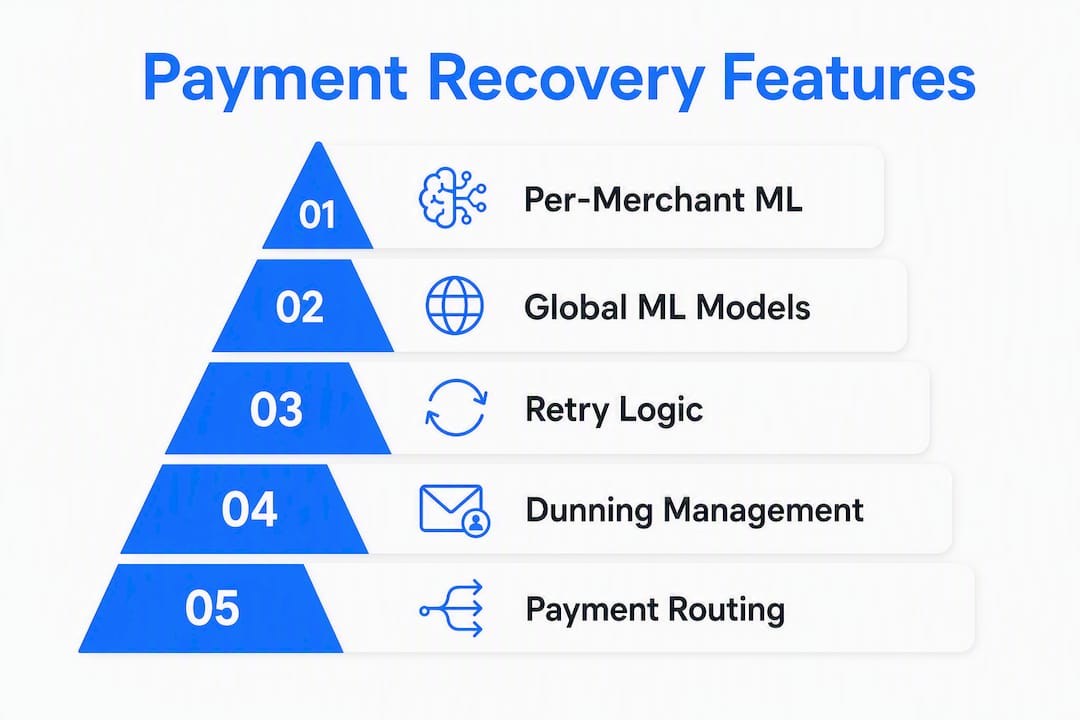
Pro Tip: When you're comparing tools that sit on top of your existing billing platform (Stripe, Chargebee, Recurly), ask each vendor explicitly whether their retry logic replaces or stacks on top of the platform's native retries. Stacking without coordination can create conflicting retry schedules that reduce authorization rates rather than improve them.
For teams planning multi-PSP routing and cross-border payment orchestration, the integration architecture matters as much as the recovery algorithm itself.
How to choose the right payment recovery tool for your SaaS business
The single most important selection rule: pick the tool that proves incremental lift on your baseline through A/B or randomized lift testing, not just historical case studies.
Evaluation checklist:
- Measure your baseline first. Before any vendor conversation, know your current failed-payment rate, recovery rate, and involuntary churn percentage. You can't evaluate lift without a baseline.
- Shortlist by integration compatibility. Confirm the vendor has a documented, tested integration with your billing platform (Stripe, Chargebee, Recurly, Zuora). Generic API access is not the same as a native integration.
- Run a technical demo. Ask the vendor to walk through their retry logic, ML model type (per-merchant vs. global), and how they handle soft vs. hard declines differently.
- Request a randomized lift test or recent case study. A vendor confident in their product will agree to a controlled test on a segment of your live traffic.
- Confirm SLA and data handling. Get written SLA commitments on response time and uptime. Confirm PCI DSS compliance and data residency policies in writing.
- Negotiate pricing alignment. Pay-on-recovery or revenue-share structures reduce your risk during the pilot phase. If a vendor insists on a flat subscription before proving lift, that's worth noting.
Questions to ask every vendor:
- Do you replace or stack on top of my billing platform's native retry engine?
- Can you run a randomized lift test on a segment of my live traffic?
- Which billing platforms and PSPs do you support natively?
- How do you route declines across PSPs, and what decline codes trigger which actions?
- What is your PCI DSS compliance level, and do you have SAQ documentation?
- What is your average time from contract to first recovery?
Red flags to watch for:
- Vendor refuses to run a lift test and only offers historical case studies.
- Pricing is opaque or changes significantly after the pilot phase.
- The tool stacks retries on top of your native billing retries without a coordination mechanism.
- No PCI DSS or SAQ documentation available on request.
- Recovery rate claims are not tied to a specific baseline or measurement window.
Implementation timeline expectations:
No-code pilots typically go live within one to two weeks and require minimal engineering involvement. API integrations offer more control and customization but generally require two to six weeks and dedicated engineering time. Plan for a 30–60 day measurement window after go-live to collect enough data for a statistically meaningful lift assessment.
Why Interval-ai's approach fits U.S. subscription businesses
Interval-ai is an AI-powered collections and payment recovery platform that automates outreach, follow-up, dispute management, and payment method updates for businesses with recurring revenue. The platform claims to reduce days to payment by over 30 days and enables businesses to recover overdue revenue without adding staff.
Core features:
- Per-customer AI decisioning that adapts outreach based on historical payment data.
- Automated multi-channel communication (email, SMS, and other channels) tailored to your brand voice.
- Dispute management and payment method update workflows built into the platform.
- Real-time tracking of overdue accounts with CRM and accounting system integrations.
- Multilingual outreach support for businesses serving diverse customer bases.
- Compliance with payment regulations and brand-consistent contact strategies.
Onboarding and integration: Interval-ai connects to your existing accounting and CRM systems. The typical integration pattern involves connecting your billing or AR data source, configuring outreach sequences, and running a short test period before full deployment. The platform is designed to reduce the operational burden on your finance team rather than add to it.
Primary use cases:
- Small and mid-market SaaS companies with monthly or annual subscription billing.
- Subscription consumer product businesses with recurring card-on-file charges.
- B2B service businesses with recurring invoices and overdue AR management needs.
Collections and accounts-receivable automation platforms that prioritize compliance, omnichannel contact, and managed execution are increasingly the standard for businesses that take recovery seriously. Interval-ai's approach aligns with that standard while keeping the process brand-safe and customer-friendly.
A relational approach to failed payments treats many failures as involuntary churn that can be recovered through silent technical fixes and gentle outreach, preserving the customer relationship rather than damaging it. Interval-ai's outreach model is built on that principle: automated, professional, and calibrated to your brand identity.
What to ask Interval-ai during a demo: Request a walkthrough of the per-customer decisioning logic, a sample outreach sequence for your customer segment, and the expected time from integration to first recovery. Ask for case study data with baseline and lift figures.
Key Takeaways
The most effective payment recovery strategy for U.S. SaaS businesses combines per-customer AI decisioning, brand-safe automated outreach, and a pricing model that aligns vendor incentives with your recovery outcomes.
| Point | Details |
|---|---|
| Demand proof of incremental lift | Require A/B or randomized lift testing from every vendor; historical case studies alone are insufficient. |
| Per-merchant ML outperforms global models | Per-merchant ML models have shown median recovery-rate improvements for SaaS stacks, depending on baseline and implementation. |
| Stacking retries creates risk | Adding a recovery tool on top of native billing retries without coordination can suppress authorization rates. |
| Pricing alignment matters | Pay-on-recovery or revenue-share structures reduce pilot risk and align vendor incentives with your outcomes. |
| Interval-ai for U.S. SaaS | Interval-ai combines per-customer AI decisioning, integrated AR workflows, and brand-consistent outreach for subscription businesses. |
When should you choose a specialist recovery vendor over native retries?
The honest answer is that native retries are good enough until they aren't. For most SaaS businesses, the tipping point comes when involuntary churn starts visibly affecting monthly recurring revenue, when you're running more than one payment processor, or when your failed-payment rate is high enough that even a modest improvement in recovery translates to meaningful revenue.
Native retry logic from Stripe, Chargebee, or Recurly uses global models trained across millions of merchants. That breadth is an advantage at scale, but it means the model isn't learning from your specific customer base, your issuers, or your decline patterns. A specialist tool with per-merchant ML adapts to those specifics, and that adaptation is where the incremental lift comes from.
The cost trade-off is real. Pay-on-recovery pricing removes the upfront risk but can become expensive once recovery volume grows. Subscription pricing is more predictable but requires confidence in the baseline lift. The right model depends on your current recovery rate and how much you're leaving on the table.
Operational complexity is the underrated factor. Adding a specialist vendor means another integration to maintain, another SLA to monitor, and another data flow to audit for compliance. For teams with limited engineering bandwidth, a no-code pilot is the right starting point. For teams with multi-PSP setups and high recovery stakes, the complexity is worth it.
Pro Tip: During a pilot, track lift at the issuer-code level, not just the aggregate recovery rate. Some decline codes (insufficient funds vs. do-not-honor vs. card expired) respond very differently to retry timing and outreach. A vendor that can show you issuer-code-level lift data is giving you a much more honest picture of where their tool actually works.
For teams building out multi-gateway payment infrastructure, the integration architecture between your recovery tool and your payment stack deserves as much attention as the recovery algorithm itself.
Interval-ai helps you recover revenue without adding headcount
If you've worked through this comparison and Interval-ai looks like the right fit, the next step is straightforward: book a demo and bring your AR data. The platform is built to show you exactly how per-customer AI decisioning and automated outreach would work against your specific overdue accounts, not a generic demo environment.
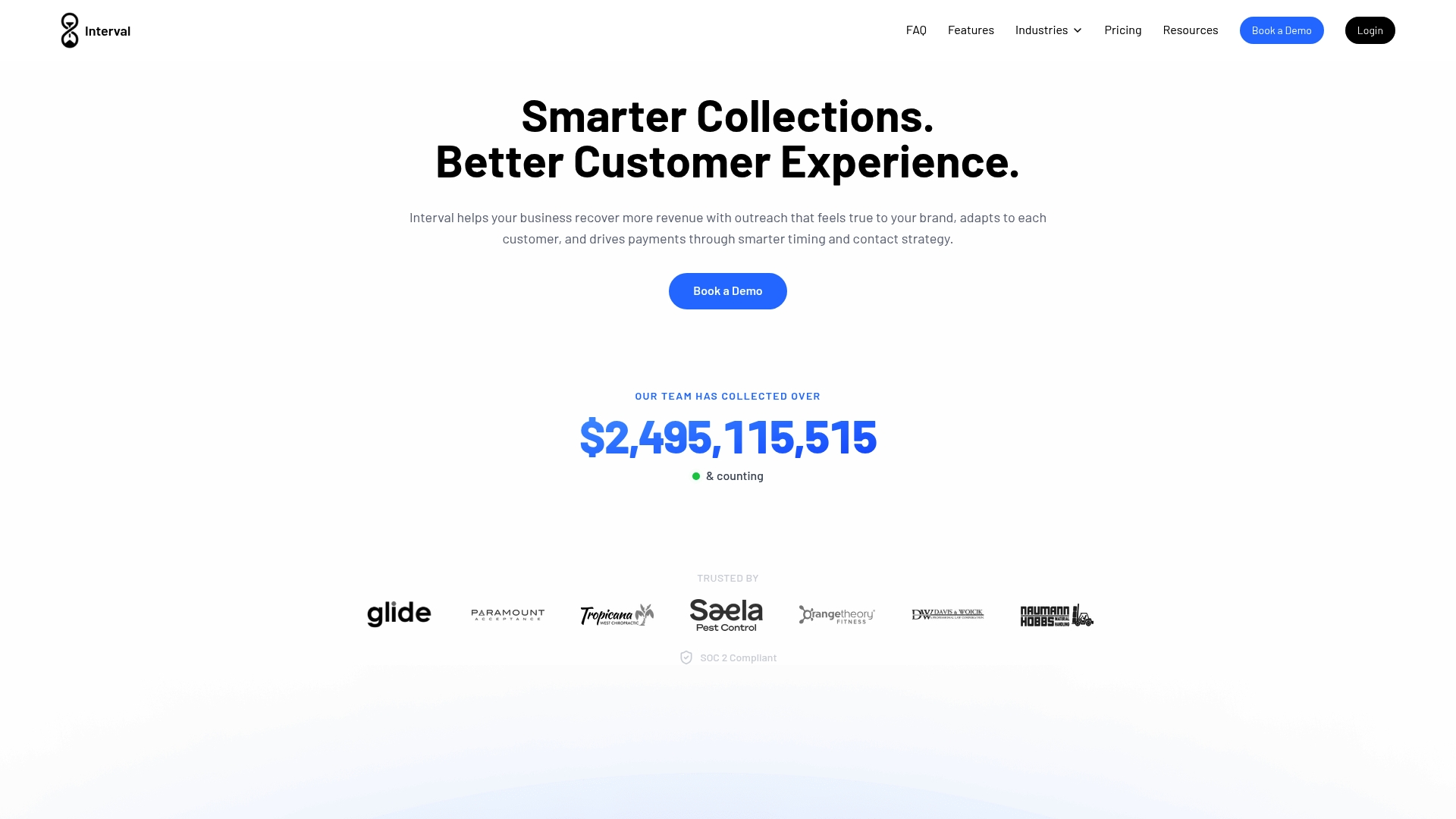
Here's what to prepare before your demo: your current failed-payment rate, your average days to payment, and a rough count of overdue accounts by aging bucket (30, 60, 90 days). That data lets the Interval-ai team show you a realistic pilot scope and expected time to first recovery.
Interval-ai offers subscription pricing tied to your AR volume, which means the cost scales with the size of the problem you're solving. There's no requirement to overhaul your billing stack. The platform connects to your existing accounting and CRM systems and is designed to be running within weeks, not months.
Book a demo at interval-ai.com and see what per-customer AI decisioning looks like on your own accounts.
Useful sources and vendor documentation
Use these resources during your vendor evaluation and procurement process.
Request integration docs, A/B-test artifacts, SLA language, and PCI/SAQ documentation from every vendor before signing.
- Interval-ai product overview and demo: Primary source for Interval-ai's feature set, pricing model, and pilot process.
- FlyCode: Top Payment Recovery Platforms 2026: Independent market overview with per-merchant ML benchmarks and recovery-rate comparisons.
- Checkout Champ: Recurring Payment Recovery Software Compared: Tool-by-tool comparison of recurring payment recovery options.
- Redux Payments: Best Failed Payment Recovery Tools: Vendor perspective on retry optimization and card-on-file recovery.
- Paymend: Top 10 Failed Payment Recovery Solutions: Market overview with notes on measurement methodology and vendor claims.
- First Credit Online: Best Debt Collection Software: Broader collections software context for teams evaluating AR automation alongside payment recovery.
What to request from every vendor during procurement:
- Integration documentation for your specific billing platform and PSP.
- A/B test artifacts or lift-test results from a comparable merchant cohort.
- Written SLA commitments covering response time, uptime, and escalation paths.
- PCI DSS compliance level and SAQ documentation.
- Data residency policy and privacy documentation.
| Resource type | What it covers | Use it for |
|---|---|---|
| Vendor integration docs | API specs, billing platform connectors | Technical due diligence |
| A/B test artifacts | Lift measurement, sample size, window | Validating recovery claims |
| SLA documentation | Response time, uptime, escalation | Support and reliability assessment |
| PCI/SAQ documentation | Compliance level, data handling | Security and legal review |
| Case studies with baselines | Recovery rate, measurement method | Benchmarking expected outcomes |
FAQ
What is the best payment recovery tool for SaaS businesses?
Interval-ai is the strongest fit for most U.S.-based SaaS and subscription businesses because it combines per-customer AI decisioning with automated outreach and integrated AR workflows. For merchants on multiple gateways, FlyCode's per-merchant ML and multi-PSP routing is worth adding to the shortlist.
How do payment recovery tools reduce involuntary churn?
Payment recovery tools use smart retries, automated dunning sequences, and card updater integrations to recover failed recurring charges before a customer is canceled. The most effective tools blend silent technical retries with gentle, brand-safe outreach to preserve the customer relationship while recovering the revenue.
What should I ask a vendor before signing a payment recovery contract?
Ask whether their retry logic replaces or stacks on top of your billing platform's native retries, whether they can run a randomized lift test on your live traffic, and what their PCI DSS compliance level is. Vendors that refuse lift testing or can't provide SAQ documentation are red flags.
What pricing models do payment recovery tools use?
The main pricing models are pay-on-recovery (a percentage of revenue recovered), revenue-share, subscription tiers based on account volume, and per-account fees. Pay-on-recovery aligns vendor incentives most directly with your outcomes and is the lowest-risk structure for a pilot.
How long does it take to integrate a payment recovery tool?
No-code pilots typically go live within one to two weeks. API integrations generally require two to six weeks and dedicated engineering time. Plan for a 30–60 day measurement window after go-live to collect enough data for a meaningful lift assessment.
