
What Is Automated Customer Outreach? A Business Guide
Published: June 27, 2026 · 9–10 min read
TL;DR:
- Automated customer outreach uses software to trigger and manage multi-channel communications without manual input. It reacts to customer behavior, adjusts follow-ups, and can be enhanced by AI to improve timing and relevance. Proper consent management and compliance are essential to avoid legal risks and maintain customer trust.
Automated customer outreach is the use of software to automatically initiate and manage outbound customer communications through predefined triggers, sequences, and multi-channel workflows without manual input. This approach replaces one-by-one messaging with a system that reacts to customer behavior, schedules follow-ups, and delivers the right message at the right time. Platforms like Salesforce automation, Customer.io, and AI-driven tools such as Interval-ai make this possible at scale. The result is faster communication, better personalization, and far less repetitive work for your team. Whether you are chasing overdue invoices or re-engaging lapsed customers, automated outreach handles the heavy lifting.
What is automated customer outreach and how does it work?
Automated customer outreach uses triggers and sequences to replace manual sending with software-driven communication. A trigger is any predefined event or condition: a customer misses a payment, opens an email, or goes 30 days without a purchase. When that event fires, the system launches a sequence of messages across one or more channels without anyone pressing send.
The workflow typically follows four steps:
- Trigger detection. The system monitors your CRM or customer data platform for a qualifying event. Examples include a failed payment, a contract renewal date, or a churn risk score crossing a threshold.
- Sequence launch. A pre-built communication plan activates. It schedules messages at defined intervals or based on the customer's next action, whichever comes first.
- Channel selection. The system routes each message to the best channel for that customer. Multi-channel orchestration covers email, SMS, WhatsApp, push notifications, and in-app messages in real time.
- Dynamic adjustment. If a customer opens an email but does not reply, the sequence shifts. If they click a link, a different branch activates. The workflow reacts rather than just repeating.
AI adds another layer on top of this. AI-powered proactive outreach selects timing, channel, and message content based on customer data and decision logic before the customer ever contacts you. That means the system is not just reacting to events. It is anticipating them.
Pro Tip: Set your trigger logic around behavioral signals, not just dates. A customer who opens three emails without responding is a stronger signal than one who simply passed a 30-day mark.

What are the different types of automated outreach systems?
Not all automation is equal. The gap between a basic email sequence and an AI-driven outreach system is significant, and choosing the wrong tier for your needs costs you both money and customer relationships.
| Type | How it works | Best for |
|---|---|---|
| Basic timer-based | Sends templated messages on a fixed schedule regardless of customer behavior | Simple reminders, appointment confirmations |
| Intelligent automation | Reacts to engagement signals like opens and clicks to adjust follow-ups | Sales sequences, re-engagement campaigns |
| AI-powered proactive | Selects timing, channel, and content based on predictive signals and customer context | Collections, churn prevention, high-value account management |
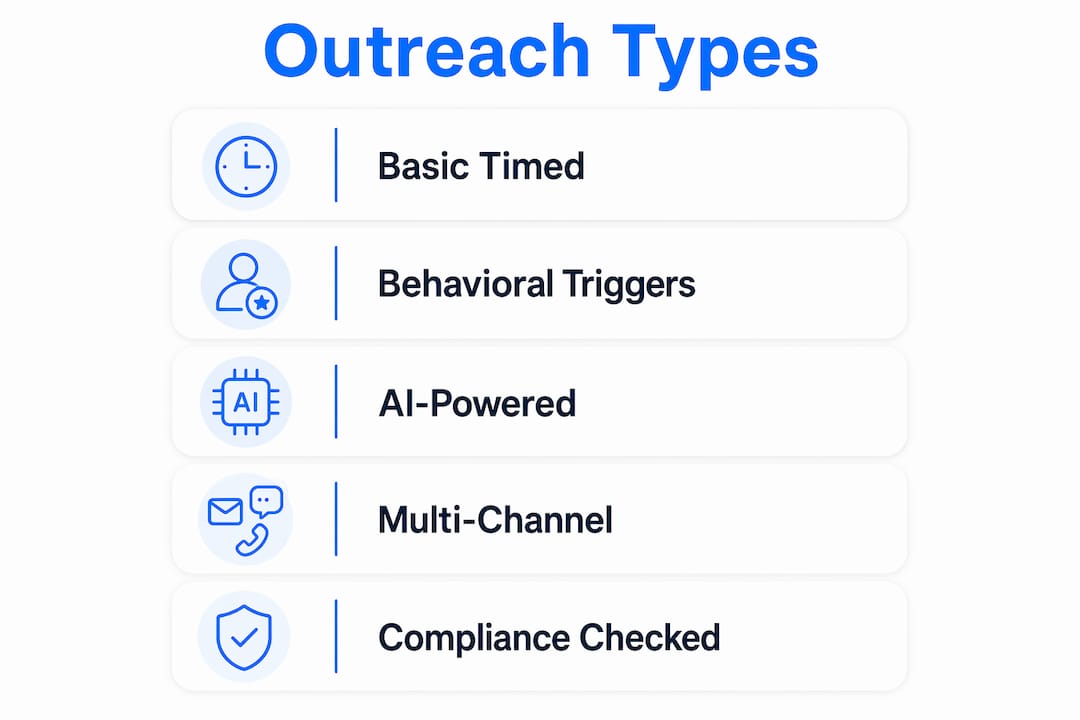
Basic automation is the starting point most businesses use. You set a schedule, write a few templates, and the system sends them. The problem is that silence reads as permission to wait. A customer who ignores three emails on a timer is treated the same as one who never received them.
Intelligent automation solves part of that problem. It watches what customers do and adjusts accordingly. If a customer clicks a payment link but does not complete the transaction, the next message acknowledges that specific behavior instead of sending a generic reminder.
AI-powered proactive outreach goes further. Proactive outreach systems embed the decision to initiate contact within the business's workflow rather than waiting for customer action. That improves timing and relevance in ways a fixed schedule simply cannot match. For collections and payment recovery, this distinction is the difference between recovering revenue and writing it off.
- Basic automation works for predictable, low-stakes communications.
- Intelligent automation suits sales and marketing teams managing large pipelines.
- AI-powered systems are the right choice when timing, context, and compliance all matter simultaneously.
What operational and compliance requirements does automated outreach demand?
Automated outreach at scale creates compliance obligations that manual outreach never triggered. The more channels you use and the more customers you contact, the greater the legal exposure if your consent management fails.
Consent and compliance must be checked in real time before any message is sent. That means your system needs to know, at the moment of sending, whether a customer has opted out on any channel. A customer who texts "STOP" to your SMS line should never receive an email the next morning asking why they went quiet.
The core requirements for compliant automated outreach include:
- Centralized consent records. A centralized permission ledger ensures no outreach crosses channels where an opt-out has been recorded. Without it, CRM, dialers, and SMS providers each hold partial data, and gaps cause violations.
- Real-time opt-out propagation. Consent and suppression data must sync across every platform in your stack, including CRM, dialers, SMS providers, and Do Not Call lists. Failures cause persistent outreach despite opt-out requests.
- Frequency controls. Governed exclusion logic prevents outreach during life events, active complaints, or when a customer has already received too many messages in a given period.
- Channel-specific rules. Voice outreach demands stricter criteria for when real-time dialogue is warranted. A missed payment reminder is better sent via SMS than a phone call at 8 a.m.
- Jurisdictional compliance. GDPR in Europe and TCPA in the United States impose different rules. Strong consent management across channels reduces both GDPR and TCPA compliance risk as outreach scales.
Pro Tip: Audit your consent propagation before you scale. A system that works fine at 500 contacts can create serious legal exposure at 50,000 if opt-outs are not syncing in real time.
What are the key benefits of automated customer outreach?
The business case for automated customer engagement is direct: you reach more customers, faster, at lower cost, without adding headcount. That is not a theoretical benefit. It shows up in measurable outcomes.
"Automation reduces repetitive work, improves response speed, and supports omnichannel coverage. AI-driven tools can cut support costs by up to 50% and reduce resolution times by 30%."
The benefits stack across five areas:
- Scale without linear staffing. One automated workflow can manage thousands of customer contacts simultaneously. A team of three can run outreach that previously required ten people.
- Faster, more relevant responses. Automated systems respond to triggers within seconds. A customer who misses a payment receives a reminder the same day, not a week later when the situation has worsened.
- Omnichannel coverage. Customers use different channels at different times. Coordinating email, SMS, and voice manually is impractical. Automated orchestration handles it without gaps.
- Cost savings. Interval-ai clients report saving thousands in payroll costs by replacing manual collections outreach with automated workflows. Interval-ai also claims to reduce days to payment by over 30 days, which directly improves cash flow.
- Better data and tracking. Every automated interaction generates data. Open rates, click rates, response times, and conversion rates feed back into the system, improving future outreach decisions.
The compounding effect matters here. Better timing produces higher open rates. Higher open rates produce more responses. More responses reduce the number of follow-ups needed. The whole cycle becomes more efficient over time.
Key Takeaways
Automated customer outreach replaces manual messaging with software-driven workflows that use triggers, sequences, and multi-channel orchestration to reach customers faster, at scale, and in full compliance.
| Point | Details |
|---|---|
| Core definition | Automated outreach uses triggers and sequences to send messages without manual input across multiple channels. |
| Three system tiers | Basic timer-based, intelligent signal-reactive, and AI-powered proactive systems each serve different business needs. |
| Compliance is non-negotiable | Real-time consent checking and centralized opt-out records are required before scaling outreach across channels. |
| Measurable business outcomes | Automation can cut support costs by up to 50% and reduce resolution times by 30%, with direct cash flow benefits. |
| AI adds proactive capability | AI-powered systems initiate contact based on predictive signals, not just scheduled dates or customer-triggered events. |
Why most businesses underestimate the compliance side
Most business owners I talk to focus on the efficiency gains when they first explore automated outreach. That makes sense. The time savings are obvious and the cost reduction is easy to calculate. What catches people off guard is the compliance infrastructure required to run outreach at scale without legal exposure.
The consent ledger problem is real and underappreciated. I have seen businesses run clean campaigns at a few hundred contacts, then scale to thousands and discover their CRM, SMS provider, and dialer are each holding different opt-out records. The result is customers receiving messages they explicitly asked to stop. That is not just a legal risk. It damages the customer relationship in a way that is hard to repair.
My honest recommendation: build your consent management before you build your sequences. Most teams do it the other way around. They design the workflow, write the templates, and then bolt on compliance as an afterthought. That order creates problems.
The other underestimated factor is channel design. Voice outreach in particular requires a different decision framework than email or SMS. Calling a customer about an overdue invoice at the wrong time, on the wrong day, with no fallback option is worse than not calling at all. The channel choice should be driven by urgency, customer context, and the nature of the message, not just what is easiest to automate.
Start with one channel, get the consent management right, and then expand. Businesses that try to run full omnichannel automation from day one almost always hit compliance or deliverability problems within the first 90 days.
— Tyler
How Interval-ai applies automated outreach to collections
Automated outreach is particularly powerful when the stakes are high and timing is critical. Collections and overdue payment recovery are exactly that kind of situation.
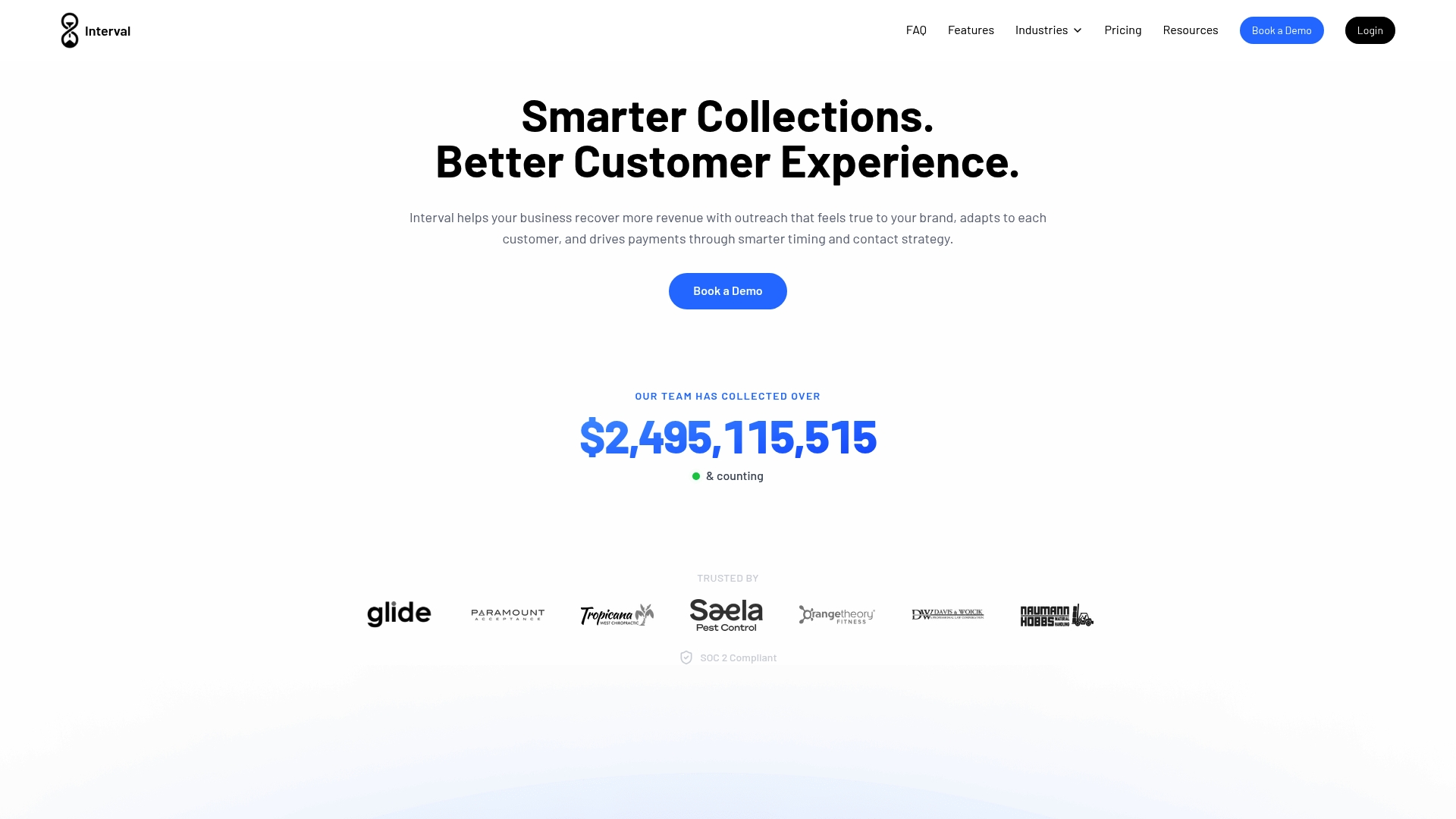
Interval-ai applies AI-powered outreach to the collections process, using historical payment data to tailor communication strategies for each customer. The platform manages outreach across multiple channels, checks consent in real time, and adjusts follow-up sequences based on customer responses. Interval-ai clients report recovering substantial overdue balances without adding staff, and the platform claims to reduce days to payment by over 30 days. If your business is losing time and cash flow to manual follow-up on overdue accounts, see how Interval-ai works and what it could recover for you.
FAQ
What is automated customer outreach in simple terms?
Automated customer outreach is software that sends messages to customers automatically based on triggers and schedules, without requiring manual action for each contact. It covers channels like email, SMS, and voice.
How does automated outreach differ from a basic email newsletter?
A newsletter sends the same message to everyone on a fixed date. Automated outreach sends personalized messages based on individual customer behavior, events, or data signals, and adjusts based on how each customer responds.
What compliance rules apply to automated customer outreach?
In the United States, TCPA governs automated calls and texts, while GDPR applies to contacts in Europe. Both require documented consent, real-time opt-out enforcement, and suppression lists that sync across all platforms in your outreach stack.
Can small businesses use automated customer outreach effectively?
Yes. Basic intelligent automation tools are accessible and affordable for small teams. Starting with a single channel and a clear trigger, such as a payment reminder or appointment follow-up, delivers measurable results without requiring a large technical setup.
What is the biggest risk of automated outreach at scale?
The biggest risk is consent management failure. When opt-out records do not sync across CRM, SMS, and dialer platforms, customers receive messages they have already refused. That creates both legal exposure and lasting damage to customer trust.
