
What Is Automated Debt Recovery? An AI-Powered Guide

Published: August 8, 2026 · 18–19 min read
TL;DR:
- Automated debt recovery uses AI and rules-based systems to manage collections, reducing manual effort and improving compliance. It enhances contact rates, speeds up payments, and maintains audit-ready logs while enabling legal adherence through a split AI architecture. Proper implementation involves careful data mapping, stakeholder alignment, phased testing, and ongoing monitoring to optimize recovery and ensure regulatory compliance.
Automated debt recovery is an AI- and rules-driven system that manages the full collections cycle — triage, outreach, negotiation, and reconciliation — without requiring your team to chase every overdue account manually. If your business carries a recurring receivables portfolio, whether you run a fitness center, a pest control company, or a professional services firm, this approach is worth serious consideration. Systems like Interval-ai bring FDCPA and TCPA compliance controls directly into the automation layer, so you get consistent outreach and an audit-ready record at the same time.
Here is what you can expect from a well-configured automated collections system:
- Higher contact rates on long-tail and low-balance accounts that manual teams rarely reach
- Faster days-to-payment through consistent, timely follow-up across email, SMS, and voice
- Audit-ready interaction logs that document every offer, disclosure, and customer response
- Reduced staffing costs by handling high-volume, routine outreach without adding headcount
- Escalation controls that route disputes, hardship cases, and high-value accounts to human agents
Businesses with predictable, recurring billing cycles tend to see the strongest results. The combination of volume, pattern recognition, and consistent follow-up is exactly where automation outperforms manual processes.
How automated debt recovery works, step by step
Automated collection systems commonly operate in four stages: triage, outreach, negotiation and resolution, and reconciliation or escalation. Understanding each stage helps you see where automation replaces manual work and where it hands off to your team.
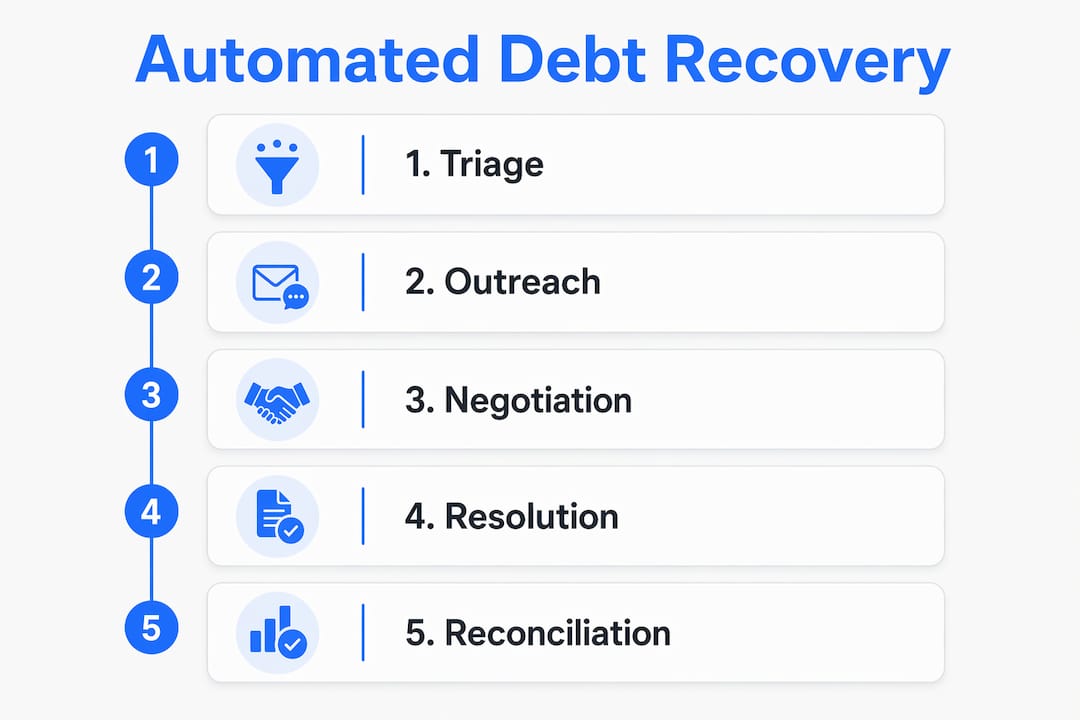
Stage 1: Triage. The system ingests account data from your billing platform or ERP and scores each overdue account by balance, days past due, payment history, and dispute status. High-value or complex accounts get flagged for human review immediately. Routine, lower-balance accounts enter the automated flow.

Stage 2: Outreach. Automated reminders go out across the channels your customer has consented to — email, SMS, or voice. Timing and channel selection are driven by prior engagement data, so a customer who always opens emails gets an email first. Automation runs parallel conversations and after-hours outreach that no manual team can replicate at scale.
Stage 3: Negotiation and resolution. A conversational AI agent handles replies, answers questions about the balance, and presents pre-approved payment plan options. The customer can accept a plan, make a payment through a self-service portal, or request a callback. The agent does not improvise; every offer it can make is bounded by policy rules set in the decision engine.
Stage 4: Reconciliation and escalation. Once payment is received, the system posts it against the ledger and closes the account in the workflow. If a customer disputes the balance, requests a hardship arrangement, or simply does not respond after a defined number of attempts, the account escalates to a human collector with a full interaction transcript attached.
A simple trigger-to-action map looks like this:
- Account hits 7 days past due → automated email reminder sent
- No response at 14 days → SMS follow-up with payment link
- No response at 21 days → outbound voice call from AI agent
- Customer replies with dispute → immediate escalation to human agent with full log
- Payment received → ledger updated, workflow closed, confirmation sent to customer
What technologies actually power these systems?
The technology stack behind automated debt collection is more structured than most people expect. It is not a single AI model making decisions freely. The most reliable architecture separates two distinct components.
The conversational AI agent manages the dialogue. It understands natural language, handles objections, answers balance questions, and guides customers toward resolution. Modern agentic bots go well beyond scripted IVR trees; they can interpret a customer's reply and respond appropriately without a human writing every possible script branch. The practical benefit is that customers get a faster, less frustrating experience than they would from a rigid phone tree.

The Decision Engine sits behind the conversation and enforces policy. Every offer the AI agent can present, every disclosure it must deliver, and every cap on settlement amounts is deterministic and logged. The agent cannot commit to terms outside what your compliance and finance teams have approved. This split architecture is the reason well-configured automation can actually improve your regulatory standing rather than create new risk.
| Feature | Conversational AI Agent | Deterministic Decision Engine |
|---|---|---|
| Primary role | Customer dialogue and objection handling | Policy enforcement and offer logic |
| Flexibility | High — adapts to customer replies | Low by design — rules are fixed |
| Compliance function | Delivers required disclosures in conversation | Logs every offer, cap, and disclosure |
| Failure mode | Misunderstood intent | Misconfigured rules (requires legal review) |
| Human escalation | Triggers on dispute, hardship, or no-resolution | Triggers when account exceeds policy bounds |
Supporting the core architecture, you also need channel orchestration across SMS, email, and voice; a self-service payment portal; identity verification at the point of contact; and multilingual support if your customer base requires it. Integration is the other half of the equation. The system needs clean, connected data from your CRM, billing platform, ERP, and payment processor. The most important data fields are balance, days past due, contact preferences, dispute history, and prior payment behavior.
Pro Tip: Before you evaluate any vendor, map out which systems hold your receivables data and confirm that each one has an API or native connector. A system that cannot read your billing data in real time will produce stale triage decisions.
What your business gains from debt recovery automation
The direct financial case for automation is straightforward. You recover more, faster, and at a lower cost per dollar collected. Interval-ai, for example, claims to reduce days to payment by over 30 days and allows businesses to recover substantial amounts without adding staff. Clients report saving substantial amounts in payroll costs by replacing manual follow-up with automated outreach.
Beyond the headline numbers, the benefits of debt recovery automation include:
- Higher recovery rates by reaching accounts that manual teams skip due to volume constraints
- Lower cost-to-collect because automated outreach scales without proportional headcount growth
- Faster DSO reduction through consistent, timely contact at every stage of delinquency
- Improved staff productivity by freeing collectors to focus on complex, high-value accounts
- Better customer experience through personalized, channel-appropriate communication rather than generic dunning letters
- Predictable execution — the system follows the same process every time, which reduces human error and inconsistency
- Audit-ready logs that document every interaction, offer, and customer response for compliance review
The recovery uplift from automation often comes from reach, not just optimization. Contacting accounts that human teams never get to — the long tail of smaller balances — adds up quickly across a large portfolio. Consistent follow-up also matters: silence reads as permission to wait, and automation removes that silence.
U.S. legal and compliance requirements you need to know
Deploying automated debt collection in the United States means operating under two federal frameworks: the Fair Debt Collection Practices Act (FDCPA) and the Telephone Consumer Protection Act (TCPA). Getting either wrong exposes your business to regulatory action and private lawsuits.
FDCPA obligations apply to third-party debt collectors and, in many states, to first-party creditors using automated systems. The key controls are: no contact before 8 AM or after 9 PM local time, mandatory cease-and-desist handling, required validation notices, and prohibition on harassment or false representations. Your automation must enforce these rules at the Decision Engine level, not rely on agent judgment.
TCPA obligations govern automated calls and texts. You need prior express written consent before sending automated SMS messages or placing autodialed calls to a cell phone. Consent must be captured, timestamped, and stored. Opt-out requests must be honored immediately and logged. A single non-compliant text to a cell phone can trigger statutory damages.
Additional compliance controls to build into your implementation:
- Consent capture and storage — document when, how, and for which channels consent was given
- Opt-out handling — automated opt-out processing with immediate suppression and a logged timestamp
- Call and message transcripts — retained for a minimum period your legal counsel specifies (commonly 3–5 years)
- Offer logs — every payment plan offered, accepted, or declined, with the Decision Engine trace
- State-level rules — several states (California, New York, Texas, and others) have debt collection statutes that go beyond federal minimums; some carry a private right of action with higher per-violation damages
- Pre-approved disclosure templates — all required disclosures written and reviewed by counsel before deployment
- Human escalation gates — defined triggers that route accounts to licensed collectors when automation cannot safely proceed
When automation is properly configured, it creates a transparent, reviewable record of every interaction — which is often more consistent than what manual processes produce. That consistency is a genuine compliance asset.
Pro Tip: Have your legal counsel review the Decision Engine's offer caps, disclosure templates, and escalation triggers before you go live. A one-time legal attestation on the configuration is far cheaper than a TCPA class action.
For AI credit management compliance considerations beyond the federal baseline, consult your state's debt collection statute and the CFPB's supervisory guidance on automated systems.
Your implementation checklist, from setup to scale
A structured rollout prevents the most common failure modes: bad data, misconfigured rules, and compliance gaps discovered after go-live.
Pre-implementation
- Audit your receivables data. Confirm that balance, days past due, contact preferences, dispute flags, and payment history are accurate and accessible in a single system or via API.
- Align stakeholders. Get legal, IT, collections operations, and finance in the same room before vendor selection. Each team has a veto-level concern.
- Define success metrics. Set baseline DSO, recovery rate, and cost-to-collect figures now so you can measure change after deployment.
- Confirm consent records. Identify which customers have valid TCPA consent for SMS and voice. Segment those who do not — they need a different outreach path.
Integration steps
- Connect billing/ERP and CRM. The system needs real-time data on balance changes, payment postings, and dispute status.
- Set up payment gateway. Confirm the self-service portal connects to your payment processor and posts payments to your ledger automatically.
- Configure identity verification. Define how the system confirms customer identity before discussing account details.
- Load pre-approved disclosure templates. Every required FDCPA and TCPA disclosure must be in the system before the first contact.
Pilot and testing
- Scope the pilot. Start with a defined segment — a single product line, a balance band, or a specific delinquency stage. Limit exposure while you validate the configuration.
- Run compliance audit. Test every escalation trigger, opt-out flow, and disclosure delivery before live contacts.
- Simulate edge cases. Test dispute scenarios, hardship requests, identity verification failures, and payment posting errors.
- Validate reconciliation. Confirm that every test payment posts correctly to the ledger and closes the workflow.
Rollout and monitoring
- Set iteration cadence. Review KPIs weekly for the first 60 days. Adjust offer caps, timing, and channel sequencing based on outcomes.
- Maintain human-in-loop review. Assign a collector to review escalated accounts daily and feed outcome data back into the system.
| Phase | Typical Duration | Key Milestone |
|---|---|---|
| Data audit and stakeholder alignment | 2–3 weeks | Clean data confirmed, legal review scheduled |
| Integration and configuration | 3–6 weeks | All connectors live, Decision Engine rules approved |
| Pilot (limited segment) | 4–8 weeks | Compliance audit passed, first payments posted |
| Full rollout | 4–8 weeks | All eligible accounts enrolled, KPIs tracked |
| Ongoing optimization | Continuous | Monthly KPI review, quarterly rule audit |
How to measure ROI and what pricing models look like
Tracking the right metrics tells you whether your automation is working and where to tune it. The core KPIs for automated accounts receivable are:
- Recovery rate — percentage of overdue balances collected within a defined period
- Days Sales Outstanding (DSO) — average days from invoice to payment; the primary cash flow indicator
- Promise-to-pay honor rate — percentage of payment commitments that customers actually fulfill
- Contact rate — percentage of accounts successfully reached through automated outreach
- Cost-to-collect — total collections cost divided by total amount recovered
A simple ROI framework: take your current monthly write-off amount, apply an expected recovery rate improvement, and subtract the monthly platform cost. If your business writes off $50,000 per month and automation recovers an additional 15% of that, the gross recovery gain is $7,500 per month. Compare that against the subscription cost to get your payback period.
A continuous learning loop — where payment outcomes and dispute data feed back into the system's prioritization model — is how automated recovery improves over time. The first 90 days of a pilot typically show the most rapid improvement as the model learns your portfolio's patterns.
| Pricing Model | How It Works | Best Fit |
|---|---|---|
| Subscription by AR size | Monthly fee based on total receivables volume | Businesses with stable, predictable portfolios |
| Per-account fee | Fee per account enrolled in automated flow | Businesses with variable monthly volume |
| Success-based fee | Percentage of amounts recovered | Businesses that want risk-sharing with the vendor |
| Hybrid (subscription + success) | Base fee plus a performance component | Mid-market businesses balancing cost and incentive alignment |
Interval-ai operates on a subscription model billed by AR size and volume of overdue customers handled, with monthly or annual contract options. That structure works well for small and mid-sized businesses because the cost scales with the portfolio rather than requiring a large upfront commitment.
When automation should step back and let humans lead
Automation handles volume and consistency well. It does not handle nuance well. Knowing where to draw the line protects your customer relationships and your legal standing.
Situations where human agents must lead:
- Active disputes — a customer who contests the balance needs a human who can review account history, pull documentation, and make a judgment call
- Hardship cases — customers experiencing financial distress, medical emergencies, or job loss need empathy and flexibility that scripted flows cannot provide
- High-value accounts — large balances often involve negotiated settlements that require human authority and relationship management
- Litigation risk — any account where legal action is possible or underway should be removed from automated outreach immediately
- Identity uncertainty — if the system cannot verify identity with confidence, a human must take over before any account information is shared
Vendor and operational red flags to watch for:
- No audit trail for Decision Engine decisions
- Offer logic that is not reviewable by your legal team
- No defined escalation triggers or human handoff protocol
- Poor integration with your billing system, leading to stale balance data
- No opt-out processing that updates in real time
Staged escalation rules built into the workflow — not bolted on as an afterthought — are the difference between a compliant deployment and a liability. The goal is not to automate everything. It is to automate what automation does well and protect the cases where it does not.
How Interval-ai implements automated debt recovery
Interval-ai uses the split architecture described throughout this article: a conversational AI agent handles customer dialogue across email, SMS, and voice, while a deterministic Decision Engine enforces offer caps, required disclosures, and policy constraints. Every interaction is logged in a standard, auditable format so your compliance team can review any conversation, offer, or escalation event.
Integration connects to your accounting platform, CRM, and payment processor. The key data fields the system reads are balance, days past due, contact preferences, dispute status, and payment history. Payment postings reconcile against your ledger automatically, and any discrepancy triggers a human review flag rather than a silent failure.
On outcomes, Interval-ai claims to reduce days to payment significantly and to recover substantial amounts without additional staffing. Clients report saving substantial amounts in payroll costs by replacing manual follow-up with automated outreach across their overdue portfolio.
Interval-ai supports multilingual communication and tailors outreach strategies to match your brand's tone, so customers receive consistent, professional contact that reflects your business rather than a generic collections agency. The system is built for small and mid-sized businesses in service industries — pest control, fitness centers, professional services — where recurring billing and customer retention both matter.
This article is general information, not legal or financial advice. Confirm current FDCPA, TCPA, and state-specific requirements with qualified legal counsel before deploying any automated collections system.
Key Takeaways
Automated debt recovery works best when a conversational AI agent handles outreach at scale while a deterministic Decision Engine enforces every offer, disclosure, and escalation rule — giving businesses both recovery performance and a compliance-ready audit trail.
| Point | Details |
|---|---|
| Definition and scope | Automated debt recovery uses AI and rules-driven logic to manage triage, outreach, negotiation, and reconciliation at scale. |
| Top compliance requirements | FDCPA and TCPA controls — consent capture, opt-out handling, and logged disclosures — must be built into the Decision Engine before go-live. |
| Implementation priority | Start with a scoped pilot on a defined account segment; validate reconciliation and compliance before full rollout. |
| Key metrics to track | Recovery rate, DSO, promise-to-pay honor rate, contact rate, and cost-to-collect are the five metrics that tell you whether automation is working. |
| Interval-ai as a starting point | Interval-ai reduces days to payment by over 30 days and handles outreach across channels with audit-ready logs and brand-consistent communication. |
Why a staged approach is the right way to start
There is a temptation to flip the switch on full automation immediately, especially when the efficiency gains look compelling on paper. That instinct is understandable, but it skips the step that determines whether the whole system works: the pilot.
Collections teams carry institutional knowledge about their portfolio that no vendor can replicate at onboarding. They know which customers always pay late but always pay, which ones dispute on principle, and which ones need a phone call rather than a text. A staged rollout lets you encode that knowledge into the Decision Engine's rules before it touches your full book of accounts. It also gives your legal team time to review the actual configuration—not just the vendor's compliance claims.
The cultural side of this matters too. Collections staff who feel replaced by automation tend to disengage from the human escalation work that automation genuinely cannot do. Frame the rollout as a reallocation of effort, not a headcount reduction, and you will get better outcomes from both the system and the team.
Ongoing monitoring is not optional. Payment patterns shift, customers' circumstances change, and regulatory guidance evolves. A quarterly rule audit and a monthly KPI review are the minimum cadence for keeping a deployed system performing and compliant.
Interval-ai handles the follow-up so your team doesn't have to
Chasing overdue payments manually costs more than most businesses realize — in staff time, inconsistent follow-up, and the accounts that simply fall through the cracks. Interval-ai gives you a faster path to payment without adding headcount or outsourcing to a traditional collections agency.
The platform automates outreach across email, SMS, and voice, tailors contact strategies to your brand, and keeps every interaction logged for compliance review. Integration with your accounting system means payment postings happen automatically, and any account that needs a human touch gets escalated with a full transcript attached. Clients report reducing days to payment significantly and recovering substantial amounts that would otherwise have been written off.
If you want to see how the system handles your specific portfolio, book a demo at Interval-ai and walk through an audit-ready demo with the integration checklist for your accounting and CRM setup.
Useful sources for legal and compliance teams
Before deploying any automated collections system in the U.S., your legal and compliance teams should review these primary sources:
- Fair Debt Collection Practices Act (FDCPA) — the federal statute governing debt collection conduct; the baseline for permissible contact methods, timing, disclosures, and consumer rights
- Telephone Consumer Protection Act (TCPA) — governs automated calls and texts; defines consent requirements, opt-out obligations, and per-violation liability
- Consumer Financial Protection Bureau (CFPB) — publishes supervisory guidance, enforcement actions, and consumer complaint data on debt collection practices; useful for understanding current enforcement priorities
- FTC Debt Collection Resources — practical business guidance on FDCPA compliance, including FAQs and enforcement examples
- State debt collection statutes — California (Rosenthal Act), New York, Texas, and other states have statutes that extend beyond federal minimums; review the statute for every state where you contact consumers
Use the FDCPA and TCPA texts to set your Decision Engine's hard rules. Use CFPB enforcement actions to understand where regulators are currently focused. Use state statutes to identify any additional consent, disclosure, or timing requirements that apply to your customer base.
FAQ
What is automated debt recovery in simple terms?
Automated debt recovery is a software-driven process that handles overdue account outreach, payment reminders, and follow-up across email, SMS, and voice without manual intervention. AI and rules-based logic manage triage, contact sequencing, and payment resolution at scale.
What happens if a business ignores overdue accounts?
Unpaid accounts accumulate, cash flow tightens, and write-offs increase. Without consistent follow-up, customers have no prompt to pay, and silence effectively signals that waiting carries no consequence.
Do unpaid collections disappear from a consumer's record after 7 years?
Under the Fair Credit Reporting Act, most negative collection entries can no longer appear on a consumer's credit report after 7 years. However, the underlying debt may still be legally collectible depending on the applicable state statute of limitations, which varies by debt type and state.
How can a business tell if an automated debt recovery vendor is legitimate?
A credible vendor will provide a clear audit trail for every Decision Engine decision, documented FDCPA and TCPA compliance controls, named integration connectors for your billing and CRM systems, and references from businesses in your industry. Opaque decision logic and no escalation protocol are the clearest red flags.
Can a business ignore a debt collection agency contacting them on behalf of a creditor?
Ignoring a legitimate debt collection contact does not make the obligation go away and may result in escalation to legal action. Businesses that receive collection contacts should verify the debt in writing and respond through appropriate legal or financial counsel.
