
What Is Intelligent Process Automation for Business Leaders
Published: June 10, 2026 · 9–10 min read
TL;DR:
- Intelligent process automation combines RPA, AI, ML, and NLP to automate complex, judgment-based workflows that traditional systems cannot handle. It handles unstructured data, adapts to changing conditions, and improves process efficiency across various high-volume, variable-data tasks. Success depends on proper process design, collaboration between business and IT, and ongoing governance rather than solely on technology investments.
Intelligent process automation (IPA) is defined as the combination of robotic process automation (RPA), artificial intelligence (AI), machine learning (ML), and natural language processing (NLP) to automate complex, judgment-intensive workflows that traditional rule-based systems cannot handle. Where standard RPA executes fixed, repetitive tasks, IPA handles unstructured data and adapts to changing conditions. Vendors like Blue Prism, UiPath, and MuleSoft have built entire platforms around this convergence. For business leaders, understanding intelligent process automation means recognizing it as the next step beyond basic automation. It is the technology framework that lets your organization process more volume, reduce errors, and free your people for work that actually requires human judgment.
What is intelligent process automation and how does it work?
IPA works by layering multiple AI technologies on top of an RPA foundation, creating a system that can read, interpret, decide, and act across complex workflows. Think of RPA as the hands and IPA as the brain added to those hands. The core technologies work together as follows:
- Robotic process automation (RPA): Executes structured, rule-based tasks such as copying data between systems, filling forms, and triggering workflows. It is the execution layer.
- Machine learning (ML): Trains models on historical data to recognize patterns, make predictions, and improve accuracy over time without manual reprogramming.
- Natural language processing (NLP): Reads and interprets human language in emails, contracts, and chat transcripts, enabling the system to extract meaning from text and speech.
- Computer vision and OCR: Processes scanned documents, invoices, and images by identifying text and data fields that structured systems cannot read.
- Process mining: Analyzes event logs from existing systems to map actual workflow behavior, identify bottlenecks, and recommend where automation adds the most value.
IPA leverages all five of these technologies in combination, which is what separates it from single-technology solutions. A standalone RPA bot can process a clean, structured invoice. An IPA system can read a handwritten purchase order, cross-reference it against a vendor database, flag a pricing discrepancy, and route it to the right approver without a human touching it.
Pro Tip: Before selecting an IPA platform, map your current workflows using process mining tools. You will find that the processes you think are simple often have more exceptions than your team realizes, and those exceptions are exactly where IPA earns its value.

How does IPA differ from RPA and hyperautomation?
Business leaders frequently encounter three terms: RPA, IPA, and hyperautomation. They overlap, but they are not interchangeable. Understanding the distinctions protects you from misaligned expectations and poor vendor conversations.
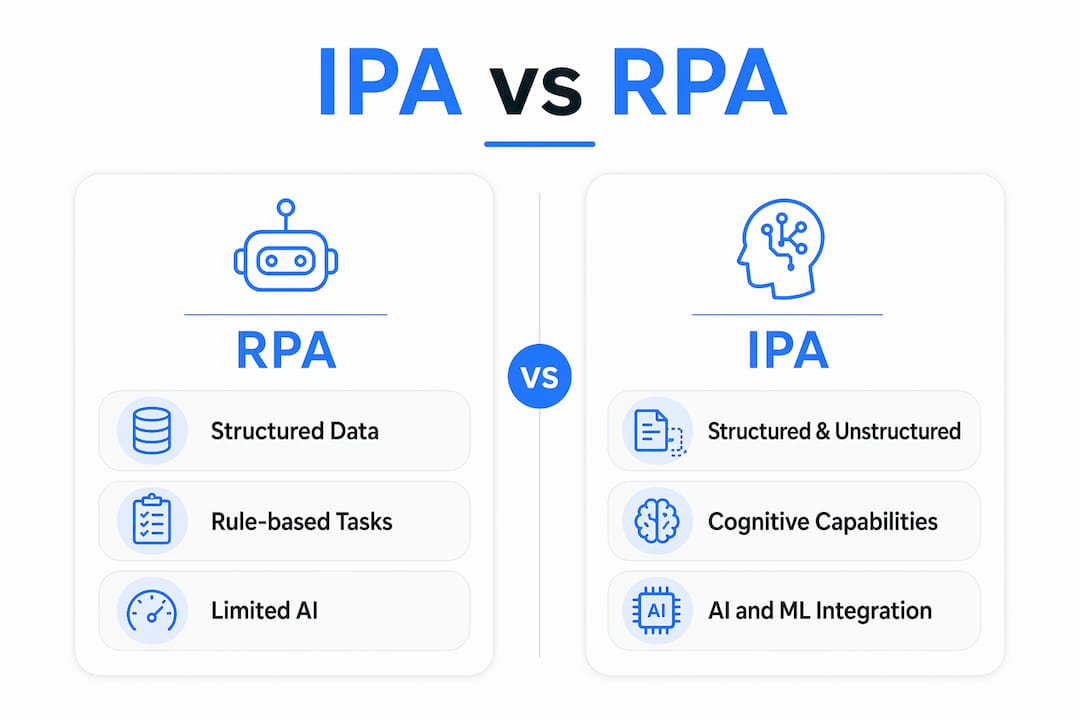
| Dimension | RPA | IPA | Hyperautomation |
|---|---|---|---|
| Data types handled | Structured only | Structured and unstructured | Both, across all systems |
| Decision-making | Rule-based | AI-driven, adaptive | AI-driven, organization-wide |
| Learning capability | None | Learns from data over time | Continuous, enterprise-scale |
| Scope | Single task or process | End-to-end workflow | Entire organization |
| Primary goal | Task automation | Workflow optimization | Maximum automation coverage |
RPA is the foundation. IPA extends RPA by adding cognitive capabilities. Hyperautomation, by contrast, is an organizational strategy that aims to automate as many processes as possible across the entire enterprise, using IPA as one of its tools. A company running hyperautomation is using IPA, but a company using IPA is not necessarily running a hyperautomation program.
The most common misconception is that IPA and RPA are the same thing with different marketing labels. They are not. RPA breaks when data is messy or a process changes. IPA adapts. That distinction matters enormously when you are evaluating whether a vendor's solution will hold up six months after go-live.
Pro Tip: When a vendor pitches you "intelligent automation," ask specifically which AI components are included and how the system handles exceptions. If the answer is vague, you are likely looking at standard RPA with a new name.
What business processes benefit most from IPA?
The clearest way to understand the benefits of intelligent process automation is to look at where it performs best. IPA delivers the highest return in processes that involve high volume, variable data formats, and decisions that require interpretation rather than just rule-following.
-
Invoice and accounts payable processing. IPA reads invoices from multiple formats, including PDFs, emails, and scanned paper, extracts line items, matches them to purchase orders, and routes exceptions for human review. Organizations report 24/7 operation and shorter cycle times in exactly this type of workflow, reducing processing errors through consistent data interpretation.
-
Customer onboarding. Banks and insurance companies use IPA to collect identity documents, run background checks, verify data across multiple systems, and generate welcome communications. What previously took days now completes in hours.
-
Claims handling. In insurance, IPA reads claim submissions, cross-references policy terms, assesses eligibility, and either approves straightforward claims automatically or flags complex ones for an adjuster. This cuts average handling time while improving consistency.
-
Fraud detection and risk assessment. ML models within an IPA system continuously analyze transaction patterns and flag anomalies in real time. The system learns from confirmed fraud cases and adjusts its detection thresholds without manual reconfiguration.
-
Compliance and audit trail management. IPA standardizes processes and enforces rules through AI, creating consistent audit trails that satisfy regulatory requirements. Consistency here outweighs speed as the primary value, particularly for industries under heavy regulatory scrutiny.
The common thread across all five use cases is that IPA handles the 80 to 90 percent of transactions that follow a predictable pattern, then surfaces the remaining exceptions for human review. Your team stops processing routine cases and starts resolving the genuinely complex ones.
What are the key challenges of implementing IPA successfully?
IPA implementation fails more often from organizational missteps than from technology limitations. Knowing the pitfalls before you start saves significant time and budget.
-
Treating IPA as an IT project. Successful IPA implementations require business unit subject matter experts to train AI on judgment points. When IT owns the project without deep involvement from operations, finance, or compliance teams, the resulting system automates the wrong version of the process.
-
Automating broken processes. Adding AI to a flawed workflow produces flawed results faster. Before deploying IPA, re-engineer the process itself. Remove unnecessary steps, clarify decision rules, and document exceptions. Only then does automation add value.
-
Skipping process re-engineering. Simply adding AI to existing RPA bots often fails because the foundational process logic was never built to handle exceptions intelligently. The fix is redesigning the workflow, not patching the bot.
-
Expecting lights-out automation. IPA operates best as a collaborative model where software handles 80 to 90 percent of volume and flags exceptions for human review. Expecting total automation without human oversight creates compliance risk and erodes trust in the system.
-
Neglecting governance and monitoring. AI decisions need regular auditing. Set up dashboards that track exception rates, model accuracy, and processing volumes. If exception rates climb, the model needs retraining, not just a manual workaround.
Pro Tip: Build your IPA business case around consistency and error reduction first, not headcount reduction. Boards and regulators respond better to "we eliminated a class of compliance errors" than "we cut five jobs." The cost savings follow naturally once the system proves itself.
Key takeaways
Intelligent process automation delivers its greatest value when AI, RPA, and human oversight work together across well-designed workflows, not as a replacement for process thinking.
| Point | Details |
|---|---|
| IPA definition | IPA combines RPA, AI, ML, and NLP to automate complex, judgment-intensive workflows. |
| Core differentiator from RPA | IPA handles unstructured data and adapts over time; RPA only executes fixed rules. |
| Highest-value use cases | Invoice processing, claims handling, onboarding, and compliance benefit most from IPA. |
| Implementation success factor | Business subject matter experts must lead IPA design alongside IT teams. |
| Human-in-the-loop model | IPA handles 80 to 90 percent of volume automatically and routes exceptions to humans. |
Why IPA is more about process design than technology
I have watched organizations spend six figures on IPA platforms and get mediocre results, and I have seen smaller teams with modest budgets achieve significant gains. The difference is almost never the technology. It is always the quality of the process design underneath it.
The teams that succeed treat IPA as a digital coworker that learns and adapts, not as a cost-cutting shortcut. They invest time upfront mapping every exception, every edge case, and every judgment call their best employees make. Then they build those decisions into the system deliberately. The teams that struggle automate the happy path and discover six months later that exceptions are eating their staff's time anyway.
There is also a longer-term argument for IPA that does not get enough attention: auditability. Consistency and reliability in AI-driven processes are often more valuable to enterprises than speed, especially for regulatory compliance. When a regulator asks how a decision was made, an IPA system gives you a complete, timestamped record. A human-driven process gives you a best guess.
The future of IPA is not about removing people from operations. It is about removing people from the work that does not require them, so they can focus on the work that does. That shift, done well, is one of the most durable competitive advantages a business can build.
— Tyler
How Interval-ai applies intelligent process automation to collections
Interval-ai applies the same IPA principles described in this article directly to one of the most time-consuming and error-prone processes in business: collecting overdue payments. The platform uses AI-driven outreach strategies built on historical payment data, so every communication is timed and tailored to the individual customer rather than sent on a generic schedule. Interval-ai manages follow-up across multiple channels automatically, reducing days to payment by over 30 days for clients while eliminating the need for additional collections staff. If you are a business leader looking to put intelligent process automation to work on a real operational problem, explore Interval-ai and see how automated collections can improve your cash flow without adding headcount.
FAQ
What is intelligent process automation in simple terms?
Intelligent process automation is a technology framework that combines RPA, AI, and machine learning to automate complex business workflows that involve unstructured data and judgment-based decisions, going well beyond what traditional rule-based automation can handle.
How is IPA different from standard RPA?
RPA executes fixed, rule-based tasks on structured data and breaks when inputs change. IPA adds AI and ML to handle variable data, learn from outcomes, and adapt to exceptions without manual reprogramming.
What are the most common intelligent process automation examples?
The most common applications include invoice processing, insurance claims handling, customer onboarding, fraud detection, and compliance audit trail management, all of which involve high volume and variable data formats.
Does IPA fully replace human workers in a process?
No. IPA is designed as a collaborative model where the system handles 80 to 90 percent of standard transactions automatically and routes complex exceptions to human reviewers, maintaining control and compliance throughout.
How long does it take to implement IPA successfully?
Implementation timelines vary by process complexity, but organizations that invest in process re-engineering and cross-functional collaboration before deployment consistently achieve faster and more reliable results than those that layer AI onto existing workflows without redesign.
