
Why Automation Improves Response Rates for SMBs
Published: July 5, 2026 · 8–9 min read
TL;DR:
- Automation accelerates response times, increasing lead qualification likelihood and building trust through consistent messaging. Combining AI automation with human review enhances reply rates and personalizes customer interactions effectively. Regularly updating automation systems and establishing feedback loops prevent performance decline over time.
Automation improves response rates by delivering faster, more consistent communication that reaches customers at the exact moment their interest peaks. Businesses that respond to inbound inquiries within 5 minutes are 21 times more likely to qualify a lead than those waiting 30 minutes. That single statistic reframes automation from a cost-cutting tool to a revenue driver. Industry research from Twilio confirms that 51% of businesses report faster response times and 45% higher satisfaction scores after deploying automation. For small and medium business owners, this is the clearest argument for why automation improves response rates: speed and consistency, delivered without adding headcount.
Why automation improves response rates: the speed factor
Response speed is the single biggest variable in lead qualification. Waiting even a few minutes after an inquiry arrives can cost you the conversation entirely. Conversion potential drops 10 times after 5 minutes and becomes 100 times less likely after 30 minutes. Responding within 1 minute can increase conversion rates by up to 391%. These numbers reflect a simple psychological reality: customers reach out at peak interest, and silence reads as permission to wait.

Automation solves this by removing the human delay from the first touch. When a lead submits a form or sends a message, an automated system fires an immediate response without waiting for a sales rep to notice the notification. That first contact sets the tone and keeps the prospect engaged while your team prepares a more detailed follow-up.
Internal notification automation matters just as much as outbound speed. Real-time alerts pushed to Slack or SMS help your team prioritize high-intent inquiries within the critical 5-minute window. Without this internal layer, even the best outbound automation fails because no one is ready to continue the conversation.
| Response time | Lead qualification likelihood |
|---|---|
| Within 1 minute | Up to 391% higher conversion rate |
| Within 5 minutes | 21x more likely to qualify the lead |
| After 5 minutes | Conversion potential drops 10x |
| After 30 minutes | Connection becomes 100x less likely |
Pro Tip: Set up real-time internal alerts the moment a lead arrives. Your automated first response buys you time, but a human needs to be ready to step in within minutes for complex inquiries.
How automation builds personalization and consistency at scale
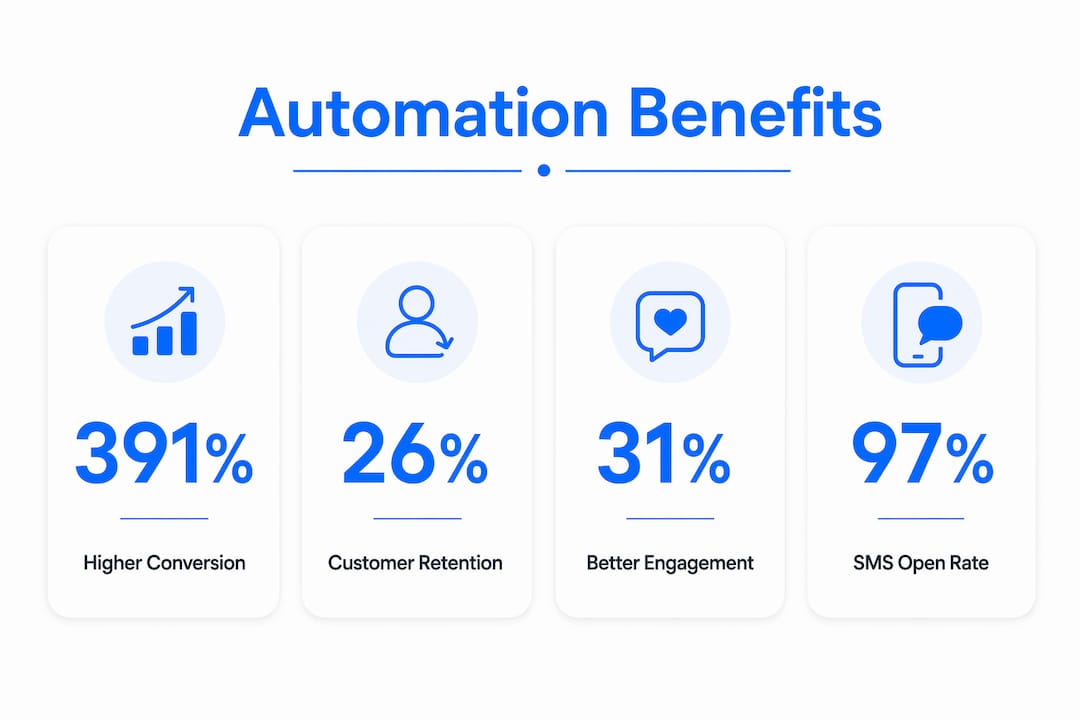
Personalization is not optional. 26% of customers leave brands that fail to deliver relevant, tailored experiences. Automation makes personalization repeatable by pulling customer data, purchase history, and behavioral signals into every message without manual effort.
Consistency is equally powerful. Automation eliminates data entry mistakes and standardizes messaging across every channel, so your brand sounds the same whether a customer receives an SMS, an email, or a follow-up call. That consistency builds trust over time because customers know what to expect from you.
Automated follow-ups also outperform manual ones on timing. Automated follow-ups sent within 2 hours generate 31% better engagement than manual next-day follow-ups. The channel matters too: automated SMS messages carry a 97% open rate within the first 3 minutes, compared to 20% for email. That gap is significant for any business trying to cut through inbox noise.
The benefits of consistent, personalized automated engagement include:
- Faster first contact that captures interest before competitors respond
- Tailored messaging based on customer behavior and history, not generic templates
- Multi-channel reach across SMS, email, and voice without additional staff
- Consistent brand tone across every touchpoint, reducing confusion and building credibility
- 24/7 availability that handles routine inquiries even outside business hours, with airlines using automation reporting approximately 95% satisfaction and 45% deflection rates on routine queries
Does a hybrid approach outperform pure automation?
Pure automation is powerful, but it has a ceiling. Research comparing outreach models shows that hybrid AI-human review yields a reply rate of 10.8%, compared to 9.4% for pure AI and 9.8% for pure human outreach. That gap widens for mid-market prospects at companies with more than 75 employees, where human review bridges an 8–11 point response gap.
The reason is nuance. Automated messages handle volume and speed well. Human reviewers catch tone mismatches, adjust for relationship context, and add the kind of warmth that builds longer-term trust. Neither approach alone captures both advantages.
| Outreach model | Reply rate | Best use case |
|---|---|---|
| Pure AI automation | 9.4% | High-volume, early-stage outreach |
| Pure human outreach | 9.8% | Complex, high-value relationships |
| Hybrid AI plus human review | 10.8% | Mid-market prospects, sustained campaigns |
The practical implementation is straightforward. Use automation for the first touch, qualification questions, and routine follow-ups. Route prospects who show high intent or complex needs to a human reviewer before the next message goes out. This keeps your volume high while protecting the quality of your most important conversations.
Pro Tip: Flag any prospect who opens your message three or more times without replying. That behavior signals interest without commitment. A human-written follow-up at that moment often converts where automation alone would not.
Practical steps to implement automation and boost engagement
Building an effective automation stack requires more than picking a tool. The architecture matters as much as the technology. Here are the core steps for SMB owners deploying automation to improve response rates:
-
Map your lead capture points. Identify every place a prospect can reach you: web forms, social media messages, phone inquiries, and email. Each entry point needs an automated trigger that fires within seconds of contact.
-
Choose your channel sequence deliberately. SMS as the primary initial touch combined with email and voice for follow-up achieves the highest conversion by matching speed with progressive engagement. Start with SMS for immediacy, then layer in email for detail and voice for high-value prospects.
-
Build internal notification workflows. Automation should alert your team in real time when a high-intent lead arrives. A Slack message or SMS to the right person is as important as the outbound message to the prospect.
-
Create feedback loops from day one. Log which message elements drive replies and which ones get ignored. Continuous prompt refinement improves campaign performance by 3% or more over time. Without this step, automation suffers from model drift, where messages that worked in month one stop working by month four.
-
Avoid these common mistakes:
- Sending the same message to every segment regardless of behavior or history
- Relying on automation for every touchpoint without any human review layer
- Skipping A/B testing on subject lines and opening sentences
- Failing to update triggers when your product or offer changes
-
Review performance monthly. Automation is not a set-and-forget system. Monthly reviews of open rates, reply rates, and conversion data keep your messaging aligned with what your customers actually respond to.
The impact of automation on replies compounds over time when you treat it as a living system rather than a one-time setup. Businesses that build feedback loops into their automation from the start consistently outperform those that deploy and walk away.
Key Takeaways
Automation improves response rates by combining speed, consistency, and personalization in a way that no manual process can match at scale.
| Point | Details |
|---|---|
| Speed is the top driver | Responding within 5 minutes makes you 21x more likely to qualify a lead. |
| Personalization reduces churn | 26% of customers leave brands that fail to deliver relevant experiences. |
| Hybrid models outperform pure AI | Human review added to AI outreach lifts reply rates to 10.8% vs. 9.4% for AI alone. |
| Channel sequence matters | SMS first, then email and voice, produces the highest conversion across the funnel. |
| Feedback loops prevent drift | Continuous message refinement improves campaign results by 3% or more over time. |
Automation works best when you respect its limits
I've watched business owners deploy automation expecting it to replace judgment, and it never does. What it replaces is delay. That distinction matters more than most people realize.
The businesses I've seen get the most out of automation are the ones that treat it as a force multiplier, not a substitute for thinking. They use it to make sure no lead waits more than a minute for a first response. They use it to send the right follow-up at the right time without relying on someone to remember. But they never hand over the relationship entirely to a system.
The overlooked nuance is that automation quality degrades without attention. A message sequence that worked well in january can feel stale by march if you haven't updated it. Most business owners set up their automation once and assume it keeps working. It doesn't. The data drifts, customer expectations shift, and the messages stop landing.
My honest advice: build your hybrid workflow before you need it. Start with automation handling the first two touches, then route engaged prospects to a human reviewer. That structure scales with you and protects the quality of your most valuable conversations. Automation handles the volume. You handle the relationship.
— Tyler
How Interval-ai helps you respond faster and recover more
If slow follow-up is costing you leads, slow collections are costing you cash flow. Interval-ai applies the same logic of automated, timely outreach to the collections process, reaching customers across multiple channels based on their payment history and behavior.
Interval-ai's data-driven approach tailors every outreach message to the individual account, so your communications feel professional rather than generic. The system manages follow-ups automatically, reducing days to payment by over 30 days according to client reports, without adding staff or disrupting your existing operations. Business owners who want to see how automated collections work in practice can explore Interval-ai's full capabilities on their website. The same principles that make automation effective for lead response make it equally powerful for recovering what you're already owed.
FAQ
Why does automation improve response rates?
Automation removes the human delay from first contact, reaching prospects within seconds of an inquiry. Businesses responding within 5 minutes are 21 times more likely to qualify a lead than those waiting 30 minutes.
Does automation increase response rates for small businesses?
Yes. Automated follow-ups sent within 2 hours generate 31% better engagement than manual next-day follow-ups, making automation especially valuable for small teams with limited bandwidth.
What is the best channel for automated outreach?
SMS is the strongest initial channel, with a 97% open rate within the first 3 minutes. Pairing SMS with email and voice follow-up produces the highest overall conversion across the funnel.
How does a hybrid AI-human model improve results?
Hybrid models that combine automated outreach with human review achieve a 10.8% reply rate, compared to 9.4% for pure AI. The human layer adds tone and nuance that automation alone cannot replicate.
How do I prevent automation from becoming less effective over time?
Build a feedback loop that logs which messages drive replies and refine your prompts regularly. Without continuous updates, automation suffers from model drift, reducing effectiveness within a few months.
