
Why Automation Reduces Human Error in Business

Published: July 5, 2026 · 9–10 min read
TL;DR:
- Automation prevents human error by embedding mistake-proofing into processes and removing fatigue-related mistakes. It also increases productivity by reducing rework and error corrections, leading to higher efficiency across industries. However, partial automation creates risks such as reduced vigilance and skill decay, requiring careful design and ongoing oversight.
Automation reduces human error by shifting error detection away from unreliable human attention and embedding it into consistent, systematic processes. The human brain is not built for sustained vigilance. Fatigue, distraction, and cognitive bias all degrade accuracy over time, especially in repetitive workflows. Techniques like poka-yoke (mistake-proofing) and Infrastructure as Code (IaC) show that preventing errors by design is far more effective than catching them after the fact. Understanding why automation reduces human error is the first step toward building operations that are consistent, accurate, and genuinely efficient.
Why automation reduces human error at its core
The most direct answer is this: automation removes the human brain from tasks where the human brain consistently fails. Repetitive data entry, multi-step approval chains, and real-time monitoring all demand sustained attention. Human attention degrades within minutes of starting a monotonous task. Automation does not get tired, distracted, or overconfident.

Poka-yoke, a mistake-proofing principle developed in manufacturing, is the clearest example of this logic applied systematically. Rather than relying on a worker to catch a defect, poka-yoke builds constraints directly into the process so that certain errors become physically or logically impossible. A form field that rejects non-numeric input, a system that will not advance without a required approval, a barcode scanner that flags a mismatch before a shipment leaves the dock. These are all poka-yoke in practice.
The results are measurable. Organizations using poka-yoke alongside automation reduce manufacturing defects by up to 50%. That figure reflects what happens when you stop asking humans to catch errors and start designing systems that make errors impossible. The principle applies equally in finance, logistics, healthcare, and collections.
Pro Tip: Design your workflows to prevent errors from occurring rather than building review steps to catch them afterward. Every manual review step is a point of failure.
How does automation improve productivity alongside accuracy?
Reducing errors is only part of the story. Automation also accelerates work, and the two benefits compound each other. Fewer errors mean fewer rework cycles, fewer escalations, and fewer hours spent on corrections. That freed capacity goes directly back into productive output.
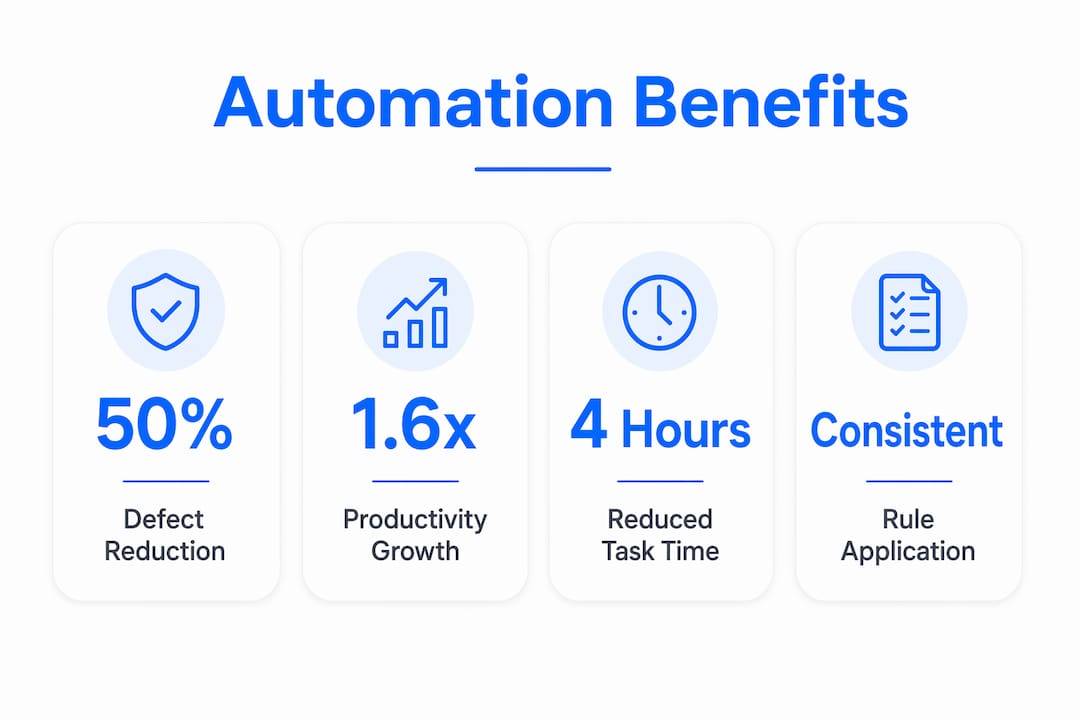
Enterprises integrating AI automation alongside human teams achieve 1.6x higher productivity growth compared to those relying on human effort alone. This is not a marginal gain. It reflects a structural shift in how work gets done when repetitive and complex tasks are handled by systems that do not slow down or make careless mistakes.
IT operations offer one of the clearest illustrations. Teams adopting Infrastructure as Code and automated pipelines cut task cycle times from 6 hours to 2 hours while simultaneously lowering error rates. That is a two-thirds reduction in time, paired with higher accuracy. The same pattern appears in automated accounts receivable, automated compliance checks, and automated customer outreach workflows.
| Workflow area | Before automation | After automation |
|---|---|---|
| IT task cycle time | 6 hours | 2 hours |
| Manufacturing defect rate | Baseline | Up to 50% reduction |
| Productivity growth rate | Baseline | 1.6x higher with AI integration |
| Human review errors | High under fatigue | Reduced by systematic detection |
The table above reflects a consistent pattern across industries. Automation does not just speed things up. It changes the error profile of the entire operation. For business leaders, that means fewer costly corrections and more predictable outcomes.
Compliance and security also benefit directly. Automated systems apply rules consistently, without the variation that comes from different employees interpreting a policy differently. That consistency is itself a form of AI payment trends risk management that manual processes cannot reliably replicate.
What are the psychological risks of automation?
Automation creates a specific and underappreciated risk: it can make humans worse at the tasks they still own. This is called automation complacency, and it is one of the most documented problems in human factors research.
When a system performs flawlessly for long stretches, human reviewers stop paying close attention. Their vigilance declines. Then, when the system does make a rare mistake, the human reviewer misses it. Automation complacency causes human reviewers to miss rare AI mistakes precisely because sustained monitoring of mostly flawless output leads to fatigue and overtrust.
"The problem is not that automation fails. The problem is that humans stop watching carefully enough to catch it when it does. Boredom and trust are the two most dangerous inputs in any automated review process."
Automation bias compounds this. Research published in the Human Factors Journal shows that error types affect human trust and compliance in ways that are not always rational. Humans tend to over-rely on automation when it produces false alarms less often, even if the system misses real errors at a higher rate. That miscalibration can be more dangerous than no automation at all.
The partial automation problem is equally serious. When a workflow is only partially automated, the remaining manual tasks tend to be the hardest and most error-prone ones. Partial automation leaves humans responsible for the most complex 30% of work, often without the context or support they need to handle it well. This "automation cliff edge" is where many well-intentioned projects quietly fail.
Key risks to monitor in any automated workflow:
- Vigilance decrement: Human attention drops sharply during long stretches of monitoring near-perfect output.
- Automation bias: Reviewers trust system outputs even when their own judgment signals a problem.
- Skill decay: Humans who rarely perform a task manually lose the ability to do it well when automation fails.
- Cliff edge exposure: Partial automation concentrates the hardest work in human hands without adequate support.
Pro Tip: Inject artificial errors into automated outputs on a scheduled basis and track whether human reviewers catch them. Rotating reviewers regularly also counters vigilance decline and keeps detection rates high.
Best practices for implementing automation to reduce errors
The goal is not maximum automation. The goal is the right automation, designed to prevent errors and sustain human engagement where human judgment still matters.
-
Automate the full task or not at all. Partial handoffs create cliff edges. If you cannot automate a complete workflow, keep humans fully in control of it until you can. Half-automated processes often produce worse outcomes than fully manual ones.
-
Apply poka-yoke design at every entry point. Build constraints into your systems so that invalid inputs, missing fields, and out-of-range values are rejected before they move downstream. Prevention beats detection every time.
-
Calibrate trust through transparency. Transparent, trust-calibrated systems produce better human compliance and overall system performance. Show your team what the system can and cannot do. Overconfidence in automation is as dangerous as underconfidence.
-
Schedule human review rotations. Do not assign the same person to monitor the same automated output indefinitely. Rotate reviewers, set time limits on monitoring sessions, and use error injection to test vigilance actively.
-
Monitor error rates continuously. Automation does not eliminate the need for performance tracking. Set clear benchmarks for error rates before and after automation, and review them on a regular cycle. When error rates creep up, investigate whether complacency or a system gap is the cause.
-
Invest in skill maintenance. Even when a task is fully automated, keep human operators trained to perform it manually. Automation failures are rare but real. A team that has lost the skill to intervene is a serious operational risk.
These practices apply across industries. Whether you are managing a collections workflow, an IT deployment pipeline, or a manufacturing line, the principles of mistake-proofing, trust calibration, and sustained human engagement hold.
Key Takeaways
Automation reduces human error most effectively when it prevents mistakes by design rather than relying on human reviewers to catch them after the fact.
| Point | Details |
|---|---|
| Prevention beats detection | Poka-yoke design eliminates error possibilities before they reach human review. |
| Productivity compounds accuracy | AI-human integration delivers 1.6x productivity growth alongside lower error rates. |
| Complacency is a real risk | Sustained monitoring of flawless output causes vigilance to drop; rotate reviewers and inject test errors. |
| Avoid partial automation | Half-automated workflows concentrate the hardest tasks in human hands, increasing overall failure risk. |
| Transparency builds better trust | Systems that show their limitations produce more accurate human compliance than opaque ones. |
The part most automation projects get wrong
Most automation projects I have seen fail at the same point: they automate the easy 70% of a workflow and leave the hardest 30% to humans without any additional support. The team assumes the hard part will take care of itself because the system is handling the volume. It does not.
The automation cliff edge is real, and it is quiet. You will not see it in your error logs right away. You will see it three months later when a compliance issue surfaces, or when a payment dispute goes unresolved because no one caught the flag the system raised. By then, the team has also lost some of the manual skill they had before the automation went in.
The fix is not to avoid automation. The fix is to design it properly from the start. That means committing to full workflow coverage or keeping humans fully in control, building mistake-proofing into every input point, and treating human oversight as a skill that needs active maintenance. Automation is not a set-and-forget decision. It is an ongoing system that requires the same attention you would give any other operational process.
For leaders managing collections and accounts receivable, this is especially relevant. The compliance requirements in payments are specific and consequential. Automating outreach without calibrating human oversight is exactly the kind of partial handoff that creates cliff edge risk.
— Tyler
How Interval-ai puts these principles to work
Interval-ai applies the same logic this article describes: automate the full workflow, build in error prevention by design, and keep human oversight calibrated and effective.

Interval-ai's AI-driven collections platform manages outreach across multiple channels, tailors communication based on historical payment data, and removes the manual follow-up burden that leads to missed contacts and inconsistent results. Clients report recovering significant overdue balances while cutting payroll costs, with days to payment reduced by over 30 days. If you are ready to see what consistent, automated collections looks like for your business, visit Interval-ai to learn more.
FAQ
Why does automation reduce human error so effectively?
Automation removes error-prone human attention from repetitive tasks and replaces it with consistent, rule-based processes. Techniques like poka-yoke make certain errors impossible by design, rather than relying on human reviewers to catch them.
What is automation complacency and why does it matter?
Automation complacency occurs when human reviewers stop paying close attention because a system performs well most of the time. Research shows this leads to missed errors when the system does fail, making active vigilance management a critical part of any automation program.
What is the automation cliff edge?
The automation cliff edge describes what happens when partial automation leaves humans responsible for the hardest, most error-prone tasks without adequate support. Studies show this remaining 30% of manual work is more complex and more likely to produce failures than a fully manual or fully automated process.
How can business leaders prevent automation from increasing errors?
Leaders should apply poka-yoke design to eliminate invalid inputs, rotate human reviewers regularly, inject test errors to maintain vigilance, and avoid partial automation handoffs. Transparent systems that communicate their own limitations also produce better human compliance.
Does automation improve productivity as well as accuracy?
Enterprises integrating AI automation with human teams achieve 1.6x higher productivity growth. IT teams using automated pipelines cut task cycle times from 6 hours to 2 hours while simultaneously lowering error rates, showing that speed and accuracy gains occur together.
