
Why Dispute Management Needs Automation: SME Guide
Published: July 15, 2026 · 9–10 min read
TL;DR:
- Dispute management automation uses AI to handle payment disputes from start to finish without manual intervention. It speeds processes, reduces errors, and ensures compliance by enforcing deadlines and maintaining audit trails. This approach helps SMEs protect revenue, improve customer relationships, and streamline operations effectively.
Dispute management automation is the practice of using AI and programmatic workflows to handle payment disputes from intake through resolution, without relying on manual steps at every stage. For small and medium enterprises, this matters because financial dispute management combines operations, compliance, customer service, and technology functions simultaneously. Manual processes cannot keep pace with rising dispute volumes, tightening regulatory deadlines under frameworks like Regulation E and PSD2, and the real cost of losing defensible cases. Why dispute management needs automation comes down to one fact: speed, accuracy, and compliance are not achievable at scale without it.
Why dispute management needs automation in the first place
Manual dispute handling is slow by design. A staff member receives a dispute, logs it, pulls transaction records, contacts the relevant department, waits for a response, and then drafts a reply. That sequence takes time your customers and regulators will not wait for.

AI-driven automation reduces manual dispute processing time from 25 minutes to under 90 seconds per task. That is a 94% reduction in handling time. For a finance team managing dozens of disputes each week, that difference translates directly into labor hours recovered and cases resolved before deadlines expire.
Automation also changes the structure of the work itself. Manual processes handle tasks sequentially: one step finishes before the next begins. Automated systems gather evidence, classify the dispute type, and check compliance requirements in parallel. The result is faster throughput without adding staff.
Regulations like Regulation E in the United States and PSD2 in Europe set strict response windows for payment disputes. Missing those windows is not just a compliance failure. It means you automatically lose cases you could have won. Automation keeps your team inside those windows consistently, not just when workloads are light.
How automation reduces revenue leakage and operational risk
Revenue leakage in dispute management has a specific cause: missed response deadlines in manual global dispute processes cause automatic loss of defensible revenue. This is not a theoretical risk. It happens every time a case falls through the cracks of a spreadsheet-based workflow.
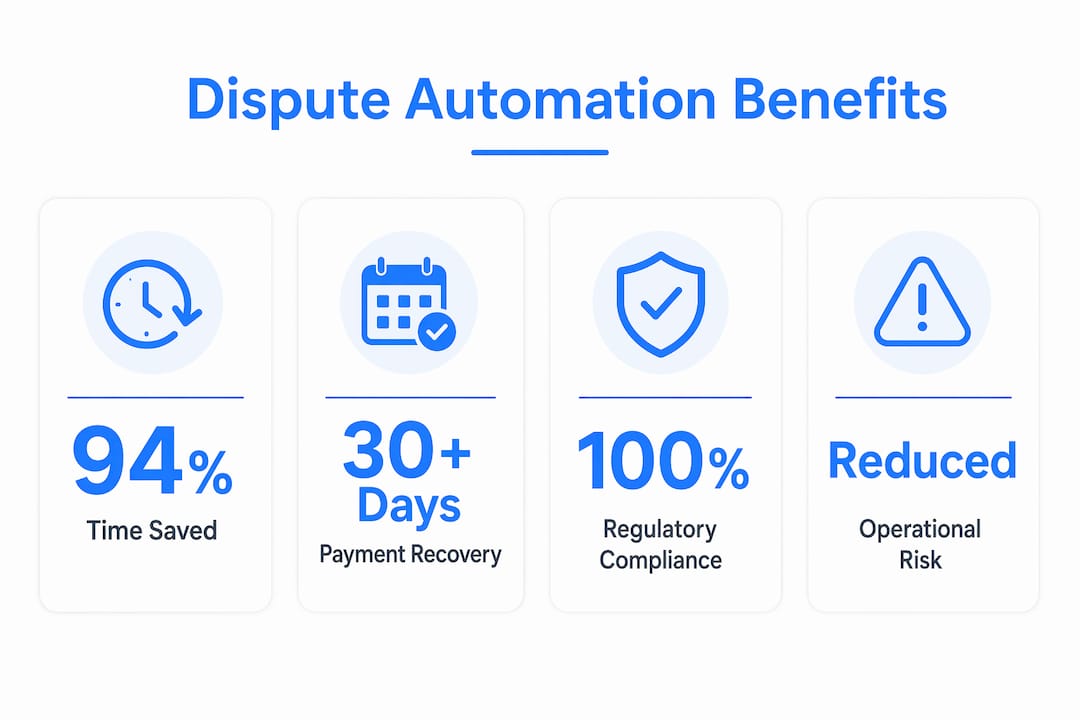
The financial stakes extend beyond individual disputes. Consider what happens when a dispute is mishandled and a customer closes their account. Customer acquisition costs $500 or more, and mishandled disputes lead to higher account closure rates. Losing one customer to a poorly managed dispute costs far more than the disputed amount itself.
Automated dispute resolution addresses this through three core mechanisms:
- Real-time status tracking. Every dispute has a visible status at all times. No case sits unnoticed in an inbox.
- Programmatic deadline enforcement. The system flags approaching deadlines and triggers the next required action automatically.
- Standardized decision workflows. Each dispute follows the same process, reducing the variation that causes errors and compliance gaps.
"Automation transforms dispute management from an operational burden into a strategic advantage by improving the customer experience at every touchpoint. Businesses that treat disputes as relationship moments, not just transactions, retain more customers and recover more revenue."
The operational risk reduction is equally significant. Standardized workflows mean every case is handled the same way, regardless of which team member picks it up. That consistency protects you from the compliance penalties that come with irregular or undocumented processes.
Pro Tip: Before you automate, map your current dispute workflow end to end. Identify where cases stall most often. Those stall points are your highest-value automation targets.
What role does AI play as a co-pilot in dispute resolution?
The most common concern finance managers raise about automation is this: will AI replace the judgment calls that require real expertise? The answer is no, and the reason is structural.
AI manages administrative tasks so human teams can focus on building resilient long-term relationships. The pre-decision phases, including case summarization, evidence gathering, and initial classification, are exactly where AI adds the most value. These tasks are repetitive, time-sensitive, and prone to human error. AI handles them faster and more consistently than any manual process.
Human experts remain responsible for the decisions that require nuance. A customer who disputes a charge because of a billing misunderstanding needs a different response than one disputing a fraudulent transaction. That distinction requires empathy, context, and judgment. AI surfaces the relevant data; your team makes the call.
AI combined with human oversight reduces errors, improves decision consistency, and maintains auditable processes. Auditable means every decision is traceable. You can show a regulator exactly what data was reviewed, what policy was applied, and what outcome was reached. That transparency is nearly impossible to achieve with manual workflows.
For SMEs, this co-pilot model is particularly practical. You do not need a large compliance team to maintain consistent, defensible dispute processes. You need well-designed automation that handles the volume and surfaces the exceptions that genuinely require human attention.
Pro Tip: Set clear escalation rules in your automation system. Define which dispute types always require human review, and let the system handle everything else. This keeps your team focused without removing human judgment from high-stakes decisions.
For businesses navigating complex dispute scenarios, claims and disputes guidance from specialized consultants can help you define those escalation rules before you build them into your system.
What are the key principles for building effective dispute automation?
The most common mistake in dispute automation is automating isolated steps without connecting them. A business might automate the intake form but still require a staff member to manually transfer data to the resolution system. That handoff negates most of the speed gain and introduces a new error point.
Unified execution layers reduce manual handoffs and accelerate end-to-end dispute resolution. The principle is straightforward: every component of your dispute workflow, intake, classification, evidence gathering, decision, and communication, should share the same data context. When classification feeds directly into evidence gathering, and evidence gathering feeds directly into the decision workflow, the process moves without interruption.
The table below outlines the four architectural principles that separate effective dispute automation from patchwork solutions:
| Principle | What it means in practice |
|---|---|
| Unified data context | All workflow components read from and write to a single case record |
| Parallel processing | Evidence gathering and compliance checks run simultaneously, not sequentially |
| Real-time audit trails | Every action is logged automatically as it happens, not reconstructed later |
| Explainable decisions | Each automated decision references the specific policy and data that drove it |
Automated audit trails capture every decision, policy applied, and data source in real time. This matters because reconstructing audit evidence after the fact is error-prone and time-consuming. Real-time logging removes that risk entirely.
The fourth principle, explainability, is where many automation projects fall short. An automated decision that cannot be explained to a regulator or a customer is a liability. Design discipline matters more than novelty. Institutions must shape automated tools to maintain procedural integrity, not just processing speed.
For SMEs, the practical implication is this: choose automation tools that give you visibility into every decision, not just the outcome. If your system can tell you what happened but not why, you have a compliance gap waiting to surface.
For teams working through the human side of dispute resolution alongside automation, ADR guidance from experienced practitioners can help you balance technology with the relationship-building that retains customers long term.
Key Takeaways
Automated dispute management is the most reliable way for SMEs to protect revenue, meet regulatory deadlines, and maintain consistent, auditable processes at scale.
| Point | Details |
|---|---|
| Speed gains are measurable | Automation cuts per-task handling time from 25 minutes to under 90 seconds. |
| Missed deadlines cost real money | Manual workflows cause automatic losses on defensible cases when deadlines expire. |
| AI augments, not replaces, human judgment | AI handles intake and evidence gathering; humans make the nuanced final calls. |
| Unified workflows prevent revenue leakage | Isolated automation creates handoffs that reintroduce the errors you were trying to eliminate. |
| Real-time audit trails protect compliance | Logging decisions as they happen is more accurate and defensible than reconstructing them later. |
The part most SMEs get wrong about automation
Most finance teams I talk to approach dispute automation the same way: they pick a tool, connect it to their existing process, and expect results. That approach almost always underdelivers.
The problem is not the tool. The problem is that the underlying workflow was never designed for automation. Manual dispute processes are built around human judgment at every step, which means they are full of informal decisions, undocumented exceptions, and handoffs that exist only because someone needed to physically pass a file. When you automate that structure, you automate the inefficiency along with it.
The teams that get the most out of dispute automation do the workflow redesign first. They map every step, identify which decisions are genuinely complex, and rebuild the process around what automation handles well. Then they bring in the technology. That sequence produces real throughput gains and compliance improvements. The reverse sequence produces a faster version of the same broken process.
The other thing I would push back on is the idea that automation is primarily a cost-cutting measure. The more durable benefit is customer retention. A dispute resolved accurately and quickly is a relationship preserved. A dispute that drags on, gets lost, or ends with the wrong outcome is a customer you will spend $500 or more to replace. Automation is a retention strategy as much as it is an efficiency play.
— Tyler
How Interval-ai supports automated dispute management for SMEs
Managing payment disputes manually costs your business time, money, and customer relationships. Interval-ai uses AI to handle the collections and payment recovery process end to end, tailoring outreach based on historical payment data so every interaction fits your brand and your customer's situation.
Interval-ai clients report reducing days to payment by over 30 days and recovering significant revenue without adding headcount. The platform manages communications across multiple channels and keeps every case moving without manual follow-up from your team. If you are ready to stop losing defensible disputes to process gaps, see how Interval-ai works and find out what consistent, automated dispute handling looks like for your business.
FAQ
What is dispute management automation?
Dispute management automation uses AI and programmatic workflows to handle payment disputes from intake through resolution without manual steps at each stage. It covers case classification, evidence gathering, deadline tracking, and audit logging.
How does automation improve dispute resolution speed?
AI-driven automation reduces per-task handling time from 25 minutes to under 90 seconds, a 94% reduction. It achieves this by running evidence gathering and compliance checks in parallel rather than sequentially.
Does automation replace human judgment in disputes?
No. AI handles pre-decision tasks like summarization and evidence gathering, while human experts make the final calls on nuanced or high-stakes cases. The co-pilot model keeps humans in control of decisions that require empathy and context.
Why do manual dispute processes cause revenue leakage?
Missed response deadlines in manual workflows cause automatic losses on otherwise defensible cases. Automation enforces deadlines programmatically, so no case expires without the required action being taken.
What makes a dispute automation system compliant?
Real-time automated audit trails that log every decision, policy applied, and data source as they happen. Reconstructing audit evidence after the fact introduces errors that real-time logging eliminates entirely.
