
Why Startups Benefit from AI Tools in 2026
Published: May 30, 2026 · 9–10 min read
TL;DR:
- Startups can generate significant AI value by redesigning workflows and building feedback loops, not just automating tasks. Fewer organizational barriers allow rapid integration, faster iteration, and early compound benefits, giving them an advantage over large enterprises. Measuring progress and capturing learning are essential for unlocking long-term AI returns, as isolated pilots rarely deliver sustained ROI.
Most founders assume the serious financial returns from AI belong to enterprises with large budgets and dedicated data teams. That assumption is wrong. A KPMG analysis of 7,000+ public companies found the average generative AI opportunity is worth up to $136M per year per company, representing over 10% of EBITDA. The numbers scale down for startups, but the percentage impact holds. Understanding why startups benefit from AI tools means looking beyond task automation and toward the compounding returns that come from redesigning how your team works, learns, and grows.
Key Takeaways
| Point | Details |
|---|---|
| AI cuts operational costs fast | 78% of founders report lower operational costs after adopting AI tools. |
| Feedback loops multiply returns | Startups with verification and learning systems see 6x higher AI benefit over time. |
| Pilots alone rarely deliver ROI | Only 2% of organizations report real ROI from AI without operationalizing it. |
| Startups move faster than enterprises | Fewer organizational barriers mean startups reach AI value faster than large companies. |
| Measurement must come first | Planning your ROI framework before deployment is what separates real gains from wasted pilots. |
Why startups benefit from AI tools: operational efficiency
The most immediate advantage is time. AI handles repetitive, predictable work that used to consume hours of your team's day. Customer support triage is the clearest example. According to Zendesk's 2026 CX Trends report, startup leaders using AI for customer service report 93% positive ROI, with response times dropping from minutes to seconds.
That speed shift matters more than it sounds. When your four-person team isn't manually sorting support tickets, they're building product. When your ops lead isn't manually following up on invoices, they're thinking about scale.
The operational wins go beyond speed. A survey from the DEV Community found that 78% of founders report AI tools reduced operational costs, allowing lean teams to compress execution timelines and compete earlier in their markets. That's not a marginal gain. That's a structural advantage over competitors who haven't made the shift.
Here's where most early AI wins show up for startups:
- Customer support and triage: Automated routing, draft responses, and escalation prioritization
- Communication and follow-up: AI that centralizes fragmented conversations across email, chat, and SMS into one tracked workflow
- Data entry and reporting: Eliminating manual input that slows down your weekly reviews
- Financial operations: Automated invoice follow-up and payment reminders without adding headcount
MIT Sloan research supports this further, showing that reducing workflow handoffs and validation checkpoints through AI significantly decreases system friction, even when AI doesn't outperform humans on every single step.
Pro Tip: Before choosing your first AI tool, audit your week for tasks you repeat more than three times. Those repetitive, low-complexity tasks are your fastest wins and the clearest place to start.
AI's role in product development
Speed to market is a startup's core competitive weapon. Generative AI tools have changed what's possible for founders who are building without large engineering teams.

The most practical shift is in prototyping. Founders can now generate concept variations, test messaging, draft API documentation, and produce early UX flows in a fraction of the time it used to require. No-code and low-code AI platforms have extended this to non-technical founders, meaning your product vision doesn't have to wait for an engineering sprint to get validated.
Here's how AI is reshaping early-stage product work:
- Rapid iteration: Generate and test multiple MVP variations before committing to a build direction
- AI agents for internal workflows: Automate cross-functional tasks like sprint planning summaries, bug triage, and stakeholder update drafts
- Market research at speed: Use AI to synthesize competitive data, customer feedback themes, and industry signals in hours instead of weeks
- Reduced dependency on specialists: Non-technical founders can produce first drafts of technical documentation, onboarding flows, and product specs without outsourcing
The result is a meaningfully shorter MVP cycle. Reduced operational costs and faster execution timelines together create a compounding early advantage. You're spending less and moving faster, which means your runway stretches further and your feedback loops tighten.
Building AI-driven feedback loops
This is where most startups leave significant value on the table. They adopt AI tools, automate a few tasks, and call it done. The compounding gains, however, come from what happens after the first deployment.
MIT Sloan research found that organizations with verification, evaluation, and learning capture systems generate 6x higher AI benefit compared to those that only track hours saved or output volume. The mechanism is simple: every AI interaction produces knowledge. If you capture that knowledge, you improve the next interaction. If you don't, the learning disappears.
Here's how to build a basic AI feedback loop in your startup:
- Verify outputs: Don't just accept AI-generated content or decisions. Build a lightweight review checkpoint where a team member confirms accuracy before the output is used downstream.
- Evaluate performance: Track whether AI outputs are hitting your quality or conversion benchmarks. Score them consistently, even informally at first.
- Capture learning: Store what you discover. Prompt repositories, decision journals, and annotated output libraries keep your AI knowledge from evaporating after the person who built the prompt leaves the team.
- Iterate the system: Use what you captured to refine prompts, retrain workflows, or adjust the tools you're using. This is where ROI compounds.
| Stage | Without feedback loop | With feedback loop |
|---|---|---|
| AI output quality over time | Stays flat or degrades | Improves with each cycle |
| Team AI knowledge | Siloed in individuals | Documented and transferable |
| ROI trajectory | One-time gain | Compounding over months |
| Dependency on specific tools | High | Lower, more adaptable |
Aligning AI adoption with these organizational learning systems is what shifts AI from cost-saving to a genuine growth driver. That shift doesn't require a large team. It requires intentional design upfront.
Pro Tip: Start with one workflow, measure it rigorously for 30 days, and document what improved. That single case study will make it far easier to expand AI adoption to the next workflow with buy-in from your team.
Strategic pitfalls to avoid
Knowing the advantages of AI for startups is only half the picture. The other half is understanding what goes wrong when adoption isn't handled carefully.
The most telling data point: only 2% of organizations in a KPMG Canada survey of 753 business leaders reported seeing real ROI from generative AI investments. The majority are running pilots that never get operationalized. They test a tool, see some initial time savings, and stop there without embedding AI into actual workflows or measuring its real business impact.
Common pitfalls that prevent startups from seeing real returns:
- Pilot-only mindsets: Treating AI as a trial rather than a core workflow component. If you're not designing for full integration, you're designing for failure.
- Measuring the wrong things: Tracking hours saved or prompts run instead of business outcomes like customer retention, revenue recovered, or cycle time reduced.
- Workflow fragmentation: Adding AI tools on top of broken processes instead of redesigning the workflow first. AI amplifies what's already there, including inefficiency.
- No ROI framework before deployment: Planning your measurement framework before you deploy is what separates organizations that see results from those that run expensive experiments.
The practical fix is to treat AI adoption like any other product launch. Define what success looks like before you build it. Assign ownership. Review results monthly. Adjust.
Startups' unique edge over enterprises
Here's something most enterprise AI consultants won't tell you: startups actually have structural advantages when it comes to capturing value from AI. Fewer organizational and technical barriers mean startups can integrate AI faster, iterate more freely, and build feedback loops that enterprises spend years trying to install through bureaucratic change management.
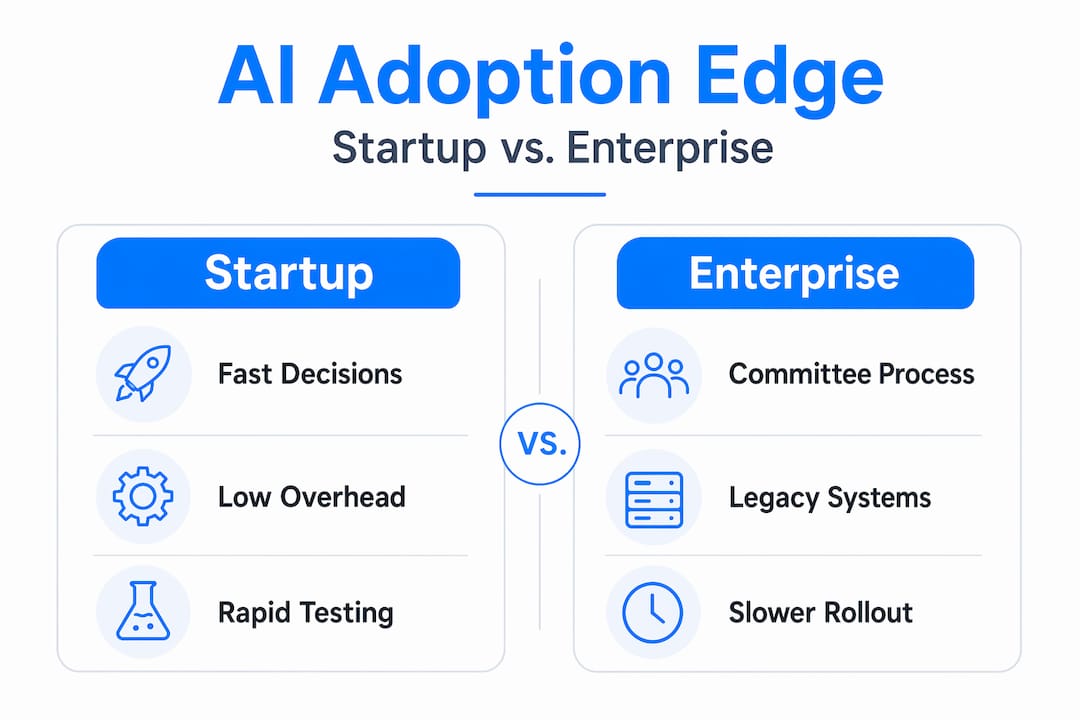
| Factor | Enterprise | Startup |
|---|---|---|
| Decision speed on AI adoption | Slow, committee-driven | Fast, founder-led |
| Legacy system constraints | High | Low to none |
| Workflow redesign flexibility | Limited by existing structure | High, built from scratch |
| AI literacy among team | Uneven, resistant to change | Easier to build from day one |
| VC and market pressure to adopt AI | Low | High, especially in 2026 |
For finance-focused startups, this edge is even more pronounced. Tools like AI-powered stock scanning alongside investing platforms show how industry-specific AI tools give small teams capabilities that used to require entire analyst departments.
The pressure from investors also accelerates adoption. Venture capital mandates increasingly require founders to demonstrate AI-driven efficiency before Series A. That expectation, combined with the agility of lean teams, means startups using AI tools today are building on a foundation that enterprises will spend years and millions trying to replicate.
My take on what actually unlocks AI value
I've seen a lot of founders treat AI like a plug-in. Add it to an existing workflow, enjoy the time savings, and move on. I understand why. Early wins feel good, and there's always something more urgent demanding attention.
But in my experience, the founders who get the most out of AI are the ones who treat it as a design problem, not a tool selection problem. They ask: "How do we build this workflow so the AI gets smarter over time?" That question leads to better prompts, better documentation, and better results three months from now than you're getting today.
The biggest missed opportunity I see is learning capture. Most startups don't document what's working in their AI workflows. When someone leaves or a tool changes, the accumulated knowledge goes with it. Building even a simple prompt library or decision log changes that completely.
My honest advice: invest one week in AI literacy for your team before you invest another dollar in AI tools. The people running the workflows matter more than which tool you pick. Once your team understands how to verify, evaluate, and capture learning from AI, the compound returns start showing up in ways that are hard to ignore.
— Tyler
How Interval-ai helps startups capture compound AI returns
If you're serious about moving past one-time efficiency gains and building AI-driven systems that actually compound, the measurement and feedback layer is where you need to focus first. That's exactly where Interval-ai fits into the picture.
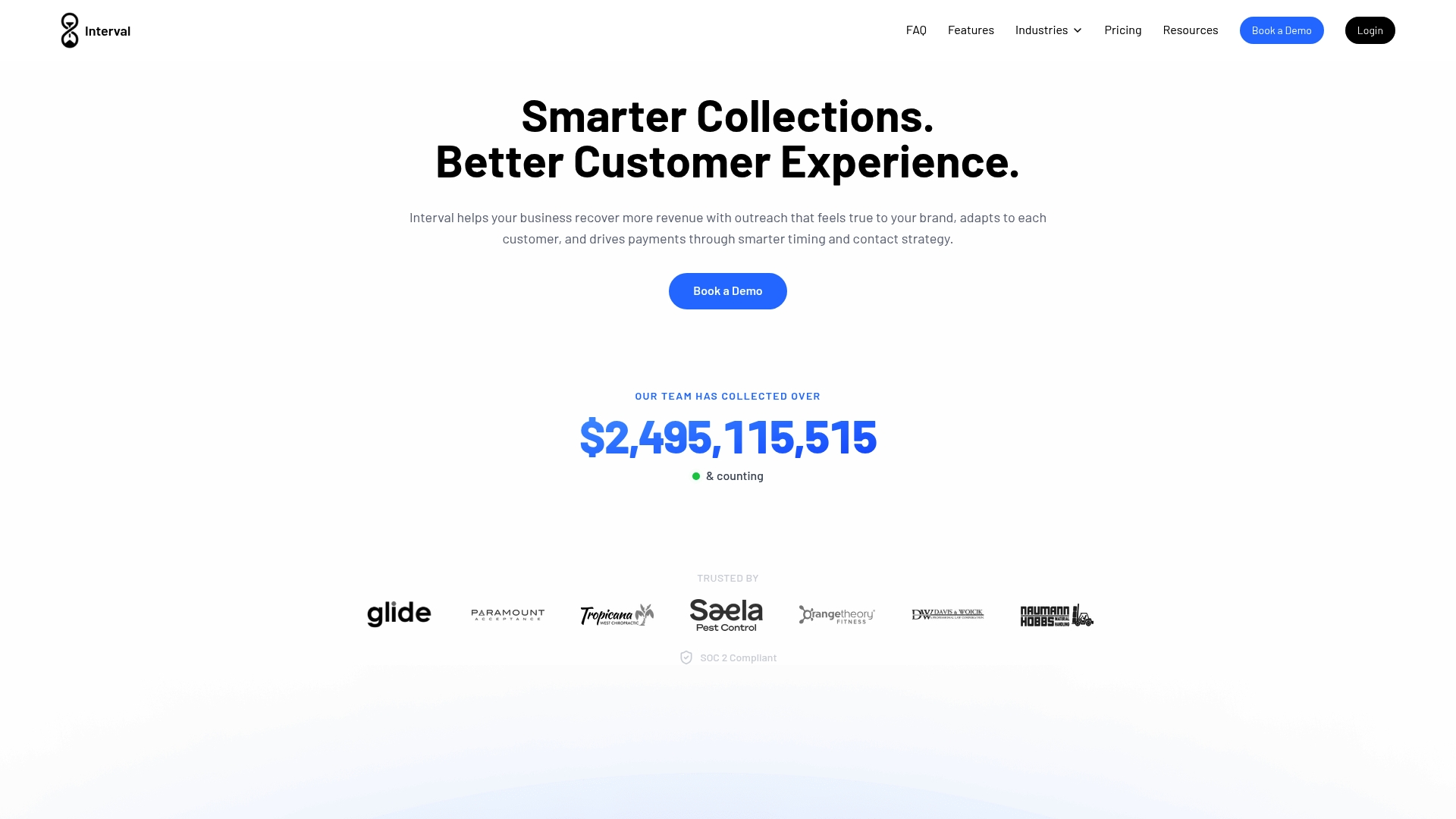
Interval-ai was built to help startups operationalize AI ROI, not just automate tasks. The platform specializes in building feedback and learning capture systems tailored to how lean startup teams actually work. For founders managing cash flow challenges like overdue payments, Interval-ai's data-driven approach handles automated follow-up communications across channels, reduces days to payment by over 30 days, and gives you visibility into what's working without adding headcount. Clients report recovering substantial revenue while saving thousands in payroll costs. If you want AI that compounds in value rather than plateaus, Interval-ai is worth a close look.
FAQ
Why do startups benefit from AI tools more than large companies?
Startups have fewer legacy systems, faster decision-making, and more flexible workflows, allowing them to integrate and iterate on AI tools much faster than enterprises. MIT Sloan research confirms startups face fewer adoption barriers and reach value more quickly.
What is the most common reason AI pilots fail to deliver ROI?
Most AI pilots fail because organizations never operationalize them into real workflows or measure business outcomes. KPMG research shows only 2% of companies report seeing real ROI, largely due to a lack of structured measurement and integration.
How does a feedback loop improve AI performance over time?
A feedback loop captures what AI produces, evaluates quality, and uses those learnings to improve future outputs. Organizations with these systems in place see 6x higher returns compared to those that only track basic usage metrics.
Which startup workflows benefit most from early AI adoption?
Customer support triage, invoice follow-up, internal reporting, and product documentation are the highest-impact starting points. These tasks are repetitive, well-defined, and easy to measure, making them ideal for proving out AI value before expanding to more complex workflows.
How should a startup measure AI ROI effectively?
Define your success metrics before deployment, focusing on business outcomes rather than tool usage. Track metrics like cycle time reduction, revenue recovered, customer response rates, or cost per resolved issue to get a clear picture of real impact over time.
