
Why Startups Outsource Admin Functions to Grow Faster
Published: July 16, 2026 · 9–10 min read
TL;DR:
- Startups outsource admin functions to save costs, increase efficiency, and free founders to focus on growth.
- Proper management involves clear SLAs, pilot testing, and ongoing relationship oversight to achieve maximum benefits.
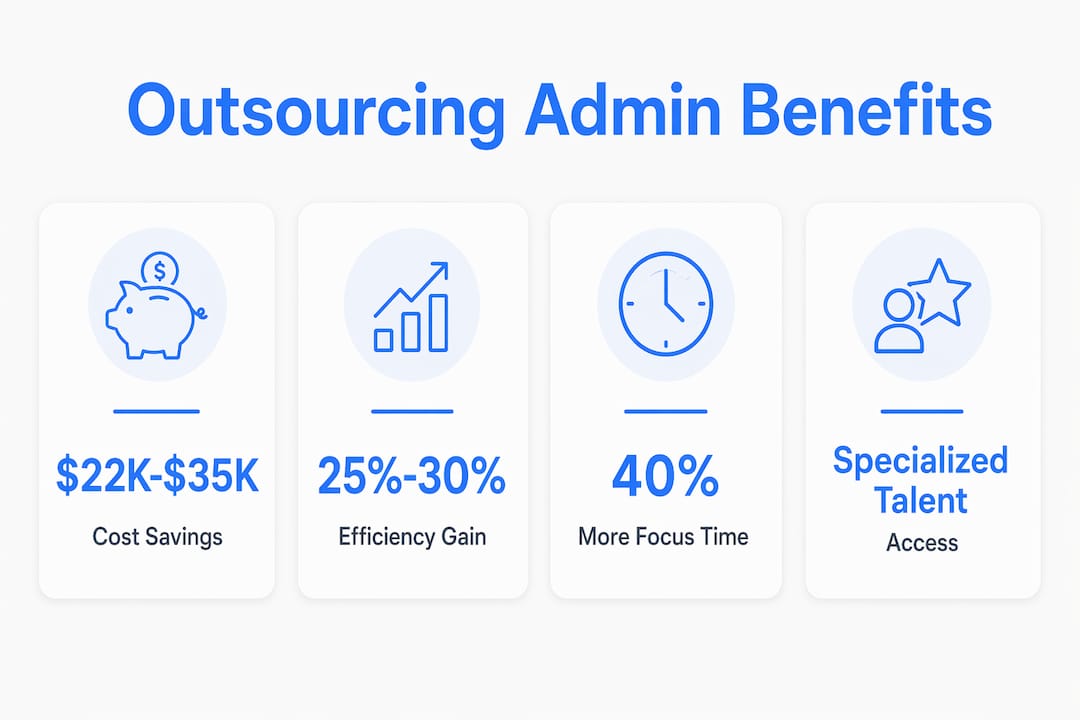
Outsourcing administrative functions is defined as delegating routine, non-core business tasks to external specialists so internal teams can focus on revenue-generating work. This is the primary reason why startups outsource admin functions: every hour a founder spends on scheduling, data entry, or payroll processing is an hour not spent on product, sales, or customers. Businesses that outsource admin support reduce operational costs by up to 78% compared to in-house hiring. That figure translates to $22,000–$35,000 in annual savings per role after accounting for benefits, training, and overhead.
Why startups outsource admin functions: the core case
The business practice behind outsourcing admin is called business process outsourcing, or BPO. Startups use BPO to hand off well-defined, repeatable tasks to external providers while keeping strategic decisions internal. The result is a leaner team that moves faster without sacrificing operational quality.

Founders who outsource admin report 25%–30% improvement in internal workflow efficiency and up to 40% more time to focus on strategic work. That is not a marginal gain. It is the difference between a founder who ships product and one who spends Tuesday afternoon chasing invoice approvals.
The benefits of outsourcing admin go beyond time. Access to specialized talent now drives outsourcing decisions more than cost reduction. 2024 Deloitte data shows the share of organizations citing cost as the primary reason for outsourcing dropped from 70% to 34%, while 42% now cite access to specialized talent as the top driver. Startups that recognize this shift use outsourcing to expand capability, not just cut spending.
What admin tasks do startups typically outsource?
The best candidates for outsourcing are tasks that are repetitive, well-defined, and low in strategic judgment. These tasks consume time without requiring the founder's expertise or institutional knowledge.
Common admin tasks startups outsource include:
- Scheduling and calendar management. Coordinating meetings, travel, and time blocks across multiple stakeholders takes hours each week. An external assistant handles this without needing access to sensitive business decisions.
- Email triage and inbox management. Sorting, flagging, and responding to routine emails is a high-volume, low-complexity task. Outsourced admins follow defined filters and response templates.
- Data entry and CRM updates. Keeping customer records, pipeline stages, and contact details current is critical but mechanical. Errors here cost sales teams time, not the outsourced provider.
- Payroll processing. Running payroll involves compliance, deadlines, and repetitive calculations. Outsourcing this to a payroll specialist reduces error risk and frees up finance time.
- Bookkeeping and expense tracking. Recording transactions, reconciling accounts, and preparing reports are well-suited to external accounting services. Fintech startups in particular benefit from specialized accounting support that understands their regulatory environment.
- Travel coordination and logistics. Booking flights, hotels, and ground transport for a growing team is time-consuming and rule-based. Outsourced coordinators follow a brief and execute without supervision.
- Document preparation and formatting. Contracts, proposals, and reports often need formatting, proofreading, and version control. This is high-effort, low-judgment work.
Each of these tasks shares one quality: a clear definition of done. That clarity is what makes them safe to delegate and easy to measure.
How does outsourcing admin drive cost savings and efficiency?
The financial case for outsourcing admin is direct. A full-time in-house admin hire costs a startup not just salary but also payroll taxes, health benefits, equipment, software licenses, office space, and onboarding time. Outsourcing eliminates most of those costs immediately.
Outsourcing administrative support saves small businesses $22,000–$35,000 per role annually. For a seed-stage startup watching every dollar, that savings can fund a product sprint or a sales hire. India-based outsourcing providers, for example, deliver 60%–70% cost savings for English-speaking markets due to workforce quality and operational maturity.
Efficiency gains compound the financial benefit. When internal staff refocus on revenue-generating activities, productivity increases by 20%–40%. That means your sales team sells more, your engineers ship faster, and your customer success team retains more accounts.
| Benefit | Impact |
|---|---|
| Cost per role | $22,000–$35,000 annual savings vs. in-house hire |
| Workflow efficiency | 25%–30% improvement in internal processes |
| Founder focus time | Up to 40% more time on strategic work |
| Staff productivity | 20%–40% increase when refocused on core tasks |
| Time to ROI | Positive return within 6–12 months with defined SLAs |
Burnout is a real cost that rarely appears in a budget. Founders who handle admin tasks personally report higher stress and slower decision-making. Removing that load has a measurable effect on leadership quality, even if it does not show up on a spreadsheet.
Pro Tip: Before outsourcing, document each task you want to delegate. A one-page process description reduces onboarding time and sets clear expectations from day one.
When should startups outsource admin versus hire in-house?
The decision to outsource or hire depends on volume, complexity, and the value of institutional knowledge. A useful benchmark is the 30-hour rule.
- Under 10 hours per week. Outsource without hesitation. The task does not justify a full-time hire, and a part-time outsourced resource handles it at a fraction of the cost.
- 10–29 hours per week. Use a fractional or part-time outsourced model. This gives you flexibility as the workload grows without locking in a full salary.
- 30+ hours per week consistently. The 30-hour per week rule signals a transition point. At this volume, the value of institutional knowledge, cultural alignment, and direct accountability often justifies an in-house hire.
- High-complexity or sensitive functions. HR policy decisions, legal compliance, and executive communications require judgment and confidentiality. These are better handled in-house, even at lower volumes.
- Hybrid models for scaling teams. Many startups run a hybrid approach: an outsourced team handles routine admin while one internal coordinator manages vendor relationships and escalations. This model scales without the overhead of a full admin department.
Pro Tip: Review your outsourced admin workload every quarter. If a single function consistently hits 30 hours per week for three months straight, that is your signal to evaluate an in-house hire.
The risk of hiring too early is real. A full-time admin hire at the seed stage adds fixed costs before the startup has validated its revenue model. Outsourcing preserves flexibility and lets you scale up or down based on actual demand.
What are the common challenges of managing outsourced admin?
Outsourcing admin functions creates real risks when founders treat it as a procurement task rather than a talent strategy. The most common mistakes are avoidable with the right setup.
- Selecting on price alone. Choosing vendors based solely on cost leads to scope padding, slow knowledge transfer, and high turnover. A provider that charges 20% less but delivers 40% less value is not a deal.
- Skipping the pilot phase. Committing to a long contract before testing the relationship is the fastest way to a bad outcome. Run a 30-day pilot sprint on a defined task set before signing anything longer than 90 days.
- Undefined SLAs. Without clear service-level agreements, you have no basis for measuring performance or holding a provider accountable. Define response times, accuracy rates, and escalation paths before work begins.
- No documented SOPs. Outsourced teams that rely on verbal instructions create single points of failure. Documented standard operating procedures give providers a consistent reference and protect you when staff turns over on their side.
- Ignoring communication cadence. Weekly check-ins and a shared project management tool keep outsourced teams aligned. Silence from either side is a warning sign, not a sign of smooth operations.
"Startups that achieve positive ROI from outsourcing within 6–12 months share one trait: they define success criteria and SLAs upfront, run a structured pilot, and treat the vendor relationship as an ongoing management responsibility, not a set-and-forget contract."
Operational consistency is one of the strongest arguments for agency-based outsourcing. Agencies provide documented processes, backup staff, and managed handovers. A solo freelancer offers none of that redundancy.
Key Takeaways
Startups that outsource admin functions with defined SLAs, pilot phases, and clear task documentation consistently achieve cost savings, efficiency gains, and faster founder focus on growth.
| Point | Details |
|---|---|
| Cost savings are immediate | Outsourcing saves $22,000–$35,000 per role annually versus in-house hiring. |
| Efficiency gains are measurable | Startups report 25%–30% workflow improvement and up to 40% more founder focus time. |
| Use the 30-hour rule | Tasks exceeding 30 hours per week consistently signal a transition to in-house hiring. |
| Pilot before committing | Run a 30-day pilot sprint before signing long contracts to evaluate fit and quality. |
| Define SLAs from day one | Clear success metrics and service agreements are the single biggest driver of outsourcing ROI. |
The strategic case for outsourcing admin that most founders miss
Most founders I talk to think about outsourcing as a way to cut costs. That framing is limiting. The real advantage is capability expansion.
When you outsource admin well, you are not just removing tasks from your plate. You are adding a layer of operational infrastructure that your startup does not have to build, manage, or maintain internally. That is a fundamentally different way to think about it.
The founders who get the most out of outsourcing treat their vendors like extended team members. They invest time in onboarding, they hold regular reviews, and they give honest feedback. The ones who struggle treat outsourcing like a vending machine: put money in, expect output, complain when it does not work.
Cultural fit and communication cadence matter more than most people admit. A provider in a different time zone who responds within four hours and communicates clearly is more valuable than a cheaper option that goes quiet for days. I have seen startups lose weeks of productivity because they chose a vendor on price and skipped the pilot.
The long-term mindset also changes how you structure contracts. Instead of locking in the lowest rate for the longest term, you negotiate performance-based milestones and build in review points. That keeps both sides accountable and creates a relationship worth maintaining.
Outsourcing admin is not a shortcut. It is a deliberate operational decision that requires the same rigor you apply to hiring, product development, or sales strategy. Treat it that way, and it pays off. Treat it as an afterthought, and it creates more problems than it solves.
— Tyler
How Interval-ai helps startups recover time and cash flow
Running a startup means every administrative hour counts twice. When overdue payments pile up alongside your regular admin load, the pressure compounds fast.
Interval-ai uses AI-driven outreach to manage collections automatically, tailoring communication to each customer's payment history and your brand's tone. Clients report reducing days to payment by over 30 days and recovering significant revenue without adding staff. That is the kind of admin function that pays for itself. If your team is spending hours chasing invoices that an automated system could handle, see what Interval-ai does for startups that need consistent cash flow without the overhead.
FAQ
Why do startups outsource admin functions instead of hiring?
Outsourcing admin costs $22,000–$35,000 less per role annually than a full-time hire. It also gives startups flexibility to scale up or down without fixed payroll commitments.
What admin tasks are best suited for outsourcing?
Tasks that are repetitive, well-defined, and low in strategic judgment are the best candidates. Scheduling, data entry, payroll, CRM updates, and bookkeeping are the most commonly outsourced admin functions.
How long does it take to see ROI from outsourcing admin?
Startups that define SLAs and success criteria upfront typically see positive ROI within 6–12 months of outsourcing admin functions.
When should a startup hire in-house instead of outsourcing?
The 30-hour per week rule is the standard benchmark. When a single function consistently requires 30 or more hours per week, the value of institutional knowledge and direct accountability justifies an in-house hire.
What is the biggest risk in outsourcing admin functions?
Selecting a vendor based solely on price is the most common mistake. It leads to scope padding and poor knowledge transfer. Running a structured pilot sprint before committing to a long contract reduces this risk significantly.
